
Buyer's contingencies are defined as contractual conditions written into a real estate purchase agreement that must be satisfied before the sale can close. Understanding what is buyer's contingencies means knowing these clauses give you the legal right to renegotiate or walk away from a deal without losing your deposit if specific conditions go unmet. 82% of homebuyers included at least one contingency in their 2024 final offer. That number tells you contingencies are not optional extras. They are the standard framework buyers use to protect themselves in one of the largest financial transactions of their lives.
What is buyer's contingencies and what types exist?
Buyer's contingency clauses fall into several distinct categories, each protecting against a specific risk. Knowing which ones apply to your situation is the first step toward writing a strong, safe offer.
-
Inspection contingency. Inspection contingencies give you time to hire a licensed inspector and negotiate repairs if major defects surface. If the inspection reveals a cracked foundation or faulty electrical panel, you can request the seller fix the issue, reduce the price, or cancel the contract entirely.
-
Appraisal contingency. Appraisal contingencies allow you to renegotiate or cancel if the lender's appraiser values the property below your offer price. Without this clause, you would be contractually obligated to cover the gap between the appraised value and your purchase price out of pocket.
-
Financing contingency. A financing contingency conditions your purchase obligation on securing an approved mortgage within the agreed timeframe. If your lender denies your loan, you can exit the contract without penalty.
-
Home sale contingency. This clause protects buyers who must sell their current home before they can afford the new one. It gives you a set window to complete that sale before your purchase obligation kicks in.
-
Title and HOA document contingencies. These less discussed clauses let you review title reports for liens or ownership disputes, and HOA financial documents for undisclosed assessments or rule violations.
Pro Tip: Never skip the appraisal contingency on a financed purchase. If the home appraises low and you have no contingency, you either pay the difference in cash or lose your earnest money trying to exit.
How do contingencies affect the closing timeline?

The closing process runs on deadlines, and contingencies are the engine driving those deadlines. Missing one can cost you the deal or your deposit.
The standard closing period spans 30–45 days. Every contingency you include has its own deadline nested within that window. Here is how the sequence typically works:
- Inspection period opens. Buyers schedule a home inspection within the first 7–10 days after the contract is signed.
- Inspection response deadline. Buyers submit a repair request or notice of cancellation before the inspection contingency expires.
- Appraisal ordered. The lender orders an appraisal, which typically takes 7–14 days to complete.
- Loan approval deadline. The financing contingency requires documented loan approval by a specific date, usually 21–25 days into escrow.
- Contingency removal. Once all conditions are satisfied, buyers sign a contingency removal form, signaling the deal is firm.
- Closing day. Final documents are signed, funds transfer, and title records in the buyer's name.
Missing a contingency deadline without formally canceling or extending puts your earnest money deposit at risk. Buyers can typically recover that deposit if they cancel under an active, valid contingency. Once contingencies are removed, that protection disappears.
Sellers care deeply about contingency timelines. A deal loaded with long contingency windows signals uncertainty, which is why sellers often favor offers with shorter periods or fewer conditions. Home sale contingencies frequently include kick-out clauses, which give sellers the right to keep marketing the property and accept a better offer if you cannot remove your contingency fast enough.
What strategic considerations apply in competitive markets?
Real estate buyer contingencies are not one-size-fits-all tools. The right combination depends on your market, your financing situation, and your risk tolerance.
Too many contingencies can make your offer less attractive to sellers, particularly in low-inventory markets where multiple offers are common. That does not mean you should strip your offer bare. The smarter move is calibration.
Shortening periods vs. waiving outright
Shortening contingency periods rather than removing them entirely is the approach experienced buyers use most often. A 7-day inspection window instead of 14 days signals confidence without eliminating your legal protection. The same logic applies to financing contingencies. Providing a strong pre-approval letter alongside a 17-day financing window reads as far more credible than no contingency at all.
When waiving makes sense
Waiving contingencies entirely carries real financial risk. The buyers who do it successfully are typically paying cash, have already inspected the property, or are investors who have priced the risk into their offer. For a financed buyer purchasing a primary residence, waiving the financing contingency means accepting personal liability if the loan falls through.
| Approach | Buyer protection | Offer appeal to seller |
|---|---|---|
| Full contingencies, standard periods | Highest | Lower in competitive markets |
| Full contingencies, shortened periods | High | Moderate to strong |
| Selected contingencies waived | Moderate | Strong |
| All contingencies waived | None | Highest |
Pro Tip: Work with your agent to get a pre-inspection done before submitting your offer. That lets you waive or shorten the inspection contingency with confidence rather than blind risk.
Kick-out clauses create real pressure for buyers using home sale contingencies. If a seller receives a better offer, they can invoke the kick-out clause and give you a short window, often 72 hours, to remove your home sale contingency or lose the property. Knowing this in advance lets you plan your timing and financing more carefully.
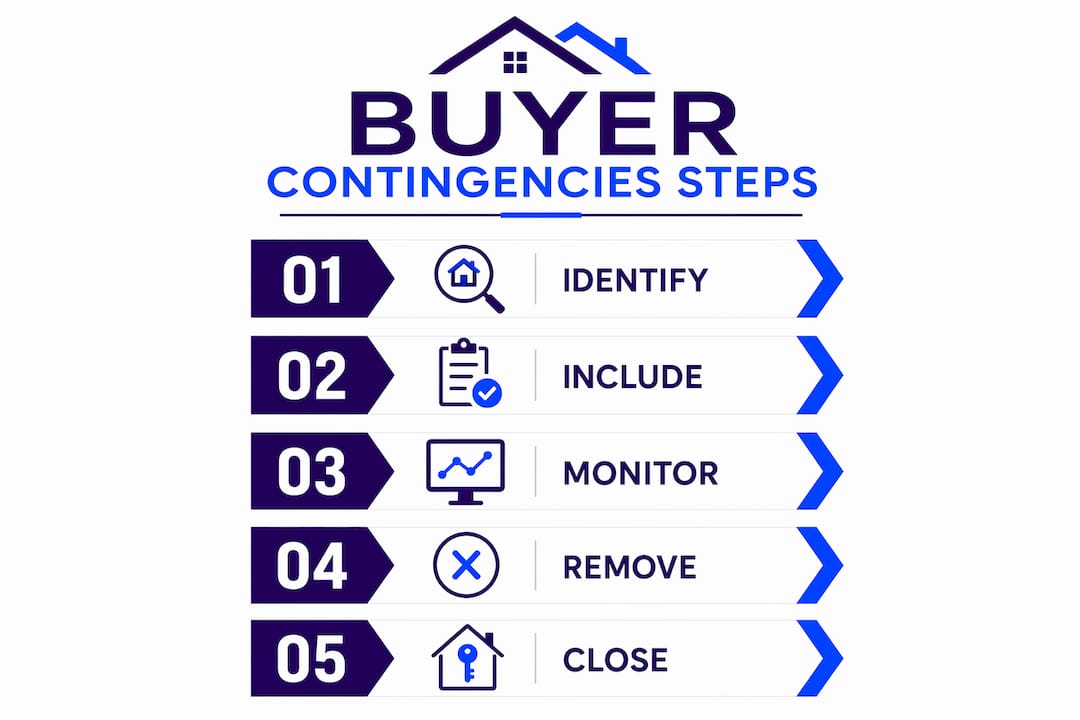
How do you properly include and remove contingencies?
Writing a contingency clause correctly is as important as including it at all. A vague or incomplete clause may not hold up when you need it most.
-
State every condition with precision. Each contingency should name the specific condition, the deadline for satisfying it, and the exact remedy if it fails. "Buyer's satisfaction" is not a legal standard. "Buyer's approval of inspection report within 10 days of acceptance" is.
-
Use the standard contract forms. In California, the California Association of Realtors purchase agreement includes standardized contingency language. Using approved forms reduces the chance of ambiguity that could cost you your deposit.
-
Notify the seller in writing. If a contingency fails and you intend to cancel, you must deliver written notice before the deadline expires. Verbal communication does not protect your earnest money.
-
Remove contingencies with a signed form. Once you are satisfied with an inspection or have loan approval in hand, sign and deliver a contingency removal form. This step is required. Silence does not count as removal.
-
Work with a licensed agent and, when needed, a real estate attorney. California law treats contingencies as mechanisms requiring buyers to act in good faith. An agent familiar with local contract norms keeps you on the right side of that standard.
The most common mistake buyers make is letting a contingency deadline pass without taking action. That passive error can be treated as a waiver, leaving you exposed. Set calendar reminders for every deadline the moment your offer is accepted.
What are the most common misconceptions about buyer contingencies?
Several widespread misunderstandings cause buyers to either over-rely on contingencies or abandon them when they should not.
-
Misconception: Waiving contingencies guarantees you win the deal. Removing all contingencies makes your offer more competitive, but it does not guarantee acceptance. Sellers weigh price, financing strength, and closing timeline alongside contingency terms.
-
Misconception: Contingencies always delay closing. A well-managed contingency with a tight deadline adds minimal time to the process. The 30–45 day closing window already accounts for standard contingency periods.
-
Misconception: The inspection contingency is optional for newer homes. New construction still carries defects. Buyers who skip inspections on new builds regularly discover issues that would have been negotiable before closing.
-
Misconception: All contingencies work the same way. Each clause has its own trigger, deadline, and remedy. Confusing a financing contingency with an appraisal contingency, for example, can leave you unprotected in a specific scenario.
Pro Tip: Ask your agent to walk you through every contingency deadline on a written timeline before you sign. Seeing the full calendar in one place prevents the passive deadline errors that cost buyers their deposits.
Key Takeaways
Buyer's contingencies are the most reliable legal tools a homebuyer has to protect their deposit and exit a bad deal without financial penalty.
| Point | Details |
|---|---|
| Definition of contingencies | Contractual conditions in a purchase agreement that must be met before the sale closes. |
| Most critical types | Inspection, appraisal, and financing contingencies protect against the most common deal-breaking risks. |
| Timeline awareness | The standard 30–45 day closing window contains nested deadlines; missing one can forfeit your earnest money. |
| Competitive market strategy | Shorten contingency periods rather than waiving them outright to balance protection and offer strength. |
| Proper management | All contingency actions, including cancellations and removals, must be delivered in writing before deadlines expire. |
What I've learned from watching buyers skip contingencies
I have worked with buyers across every price point in San Diego, and the pattern I see most often is this: buyers in hot markets panic and strip their offers of contingencies to compete, then spend the next 30 days hoping nothing goes wrong. Sometimes it works out. When it does not, the consequences are severe.
The buyers I have seen come out ahead are the ones who treat contingencies as negotiating tools rather than obstacles. A 7-day inspection window with a pre-approval letter from a strong lender is a genuinely competitive offer. It signals preparation, not desperation. Sellers respond to that.
The appraisal contingency is the one I push hardest to keep. In a market where prices have moved fast, the gap between offer price and appraised value can be significant. Buyers who waive the appraisal contingency and then face a $40,000 shortfall have very few good options. That is a situation I work hard to help my clients avoid.
My honest advice: keep your core contingencies, tighten your deadlines, and let your preparation do the competitive work. The negotiation process has more levers than most buyers realize. Contingencies are one of the most powerful ones.
— Jeff
Working with Jeffsellssandiego on your next purchase
Buyer's contingencies require precise timing, clear contract language, and a local agent who knows how San Diego sellers respond to different offer structures.

Jeffsellssandiego works with homebuyers and investors across San Diego County to structure offers that protect your interests without sacrificing competitiveness. From managing inspection and appraisal deadlines to advising on when to shorten or waive specific clauses, the guidance is grounded in real local market experience. Start with the San Diego home listings to find properties that match your criteria, or visit the buyer's guide for a full breakdown of the purchase process, including how contingencies work at every stage.
FAQ
What is a buyer's contingency in real estate?
A buyer's contingency is a condition written into a purchase contract that must be satisfied before the sale can close. If the condition is not met, the buyer can cancel the contract and typically recover their earnest money deposit.
Which contingency is most important for financed buyers?
The financing contingency is the most critical for buyers using a mortgage, because it allows cancellation without penalty if the loan is denied. The appraisal contingency runs a close second, protecting buyers when the property appraises below the offer price.
Can a buyer lose their earnest money if a contingency is not removed on time?
Yes. If a contingency deadline passes without written action from the buyer, the seller may treat the contingency as waived. Buyers who then try to cancel can lose their earnest money deposit as a result.
Do contingencies make an offer weaker in a competitive market?
Too many contingencies with long deadlines can reduce offer appeal, but shortening contingency periods rather than removing them entirely keeps protection intact while signaling seriousness to the seller.
What is a kick-out clause and how does it affect buyers?
A kick-out clause gives the seller the right to accept another offer while a home sale contingency is active, requiring the buyer to remove the contingency quickly or lose the property. Buyers using home sale contingencies should understand this clause before signing.