
San Diego's real estate market in 2026 is moving fast, and the rules keep changing. Mortgage rates shifted significantly from where they stood a year ago, median home prices have pulled back, and yet competition in desirable neighborhoods remains fierce. Whether you're trying to break into homeownership for the first time or you're a seller trying to maximize your outcome without stumbling over California's strict disclosure requirements, the path forward is rarely obvious. This guide lays out exactly what you need to know, step by step, so you walk into your next transaction prepared and confident.
Table of Contents
- Understanding the San Diego housing market
- Key requirements for San Diego buyers and sellers
- Step-by-step guide to buying a home in San Diego
- Seller checklist: Preparation, compliance, and closing
- What most guides miss about San Diego real estate sales
- Connect with San Diego's trusted real estate resources
- Frequently asked questions
Key Takeaways
| Point | Details |
|---|---|
| Market shifts matter | Mortgage rates and home prices have changed in 2026, impacting buying and selling strategies. |
| Disclosure is critical | Sellers must submit TDS and NHD documents, and a strategic approach reduces risks. |
| Buyer assistance available | San Diego buyers can access SDHC’s down payment and closing cost grants if eligible. |
| Preparation guides success | Following step-by-step buyer and seller checklists makes transactions smoother and safer. |
| Local expertise is key | Real estate professionals and guides help navigate compliance and market volatility. |
Understanding the San Diego housing market
Before you make any move, you need a clear picture of where the market stands. The good news for buyers is that spring 2026 rates have dropped to around 6.23% on a 30-year fixed mortgage, compared to 6.81% a year ago. That difference saves you real money each month. The median home value in San Diego has settled at approximately $968,817, which is down about 4% year over year.
Lower prices combined with lower rates sounds like an obvious win. But here's what people miss: when conditions improve for buyers, more buyers show up. Spring consistently brings a surge of activity, and San Diego is no different. More buyers competing for the same inventory means sellers still hold meaningful leverage on well-priced, well-presented homes.
What the numbers look like right now
| Metric | 2025 | 2026 | Change |
|---|---|---|---|
| 30-year fixed rate | 6.81% | 6.23% | Down 0.58% |
| Median home value | ~$1.01M | $968,817 | Down ~4% |
| Spring market activity | Moderate | High surge | Increased |
| Days on market (avg.) | 28 | 22 | Faster |
The market does not behave the same across all of San Diego. Pacific Beach trends look very different from inland areas. Coastal properties in Pacific Beach and La Jolla command premium prices and shorter days on market, while inland communities like El Cajon or Santee offer more inventory and more negotiating room.
Key factors shaping conditions right now:
- Inventory remains tight in coastal and walkable neighborhoods
- New listings spike in April and May, creating brief windows of opportunity
- FHA and VA loan buyers face more competition as more buyers enter the spring market
- Price reductions are more common in the $1.2M+ range than in entry-level price points
- Timing matters and timing in La Mesa can shift your outcome by thousands of dollars
If you want a more detailed breakdown of specific communities, the San Diego neighborhood guide is a solid starting point for comparing price points, amenities, and market pace across the region.
Key requirements for San Diego buyers and sellers
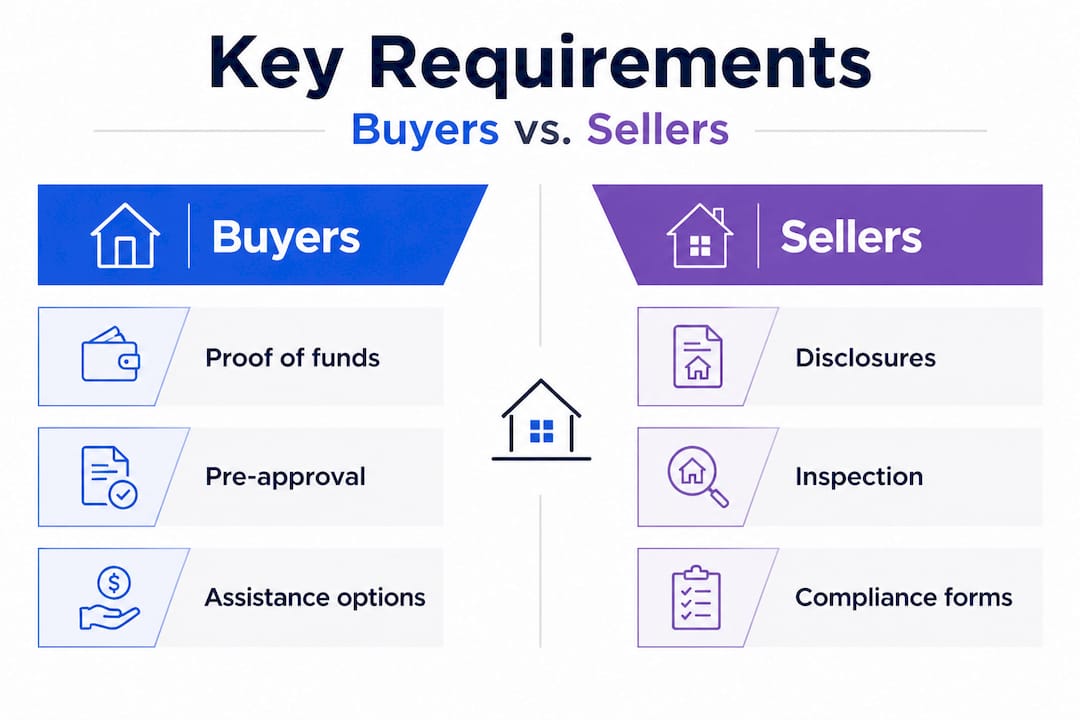
Knowing the market is one thing. Knowing what you're legally and financially required to have in place is another. Both buyers and sellers carry responsibilities that, if ignored, can derail or delay a transaction at the worst possible time.

For sellers, California law requires specific disclosures before a sale can close. The Transfer Disclosure Statement (TDS) is the primary document. It requires you to reveal known material defects, issues with systems and appliances, and any legal claims affecting the property. If your home sits in a designated hazard zone, you also need the Natural Hazard Disclosure (NHD). According to California's legal requirements for home sales, these disclosures are a central compliance requirement, not optional paperwork. Skipping or misrepresenting them creates legal liability that can follow you long after closing.
For buyers, the most overlooked opportunity is down payment assistance. Many buyers assume they need 20% saved before they can even consider buying. That's simply not true in San Diego.
| Program | Who qualifies | Benefit |
|---|---|---|
| SDHC deferred second trust deed | First-time buyers, income limits apply | Down payment assistance, no monthly payments |
| SDHC closing cost grant | City of San Diego residents | Reduces upfront cash needed |
| FHA loan | Credit score 580+, 3.5% down | Low down payment option |
| VA loan | Veterans and active duty | Zero down, no PMI |
| CalHFA MyHome | First-time buyers statewide | Deferred junior loan |
The SDHC first-time homebuyer programs offer deferred-payment assistance and closing-cost grants specifically for eligible buyers purchasing within the City of San Diego. These programs are income-restricted, but they serve a wide range of buyers who might be surprised to find they qualify.
Pro Tip: Request a full list of all available assistance programs from your lender AND from a local real estate agent before you assume you don't qualify. Many buyers leave money on the table by not asking.
Key checklist items before any transaction:
- Sellers: Gather permit history, HOA documents, roof and HVAC records, and any known repair history
- Buyers: Pull your credit report, calculate your debt-to-income ratio, and get preapproved (not just prequalified)
- Both: Understand your timeline and build in buffer for inspections, loan processing, and title work
For San Diego seller compliance specifics, especially if the property came to you through inheritance, there are additional layers worth reviewing early in the process. And if you're thinking about prepping a North Park home for sale, preparation strategy in that neighborhood's competitive market is very specific and worth reading before you list.
Step-by-step guide to buying a home in San Diego
The buying process in San Diego has a clear structure. Problems happen when buyers skip steps or assume they can circle back to funding details after they've already fallen in love with a house. Here's the right order:
-
Check SDHC eligibility first. Before you do anything else, visit the SDHC programs page to see if you qualify for deferred payment assistance or closing cost help. This shapes how much cash you actually need.
-
Get preapproved, not just prequalified. A prequalification is a soft estimate. A preapproval means a lender has reviewed your income, assets, and credit and issued a formal commitment. In a competitive market, sellers often won't even look at an offer without one.
-
Stack and compare your loan options. Don't take the first offer your bank gives you. Compare conventional, FHA, and VA products. Look into top mortgage strategies used in high-value neighborhoods and apply those principles to your own search. Rate differences of even 0.25% add up to tens of thousands of dollars over a 30-year loan.
-
Work with an agent who knows your target neighborhoods. San Diego is not one market. An agent fluent in mortgage rate tips and local market rhythm can save you significant time filtering listings that won't appraise or that have hidden complications.
-
Make offers with smart contingencies. When you find the right home, your offer should include inspection and appraisal contingencies that align with what the disclosure package reveals. Review the seller's TDS and NHD before removing any contingency. That disclosure packet is your best tool for protecting yourself.
-
Navigate escrow carefully. Escrow in California typically runs 30 to 45 days. During this time, you'll complete your inspections, finalize your loan, review title, and sign closing documents. Stay responsive to your agent and lender to avoid delays.
Remember: Removing a contingency before you have all your information is one of the most common and costly mistakes buyers make in competitive markets. Pressure to "go clean" on an offer feels urgent in the moment, but it transfers all the risk to you.
Pro Tip: If you're using SDHC assistance, communicate that to your agent from day one. Some sellers are unfamiliar with how these programs work, and your agent can explain the timeline so it doesn't become a sticking point during negotiations.
Seller checklist: Preparation, compliance, and closing
Sellers who treat compliance as a strategy, rather than a bureaucratic burden, consistently fare better in negotiations and close faster. Here's why: when your disclosure package is complete, accurate, and delivered early, buyers have less room to request credits or renegotiate after inspections.
According to California's home sale requirements, treating disclosure as a core part of the strategy rather than a final paperwork step reduces legal and transaction risk. Buyers who receive a thorough disclosure packet upfront can also use it to structure their contingencies more confidently, which actually speeds up the process for everyone.
Seller preparation checklist:
- Complete the Transfer Disclosure Statement accurately and thoroughly
- Order a Natural Hazard Disclosure report from a licensed provider
- Pull permit records for any additions, remodels, or conversions
- Schedule a pre-listing home inspection to identify issues before buyers do
- Address cosmetic issues that hurt first impressions but are inexpensive to fix
- Stage the home or at minimum declutter and deep clean every space
- Price the home based on recent comparable sales, not what you hope to get
- Set a clear timeline for offers and communicate it through your agent
Homes priced accurately from day one spend far fewer days on market than those that start high and reduce. Buyers notice price reductions and often assume something is wrong.
Pro Tip: Order your own home inspection before listing. The $400 to $600 you spend upfront can prevent a buyer from using surprise findings as leverage to reduce your price by $15,000 at the worst possible moment.
For complex situations, such as strategy for inherited homes, the compliance requirements layer with probate considerations and title chain questions that need professional guidance early. If your property is in a coastal neighborhood, the Point Loma property guide offers useful neighborhood context that affects how you price and market.
What most guides miss about San Diego real estate sales
Here's something most step-by-step articles won't tell you: the buyers and sellers who do best in San Diego aren't the ones with the most money or the fastest timeline. They're the ones who treat every part of the process as a source of leverage, not just a box to check.
Disclosures, for example, are universally described as legal obligations. That's true. But smart sellers use the disclosure process to set the tone for negotiations. A complete, well-organized disclosure packet signals to buyers that you're a serious, honest seller. It reduces fear. And buyers who feel informed and protected are far less likely to chip away at your price after inspections. The disclosure is not just paperwork. It's a positioning tool.
On the buyer side, most people obsess over finding the perfect house. The smarter focus is on finding the perfect financing position first. Knowing your exact buying power, which programs you qualify for, and what your monthly cost looks like at various price points puts you in a completely different negotiating posture than a buyer who's guessing.
The market also moves in ways that surprise even experienced players. Seasonal selling advice is valuable, but the San Diego market doesn't always follow the national calendar. A slow January can flip into an extremely competitive February if a large employer announces a local expansion or interest rates drop unexpectedly. Buyers and sellers who are ready to act quickly when conditions shift consistently capture better outcomes.
Local connections matter enormously. Knowing which lenders close on time, which inspectors are thorough without being alarmist, and which title companies process complex deals efficiently is not information you find on a national real estate website. It's knowledge that lives in the local community. The difference between a smooth 30-day close and a painful 60-day disaster often comes down to who's on your team, not just what house you chose.
Connect with San Diego's trusted real estate resources
Understanding the process is a powerful start, but executing it well requires the right people and tools in your corner.

At jeffsellssandiego.com, you'll find neighborhood guides, current listings, and seller and buyer resources built specifically for San Diego's residential market. Whether you're searching for the right community, trying to understand what your home is worth, or ready to start the conversation with an experienced local agent, the site is designed to give you real, actionable information without the fluff. San Diego buyers and sellers deserve guidance that's grounded in how this specific market actually works, and that's exactly what you'll find there.
Frequently asked questions
What disclosures are required for selling a home in San Diego?
Sellers must provide the Transfer Disclosure Statement and, if the property sits in a designated hazard zone, the Natural Hazard Disclosure, both detailing material facts that affect the home's value and safety.
Can San Diego buyers get down payment assistance?
Yes, eligible first-time buyers can access SDHC deferred assistance in the form of a second trust deed with no monthly payments, plus closing cost grants for purchases within the City of San Diego.
How have San Diego mortgage rates and home prices changed in 2026?
30-year fixed rates sit at 6.23%, down from 6.81% a year ago, while the median home value has eased to $968,817, a drop of roughly 4% year over year.
Why is disclosure strategy important for sellers?
Treating your disclosure as strategy rather than a legal formality reduces negotiation risk after inspections and signals to buyers that you're a transparent, trustworthy seller, which often results in fewer credits and faster closes.