
Most first-time buyers assume a real estate contract is just a formal version of "we agreed on a price." It's not. A real estate contract is a legally binding document that defines every condition of the transaction, and misreading even one clause can cost you your deposit, your timeline, or the home itself. Understanding what is a real estate contract, what goes in it, and what your rights actually are isn't optional. It's the difference between a smooth closing and an expensive lesson.
Table of Contents
- Key takeaways
- What is a real estate contract?
- Core components of a real estate contract
- Understanding contingencies
- Common mistakes first-time buyers make
- How to approach drafting and reviewing a contract
- My honest take on contract literacy for buyers
- Start your San Diego home search with confidence
- FAQ
Key takeaways
| Point | Details |
|---|---|
| Written contracts are required | All states require real estate agreements in writing; verbal promises are not legally enforceable. |
| Contingencies protect both parties | Financing, inspection, and title contingencies give buyers legal exit ramps if conditions aren't met. |
| Price isn't the main dispute trigger | Most contract disputes involve property descriptions and what items are included or excluded at closing. |
| Deadlines are binding | Missing a contingency deadline can forfeit your right to cancel without penalty. |
| All terms are negotiable | No clause in a purchase agreement is automatically "standard." Everything can be negotiated. |
What is a real estate contract?
A real estate contract is a written legal agreement between a buyer and a seller that outlines the terms under which a property will be transferred. Its purpose is simple: to document exactly what both parties agreed to, so there's no room for "I thought you meant..." conversations after closing.
Every state requires this agreement to be in writing. The Statute of Frauds applies to real estate transactions in all 50 states, meaning verbal promises about price, repairs, or included items carry no legal weight whatsoever. If it's not in writing and signed, it didn't happen legally.
You may also hear a real estate contract called by different names. The most common terms include:
- Purchase and Sale Agreement (PSA)
- Real estate purchase agreement
- Contract of sale
- Real estate sales contract
- Purchase contract
The name varies by state and sometimes by agent preference, but they all refer to the same thing. For a contract to be legally valid, it needs offer and acceptance, consideration (that's the money), mutual consent, and the legal capacity of both parties to sign.
One thing first-time buyers often miss: a signed offer becomes binding only when both parties sign without modification. The moment a seller counters the offer, the original offer is void. A counter is a new offer. Keep that chain clear in your head.
Core components of a real estate contract
First-time buyers sometimes focus so heavily on the price that they skim the rest. That's a mistake. According to buyer misconception research, most real estate disputes don't involve price at all. They involve the material terms that buyers skipped over.
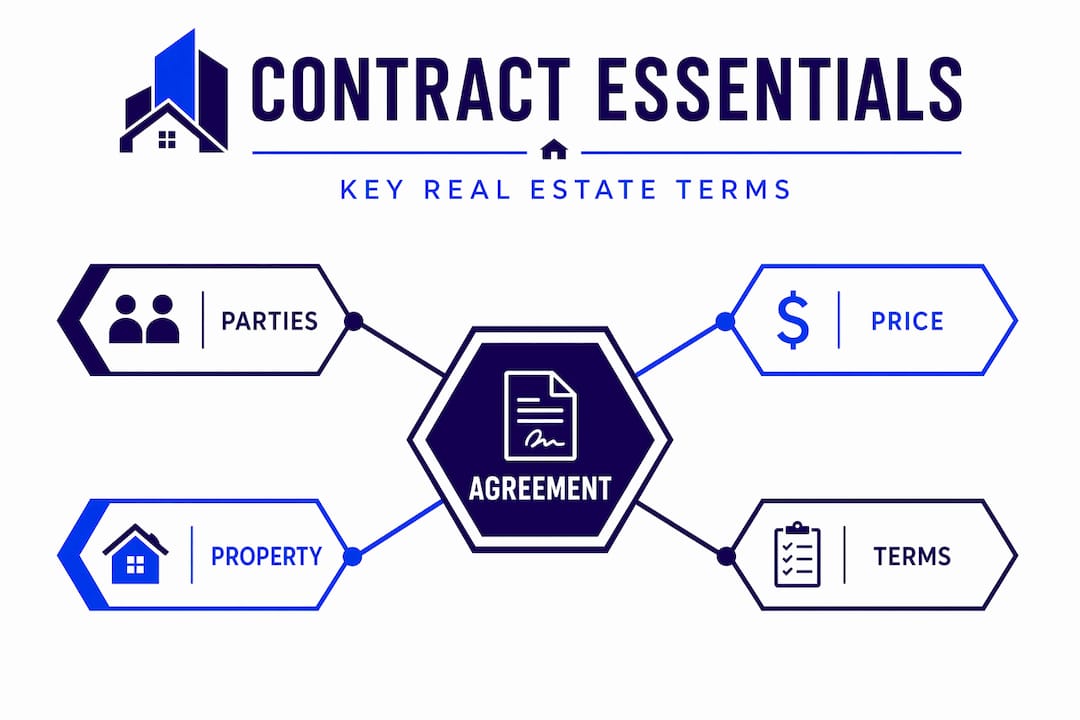
Here are the key contract elements every purchase agreement should contain:
- Buyer and seller identification: Full legal names exactly as they should appear on the deed.
- Property description: This goes beyond a street address. A proper legal description references parcel numbers and deed records. Vague descriptions cause problems.
- Purchase price: The agreed amount plus how it will be paid (cash, conventional loan, FHA, VA, etc.).
- Earnest money deposit: The amount, where it's held, and the conditions for its return or forfeiture.
- Closing date: When the transfer of ownership is scheduled to occur.
- Possession terms: When you actually get the keys. This isn't always the same as the closing date.
- Items included or excluded: Appliances, fixtures, window treatments, outdoor structures. Every item needs explicit mention.
That last point causes more friction at closing than almost anything else. Buyers assume the refrigerator is included. Sellers assume it's not. Disputes over fixtures and personal property are among the most common in residential real estate, and they're 100% preventable with clear contract language.
Pro Tip: Walk through the property before closing with a copy of the contract's included/excluded items list. If something you expected to see is gone, you have documentation to back your position.

Understanding contingencies
Contingencies are conditions that must be satisfied before the contract becomes fully binding. Think of them as checkpoints. If a checkpoint fails, the contract can typically be canceled without penalty, and earnest money is returned to the buyer.
Contingencies in real estate contracts serve as exit ramps that allow either party to cancel if a specific condition isn't met within an agreed timeframe. They are time-bound, which is the part most buyers underestimate.
The most common contingencies are:
- Financing contingency: Gives the buyer a set number of days to secure a mortgage. If the loan falls through, the buyer can exit without losing their deposit.
- Inspection contingency: Allows the buyer to hire a home inspector and negotiate repairs or credits, or walk away based on findings.
- Appraisal contingency: Protects buyers if the home appraises below the agreed purchase price. Without this, you may be obligated to cover the gap.
- Title contingency: Gives time to review the title report and confirm there are no liens, disputes, or clouds on ownership.
- HOA review contingency: The HOA review contingency gives buyers time to evaluate HOA financials, rules, and covenants before committing to a property governed by an association.
- Home sale contingency: Protects buyers who need to sell their current home before they can purchase. This one can complicate offers in competitive markets.
- Kick-out clause: This one favors sellers. If the kick-out clause is in effect, the seller can continue showing the property and must give the buyer a short window to remove their contingencies or lose the deal.
- Rent-back clause: Allows the seller to remain in the home for an agreed period after closing, essentially renting it from the new owner.
The most critical function of contingencies is that they make purchase conditions clear and time-bound. Both parties know exactly what must happen and by when. That clarity protects everyone at the table.
Pro Tip: Put every contingency deadline in your calendar the day you go under contract. Missing a deadline by even one day can cost you the right to cancel and your full earnest money deposit.
Common mistakes first-time buyers make
Knowing what a real estate contract contains is useful. Knowing where buyers typically go wrong is more useful. Here are the most common pitfalls that show up repeatedly in residential transactions:
-
Relying on verbal agreements. If your agent, the listing agent, or the seller says something verbally that isn't in the contract, it does not exist legally. Get every agreement, repair promise, or inclusion confirmed in a written addendum.
-
Waiving contingencies to compete. In hot markets, buyers sometimes waive inspection or financing contingencies to make their offer more attractive. This is a real risk. Waiving a financing contingency means you could lose your earnest money if your loan falls through.
-
Assuming items are included. That built-in microwave? The mounted TV brackets? The backyard playset? None of these are automatically included unless the contract says so. Ambiguities over fixtures are a leading cause of closing-day disputes.
-
Mismanaging contingency timelines. Calendar management of contingency periods is not optional. Buyers who miss their inspection deadline or forget to formally remove a contingency in writing can find themselves locked into a purchase they wanted to exit.
-
Treating the contract as non-negotiable. Many first-time buyers receive a contract and assume it's a standard form they just sign. Every term in a purchase agreement is negotiable before both parties sign. You have more leverage than you think, especially regarding timelines and inclusions.
How to approach drafting and reviewing a contract
When you're ready to make an offer, your agent will typically work from a standardized state-approved form. But standardized doesn't mean complete. Every transaction has specific details that need to be added, and those details matter.
Start by reading the entire contract before signing anything. This sounds obvious, but many buyers skim and sign under time pressure. Read every line. If you don't understand a clause, ask your agent or a real estate attorney to explain it in plain language before you commit.
When negotiating, think beyond price. Your buyer's guide for the San Diego market can walk you through the full offer process, but the core principle applies everywhere: contingency periods, repair credits, closing timelines, and included items are all negotiable. Each one affects your risk and your out-of-pocket costs.
Document every change. When you and the seller agree to modify a term after the initial contract is signed, that change must be documented in a written addendum and signed by both parties. A text message or email confirmation is not a legally binding contract modification. Verbal assurances carry even less weight.
Pro Tip: Ask your agent to create a one-page contingency timeline summary after you go under contract. List each deadline with the exact date it expires. Review it weekly and confirm in writing when each contingency is satisfied or removed.
Understanding closing costs in San Diego is also part of reviewing a contract carefully, since some costs are negotiated into the agreement itself rather than addressed separately at closing.
My honest take on contract literacy for buyers
I've sat across the table from hundreds of buyers over the years, and I consistently see the same thing: buyers who are confident about their finances but completely unprepared for the contract phase. They've spent months getting pre-approved, touring homes, and calculating monthly payments. Then they get a 15-page purchase agreement in their inbox and sign it in 20 minutes.
What I've learned is that the contract is where the deal actually lives. The price is the starting point. The contract is everything else. I've seen buyers lose significant earnest money because they missed a contingency deadline by two days. I've seen closing-day fights over a $400 refrigerator that wasn't mentioned in the contract. These situations are preventable, every single time.
My take is this: no clause is automatically standard, and no term should confuse you without getting an explanation first. Agents should explain every section before you sign, not after a problem surfaces. If your agent can't or won't walk you through the contract in plain language, that's a problem worth addressing before you're legally bound.
The buyers who come out best are the ones who ask questions, read carefully, and treat the contract as the actual foundation of the purchase rather than the paperwork that comes after the "real" decision. Because the contract is the real decision.
— Jeff
Start your San Diego home search with confidence

Understanding a real estate contract is step one. Putting that knowledge to work in an actual search is step two. At Jeffsellssandiego, we work with first-time buyers throughout San Diego to make the contract process clear from offer through closing. Browse current San Diego listings to see what's available right now. When you're ready to go deeper, the Jeffsellssandiego buyer's guide covers every phase of the purchase process, including how to review offers, manage contingencies, and negotiate terms that protect you. If you have questions about a specific neighborhood, explore the San Diego neighborhood guide for area-specific insights that inform smarter location decisions before you sign anything.
FAQ
What is a real estate contract in simple terms?
A real estate contract is a written legal agreement between a buyer and seller that details the terms of a property sale, including price, closing date, contingencies, and what items transfer with the home. Without a written contract, the transaction has no legal standing.
What are the most common types of real estate contracts?
The most common types include the purchase and sale agreement (PSA), real estate purchase agreement, contract of sale, and land contract. They serve the same core purpose but may vary by state in language and required disclosures.
What happens if I miss a contingency deadline?
Missing a contingency deadline can forfeit your right to cancel the contract without penalty. In some cases, it also means losing your earnest money deposit. Track every deadline in writing from the day you go under contract.
Are all terms in a real estate contract negotiable?
Yes. Every term in a purchase agreement can be negotiated before both parties sign, including contingency periods, included items, closing dates, and repair credits. No clause is automatically fixed or standard.
Does a verbal agreement count as a real estate contract?
No. All states require real estate contracts to be in writing under the Statute of Frauds. Verbal promises about price, repairs, or included items are not legally enforceable, regardless of who made them or when.