
Most buyers and sellers in San Diego still believe winning in real estate comes down to who bids fastest and highest. That mindset worked during the pandemic frenzy. It doesn't work now. The role of negotiation in real estate has shifted fundamentally, and the buyers and sellers who understand that shift are the ones walking away with better deals, fewer surprises, and far less stress.
Table of Contents
- Understanding the San Diego market shift and its negotiation impact
- Key negotiation fundamentals for homebuyers and sellers
- Leveraging contingencies to maximize negotiation outcomes
- Negotiating repairs after home inspections: strategy and priorities
- Adapting negotiation tactics to neighborhood competitiveness in San Diego
- Why traditional negotiation tactics often fail in San Diego's evolving market
- Enhance your San Diego real estate deals with expert negotiation support
- Frequently asked questions
Key Takeaways
| Point | Details |
|---|---|
| San Diego’s market shift | The 2026 market favors strategic negotiation over speed due to longer days on market and more homes below list price. |
| BATNA importance | Defining your Best Alternative to a Negotiated Agreement strengthens your position and helps avoid pressured decisions. |
| Contingencies protect | Including contingencies like inspection clauses provides crucial leverage and financial safeguards in deals. |
| Repair negotiations | Focusing on critical repairs with documented estimates improves chances of seller cooperation. |
| Neighborhood differences | Negotiation tactics must adapt to whether the property is in a competitive or less competitive San Diego neighborhood. |
Understanding the San Diego market shift and its negotiation impact
The bidding wars that defined 2021 and 2022 in San Diego are largely behind us. That's not bad news. It's an opportunity, if you know how to use it.
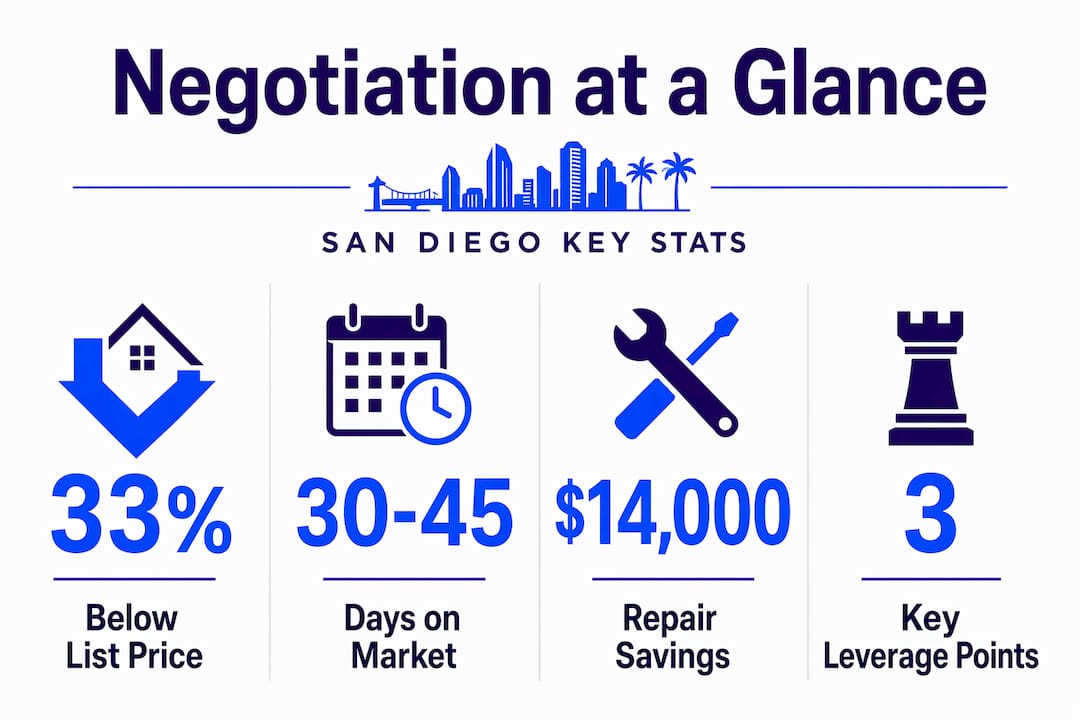
Homes now typically sit on the market for 30 to 45 days, and approximately 33% of homes are selling below list price. That single statistic changes everything about how you should approach a transaction. Time on market translates directly into negotiating room. The longer a property sits, the more motivated a seller becomes, and the more leverage shifts toward the buyer.
But here's what most people miss: the market isn't uniform across San Diego. La Jolla, Coronado, and neighborhoods with strong school ratings still move quickly. Getting your pricing your Allied Gardens home strategy right matters enormously because overpriced listings in any neighborhood are exactly where buyers find their best negotiating windows.
What this market shift means for you:
- Buyers can now request repairs, credits, and price reductions with genuine confidence
- Sellers who price correctly face fewer concession requests than those who start high
- Closing cost credits have become a standard tool sellers use to attract qualified buyers
- Inspection-related negotiations are back at the table after years of buyers waiving everything
- Location still determines how much leverage you actually hold going in
The importance of negotiation in real estate right now is precisely that it rewards preparation over panic. You have time. Use it deliberately.
Key negotiation fundamentals for homebuyers and sellers
Before you write an offer or set a list price, you need to understand the mechanics beneath the surface. Negotiation isn't arguing about numbers. It's a structured process of surfacing what both parties actually need and finding ways to satisfy those needs simultaneously.
The most powerful concept in any negotiation is your BATNA, which stands for Best Alternative to a Negotiated Agreement. Simply put: what will you do if this deal falls apart? Defining your BATNA gives you the single greatest source of leverage you can carry into any negotiation. If you're a buyer with a strong BATNA, say three other homes you'd happily purchase, you negotiate from a position of calm confidence rather than desperation. Desperation is the most expensive emotion in real estate.
Emotional intelligence matters just as much. Successful negotiation focuses on motivations and emotional management rather than just price. A seller who raised their family in a home for 20 years may care deeply about who's buying it next. Acknowledging that in a personal letter or through your agent's conversations can move the deal in your favor without changing your price by a single dollar.
Effective negotiation skills in real estate also mean thinking creatively. Instead of two parties fighting over one number, look for multiple variables you can trade. Price, closing date, included appliances, leaseback arrangements, and closing costs negotiation are all levers. Moving one in exchange for another is how deals close when they might otherwise fall apart.
Core principles to bring to every negotiation:
- Know your walk-away point before you start, not after you're emotionally invested
- Listen more than you talk; information is leverage
- Never make a concession without asking for something in return
- Avoid round-number anchors when possible; specific numbers signal that you've done your homework
- Silence is a tactic; don't fill it with concessions
Pro Tip: If you're a buyer, find out before negotiating why the seller is moving. Relocation deadlines, estate sales, and divorce situations all create different negotiation dynamics you can work with ethically and effectively.
Leveraging contingencies to maximize negotiation outcomes
Contingencies are the contractual checkpoints built into every real estate transaction. They protect you. And when used correctly, they also give you negotiation power that extends well past the initial offer.
The three contingencies that matter most in San Diego transactions are inspection, financing, and appraisal. Each one creates a moment in the deal where terms can be renegotiated based on new information.
How to use each contingency strategically:
- Inspection contingency: This is your most powerful tool after an offer is accepted. It opens a second negotiation round based on the actual condition of the property, not the seller's representations.
- Financing contingency: Protects you if your loan terms change unexpectedly. It also signals to sellers that your financing is not yet fully locked, which matters in competitive situations.
- Appraisal contingency: If the property appraises below the agreed price, this contingency lets you renegotiate the price or exit the contract without losing your deposit.
- Title contingency: Ensures the title is clear of liens, judgments, or ownership disputes before you're committed to closing.
- HOA document review contingency: Critical in San Diego's many condo and townhome communities; you need time to review financials and meeting minutes before you're locked in.
Inspection contingencies save buyers an average of $14,000 in negotiated repairs or price reductions. That's not a small number. It's often the difference between a good deal and an expensive regret.
| Contingency | Who it protects most | Typical deadline in San Diego |
|---|---|---|
| Inspection | Buyer | 10 to 17 days |
| Financing | Buyer | 21 days |
| Appraisal | Buyer | 17 to 21 days |
| Title review | Buyer | 5 to 7 days |
| HOA documents | Buyer | 5 days |
Pro Tip: Sellers, don't view contingencies as buyer obstacles. A well-structured contingency period with clear deadlines protects you too, because it locks in timelines and prevents buyers from dragging their feet indefinitely.
Before listing, consider preparing your home for sale thoroughly. Fewer undisclosed defects mean fewer inspection surprises, which means fewer renegotiations eating into your net proceeds.
Negotiating repairs after home inspections: strategy and priorities
The inspection report arrives. It's 40 pages long and lists 87 items. Now what?

Most buyers and sellers handle this moment badly. Buyers try to negotiate every single item, including the burned-out porch light and the sticky cabinet drawer. Sellers dig in because they feel attacked. The deal sours. Structuring repair requests by priority and backing them with contractor estimates increases seller cooperation because it signals professionalism, not opportunism.
Focusing on critical safety and major system issues while avoiding nickel-and-diming improves negotiation outcomes for both sides. Here's how to approach it correctly.
Repair negotiation priorities:
- Deal-breakers first: Structural defects, foundation cracks, roof failures, active water intrusion, faulty electrical panels, and environmental hazards like mold or asbestos belong at the top
- Major systems second: HVAC, plumbing, and water heater issues that affect habitability and carry significant replacement costs
- Safety items third: Anything that creates a liability, such as missing GFCI outlets, broken stair railings, or missing smoke detectors
- Skip the small stuff entirely: Cosmetic issues, minor wear, and items under $200 are not worth the goodwill you'll spend requesting them
Back every request with a local contractor quote. Not an online estimate from a national app. A real quote from a San Diego contractor, because costs here are higher than the national average and sellers know it. That specificity communicates that you've done the work.
Always document agreed repairs or credits in a signed contract addendum. Verbal agreements in real estate are worth nothing. If it isn't in writing before closing, it doesn't exist.
For sellers, reviewing your pre-listing repairs guide before you list eliminates the most common inspection surprises and keeps you from losing negotiating ground at a critical moment in the transaction.
Pro Tip: Ask for a closing cost credit instead of seller repairs when possible. Credits give you control over who does the work, the quality of materials used, and the timeline. Seller repairs are often done at minimum cost and don't always meet your standards.
Adapting negotiation tactics to neighborhood competitiveness in San Diego
San Diego is not one market. It's dozens of micro-markets stacked next to each other, and the real estate negotiation tactics that work in one neighborhood can fail spectacularly in another.
Competitive homes in coastal or strong school zones sell in under 5 days. That's a completely different negotiating environment than a home sitting in a less competitive inland neighborhood for six weeks. Your approach needs to match the reality of the specific property you're pursuing.
| Market type | Average days on market | Buyer leverage | Common tactics |
|---|---|---|---|
| High competition (coastal, top schools) | Under 5 days | Low | Clean offers, minimal contingencies, personal letters |
| Moderate competition | 15 to 30 days | Moderate | Standard contingencies, modest repair requests |
| Low competition | 30 to 60 days | High | Repairs, price reductions, closing credits |
In Point Loma real estate and similar in-demand neighborhoods, sellers routinely receive multiple offers. Waiving the appraisal contingency on a home you've already reviewed carefully, or offering a flexible closing date, can win the deal without raising your price. That's the impact of negotiation on property sales in action: terms, not just dollars.
Adapting your strategy by neighborhood type:
- In hot markets, lead with your strongest offer. You likely won't get a second chance.
- In slower markets, hold your best terms in reserve for a counteroffer.
- In mid-range markets, use contingencies normally but keep requests reasonable.
- Always confirm days on market and recent sold-to-list-price ratios before making an offer.
Why traditional negotiation tactics often fail in San Diego's evolving market
Here's an uncomfortable truth I see play out regularly: most buyers and sellers enter negotiations with a strategy built for a market that no longer exists.
Buyers who were priced out during the pandemic years came back to the market in 2024 and 2025 still in scarcity mode. They rush. They overbid. They waive protections they genuinely cannot afford to lose. The irony is that waiving contingencies in a market where roughly a third of homes are selling below list price isn't competitive strategy. It's just unnecessary risk-taking.
On the seller side, I see the opposite problem. Sellers price based on what their neighbor got in 2022, refuse to negotiate, and then sit on the market for two months, eventually accepting less than they would have received with a well-priced, well-negotiated launch. Stubbornness is expensive.
Successful negotiation is rarely about a single number but about surfacing motivations and structuring mutually satisfying options. The buyers I've seen get the best outcomes in 2025 and into 2026 are not the ones who came in lowest or highest. They're the ones who understood what the seller needed, whether that was a fast close, a flexible possession date, or certainty of financing, and structured their offer around that.
True leverage in San Diego right now comes from three things: preparation before you make any offer, knowing your BATNA so you negotiate without fear, and the emotional discipline to stay at the table without getting reactive. If you're working on preparing your home for top dollar, that same principle applies: the preparation happens before the negotiation, not during it.
Enhance your San Diego real estate deals with expert negotiation support
Knowing negotiation strategy is one thing. Executing it under pressure, in a live transaction, with money and time on the line, is another.

Working with an experienced local agent means you have someone in your corner who knows how to read a San Diego micro-market, structure contingency timelines correctly, and handle counteroffer dynamics without letting emotion drive decisions. Whether you're just starting your search, explore the buyer's guide for San Diego homes to understand the full process from offer to close. If you're ready to list, the seller's guide in San Diego covers pricing strategy, negotiation prep, and what to expect from today's buyers. You can also browse current San Diego listings to get a real-time feel for what's active and where the negotiating windows are widest right now.
Frequently asked questions
What is negotiation leverage in the current San Diego real estate market?
Leverage is your ability to influence price and terms during a transaction. With about one-third of San Diego homes selling below list price and typical market times running 30 to 45 days, buyers currently carry more leverage than at any point since 2019.
How does an inspection contingency help in negotiation?
It gives buyers a contractual window to request repairs, credits, or price reductions after reviewing the property's actual condition. Inspection contingencies save buyers an average of $14,000 in concessions, making it one of the most financially valuable protections in any purchase contract.
Should I waive contingencies to make my offer more attractive?
In highly competitive San Diego neighborhoods it may improve your offer's appeal, but waiving protections you cannot afford to lose is the wrong move at any price point. Evaluate the specific property's risk profile and your financial cushion before removing any contingency.
How do neighborhood competition levels affect negotiation strategies?
Competitive coastal and school-zone homes sell in under 5 days and require clean, fast offers with minimal conditions, while homes in less competitive areas give buyers 30 to 45 days to negotiate repairs, credits, and price reductions from a position of real strength.