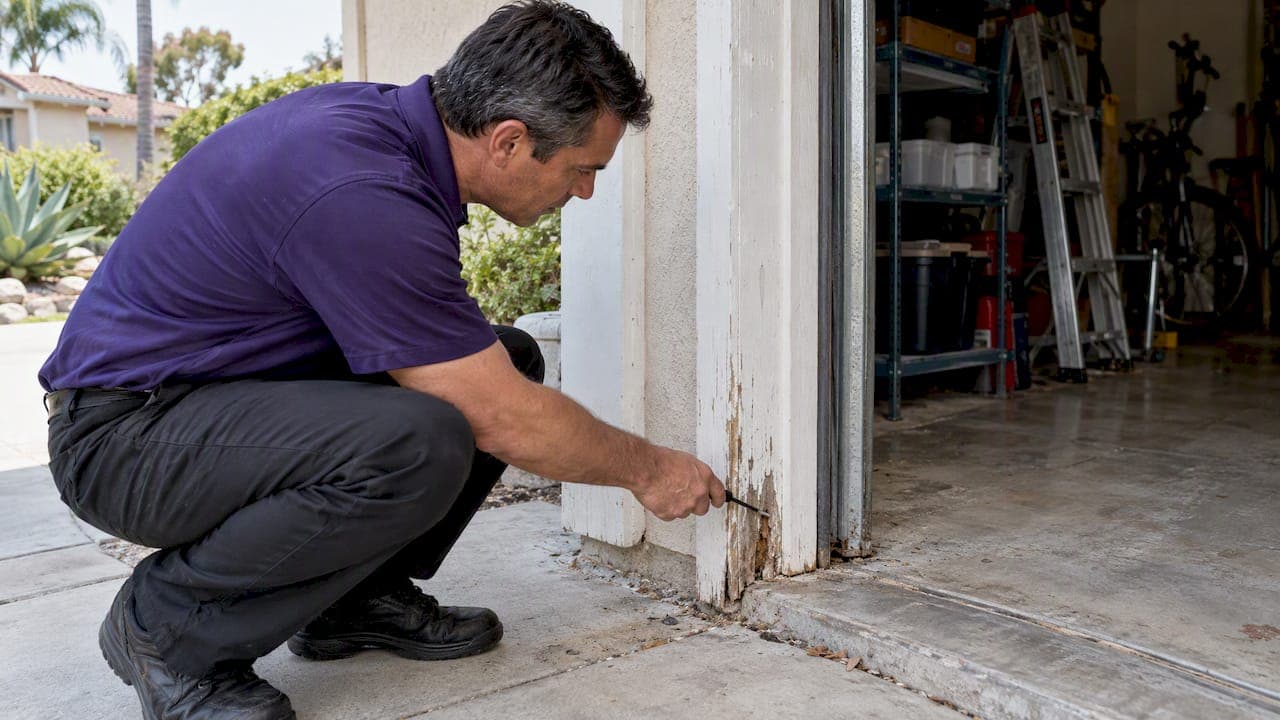
If you are buying a San Diego home with a VA loan, expect a termite (wood-destroying pest) inspection. California is on the VA's list of states that require wood-destroying insect information before the VA issues a Notice of Value, according to the VA's local requirements page. Since 2022, the VA has allowed veterans to pay for the report. It still encourages you to negotiate with the seller first. Order the inspection early, and a clean report or a short repair list should not slow your closing.
This guide walks through what the requirement means, who pays, what happens when the inspector finds something, and how we handle it for buyers and sellers in San Diego County.
TL;DR
- California requires wood-destroying insect information on VA purchases, and the requirement is usually conditioned in the VA Notice of Value (NOV).
- Under VA Circular 26-22-11, the VA has authorized veterans to pay the inspection fee where the NOV requires it. It still encourages you to ask the seller to pay.
- Any repairs needed to meet the VA's Minimum Property Requirements must be documented with itemized invoices.
- Order the inspection early in escrow, and negotiate who pays for the report and repairs in your offer or during the contingency period.
- Termites are common in San Diego, so a finding is a negotiation item, not a reason to panic.
Table of Contents
- What "VA termite clearance" actually means
- Who pays for the VA termite inspection?
- What it costs in San Diego
- Why San Diego homes so often have findings
- Step by step: from offer to a clear report
- How termite findings interact with your contingencies
- Choosing an inspector without getting pressured
- Perspective: how we handle this for VA buyers
- If you are selling to a VA buyer
- Working with us
- FAQ
- Sources
What "VA termite clearance" actually means
People use several phrases for the same thing: VA termite inspection, pest inspection, wood-destroying insect report, or "termite clearance." The VA's own wording is wood-destroying insect (or pest) inspection. The goal is to confirm the home is structurally sound before the VA guarantees the loan.
Two parties care about the result:
- The VA appraiser and the VA. The requirement is typically conditioned in the NOV, the document that sets the property's value and any conditions that must be met.
- Your lender and escrow. The lender must keep documentation in the loan file, including itemized invoices for inspection and repair costs charged to the veteran, per Circular 26-22-11.
In California, many agents and escrow officers also talk about "Section 1" and "Section 2" findings. In common local practice, Section 1 covers active infestation or damage that exists now, and Section 2 covers conditions that could lead to infestation later. Ask your lender and escrow officer which items they will require corrected, because practices vary, and the NOV conditions are what govern your loan.
Who pays for the VA termite inspection?
This is the question we hear most often, and it has changed over time.
Historically, VA rules treated the termite report as a fee the veteran could not pay, so the seller was expected to cover it. The VA's Circular 26-22-11, dated June 15, 2022, addresses wood-destroying pest inspection fees and repair costs. It describes a local variance that allows veterans to pay for the inspection when the NOV requires it.
In practice:
- Your first move is to ask the seller. The VA still encourages veterans to negotiate this cost with the seller.
- If the seller declines, you may be allowed to pay. Confirm with your lender before you order anything, so the invoice is documented properly.
- Repairs follow the same logic. If you pay for repairs needed to satisfy the Minimum Property Requirements, the lender needs an itemized invoice for the loan file.
In a competitive San Diego market, a seller may accept a VA offer more readily when the buyer's agent has already explained the process and priced the risk. We write the termite terms into the offer clearly, so there is no surprise in week two of escrow. For the negotiation side, see our guide to the role of negotiation in San Diego real estate.
What it costs in San Diego

Inspection prices vary by company and home size. Search results for San Diego show wide ranges. One listing puts typical inspections at $75 to $150, and another cites an average of $324 to $473 with outliers from $100 to $991. Get at least two quotes and ask what the report includes.
Treatment is a different budget. One San Diego price guide reports a typical treatment range of $1,200 to $4,500. It says most County homeowners pay $1,800 to $2,800 for whole-structure tent fumigation on a 1,800 to 2,400 square foot home. It also cites $750 to $1,400 for localized perimeter-style work. Treat those as ballpark figures, not quotes. Your inspector's written estimate is the number that matters.
| Item | Who usually pays | What to do |
|---|---|---|
| Inspection report | Negotiated: seller preferred, veteran allowed where the NOV requires it | Put it in the offer; confirm with the lender |
| Active infestation treatment | Typically negotiated with the seller | Request a written bid and a completion certificate |
| Repairs needed for VA Minimum Property Requirements | Negotiated; if veteran pays, itemized invoice required | Keep every invoice |
| Optional preventive work | Buyer, by choice | Decide after the report |
Why San Diego homes so often have findings
Termites are not a sign of a neglected house here. They are a regional fact. The UC Statewide IPM Program notes that the western drywood termite is native and commonly found along the Pacific coastal region and into the deserts of Southern California. Drywood termites are hard to detect because they live deep inside the wood.
Two types matter, and they are treated differently:
- Drywood termites live entirely inside the wood they eat. A common clue is small six-sided fecal pellets.
- Subterranean termites forage from the soil and build mud tubes on foundation walls.
A local pest control blog cites UC IPM in noting that drywood swarmers fly in daytime in summer and fall. Subterranean swarmers fly on clear afternoons in spring or fall after a soaking rain.
Seeing winged insects does not by itself prove the home is infested. The UC IPM guidance on subterranean and other termites says a professional inspection is usually needed to confirm an infestation. Skip DIY pesticide sprays before the inspection, because they are often ineffective and can complicate professional treatment later.
Step by step: from offer to a clear report
- Write the termite terms into your offer. State who pays for the inspection and whether you are asking the seller to cover treatment of active infestation. Your agent should check this against the lender's guidance.
- Confirm what the NOV requires. The appraisal drives this. Our VA appraisal guide for San Diego explains the timing and the conditions that can appear.
- Order the inspection right away. Do it in the first days of escrow, not after the appraisal comes back. If findings turn up, you want time to bid, repair and re-inspect.
- Read the full report with your agent. Look at what is active, what is conditional, and what is merely recommended.
- Get written bids. Ask for itemized bids. Pass them to the seller's side with a clear request.
- Negotiate in writing. Options include seller-paid treatment, a price credit where the lender allows it, or a repair completed before closing. Confirm credits with your lender first.
- Collect the paperwork. Keep the completion certificate and itemized invoices, so the lender can document everything.
- Watch the clock. A delay here can ripple through your closing date. Our San Diego closing timeline shows how the pieces fit.
How termite findings interact with your contingencies
A termite report is not the same as a general home inspection. The general inspection looks at the whole house, and the pest report looks at wood-destroying organisms. You usually want both. We cover the broader picture in The Role of Home Inspections in San Diego Real Estate.
Contingencies are what protect your deposit if findings are serious. If you want to understand how those protections work, read our San Diego contingent offer checklist and our explanation of the loan contingency. Know your deadlines. Removing a contingency before you have the pest report in hand puts your earnest money at risk.
Buying a condo? The termite question looks different when the building has shared structure and an HOA. Start with our guide to VA approved condos in San Diego.
Choosing an inspector without getting pressured
Use a licensed pest control company, and verify the license yourself. The U.S. EPA's tips for selecting a pest control service advise checking that the company holds a current state license. It also warns against firms that push you into an immediate contract by claiming structural collapse is imminent or offering "secret formulas."
Practical filters:
- Ask for the report in writing before you discuss price.
- Ask for photos and exact locations of each finding.
- Ask whether the company is quoting treatment for the specific species found, since drywood and subterranean treatments differ.
- Get a second bid on anything costing four figures.
- Be wary of any inspector who will not separate the inspection from the sales pitch.
If you are the seller, the same logic applies in reverse. A company that inspects and also bids the work has an incentive to find work. A second opinion is reasonable.
Perspective: how we handle this for VA buyers
We have worked San Diego deals for over two decades, and the termite report is rarely what kills a VA purchase. Surprises do. The buyer who learns in week three that the NOV requires a report, that nobody ordered it, and that the seller assumed the buyer would pay, is the one who loses days.

So we deal with it up front. When we write a VA offer, the termite terms are on the page. We tell veteran buyers what the VA allows, what we will ask the seller to cover, and what we will do if the seller says no. We line up the inspection in the first days of escrow and read the report alongside you. Then we negotiate from the facts, with written bids rather than guesses.
On the sell side, we tell homeowners the same thing: a VA buyer is a good buyer, and a seller who understands the termite process is more likely to close. A pre-listing inspection can take the guesswork out of pricing and negotiation, and it keeps a repair request from becoming a renegotiation. We are available when you need us, from the first showing through closing.
— Jeff
If you are selling to a VA buyer
Do not treat a VA offer as a problem. VA buyers are common in San Diego, and the pest requirement is a known step. What helps:
- Know your home's history. Pull any prior termite reports and treatment certificates.
- Decide early whether to inspect before listing. Findings you already know about are easier to price in than findings discovered in escrow.
- Be ready to answer the "who pays" question. Offering to cover the report can make your offer easier to accept.
- Keep invoices. If any repair is part of the deal, the lender will want itemized paperwork.
If you are thinking about selling, start with a value check on our home valuation page, then talk to us about the best way to position your home for a VA buyer.
Working with us
We represent buyers and sellers across San Diego County. If you are a veteran shopping with a VA loan, our Buy With Confidence service walks you through the offer, the appraisal, the pest report and closing. If you are selling, Sell With Strategy covers pricing, marketing and negotiating with all kinds of buyers, VA included. Prefer to see homes first? Try our VIP Home Search.
FAQ
Does the seller have to pay for a termite inspection on a VA loan?
No rule forces the seller to pay. The VA has authorized veterans to pay for the inspection where the NOV requires it, according to Circular 26-22-11. The VA still encourages veterans to negotiate with the seller first. Put your request in the offer.
Does California require a termite inspection for a VA loan?
Yes. California is listed on the VA's wood-destroying insect local requirements page as a state requiring this information before the NOV is issued. Your lender will tell you exactly how it appears in your conditions.
Why are there so many termites in San Diego?
The climate suits them. A San Diego price guide points to the Mediterranean climate and year-round moisture in wood framing, and UC IPM says the western drywood termite is native to coastal Southern California. Findings are common, and a finding does not mean you should walk away.
Does seeing flying termites mean my house is infested?
Not necessarily. UC IPM says swarms do not always mean a building is infested, and a professional inspection is usually needed to confirm. Call a licensed inspector rather than spraying it yourself.
How often should a San Diego homeowner get an inspection?
UC IPM guidance cited in our research recommends professional inspections every 3 to 5 years, even without visible signs. If you are buying or selling, the transaction inspection usually covers it.
Sources
- VA Circular 26-22-11, wood destroying pest inspection fees and repair costs
- VA Home Loans: Local Requirements, wood-destroying insect information
- UC IPM: Drywood termites
- UC IPM: Subterranean and other termites
- U.S. EPA: Tips for selecting a pest control service
- Termite treatment cost in San Diego: price guide
- When do termites swarm in San Diego?