
A loan contingency (also called a mortgage contingency or financing contingency) is a clause in a home purchase contract that gives you the right to walk away and get your earnest money back if your lender doesn't approve your loan by a set deadline. Per Chase's mortgage education resources, it protects your deposit and lets you exit penalty-free when financing falls through. The primary trade-off: it protects you, but it can make your offer look less attractive to a seller in a competitive market.
Here's a quick example. Say you're under contract on a San Diego home at $850,000, and your lender denies the loan three weeks later because your debt-to-income ratio came in too high. With a properly written loan contingency in place, you submit the denial letter, invoke the clause, and your earnest money comes back. Without it, that deposit is at risk.
Key Takeaways
A loan contingency is your contractual right to exit a purchase and recover your earnest money if financing fails by the deadline, but only if the clause is written with specific terms and invoked with proper documentation.
| Point | Details |
|---|---|
| Define the clause precisely | Specify loan type, minimum loan amount, rate cap, and a hard deadline in the contract. |
| Timeline runs 30–60 days | Preapproved buyers can negotiate shorter windows; buyers without preapproval should request more time. |
| Document denials in writing | A written lender denial letter is required to invoke the contingency and recover your deposit. |
| Waiving carries real risk | Without the contingency, a financing failure means losing your earnest money deposit. |
| Jeffsellssandiego | Provides buyer representation in San Diego, including contingency negotiation and lender coordination. |
Table of Contents
- What is a loan contingency and how does it work?
- What should a loan contingency clause actually include?
- What happens when a loan contingency isn't satisfied?
- Should you waive a loan contingency?
- Practical tips to stay protected and stay competitive
- How do other contingencies interact with a loan contingency?
- How a buyer's agent helps you manage the loan contingency
- The trade-off most buyers get wrong
- Buying a home in San Diego? Work with someone who knows the contract
- Sources
What is a loan contingency and how does it work?
The mechanics follow a predictable sequence, and knowing each step keeps you from missing a deadline that could cost you your deposit.
- Offer accepted. The purchase contract is signed with the loan contingency clause included, specifying loan type, minimum loan amount, maximum interest rate, and the contingency deadline.
- Apply immediately. Submit your formal loan application within the first few days of acceptance, not the first few weeks. Underwriting takes time.
- Underwriting and appraisal. Your lender orders an appraisal and reviews your full financial file. This is where most financing failures happen: the appraisal comes in low, a document is missing, or your credit profile changes.
- Commitment letter or denial. If approved, your lender issues a loan commitment letter before the contingency deadline. If denied, you invoke the contingency in writing.
- Deadline or extension. If underwriting isn't complete by the deadline, you can request an extension (with seller agreement) or face losing your contingency protection.
Zillow's financing contingency guide notes that these windows commonly run 30–60 days, with preapproved buyers sometimes negotiating shorter periods and buyers without preapproval requesting more time. Even with preapproval, CrossCountry Mortgage points out that full loan approval isn't guaranteed until underwriting closes, so the contingency remains your legal exit if something changes.
Key timeline reality: Preapproval is a lender's preliminary assessment. Underwriting is the full verification. Those are two very different things, and the gap between them is exactly where contingencies earn their keep.
What should a loan contingency clause actually include?
Vague contingency language is almost as dangerous as no contingency at all. Rocket Mortgage's mortgage contingency breakdown is clear: the clause should specify loan terms precisely, so that if the lender's final offer falls outside those parameters, you're still protected.
| Clause Element | What to Include | Why It Matters |
|---|---|---|
| Loan type | Conventional, FHA, VA, or USDA | Switching types without seller approval can void the clause |
| Minimum loan amount | Dollar figure | Protects you if lender approves less than you need |
| Maximum interest rate | Rate cap | Lets you exit if rates spike before closing |
| Contingency deadline | Specific date, not "30 days" | Removes ambiguity about when protection expires |
| Extension process | How and when to request more time | Prevents accidental deadline expiration |
| Commitment letter requirement | Written lender commitment required | Verbal approvals don't satisfy most contracts |
| Appraisal condition | Whether low appraisal triggers the clause | Clarifies overlap with a separate appraisal contingency |
Here's a short sample clause buyers can bring to their agent or attorney:
Pro Tip: Set your interest-rate cap slightly above your current quoted rate, not at the exact rate. A quarter-point move during underwriting shouldn't kill your deal, but a cap set too tight can trigger an unintended exit or leave you exposed if you want to proceed anyway.
One more thing worth flagging from Rocket Mortgage's guidance: if you switch loan types after signing (say, from FHA to conventional) without a contract amendment and seller sign-off, the seller may have grounds to cancel. Lock in the loan type early and don't change it unilaterally.
What happens when a loan contingency isn't satisfied?
When financing falls through, you have a few paths forward. Which one applies depends on how the contingency was written, whether you documented the denial properly, and how quickly you act.
- Buyer terminates and recovers earnest money. This is the intended outcome when the contingency is properly invoked. Credible's loan contingency guide confirms that a properly documented denial, submitted in writing before the deadline, typically allows the buyer to exit and recover the deposit.
- Buyer seeks alternative financing. If the denial was lender-specific (not a fundamental qualification issue), you might switch lenders and request a contingency extension from the seller. This works best when you have time and a strong file.
- Parties negotiate an extension. Both sides can agree in writing to push the deadline. Sellers often prefer this over relisting, especially in slower markets.
- Seller cancels and keeps the deposit. This happens when the buyer waived the contingency, missed the deadline without an extension, or failed to document the denial properly. It's the worst-case scenario and entirely avoidable.
Documentation is non-negotiable. A verbal denial from your loan officer is not enough. You need a written lender denial letter or a conditional commitment that clearly states the reason for denial. Underwriting notes and any written communication about appraisal shortfalls also help. Chase's guidance is explicit on this point: verbal denials don't preserve earnest-money protections in most contracts.
Three quick scenarios worth knowing:
- Denial due to underwriting: Submit the written denial letter before the deadline, invoke the contingency, get your deposit back.
- Low appraisal: If your contract ties the loan contingency to the appraised value, a low appraisal that reduces the lender's approved amount can trigger the clause. If it doesn't, you may need a separate appraisal contingency.
- Late documentation: If you miss the deadline because you were slow gathering paperwork, the seller may not be obligated to extend. Start collecting documents on day one.
Should you waive a loan contingency?
Sometimes buyers do waive it, usually in a seller's market with multiple competing offers. Better's mortgage contingency analysis lays out the core risk plainly: waiving exposes you to losing your earnest money, removes your ability to renegotiate after a low appraisal, and may force you to scramble for alternative financing fast.
Situations where waiving sometimes makes sense:
- You're paying all cash and no loan is involved (no contingency needed at all)
- You have a fully underwritten preapproval, a rate lock, and significant cash reserves
- The property is priced well below market and the appraisal risk is minimal
- You've done a thorough financial review and can absorb the loss if financing fails
Run through this checklist before considering a waiver:
- Do you have a fully underwritten preapproval (not just a standard prequalification letter)?
- Is your rate locked, and does it hold through the expected closing date?
- Do you have enough cash reserves to cover the earnest money loss if financing fails?
- Is the purchase price at or below likely appraised value?
- Has your financial profile been stable for at least 60–90 days (no new debt, no job changes)?
- Have you discussed the specific underwriting risks with your lender in writing?
If you can't answer yes to all six, keeping the contingency is the safer call. SoFi's mortgage contingency guide notes that sellers sometimes view financing contingencies as a hesitation point in competitive markets, but buyers rely on them precisely because appraisal shortfalls and underwriting surprises are common even with strong files.
In a buyer's market, there's almost no reason to waive. In a seller's market, shortening the contingency window (with lender confidence) is often a better compromise than eliminating it entirely.

Practical tips to stay protected and stay competitive
The goal isn't to choose between protection and a winning offer. With the right preparation, you can have both.
- Get a fully underwritten preapproval before you make any offer. This is different from a standard preapproval letter and carries significantly more weight with sellers and underwriters.
- Lock your rate as soon as your offer is accepted, or earlier if your lender allows it. Rate movement during escrow is a real risk.
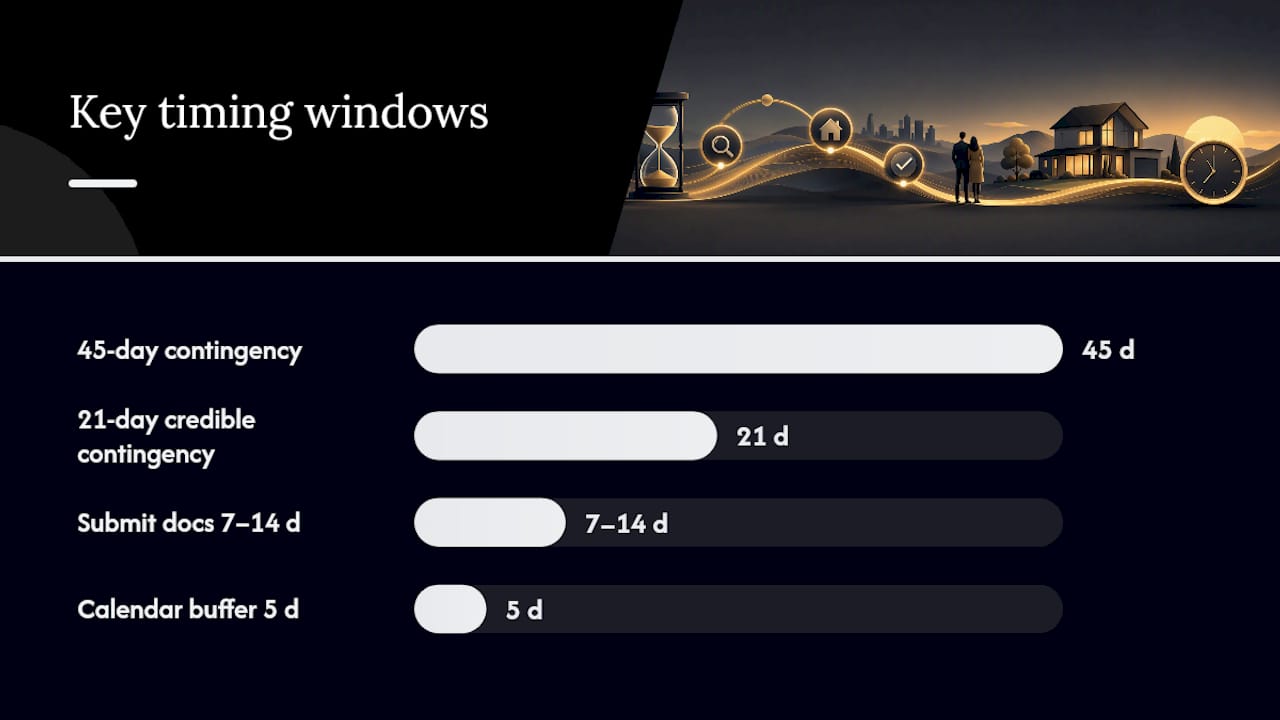
- Shorten the contingency window only if your lender is confident. A 21-day contingency with a lender who's already reviewed your full file is more credible than a 45-day contingency with a lender who's barely started.
- Offer the seller proof of funds for your down payment alongside your preapproval. It signals financial strength without waiving the contingency.
- Request the appraisal immediately after offer acceptance. Appraisal scheduling is often the longest lead-time item in the process.
Pro Tip: In the first 7–14 days after offer acceptance, submit your complete loan application, provide all requested documents to your lender the same day you receive the request, confirm the appraisal is scheduled, and get the contingency deadline in your calendar with a 5-day buffer alert. Most financing failures are documentation failures, not qualification failures.
For a broader look at contract mistakes buyers make, this buyer's guide on things to avoid covers common missteps that can undermine your contingency protections.
How do other contingencies interact with a loan contingency?
A loan contingency rarely stands alone in a purchase contract. Understanding how it overlaps with other contingencies helps you avoid gaps in protection.
| Contingency Type | What It Covers | Interaction with Loan Contingency |
|---|---|---|
| Appraisal contingency | Lets buyer exit or renegotiate if appraised value falls below purchase price | Overlaps: a low appraisal can reduce lender approval amount, triggering both clauses |
| Inspection contingency | Lets buyer exit or request repairs based on physical condition of the property | Independent: protects buyer from physical defects, not financing issues |
| Sale-of-home contingency | Lets buyer exit if they can't sell their current home in time | Interacts: if sale proceeds fund the down payment, a failed sale can also kill financing |
A few practical notes on sequencing:
- An appraisal contingency and a loan contingency often need to be satisfied together. If the appraisal comes in low and the lender reduces the loan amount below your contract minimum, both clauses may apply. Make sure your contract is clear about which one governs.
- An inspection contingency is independent of financing. Even if your loan is approved, you can still exit on inspection grounds (within the inspection period). These timelines often run simultaneously, so track both deadlines separately.
- A sale-of-home contingency adds complexity when your down payment depends on closing your current property. If that sale falls through, your financing may also collapse, and you'll want both contingencies in place.
For a full breakdown of how these clauses fit into the broader purchase contract, the buyer's contingencies guide covers each type in detail.
How a buyer's agent helps you manage the loan contingency
An experienced buyer's agent doesn't just write the contingency into the contract and move on. They actively manage the timeline, coordinate with your lender, and protect you from deadline errors that can be expensive.
Agent contingency checklist:
- Confirm preapproval is in hand before submitting the offer
- Write the contingency clause with specific loan type, amount, rate cap, and deadline
- Coordinate appraisal scheduling immediately after offer acceptance
- Track the underwriting timeline and flag any documentation delays to the lender
- Request a written extension addendum if underwriting is running close to the deadline
- Collect the lender commitment letter and confirm it meets the contract's stated terms
- File any extension or termination paperwork before the deadline, not after
Here's the kind of clause language a good agent often proposes for San Diego transactions:
In San Diego specifically, underwriting timelines can stretch longer than buyers expect, particularly for jumbo loans (which are common given local price points) and FHA loans on condos requiring project approval. A 30-day contingency window that works fine for a conventional loan on a single-family home may be too tight for a jumbo or FHA condo purchase. Local agents who work these transactions regularly know which lenders move faster and can help you set a realistic deadline.
Pro Tip: Ask your lender directly: "What's the realistic timeline from application to commitment letter for this loan type?" Then add 5 days to that number when negotiating your contingency deadline. Padding the deadline costs you nothing and protects you from a documentation delay that's almost always outside your control.
The trade-off most buyers get wrong
Most buyers treat the loan contingency as a binary choice: keep it and look cautious, or waive it and look strong. That framing misses the real leverage point.
The contingency's value isn't just that it lets you exit. It's that it forces you to structure your financing properly before you're under contract. Buyers who get fully underwritten preapprovals, lock rates, and submit complete documentation on day one rarely need to invoke the contingency at all. They keep it as insurance while behaving like buyers who don't need it.
The red flags to watch for: a lender who won't give you a realistic commitment timeline, a contract with a contingency deadline shorter than your lender's stated processing time, or an agent who suggests waiving the contingency without first confirming your underwriting is essentially complete. Any of those situations deserves a hard conversation before you sign.
Ask your agent and lender these three questions before every offer: How long will underwriting realistically take? Is the contingency deadline achievable? And what documentation do I need to preserve my earnest money if financing falls through?
Buying a home in San Diego? Work with someone who knows the contract
Navigating loan contingencies in San Diego's market requires more than a template clause. Jeffsellssandiego provides full buyer representation, including contract review, contingency negotiation, and lender coordination, specifically for buyers purchasing residential property in San Diego County.

Whether you're making your first offer or your fifth, having an agent who tracks contingency deadlines, pushes lenders for timely commitments, and knows when to request an extension (and how to write one that holds) is the difference between a protected transaction and an expensive mistake. Start your San Diego home search or reach out directly to discuss your financing situation and how to structure your next offer.
Sources
- What is a mortgage contingency? | Rocket Mortgage
- Mortgage Contingency: What is & How Does it Work? | Chase
- What Is Financing Contingency on a Home Purchase? | Zillow
- What Is a Mortgage Contingency? Why It’s Important | SoFi
- Understanding Loan Contingencies in Real Estate Transactions | Credible
This article provides general educational information about loan contingencies in U.S. real estate transactions. It is not legal or financial advice. Confirm current contract requirements and loan program rules with a licensed real estate attorney, your lender, or a qualified real estate professional in your state.
This article is general information, not a substitute for advice from a qualified financial advisor. Consult a qualified financial professional about your own circumstances before acting on anything here.