
Missing one word in a real estate contract can cost you thousands. In San Diego's competitive housing market, that's not an exaggeration. Terms like "contingency removal," "lis pendens," and "CC&Rs" appear routinely in offers and disclosures, yet many buyers and sellers skip past them without a second look. This guide cuts through the confusion by giving you plain-English definitions, local context, and practical examples for the terminology you'll actually encounter when buying or selling a home in San Diego. Think of it as your personal translation guide for one of California's most complex real estate markets.
Table of Contents
- Why local terminology matters in San Diego real estate
- Essential San Diego real estate terms explained
- Making sense of contingencies, escrow, and deadlines
- Unusual and overlooked terminology: What catches San Diego buyers and sellers off guard
- The real risk: Why you can't skim over real estate lingo in San Diego
- Get expert help with San Diego real estate language
- Frequently asked questions
Key Takeaways
| Point | Details |
|---|---|
| Know local terms | Understanding San Diego’s unique real estate language helps you avoid costly mistakes. |
| Contingencies carry risk | Missing a contingency deadline can jeopardize deposits or your ability to cancel a contract. |
| Use trusted resources | Always check unfamiliar terms with county legal info or reliable guides before signing. |
| Ask for clarity | Never hesitate to ask agents or attorneys for plain-language explanations of complex terminology. |
Why local terminology matters in San Diego real estate
San Diego real estate moves fast. A well-priced home in neighborhoods like Mission Hills or North Park can attract multiple offers within 48 hours. In that environment, knowing your terminology isn't just helpful. It's the difference between winning a deal on your terms and losing a home you love because of a misread clause.
Every offer you write or receive is a legal document. The words in that document carry specific legal weight, and California real estate law is not forgiving of vague interpretations. When your agent says "we need to release the contingency by Friday," that isn't casual conversation. That's a contractual deadline with real financial consequences.
Here are the key market context words you'll hear constantly in San Diego:
- List price: The asking price set by the seller. In San Diego, homes frequently sell above list price during low-inventory periods.
- Inventory/active listings: The number of homes currently for sale. Low inventory gives sellers more leverage; high inventory favors buyers.
- Days on market (DOM): How long a home has been listed. A high DOM often signals room to negotiate.
- Buyer leverage vs. seller leverage: Who holds the stronger negotiating position based on market conditions.
Understanding these terms helps you read the room. San Diego's market trends shift by season and by neighborhood, and real estate market trends in San Diego show that inventory levels, list prices, and days on market all directly shape how much power you have at the negotiating table.
"Knowing the language of the market isn't just for agents. Buyers and sellers who understand these terms make faster, more confident decisions and rarely get blindsided by paperwork."
The financial stakes are enormous. The median home price in San Diego regularly exceeds $800,000. Even a 1% miscalculation or misunderstanding of terms can translate to $8,000 or more. That's not fine print. That's a family vacation, a car payment, or a year of college tuition. If you're exploring different San Diego neighborhoods and weighing your options, understanding the local language gives you a sharper edge in every conversation you have with a seller, agent, or lender.
Essential San Diego real estate terms explained
Let's get specific. The following terms appear in nearly every San Diego purchase contract. Read through these carefully, because each one has a job to do in protecting you or the other party.
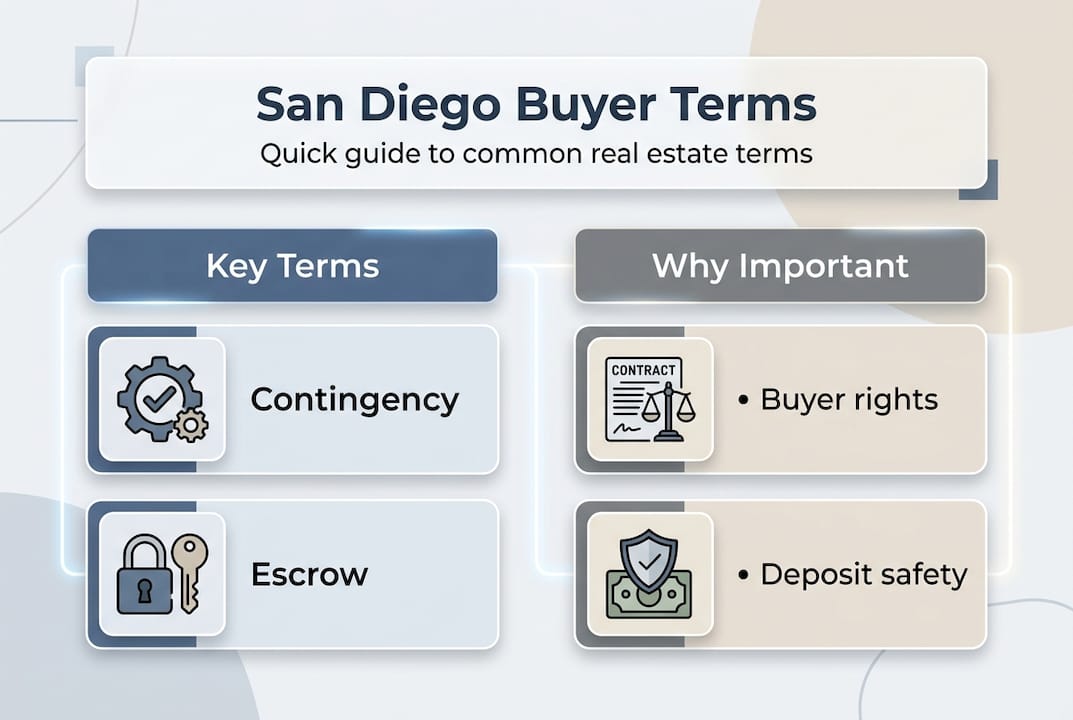
Contingency: A condition in the contract that must be satisfied before the sale can close. Common contingencies include loan approval, home inspection results, and appraisal value. If a contingency isn't met, the buyer can typically cancel without penalty. Contingency removal deadlines are particularly critical in California, because missing them can eliminate your right to cancel.
Escrow: A neutral third party holds funds and documents during the transaction until all conditions are met. In San Diego, escrow companies handle the safe transfer of your deposit, loan funds, and title.

Earnest money deposit (EMD): Cash you put down shortly after an offer is accepted, typically 1% to 3% of the purchase price in San Diego. This signals to the seller that you're serious. It goes into escrow and can be at risk if you back out without a valid contingency.
Appraisal: A licensed appraiser evaluates the home's market value for the lender. If the home appraises below the purchase price, you may need to renegotiate or pay the difference in cash.
Home inspection: A licensed inspector reviews the home's physical condition. This creates an opportunity for you to request repairs or credits from the seller, or to cancel if the findings are serious enough.
Offer: Your formal written proposal to purchase the home at a specific price and terms.
Counteroffer: The seller's response to your offer, proposing different terms. This starts a negotiation back and forth until both parties agree or walk away.
Here's a quick reference table to keep these straight:
| Term | What it means | Why it matters |
|---|---|---|
| Contingency | A condition that must be met | Protects your right to cancel |
| Escrow | Neutral third party holding funds | Ensures safe transfer of money |
| Earnest money deposit | Upfront deposit showing commitment | Can be forfeited if you cancel improperly |
| Appraisal | Professional home value estimate | Protects lenders and buyers from overpaying |
| Home inspection | Physical condition review | Reveals hidden issues before closing |
| Counteroffer | Seller's response to your offer | Opens negotiation |
Whether you're deciding between a condo or house in Pacific Beach or exploring downtown San Diego real estate, these terms will appear in your paperwork. You should also review closing costs carefully, because they involve several of these same concepts.
Pro Tip: California's residential purchase agreement (RPA) sets specific default timelines for contingency removal. If you don't actively cancel a contingency in writing by the deadline, the seller can issue a notice to perform, which starts a countdown that could force you to remove contingencies or cancel the deal entirely.
Making sense of contingencies, escrow, and deadlines
Now let's slow down on the three terms that carry the most risk: contingencies, escrow, and deadlines. These are where real money gets lost.
Contingencies in California contracts are not casual promises. They are formal contractual conditions protected under California Civil Code § 1436. The most common ones in San Diego transactions are:
- Loan contingency: Protects you if your financing falls through. This gives you a set number of days (usually 21) to secure final loan approval.
- Appraisal contingency: If the home appraises low, this gives you the right to renegotiate the price or walk away without losing your deposit.
- Inspection contingency: Lets you review the home's physical condition and either accept it, request repairs, or cancel the contract.
- Title contingency: Ensures the seller can deliver clear title to the property without hidden liens or ownership disputes.
In California, contingency deadlines are not flexible. Once the deadline passes, the contingency is typically considered active but can be triggered by a seller's notice to perform. If you miss the written removal step, you may not be able to cancel without penalty.
Escrow works as a kind of holding pen for your transaction. Once you open escrow, the clock starts. Your earnest money deposit goes in, your lender orders the appraisal, and the title company begins its work. Buyers near Point Loma and similar neighborhoods should understand that closing in Point Loma typically takes 30 to 45 days from accepted offer to funded sale.
Here's a comparison of what can happen depending on whether you meet or miss key deadlines:
| Scenario | Buyer risk | Seller risk |
|---|---|---|
| Meet all contingency deadlines | Sale moves forward smoothly | Confidence the deal will close |
| Miss loan contingency deadline | May lose EMD if loan fails | Uncertainty about deal viability |
| Miss inspection deadline | Less leverage to negotiate repairs | Reduced liability for disclosed issues |
| Miss appraisal deadline | Stuck paying above appraised value | Buyer may challenge price anyway |
Pro Tip: Keep a physical or digital calendar specifically for your contract deadlines. Write each date down the day your offer is accepted. Don't rely on your agent to remind you of every deadline. Treat these dates the way you'd treat a court appearance.
Unusual and overlooked terminology: What catches San Diego buyers and sellers off guard
Standard terms are one thing. The following terminology tends to appear in disclosures, title reports, and legal documents, and it catches people completely off guard.
- Alienation clause: A mortgage provision requiring the loan to be paid in full if the property is sold or transferred. This prevents you from simply passing a mortgage to a new buyer without lender approval.
- Lis pendens: Latin for "lawsuit pending." If you see this on a title report, it means the property is involved in active litigation. That is a serious red flag that requires legal review before you proceed.
- CC&Rs (Covenants, Conditions, and Restrictions): Rules governing what you can and can't do with your property in a planned community or HOA. San Diego has hundreds of HOA communities, and CC&Rs can restrict everything from paint colors to parking.
- Easement: A legal right for someone else to use a portion of your property, often for utility access or shared driveways.
- Subordination clause: A provision in a mortgage that places the lender's claim below another lender in priority. This comes up during refinancing or when multiple loans are involved.
- Quitclaim deed: A document that transfers one party's interest in a property to another without guaranteeing that the interest is valid or clear.
A County of San Diego legal resource specifically addresses real estate terminology for homebuyers, pointing readers toward established legal dictionary resources for terms like these. Don't skip that step.
"Never sign a document with a term you don't recognize. Your agent is there to help you understand the paperwork, not just fill it out."
If you're navigating something more layered, like selling an inherited home in San Diego, the legal language becomes even more technical. Terms like "probate sale," "affidavit of heirship," and "administrator's deed" will enter the picture, and each one has specific legal implications.
The best strategy when you see unfamiliar language: stop. Write it down. Ask your agent, and if the answer isn't fully satisfying, ask a real estate attorney. California offers many resources for low-cost legal consultations, and a 30-minute call can save you from a very expensive mistake.
The real risk: Why you can't skim over real estate lingo in San Diego
Here's the truth most articles won't say plainly: the majority of buyers and sellers who lose money in real estate do so not because of the market, but because of paperwork they didn't fully read.
I've seen buyers lose their full earnest money deposit, sometimes $15,000 or more, because they didn't understand that failing to submit a written contingency removal by the deadline meant they were locked in. I've seen sellers accept offers without understanding what "subject to appraisal" actually means for their bottom line.
Real estate paperwork is not just administrative. It is a negotiation tool. Every clause in a California purchase contract can be adjusted, removed, or strengthened, but only if you know it's there and know what it means. Even experienced investors and agents regularly consult legal dictionaries and real estate attorneys when unusual language appears.
The uncomfortable truth is that "I didn't understand it" is not a legal defense in a contract dispute. Your signature on that document is your agreement to all of it. So ask questions. Demand plain-language explanations. Explore your neighborhood options with full knowledge of what the contracts there typically look like. Knowledge is the only protection that works in every market condition.
Get expert help with San Diego real estate language
Understanding real estate terminology is the first step. Applying it correctly in a live transaction is where expert guidance makes all the difference.

Whether you're a first-time buyer trying to decode your first offer or a seller reviewing a counteroffer full of unfamiliar clauses, having a knowledgeable agent by your side changes everything. Browse San Diego home listings to see what's currently on the market, and get prepared before you ever step into an offer situation. The San Diego Buyer's Guide and San Diego Seller's Guide both walk you through the process step by step, in plain language, with local context. Reach out when you're ready to stop guessing and start making confident decisions.
Frequently asked questions
What does 'contingency' really mean in a San Diego home offer?
A contingency is a condition in the contract that must be met before the sale moves forward, such as passing inspection or securing a loan. Under California law, contingency deadlines must be tracked carefully, because missing them can eliminate your right to cancel without losing your deposit.
Where can I find definitions for unusual real estate terms in San Diego contracts?
County legal resources and legal dictionaries are excellent places to find clear definitions for uncommon terms in real estate documents. The County of San Diego legal resource specifically covers homebuyer terminology and points to additional legal reference tools.
What local market terms should I know before buying or selling in San Diego?
You should know list price, inventory, days on market, and leverage, since these terms greatly impact pricing and negotiations. San Diego market data shows that inventory levels and days on market shift regularly, making these terms essential for reading any local deal.
What happens if I miss a contingency or escrow deadline?
Missing important deadlines can result in losing your deposit or being unable to back out of a deal without penalty. California's purchase contract is strict on this point, and missing contingency removal in writing can leave you legally committed to a transaction you wanted to exit.