
Yes, assumable FHA and VA mortgages exist in San Diego, and they can let a buyer step into a seller's low rate from the 2019 to 2022 lending window. The catch is the equity gap, between the home's current value and the outstanding loan balance, plus a loan servicer that has to approve you before the deal closes. Both are solvable, but neither is optional.
TL;DR:
- Assumable FHA and VA loans in San Diego are mostly tied to loans originated during the 2019-2022 low-rate period, often with rates around 2.75%.
- Locating assumable listings requires searching MLS remarks for keywords or using specialized platforms, as standard filters do not flag these opportunities.
- Servicer approval, not seller consent, determines if the assumption can proceed, with credit, income, and occupancy standards rigorously applied.
- Bridging the equity gap between the home's sale price and the remaining loan balance often involves cash, second mortgages, or seller financing, with blended costs typically lower than new loans.
- A skilled agent with market experience can significantly speed up assumption approval, navigate servicer relationships, and help manage timelines and contingencies.
Table of Contents
- What Makes a Mortgage "Assumable" in San Diego Real Estate Financing?
- Where To Find Assumable Listings in San Diego
- How FHA and VA Assumptions Actually Work
- Qualification, Process Steps, Timeline, and Typical Costs
- Equity-Gap Strategies: Bridging the Difference
- San Diego Neighborhoods With the Most Assumable Inventory
- Tax Implications and Potential Benefits of Mortgage Assumption
- Benefits and Risks: Assuming a Mortgage vs. Getting a New One
- How Credit Scores and Financial Qualifications Affect Approval
- Common Mistakes Buyers Make During an Assumption
- Why an Experienced Agent Matters in an Assumable Deal
- Agent Perspective: Why a San Diego Buyer's Agent Speeds Assumable Deals
- Ready To Search San Diego's Assumable Listings?
- Sources
- FAQ
What Makes a Mortgage "Assumable" in San Diego Real Estate Financing?
FHA and VA loans are the two mainstream products that carry assumption rights nationwide, San Diego included. Conventional loans, the ones most sellers actually have, almost never allow this because Fannie Mae and Freddie Mac contracts trigger a "due on sale" clause that forces payoff at closing. USDA loans are technically assumable too, but they're rare in urban San Diego County, so FHA and VA are where the real opportunity sits.
That distinction matters for how you search. If a listing agent doesn't flag a loan as FHA or VA in the remarks, don't assume there's anything to assume.
Where To Find Assumable Listings in San Diego
Standard MLS filters weren't built for this. There's no checkbox for "assumable loan," so most buyers and even some agents scroll right past listings that qualify. You have to hunt for it in the remarks section, where an agent might write "VA assumable loan, 2.75%" or "buyer to qualify for FHA assumption." Sellers who know their loan is assumable and want to advertise the perk usually say so explicitly because it's a selling point.
A few tactics work better than brute-force scrolling:
- Search MLS remarks directly for terms like "assumable," "assume," or specific rate figures, since agents often lead with the rate to grab attention.
- Use specialist feeds built specifically for this. AssumeList aggregates San Diego assumable listings and connects buyers to gap-financing resources, which saves hours of manual searching.
- Work with an agent who actively tracks assumable originations rather than one who's never closed one, since they'll recognize loan patterns other agents miss.
- Watch for red flags in listing language, like "assumable subject to lender approval" with no rate mentioned, which sometimes signals the seller hasn't actually confirmed eligibility with their servicer yet.
Listings that mention a loan number, servicer name, or specific origination year are usually the most reliable signal that the seller has already done homework on their own assumability.
How FHA and VA Assumptions Actually Work
FHA and VA loans are legally assumable under federal guidelines, which means the loan itself, along with its interest rate and remaining term, transfers to a qualified buyer instead of getting paid off. That's the whole appeal. A seller with a 2.75% VA rate from 2021 can pass that rate to you instead of forcing a fresh loan at today's market rate.
But "legally assumable" doesn't mean automatic. The loan servicer, not the seller, decides whether you qualify, and they run essentially the same underwriting they'd run on a new loan:
- Credit score review against FHA or VA minimums.
- Income verification and debt-to-income ratio calculation.
- Confirmation that you meet occupancy requirements, particularly for VA loans.
Servicer approval is not a formality. HUD's Single Family Housing Policy Handbook spells out the documentation and creditworthiness standards servicers must apply before releasing an FHA seller from liability, and VA servicers follow a parallel process detailed in VA Form 26-6381.
VA loans carry an extra wrinkle worth understanding before you get attached to a property. If a non-veteran buyer assumes a VA loan, the seller's VA entitlement stays tied to that property until the loan is paid off, refinanced, or the buyer is also a qualifying veteran who substitutes their own entitlement. Some veteran sellers accept that trade for a faster sale or stronger net proceeds; others won't touch it. It's worth confirming a seller's stance on entitlement before you write an offer.

Qualification, Process Steps, Timeline, and Typical Costs
Assuming a mortgage runs on its own timeline, separate from a standard purchase closing, and it pays to know the sequence before you fall in love with a listing.
- Identify a property with a confirmed FHA or VA assumable loan, ideally with the rate and servicer named in the listing.
- Write an offer with an assumption contingency, giving you an exit if the servicer denies approval.
- Submit your application directly to the loan servicer, not the seller, including income docs, credit authorization, and asset statements.
- Provide any additional documentation the servicer requests, which can include verification of employment, tax returns, or explanation letters for credit issues.
- Close once the servicer issues approval, at which point the seller is released from liability and you take over the note.
Timelines vary more than most buyers expect. A well-run servicer can process an assumption in 45 to 60 days, but sluggish ones stretch past 75 days, especially if paperwork gets lost in a servicing department that doesn't handle many assumptions. Faster servicers tend to be ones with dedicated assumption processing teams; slower ones often route requests through general customer service queues that weren't built for this.
Pro Tip: Ask the seller's servicer directly, before you make an offer, how many assumption requests they process monthly. A servicer that handles this regularly will usually quote you a realistic timeline upfront, while one that rarely does it may not even know their own process.
Budget for an assumption fee (often a few hundred dollars, set by the servicer), a new appraisal, title and escrow charges, and, if you're bridging an equity gap, potential costs tied to a second loan or bridge financing.
Equity-Gap Strategies: Bridging the Difference
The equity gap is simply the space between the home's sale price and the remaining balance on the assumable loan. When the home's sale price exceeds the remaining balance on the assumable loan, buyers must cover the difference through cash, financing, or seller cooperation before the deal can close.
A few common ways buyers close that gap:
- Cash payment. Cleanest option, but obviously limited to buyers with substantial liquid savings.
- Second mortgage or HELOC. Covers the gap but adds a second payment at current market rates, which can erode some of the savings from the low first-lien rate.
- Seller carryback financing. The seller finances part of the gap directly, sometimes at a negotiated rate, which can work well when a seller wants a faster close.
- Blended negotiation. Buyers ask for seller concessions or price adjustments to shrink the gap itself rather than financing all of it.
Here's where the math gets interesting. When blending the assumable loan rate with financing on the equity gap at current market rates, the overall blended cost is usually still below what a completely new conventional loan at today's rates would cost. Local reporting on San Diego assumable deals confirms buyers are actively running this exact math to justify the extra paperwork.
Negotiation matters as much as the financing structure. Sellers eager to close quickly sometimes agree to price reductions or concessions specifically to make the gap easier to finance, since a deal that falls apart over gap financing costs them time and money too.
San Diego Neighborhoods With the Most Assumable Inventory
Military concentration drives assumable supply more than any other factor in this county. Analysis of San Diego's assumable market points to a structural pattern: a large share of local VA loan originations happened during the 2019 to 2022 low-rate window, when active-duty buyers were purchasing at scale, and those loans are now surfacing as inventory as owners get reassigned.
Corridors worth prioritizing in your search:
- Chula Vista, close to naval and border-area commands, with a steady flow of VA-originated homes.
- Oceanside and Vista, near Camp Pendleton, where PCS-driven turnover creates predictable listing cycles.
- The Miramar corridor, tied to Marine Corps Air Station Miramar.
- Rancho Bernardo and inland East County, where price points made FHA loans more common among first-time buyers during the same rate window.
Coastal neighborhoods like La Jolla or Coronado carry far higher price tags, which widens the equity gap dramatically even when an assumable loan exists. Inland communities keep that gap more manageable, often making them the more realistic hunting ground.
Timing helps too. Military relocation seasons, concentrated in summer months tied to PCS orders, tend to push more assumable listings onto the market at once. An agent who watches those cycles can flag new inventory before it gets bid up.
Tax Implications and Potential Benefits of Mortgage Assumption
Assuming a mortgage doesn't trigger the same tax events as a sale in most cases, since you're stepping into an existing loan rather than creating a brand-new financing arrangement. Mortgage interest on the assumed loan remains deductible under the same general rules that apply to any qualified home loan, subject to the usual IRS limits on mortgage interest deduction.
The clearer financial benefit shows up in your monthly cash flow rather than on a tax return. Locking in a rate two to four percentage points below today's market, even blended with gap financing, can mean hundreds of dollars in monthly savings compared to a fresh loan. Over a 30-year term, that gap compounds into real money.
One nuance worth flagging: if you use seller carryback financing to bridge the equity gap, that arrangement can carry its own tax implications for the seller, who may need to report interest income on the carryback note. Buyers generally don't face extra tax exposure from the carryback itself, but it's worth having a tax professional review any seller-financed piece of the deal before you sign, since carryback terms vary and IRS treatment depends on how the note is structured.
None of this replaces professional tax advice specific to your situation, but it's useful context heading into a negotiation.
Benefits and Risks: Assuming a Mortgage vs. Getting a New One
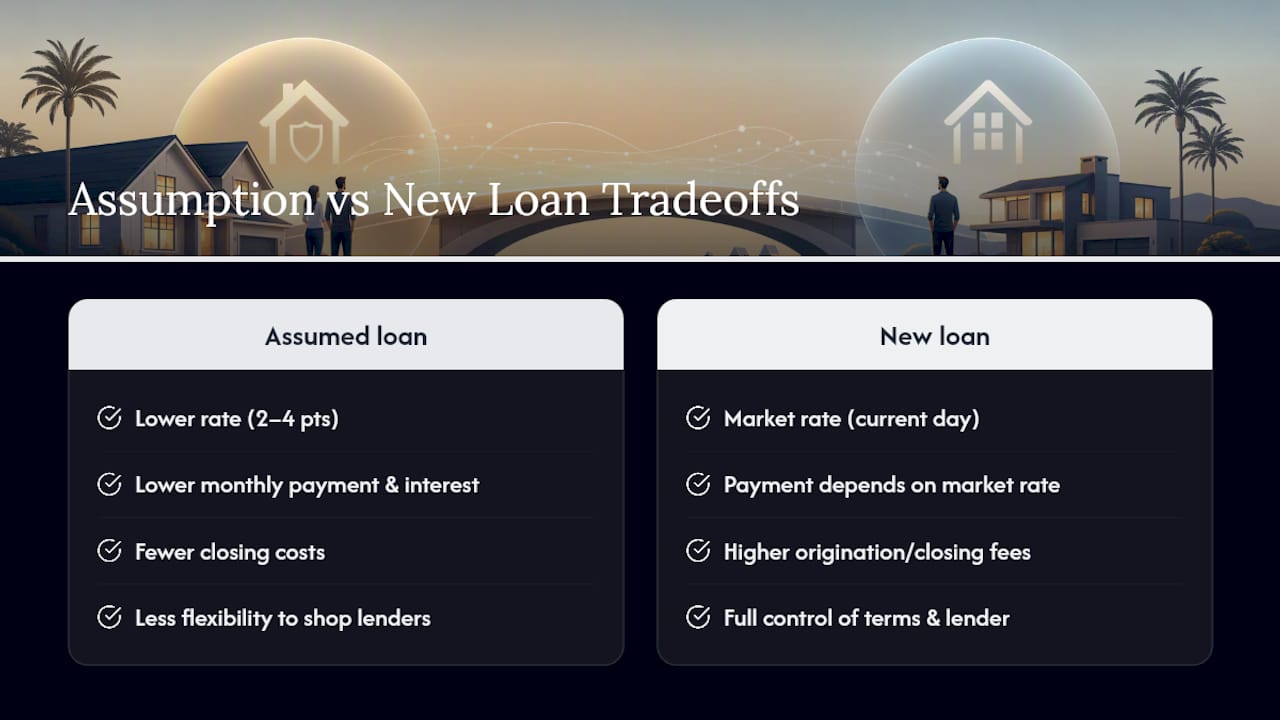
The benefit side is straightforward: you inherit a rate that may be two to four points below today's market, which can translate into a materially lower monthly payment and less interest paid over the life of the loan. You also often face fewer closing costs than a full new-loan origination, since you're not paying many of the fees tied to creating a brand-new mortgage.
The risk side deserves equal attention. You're taking on a loan with terms the original borrower negotiated, not you, which means less flexibility to shop rates or lenders. The servicer approval process can also fall through late in the transaction if your credit or income doesn't meet their standards, and by then you may have spent weeks and some money on inspections or appraisals. There's also the equity-gap financing itself, which, if not planned carefully, can eat into the savings the low rate was supposed to deliver.
A new conventional or FHA/VA loan, by contrast, gives you full control over loan terms, lender choice, and structure, but at whatever rate the market offers that day. For most San Diego buyers weighing this, the decision comes down to a simple question: does the blended cost of an assumption plus gap financing beat a new loan at current rates? Run that math before you fall for a listing's advertised rate alone.
How Credit Scores and Financial Qualifications Affect Approval
Assuming a loan doesn't mean skipping underwriting. The servicer treats you like any new borrower, checking your credit score, income, and debt-to-income ratio against FHA or VA minimums before releasing the seller from liability.
FHA guidelines generally require a credit score in the 580 to 620 range depending on the servicer's own overlays, though some servicers set higher internal thresholds than HUD's baseline. VA assumptions require the buyer to meet the servicer's creditworthiness standards even though VA loans themselves don't have a hard-set minimum credit score at the federal level.
Your debt-to-income ratio matters just as much as your score. If you're financing an equity gap with a second mortgage, that payment gets added into your DTI calculation, which can push some buyers right up against approval limits even when their credit looks solid. Getting pre-qualified for the gap financing before you submit the assumption application avoids a nasty surprise midway through the process.
Common Mistakes Buyers Make During an Assumption
The biggest mistake is assuming the seller's approval or the listing agent's confidence means the servicer will say yes. Only the servicer's underwriting decision counts, and buyers who skip getting pre-qualified before writing an offer sometimes lose weeks discovering they don't meet income or credit standards.
Another frequent error: underestimating the equity gap before falling in love with a property. Buyers sometimes fixate on the advertised low rate without running the blended-cost math against gap financing, only to find the total monthly payment isn't actually much better than a new loan would have been.
Skipping the assumption contingency in the purchase offer is a costly oversight too. Without it, a buyer whose servicer application gets denied can end up losing earnest money or scrambling for last-minute alternative financing. And some buyers wait too long to start the servicer application, not realizing the 45 to 75 day timeline can eat into rate locks or contingency deadlines elsewhere in their contract.
Why an Experienced Agent Matters in an Assumable Deal
Not every agent has closed an assumable transaction, and that experience gap shows up fast once you're in escrow. An agent who's done this before knows which servicers move quickly, how to draft an assumption contingency that actually protects you, and where to source gap financing without starting from scratch.
Brokers who specialize in this niche, including those referenced through services like AssumeList's San Diego listings, often maintain relationships with lenders comfortable underwriting second mortgages against an assumed first lien. That's not a connection most general-practice agents have on hand, and it can shave real time off your closing.
Agent Perspective: Why a San Diego Buyer's Agent Speeds Assumable Deals
Assumable deals live or die on coordination, not paperwork alone. Someone has to keep the servicer, the appraiser, and the gap lender moving on parallel tracks, because a delay in any one of them stalls the whole closing. An agent who's tracked these transactions before knows which servicers answer emails and which ones need a phone call every week to stay on schedule.
The honest gap in this market isn't finding an assumable listing, it's finding someone who can actually get the deal closed once you do. That's the piece most buyers underestimate until they're three weeks into a servicer application wondering why nothing's moving.
— Jeff
Ready To Search San Diego's Assumable Listings?
This search runs differently than a standard MLS scroll. Instead of hoping a listing agent remembered to flag an FHA or VA assumable loan in the remarks, some search processes actively filter for these opportunities and track servicer relationships that tend to move faster on assumption approvals.

That local coordination is the real value here. Drafting an assumption contingency that protects earnest money, introducing clients to lenders who underwrite second mortgages against an assumed first lien, and keeping a servicer application from stalling for weeks all take relationships built over time in this specific market. If you're ready to see what's actually available right now, reach out through Buy With Confidence to start a targeted search built around assumable inventory in San Diego County.
Sources
FHA assumption procedures and servicer requirements come from HUD's Single Family Housing Policy Handbook, while VA-specific entitlement and paperwork rules are detailed in VA circular 26-23-10.
- HUD Single Family Housing Policy Handbook (4000.1)
- VA - Form 26-6381
- Assumable mortgages give homebuyers path to lower interest rates in tough market — 10News
- AssumeList - San Diego listings
This article is general information, not a substitute for advice from a qualified financial advisor. Consult a qualified financial professional about your own circumstances before acting on anything here.
FAQ
Do Banks Still Offer Assumable Mortgages?
Banks don't originate new assumable loans in the way people sometimes assume, but existing FHA and VA loans remain legally assumable by qualified buyers under HUD and VA rules. The bank or servicer's role is reviewing and approving the buyer, not creating a new assumable product.
How Do I Find Assumable Mortgages in My Area?
Search MLS remarks directly for terms like "assumable" or a specific interest rate, since standard filters don't flag this feature. Specialist platforms such as AssumeList aggregate San Diego assumable listings, and working with an agent who tracks assumable originations speeds the search considerably.
What Is the Conforming Loan Limit for 2026 in San Diego?
Conforming loan limits are set annually and vary by county, and current figures are published directly by the Federal Housing Finance Agency each year rather than fixed in this guide. Check with a local lender or the current FHFA release for the exact 2026 figure applicable to San Diego County.
Are Home Prices Dropping in San Diego County?
Pricing trends shift by neighborhood and price tier, with inland communities generally showing more flexibility than coastal areas. A current market analysis from a local agent gives a more accurate read than any single countywide average, since coastal and inland submarkets can move in different directions at the same time.
Can a Non-Veteran Assume a VA Loan in San Diego?
Yes, a non-veteran buyer can assume a VA loan as long as they meet the servicer's income and credit requirements. Doing so leaves the seller's VA entitlement tied to the property until the loan is paid off or refinanced, which is a factor worth discussing directly with the seller before making an offer.