
Most San Diego homebuyers assume the path to a mortgage runs straight through a bank. You walk in, apply, and hope for the best. That assumption costs buyers real money and real time. A mortgage broker sits between you and dozens of lenders, shopping your application, managing paperwork, and keeping the whole process moving. This guide breaks down exactly what a mortgage broker does, how they support you from the first document to closing day, and when you might choose a direct lender instead. If you're buying in San Diego, this is knowledge worth having before you ever sign anything.
Table of Contents
- What does a mortgage broker do?
- Step-by-step: How mortgage brokers help you buy a home
- Special advantages for San Diego homebuyers
- What mortgage brokers can't (always) do
- Should you use a broker or go direct?
- Why workflow and communication matter more than tools
- Start your San Diego home search with expert guidance
- Frequently asked questions
Key Takeaways
| Point | Details |
|---|---|
| Brokers broaden your options | Mortgage brokers shop your application to multiple lenders so you have more loan choices. |
| Personalized guidance | Brokers walk you through paperwork, help with tricky situations, and manage communication so you can focus on finding a home. |
| Know the limitations | Not all lenders work with brokers, and brokers can't always control underwriting decisions. |
| Direct vs broker is personal | Some buyers prefer hands-on control with a lender, while others favor a broker for guidance and convenience. |
| Workflow matters most | Smooth communication and organized process are key to a great mortgage experience—no matter which path you choose. |
What does a mortgage broker do?
A mortgage broker is not a lender. That's the most important distinction to understand before anything else. A broker is an intermediary: a licensed professional who takes your application and submits it to multiple lenders on your behalf. They don't fund the loan themselves. They find who will.
As Experian explains, a mortgage broker acts as an intermediary who shops your application to multiple lenders rather than a single bank, helping you compare loan options and move toward approval. That breadth of access is hard to replicate if you're applying lender by lender on your own.
Here's what a mortgage broker typically handles on your behalf:
- Reviewing your financial profile to identify which lenders are likely to approve you
- Gathering your documents such as pay stubs, tax returns, bank statements, and identification
- Completing the loan application with accuracy, reducing errors that cause delays
- Submitting your file to multiple lenders and tracking responses
- Comparing loan terms, rates, and fees across offers so you see the real cost of each option
- Communicating with underwriters and lenders throughout the process
- Helping you understand loan estimates and walking you through the final disclosure documents
"For homebuyers, a mortgage broker acts as an intermediary who shops your application to multiple lenders (not a single bank), helping you compare loan options and move toward approval." — Experian
This means you submit your documents once. The broker does the shopping. If you've ever tried to get quotes from four different banks in the same week, you know how exhausting that process can be. A broker eliminates that friction immediately.
For buyers interested in financing in neighborhoods like La Jolla, where property prices push well above the county median, understanding how to find the best mortgage rates in La Jolla starts with knowing who to have in your corner.

Step-by-step: How mortgage brokers help you buy a home
The broker's value isn't just theoretical. It plays out in very concrete steps from the moment you start thinking about financing through the day you get your keys.
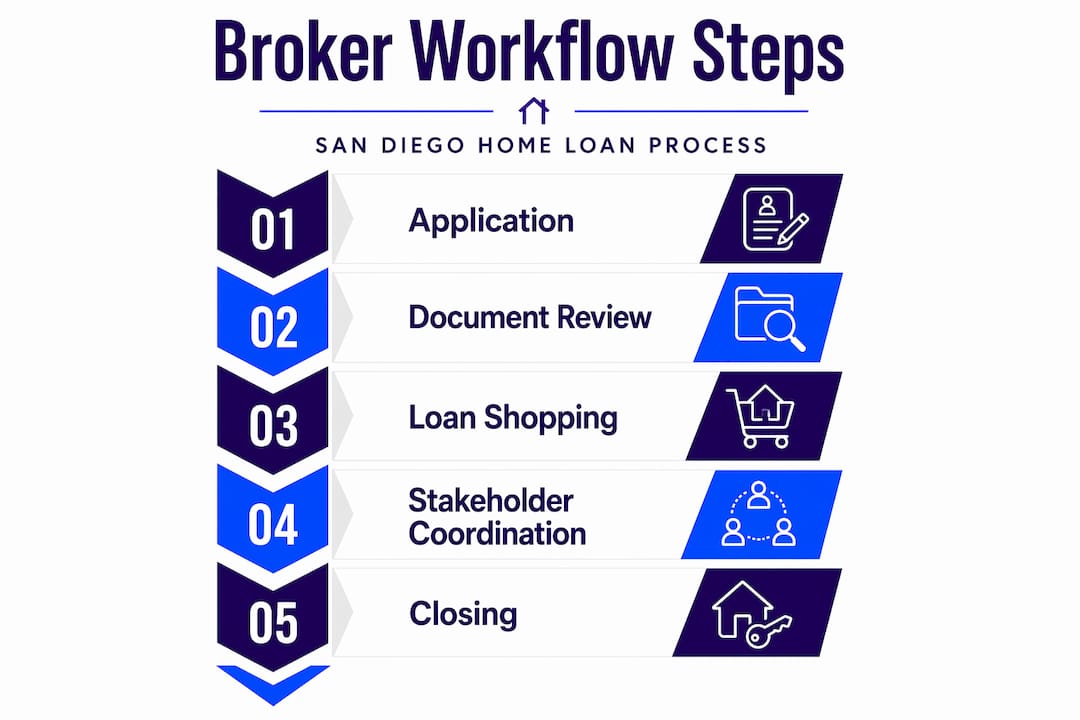
Here's how the process typically works:
- Initial consultation. You meet with the broker and share your financial picture: income, debts, savings, credit score, and your target price range. They assess which loan programs fit your situation.
- Document collection. The broker gives you a checklist and collects everything needed for the application. This step alone is where many buyers get tripped up when going direct.
- Application completion. The broker fills out the loan application with you, catching common mistakes that delay approvals.
- Lender submission. Your file goes out to multiple lenders simultaneously, each evaluating your application against their own criteria.
- Communication management. As Freedom Mortgage notes, a broker's day-to-day methodology includes managing the paperwork flow through underwriting toward closing, so you're not left chasing status updates on your own.
- Condition handling. When a lender asks for additional documents or explanations, the broker handles that back-and-forth rather than putting it on you.
- Loan comparison. Once offers come in, the broker presents them side by side so you can make an informed decision, not just go with the one that sounds good.
- Closing support. The broker coordinates with the title company, escrow, and lender to make sure all documentation is in order before your closing date.
According to Chase, brokers coordinate across stakeholders after the application is submitted, keeping the file moving through updates, follow-ups, and condition handling rather than leaving the borrower to manage each lender touchpoint.
| Stage | With a broker | Without a broker |
|---|---|---|
| Document submission | Once, to the broker | Separately, to each lender |
| Lender comparison | Broker handles it | Buyer shops individually |
| Underwriting follow-up | Broker manages it | Buyer contacts lenders directly |
| Time to approval | Typically streamlined | Varies, often longer |
| Condition response | Coordinated by broker | Managed by buyer |
Pro Tip: In San Diego, the most common documentation bottlenecks involve self-employment income verification and large unexplained deposits in bank statements. A broker who knows the local market will flag these issues before submitting your file, giving you time to prepare a paper trail that satisfies underwriters upfront.
Knowing how to reduce unnecessary expenses is also important. Pairing your broker's guidance with a clear understanding of saving on closing costs can make a meaningful difference in what you pay at the table. If you want a full picture of the buying journey, the step-by-step buyer's guide is a practical place to start.
Special advantages for San Diego homebuyers
San Diego is not a typical real estate market. Home prices here regularly exceed $900,000, military relocation is common, and a large number of buyers are self-employed or work in non-traditional income situations. These factors make the broker model particularly valuable here.
As Bankrate points out, mortgage brokers can differentiate in complex borrower situations such as first-time buyers, unusual income, or atypical files by matching the file to lenders with differing criteria and submitting multiple applications on the borrower's behalf.
| Loan situation | Direct lender | Mortgage broker |
|---|---|---|
| Standard W-2 income, 700+ credit | Strong fit | Strong fit |
| Self-employed income (2+ years) | May decline | Can find niche lenders |
| First-time buyer, limited savings | Limited programs | Access to more programs |
| Military relocation, short timeline | Possible delays | Broker familiar with VA loans |
| High loan amount (jumbo loans) | Narrow options | Wider panel access |
| Recent credit event | Often declined | Can target specialty lenders |
San Diego buyers face some specific circumstances that make broker access especially useful:
- High property prices mean jumbo loans are common, and not all lenders offer competitive jumbo products
- Military and VA buyers often need brokers who understand the full VA loan process, including entitlement restoration after prior use
- Self-employed professionals and small business owners need lenders that accept bank statement loans or alternative income documentation
- Frequent relocations from military assignments mean buyers may be purchasing from out of state, which brokers can help coordinate remotely
- First-time buyers benefit from brokers who can identify down payment assistance programs specific to California or San Diego County
Understanding top mortgage rate strategies alongside working with a broker gives buyers the best overall position in a high-cost market like San Diego. For those arriving on military orders, there's also solid military relocation advice worth reading before you start the process.
What mortgage brokers can't (always) do
No tool is perfect. Brokers add real value in many situations, but there are limitations worth knowing before you commit to that approach.
As Which? reports, because brokers may serve as a middleman in some edge cases, limitations can include not being able to access certain lenders or products depending on their panel, and brokered files may be less controllable at the underwriting stage.
Common limitations include:
- Not all lenders work with brokers. Some large banks and credit unions offer products only through direct channels, meaning a broker may miss those options
- Broker compensation can vary. Some brokers are paid by the lender (through a yield spread premium), which could theoretically influence which products they recommend
- Less direct underwriting control. A broker submits your file but can't always push it forward the same way an in-house loan officer can at a direct lender
- Panel limitations. Smaller broker operations may not have relationships with every lender, reducing your actual selection
- Communication gaps. If a broker is managing many clients at once, your file may not get the attention it needs at critical moments
A 2026 Boon Brokers study found that 78% of borrowers reported satisfaction with broker efficiency, which is strong but not unanimous. That other 22% matters, and it usually comes down to communication and process management.
According to Garris Horn LLP, compensation structure and broker licensing compliance matter significantly for consumer protection, making it essential to verify your broker is legitimate before you hand over personal financial documents.
Pro Tip: In California, all mortgage brokers must be licensed through the Department of Financial Protection and Innovation (DFPI). You can verify a broker's license in seconds at the DFPI website. Always check before signing any agreement. A licensed broker is accountable under California law in ways an unlicensed one is not. Also look for NMLS registration, which is the national licensing system used by all legitimate mortgage originators. When getting the lowest rate is your goal, working only with verified professionals protects you throughout the process.
Should you use a broker or go direct?
This is an honest question, and there's no single right answer. Your decision depends on your financial situation, your comfort with paperwork, and how much you want to be involved in the process.
According to Chase, some borrowers prefer the hands-on control and fewer handoffs of direct lending channels, while others prioritize breadth of options and advice, noting that brokers are optional depending on how hands-on the buyer wants to be.
Reasons to work with a broker:
- You want one point of contact who shops multiple lenders for you
- Your income or credit situation is non-standard
- You don't have time to manage lender communications yourself
- You're new to the homebuying process and want guided support
- You want access to a wide range of loan types and programs
Reasons to go direct:
- You already have a strong relationship with a bank or credit union
- You're refinancing a loan you already have with that lender
- You want complete transparency at every underwriting step
- You're in a time-sensitive situation where fewer handoffs matter
- The lender you want doesn't work through brokers
Some buyers take a blended approach: they consult a broker first to understand what's available across the market, then contact one or two direct lenders to compare. That approach takes more time but gives you a fuller picture before committing. It's especially useful in San Diego, where loan amounts and property types vary significantly by neighborhood.
Exploring the San Diego real estate neighborhood guide can help you understand how neighborhood characteristics, price ranges, and property types influence your financing decisions before you even start the mortgage process.
Why workflow and communication matter more than tools
Here's an opinion you don't hear often enough: the choice between a broker and a direct lender matters far less than how well either one communicates with you.
The real friction in homebuying is not rate shopping. It's paperwork confusion, missed deadlines, unanswered emails, and not knowing where your file is in the process. Buyers lose sleep over those things, not over a quarter-point rate difference.
As SD Loans notes, a broker's most concrete contribution is workflow reduction for buyers: one coordinated application and document packet, lender shopping, and ongoing communication so the buyer can focus on property decisions while the broker manages submission and conditions.
That's the real value. A broker who returns calls the same day, explains every document request in plain English, and proactively tells you what's happening next is worth more than a broker who has 40 lenders on their panel but leaves you wondering for three weeks what's going on with your file.
When you're evaluating a broker or a direct lender, ask these questions directly: How often will you update me? Who is my point of contact? What happens if something goes wrong with my file? The answers tell you everything about whether that professional will reduce your stress or add to it.
The San Diego buyer's guide is a good starting point for understanding the full picture of what you're navigating, so you can ask better questions when you sit down with a mortgage professional.
Start your San Diego home search with expert guidance
Finding the right home in San Diego is challenging enough without navigating the financing process alone.

Working with a local real estate agent who understands San Diego neighborhoods and can connect you with reputable, licensed mortgage professionals gives you a real advantage. Whether you're a first-time buyer or moving within the county, starting with the right team makes the entire experience smoother. Explore homes in San Diego to browse listings by neighborhood, get a feel for current pricing, and connect with guidance built around buyers just like you. Local knowledge and the right lending team together are what turn a stressful search into a successful purchase.
Frequently asked questions
What's the difference between a mortgage broker and a direct lender?
A mortgage broker shops your application to multiple lenders, while a direct lender uses only their own in-house products. Brokers give you access to more options; direct lenders give you a single, controlled pipeline.
Is a mortgage broker required for buying a home in San Diego?
No, using a broker is optional. As Chase notes, brokers are optional depending on how hands-on the buyer wants to be, and some buyers prefer going directly to a lender they already know.
Do mortgage brokers charge extra fees?
Brokers may charge origination fees, but these must be disclosed upfront before you sign. As Garris Horn LLP highlights, compensation structure and licensing both matter, so always review the Loan Estimate carefully and confirm your broker is properly licensed in California.
Can a mortgage broker guarantee I'll get the best possible rate?
A broker shops your application to multiple lenders, but they can't guarantee the absolute lowest rate because not all lenders work with brokers. As Which? explains, brokers may not access every mortgage available on the market depending on their lender panel.
How long does the mortgage process take with a broker?
Timing varies by your situation and the lender, but 78% of borrowers reported satisfaction with broker efficiency in a 2026 UK study, with 43% reporting the process took 15 to 30 days from application to approval.