
In most San Diego home purchases, escrow fees are split roughly 50/50 between buyer and seller, with each party typically budgeting somewhere between $800 and $1,800 depending on the sale price and the escrow company chosen. That said, the purchase agreement controls the final split, not local custom.
A few things to know before you go further:
- The 50/50 split is a convention, not a law. California has no statute that fixes escrow fee amounts; the purchase contract and escrow instructions determine who pays what.
- On a $600,000 home, each party's escrow fee commonly runs $1,200–$1,500, though add-on charges (wire fees, courier, mobile notary) can push the total higher.
- Refinances work differently: the borrower typically covers the full escrow fee, not half.
The single most useful thing you can do at the start of any transaction is ask the escrow officer for a preliminary, itemized net sheet. That document shows every line item before you're committed to the numbers.
Key Takeaways
| Point | Details |
|---|---|
| Who pays escrow fees | Buyer and seller typically split the fee equally, but the purchase contract determines the actual split. |
| Typical fee range | Each party commonly budgets a few hundred to a couple thousand dollars depending on sale price and escrow provider. |
| Total buyer closing costs | Expect roughly 2%–4% of the purchase price; on a $600,000 home, that's $12,000–$24,000. |
| Get a net sheet early | Request an itemized preliminary net sheet when escrow opens to avoid last-minute surprises. |
| Jeffsellssandiego | Prepares net sheets and negotiates closing-cost splits for San Diego buyers and sellers before contract. |
Table of Contents
- What does an escrow fee actually cover?
- How are escrow fees calculated in San Diego?
- Who usually pays escrow fees in San Diego?
- How do escrow fees fit into total San Diego closing costs?
- When does escrow open, and when do fees get paid?
- San Diego-specific closing items to watch
- How to get an itemized estimate and lower your closing costs
- How to pick an escrow company in San Diego
- A note on how these figures were estimated
- What I've seen work in San Diego closings
- Ready to budget your San Diego closing costs with a local expert?
- Sources
What does an escrow fee actually cover?
Escrow is the neutral third party that holds funds and documents while a sale moves from accepted offer to recorded deed. The escrow officer's core job covers four things: holding the buyer's earnest money and down payment, coordinating loan documents with the lender, disbursing funds to the seller and paying off any liens, and sending the deed to the county recorder.
The base settlement fee pays for that coordination work. What it usually includes:
- Handling and disbursement of funds
- Preparation and review of escrow instructions
- Coordination with the lender, title company, and agents
- Basic document management through closing
What it typically does not include are pass-through charges billed separately. These add-ons can increase the final invoice and are sometimes negotiable:
- Recording fees (paid to the county)
- Wire transfer fees ($25–$50 per wire is common)
- Courier or overnight delivery charges
- Mobile notary fees if you sign away from the escrow office
- Notary acknowledgment fees
Pro Tip: Ask the escrow officer to send you a sample closing statement or net sheet before you open escrow. Seeing the line items in advance tells you exactly which charges are bundled into the base fee and which will appear as separate pass-throughs.
How are escrow fees calculated in San Diego?
Two pricing models dominate the local market. The first is a per-$1,000 sliding scale: the escrow company charges a base rate (often around $2.00–$3.00 per $1,000 of sale price) plus a flat base fee. The second is a flat or flat-plus model where the company sets a fixed fee for a given price range and adds a per-$1,000 increment above a threshold.
Variables that move the number up or down:
- Sale price. Higher prices mean higher fees on a per-$1,000 model.
- Transaction type. Purchases split between parties; refinances typically fall entirely on the borrower.
- Complexity. Short sales, probate transactions, or deals with multiple liens take more officer time.
- Signing method. Mobile or concierge signings add a notary fee; remote online notarization (where available) can reduce it.
- Loan funding timeline. Rush fundings sometimes carry a premium.
Here is how the math scales across common San Diego price points using a representative per-$1,000 model:
These figures reflect the local estimates commonly cited for San Diego transactions and are useful for planning. Your actual quote will differ by provider and transaction details.
Pro Tip: Get at least two escrow quotes before opening escrow. Fee structures vary enough between companies that a quick comparison can save several hundred dollars, especially on higher-priced homes.
Who usually pays escrow fees in San Diego?
The short answer: both parties, usually equally. The longer answer is that the purchase agreement determines the final split, and that agreement is negotiable.
Common local practice in San Diego:
- Buyer and seller each pay half the escrow fee.
- Seller typically pays the owner's title insurance premium (a separate but related cost).
- Buyer typically pays the lender's title insurance if a mortgage is involved.
- In a refinance, the borrower pays the full escrow fee.
The contract controls everything. Here is how negotiation usually plays out:
- Seller's market conditions. When inventory is tight and sellers have leverage, buyers rarely ask sellers to cover more than their customary half. Asking for concessions on escrow fees in a competitive offer can cost you the deal.
- Buyer's market conditions. Sellers may offer to pay a larger share of closing costs, including escrow fees, to attract buyers or close faster.
- Seller credits. Rather than restructuring who pays which fee, many agents negotiate a lump seller credit toward buyer closing costs. This keeps the escrow instructions clean while achieving the same financial result.
- As-is sales and distressed properties. Sellers in these situations sometimes offer to cover escrow fees entirely to compensate for the buyer taking on more risk.
- Builder/new construction. Builders often designate their own escrow company and may cover fees as an incentive, but read the fine print on what "covered" actually includes.
Your agent's job is to know which lever to pull given current market conditions. Asking for an escrow-fee credit in a multiple-offer situation is a different calculation than asking in a slow market with a motivated seller.
How do escrow fees fit into total San Diego closing costs?
Escrow fees are one line item in a longer list. Buyer closing costs in San Diego typically run 2%–4% of the purchase price, with lender fees and prepaid items (property taxes, homeowners insurance, prepaid interest) often being the largest components. Seller closing costs tend to run higher as a percentage because of agent commissions, though those are negotiated separately.
Here is a worked example for a $600,000 purchase with a conventional loan:
The buyer's range is wide because lender fees vary significantly by loan type and lender. An FHA loan adds mortgage insurance; a VA loan eliminates some fees but adds a funding fee. The CFPB's Loan Estimate and Closing Disclosure are the authoritative documents for your actual buyer-side numbers once you're in contract.
Sellers should also factor in agent commissions and any negotiated credits, which are not shown above. For a full breakdown of the seller side, the costs of selling a San Diego home covers those line items in detail.
When does escrow open, and when do fees get paid?
The escrow timeline in San Diego typically runs 21–45 days for a financed purchase, shorter for cash. Here is the sequence:
- Offer accepted. Escrow opens, usually within 24–48 hours. The escrow company sends opening instructions to both parties.
- Earnest money deposit. The buyer wires or delivers the earnest money deposit, typically within 3 business days of acceptance. This is held in escrow until closing. More on earnest money timing in San Diego if you want the details.
- Preliminary net sheet. The escrow officer provides an itemized estimate of costs for each party. Review it carefully and ask questions about any line item you don't recognize.
- Contingency periods. Inspection, appraisal, and loan contingencies run concurrently. Escrow holds all documents during this phase.
- Loan approval and final documents. The lender sends loan documents to escrow, typically 3–5 days before closing. The buyer reviews and signs.
- Final funds due. The buyer wires the remaining down payment and closing costs, usually 1–2 days before the scheduled close date. Accepted methods: wire transfer, cashier's check. Personal checks are rarely accepted for large amounts.
- Recording and disbursement. The county records the deed, escrow confirms recording, and funds are disbursed to the seller, lienholders, and agents. The seller typically receives proceeds the same day or the next business day.
What to confirm with your escrow officer at each stage: the exact wire instructions (verify by phone, never by email alone), the deadline for final funds, and whether any last-minute changes to the closing statement require a new signature.
San Diego-specific closing items to watch
A few line items appear on San Diego closing statements that buyers and sellers from out of state sometimes don't expect.
- Documentary transfer tax. California counties charge a transfer tax on property sales. In San Diego County, the rate is $1.10 per $1,000 of sale price (or per $1,000 of equity transferred if there's an existing loan). On a $600,000 sale, that's $660. The seller typically pays this, though it's negotiable.
- City transfer taxes. Most San Diego cities do not impose an additional city-level transfer tax, but verify with your escrow officer for the specific municipality.
- County recording fees. San Diego County charges per-page recording fees for the grant deed and deed of trust. Expect $15–$25 per document, with totals commonly running $150–$250 depending on document length.
- Natural Hazard Disclosure (NHD) report. Sellers are required to provide this report, which discloses whether the property sits in a flood zone, fire hazard area, earthquake fault zone, or similar. The fee runs roughly $100–$150 and is typically a seller cost.
- HOA transfer fees and document fees. If the property is in a homeowners association, expect transfer fees, document preparation fees, and sometimes a demand fee. These vary widely by HOA and can run $200–$600 or more.
- Mello-Roos and special district assessments. Many newer San Diego communities carry Mello-Roos bonds that appear as line items on the property tax bill. These are disclosed in the NHD report and affect the buyer's ongoing costs, not just closing.
Verify every amount with your escrow officer and title company before signing. Amounts for recording fees and transfer taxes are set by the county, but HOA fees and NHD costs vary by provider.
How to get an itemized estimate and lower your closing costs
Getting a net sheet early is the single most effective thing you can do to avoid closing-day surprises. Here is a practical sequence:
- Request a preliminary net sheet when escrow opens. Ask for it in writing, itemized by line. A good escrow officer sends this within 24–48 hours of opening.
- Ask which items are bundled into the base fee. Some companies include wire fees and courier in the settlement fee; others bill them separately. Knowing this upfront lets you compare quotes accurately.
- Get at least two title and escrow quotes. Escrow fees are not regulated at a fixed rate, so shopping saves money. Your agent can recommend providers, but you are not required to use the one they suggest.
- Choose digital signing where possible. Remote online notarization and e-signing reduce or eliminate mobile notary fees. Some San Diego escrow companies now offer digital signing and remote-closing options that cut both cost and inconvenience.
- Confirm who covers wire fees. Each wire transfer typically costs $25–$50. On a transaction with multiple wires (buyer's funds in, seller's proceeds out, payoff to lender), those add up. Ask upfront which party covers each one.
- Negotiate seller credits rather than individual fee waivers. A lump credit is cleaner than trying to restructure who pays each line item, and it gives you flexibility to apply the credit where you need it most.
For neighborhood-specific savings strategies, the Point Loma closing-cost breakdown shows how these tactics play out in a specific San Diego market.
Pro Tip: If your lender allows it, ask about a "no-closing-cost" loan option. You'll pay a slightly higher interest rate, but the lender credits cover most third-party fees. Run the break-even math with your agent before deciding.
How to pick an escrow company in San Diego
Your agent will likely have a preferred escrow company, and that referral is worth considering. But you have the right to choose, and the choice matters.
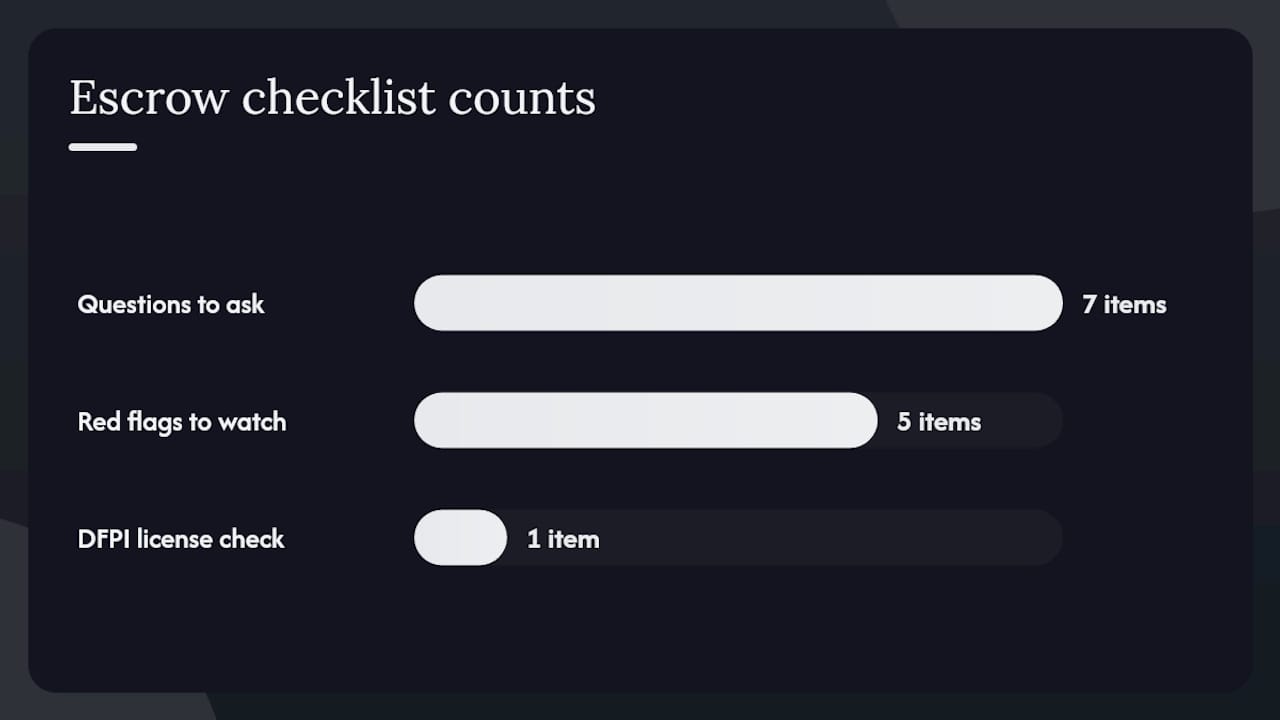
Questions to ask any escrow company before opening:
- Are you licensed by the California Department of Financial Protection and Innovation (DFPI)?
- Can you provide a sample net sheet for a transaction at my price point?
- What is your typical turnaround time for loan documents once received from the lender?
- Do you offer remote online notarization or digital signing?
- What is your fee structure, and which charges are bundled vs. billed separately?
- How do you handle wire fraud prevention? Do you verify wire instructions by phone?
Red flags to watch for:
- Refusal to provide an itemized estimate before you open escrow.
- Vague answers about pass-through charges ("we'll figure that out at closing").
- Slow response times during the initial inquiry phase. If they're slow before you're a client, expect the same during the transaction.
- No written wire-handling procedures. Wire fraud is a real risk in real estate closings; a professional escrow company has documented protocols.
- Pressure to use affiliated services (title, notary) without disclosing the relationship.
Online reviews on Google and Yelp give a useful signal, but weight recent reviews more heavily than older ones. Ask your agent which escrow companies they've seen handle problems well, not just smooth transactions. The real test of an escrow officer is how they perform when something goes sideways.
Pro Tip: Call the DFPI's escrow licensee lookup to confirm the company's license is current before you open. It takes two minutes and confirms you're working with a regulated entity.
A note on how these figures were estimated
The fee ranges and worked examples in this article draw from local escrow quotes, county recording fee schedules, and published closing-cost calculators for San Diego County. The $600,000 example uses mid-range estimates and a conventional loan scenario; actual figures will vary by lender, escrow provider, loan type, and transaction complexity.
The only authoritative source for your specific closing costs is the written estimate from your escrow officer and, for financed purchases, the Loan Estimate and Closing Disclosure your lender is required to provide. Request both documents early and compare them line by line before signing anything.
What I've seen work in San Diego closings
The biggest mistake buyers and sellers make is treating the escrow fee as a fixed, non-negotiable number. It isn't. The split is a convention, the base fee varies by provider, and the pass-throughs are often avoidable with a few direct questions asked early.
The second-biggest mistake is waiting until a week before closing to look at the net sheet. By then, you've already committed to the escrow company, the title provider, and most of the fee structure. Surprises at that stage create stress and sometimes kill deals. Asking for an itemized estimate on day one of escrow costs nothing and gives you real leverage.
In practice, sellers who offer to cover a slightly larger share of escrow costs in a slow market often close faster and with fewer renegotiations. Buyers who come in with a clean offer and don't nickel-and-dime escrow fees in a competitive market tend to win more often. The math on escrow fees is real, but the strategic context around when to push and when to let it go matters just as much as the dollar amount.
Ready to budget your San Diego closing costs with a local expert?
Escrow fees are one piece of a closing-cost picture that can run $6,000–$10,000 or more on a typical San Diego purchase. Getting that picture right before you're in contract, not after, is the difference between a smooth close and a last-minute scramble.
Jeffsellssandiego prepares itemized net sheets for buyers and sellers before they're in contract, so you know exactly what to expect at the table. Whether you're buying your next San Diego home or planning a sale, the starting point is a real number, not a guess.

Start with a no-pressure conversation. Search current San Diego listings or reach out directly to get a preliminary net sheet built around your specific transaction.
Sources
Before you sign anything, check these directly:
- Who Pays Escrow Fees in San Diego? What Buyers and Sellers Usually Cover - Cal Pacific Escrow, Inc.
- About the escrow law - CA DFPI
- San Diego Closing Costs Explained 2026 — What Buyers & Refinancers Pay
- What documents should I receive before closing on a mortgage loan? - CFPB
Always verify specific dollar amounts with your escrow officer. Published ranges and calculators are planning tools; the written estimate from your escrow company is the number that counts.