
What is home equity?

Home equity is the portion of your home you actually own, calculated as the difference between your property's current market value and the total outstanding balances on any liens or mortgages secured against it. The Cornell Law School's Legal Information Institute defines it simply as the homeowner's financial interest in their real property. Think of it this way: if your home is worth $400,000 and you owe $250,000, you own $150,000 of it outright.
Key elements of home equity:
- Ownership portion: The share of the property you control free of debt
- Market value: What a buyer would pay for your home today
- Outstanding liens: Your mortgage balance, home equity loans, or HELOCs
- Net worth contribution: Equity counts as an asset on your personal balance sheet
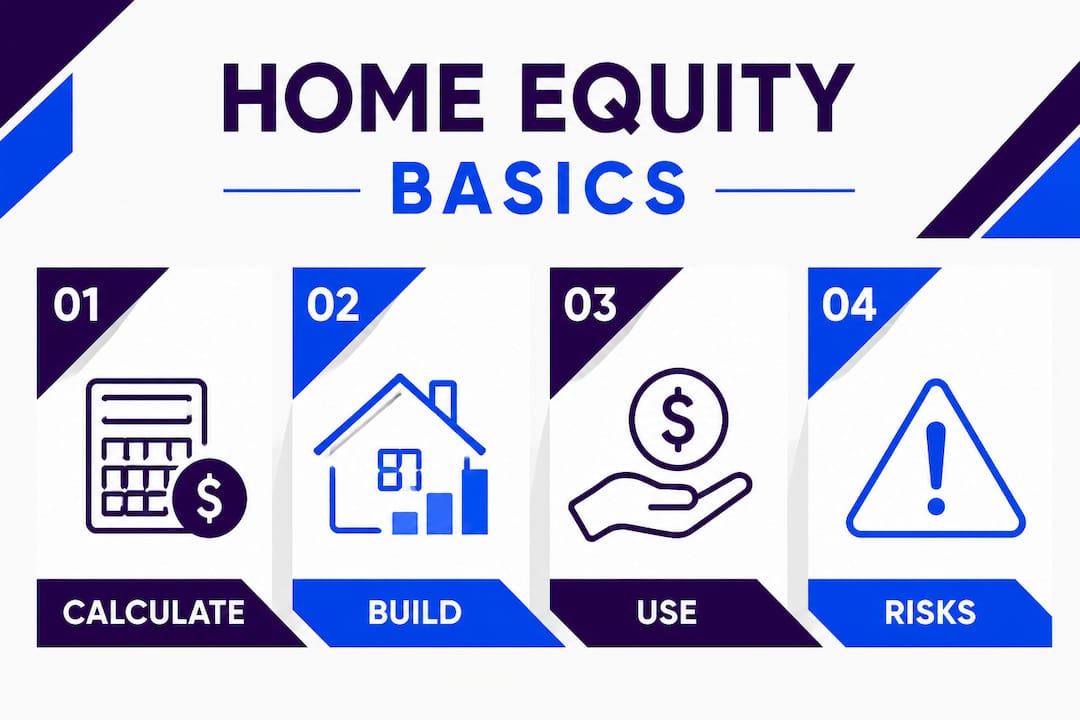
How to calculate your home equity
The formula is straightforward: subtract your total mortgage balance from your home's current market value. A $400,000 home with a $250,000 mortgage leaves you with $150,000 in equity, or 37.5% ownership.
Two ratios lenders use constantly:
- Loan-to-Value (LTV): Your mortgage balance divided by home value, expressed as a percentage. A $250,000 mortgage on a $400,000 home gives you an LTV of 62.5%.
- Combined Loan-to-Value (CLTV): Adds all secured loans together. Most lenders cap CLTV at 80–85%, so you can never borrow your full equity amount.
Pro Tip: Online estimates from automated tools can differ meaningfully from what a lender's appraiser concludes. Get a professional appraisal or an agent's comparative market analysis before making any borrowing decisions.
How homeowners build and lose equity over time

Equity is not static. It moves with your mortgage payoff schedule and with the market around you.
Ways equity grows:
- A larger down payment at purchase gives you an immediate equity head start
- Each monthly mortgage payment chips away at principal, not just interest
- Home value appreciation, whether from local demand or your own renovations, adds equity without any extra payment
- Reaching 20% equity lets you remove private mortgage insurance, cutting your monthly costs
Ways equity shrinks:
- Property value declines in a soft market reduce your equity dollar for dollar
- Taking out a home equity loan or HELOC adds a new lien, lowering net equity
- Negative equity occurs when your home's value drops below what you owe, making it hard to sell or refinance without paying the difference out of pocket
Common uses of home equity and what to watch out for
Home equity is an asset, but it is an illiquid one. You cannot spend it without either selling your home or borrowing against it, and borrowing converts ownership into debt.
Common uses:
- Home renovations that increase resale value
- Debt consolidation at lower interest rates than credit cards
- Education or major life expenses
- Down payment on an investment property
The most financially sound use is directing equity toward improvements that raise your home's value, where interest may also be tax-deductible. Using it to fund vacations or consumer spending puts your home at risk for no lasting gain. Foreclosure is a real outcome when equity-backed loans go unmanaged.
What a San Diego agent sees that the numbers miss
Appraised value and online estimates often tell different stories, and that gap directly affects how much you can borrow. Local market trends in San Diego neighborhoods shift quickly, meaning your equity position six months ago may look very different today. Lenders require professional appraisals or automated valuation models to confirm value before approving any equity product.
Pro Tip: Before tapping equity or listing your home, get a current market value assessment. Jeffsellssandiego offers a home value estimate that reflects actual San Diego sales data, not just algorithm outputs.
Home equity vs. property value: they are not the same thing
Property value is what your home is worth on the open market. Home equity is what you own after subtracting debt. A home worth $700,000 with a $600,000 mortgage has strong property value but thin equity. Conversely, a paid-off $300,000 home carries 100% equity. Home value fluctuations affect both figures, but only equity tells you what you would actually walk away with after a sale and payoff.
Key Takeaways
Home equity is the difference between your home's market value and what you still owe, and it functions as your most significant personal asset only when managed with discipline.
| Point | Details |
|---|---|
| Core definition | Equity equals home market value minus all outstanding liens and mortgage balances. |
| Calculation example | A $400,000 home with a $250,000 mortgage yields $150,000 in equity, or 37.5% ownership. |
| 20% threshold matters | Reaching 20% equity unlocks home equity loans and removes private mortgage insurance. |
| Equity is illiquid | Accessing it requires selling or borrowing, which converts your asset into secured debt. |
| Value vs. equity | High property value does not equal high equity; outstanding debt is the deciding factor. |