
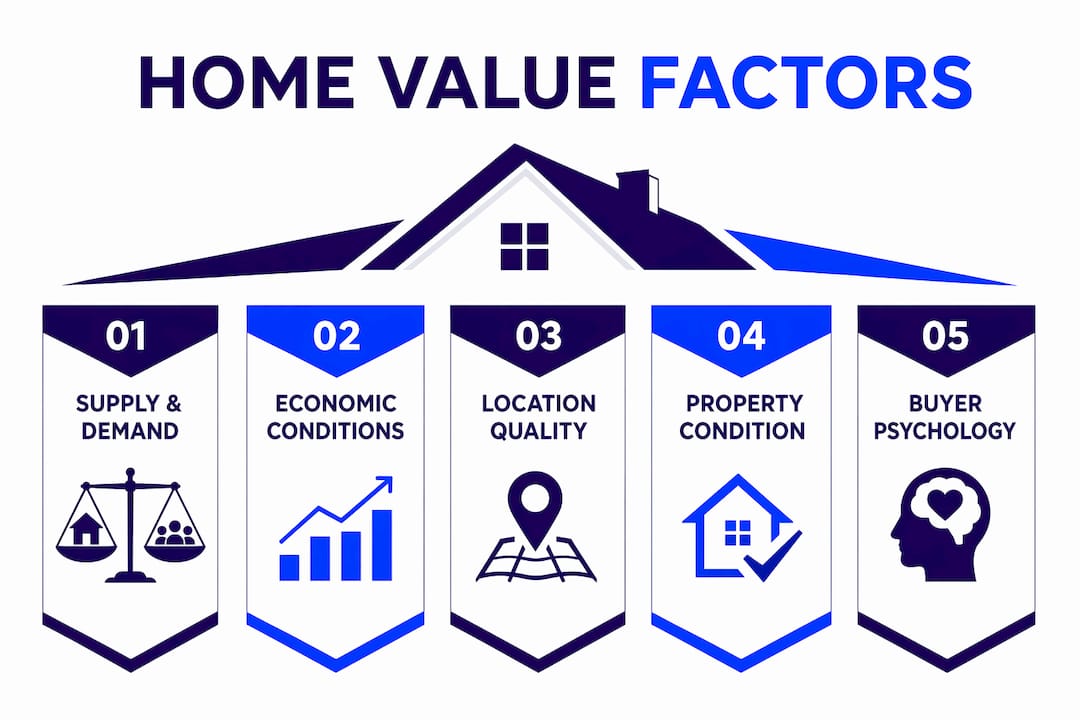
Home value fluctuation refers to the changing price of residential properties driven by supply and demand imbalances, economic shifts, and localized market conditions. These forces do not act in isolation. They interact constantly, which is why a home worth $650,000 in one year can be worth $590,000 or $720,000 just 24 months later. Home values have appreciated about 4.5% annually since 2008, yet that long-term trend masks significant short-term swings. Understanding the real drivers behind property value shifts gives you a concrete edge when deciding to buy, sell, or hold.
Why home value fluctuates: supply and demand explained
Supply and demand is the single most powerful force behind home price changes. When more buyers compete for fewer homes, prices rise. When supply outpaces demand, prices soften or fall.

Tight supply relative to buyer demand is the principal reason for elevated home prices in current markets. Post-pandemic supply shortages have persisted even as mortgage rates climbed and new construction increased. That persistence tells you something critical: demand does not evaporate quickly, even when buying becomes more expensive.
Several forces shape the supply and demand balance at any given time:
- Inventory levels. Fewer homes listed means buyers compete harder, pushing prices up.
- Population growth. Cities with strong in-migration see sustained demand that outpaces new construction.
- New construction pace. Builders face financing, labor, and regulatory challenges that slow supply growth, keeping upward pressure on prices.
- Mortgage rate levels. Higher rates price some buyers out of the market, reducing demand and cooling prices.
Pro Tip: Watch active inventory counts in your target neighborhood monthly. A rising inventory count signals a shift toward buyer-friendly conditions before price drops show up in the data.
The supply side has a structural problem in many American cities. Zoning restrictions, construction costs, and permit delays mean new homes cannot appear fast enough to meet demand spikes. That structural gap is a core reason why home prices in high-demand metros tend to recover faster after downturns than prices in slower-growth areas.
How do economic conditions and interest rates affect home prices?
The broader economy sets the ceiling and floor for what buyers can afford and what sellers can expect. Strong job growth, rising wages, and consumer confidence push demand higher. Recessions do the opposite.
Rising mortgage rates increase borrowing costs directly. A one-percentage-point rate increase on a $600,000 loan adds roughly $400 per month to a buyer's payment. That cost increase eliminates a meaningful share of qualified buyers, reducing competition and cooling prices.
The relationship between rates and prices contains one counterintuitive twist. Higher mortgage rates keep many homeowners from selling, because owners who locked in 3% rates in 2020 and 2021 have little financial incentive to trade into a 7% mortgage. This "lock-in effect" constrains inventory and sustains high prices even when demand weakens. The result is a market where prices stay elevated despite fewer transactions.
Key economic factors that drive home value changes include:
- Employment rates. High employment supports buyer confidence and purchasing power.
- Wage growth. Rising incomes expand the pool of qualified buyers.
- Inflation. Inflation raises construction costs, which raises the price floor for new homes.
- Federal Reserve policy. Rate decisions ripple directly into mortgage rates within weeks.
Homes in growing job markets appreciate faster than those in areas with declining employment or stagnant population growth. San Diego's combination of military employment, biotech, and tourism creates a demand base that insulates local values from national downturns better than most markets.
What role does location and property condition play in value shifts?
Location and property condition explain why two homes on the same street can appraise thousands of dollars apart. These factors affect home appraisal variations more than most owners realize.
Recent closed comparable sales drive home value more than cosmetic upgrades or active listings. An appraiser looks at what similar homes actually sold for in the past 90 days, not what sellers are asking. That distinction matters enormously when you are pricing a home or making an offer.
Property condition carries more weight than most sellers expect. Homes with well-maintained major systems like roofs and HVAC units outperform cosmetically upgraded properties with deferred maintenance. A fresh coat of paint does not offset a 20-year-old roof in an appraiser's eyes.
Pro Tip: Before listing, get a pre-inspection. Knowing your roof, HVAC, and plumbing status lets you price accurately and avoid surprises that kill deals in escrow.
Location factors like proximity to schools, amenities, and neighborhood trajectory strongly influence demand and therefore value. A home near a top-rated school district commands a premium that persists through most market cycles. Conversely, negative influences reduce value in measurable ways:
| Factor | Effect on value |
|---|---|
| Top-rated school district | Sustained premium across market cycles |
| Flood zone designation | Reduces buyer pool and increases insurance costs |
| High HOA fees | Cuts effective affordability, lowering offer prices |
| Nearby commercial development | Can increase or decrease value depending on type |
| Neighborhood improvement trend | Drives appreciation ahead of broader market |
Minor renovations have limited impact on value compared to recent comparable sales and major home system condition. Sellers who spend $40,000 on a kitchen remodel in a neighborhood where comps top out at $750,000 rarely recover that investment. Check the renovations that actually move the needle before committing to any upgrade budget.
How does market psychology drive home price swings?
Buyer emotions and investor behavior create price movements that fundamentals alone cannot explain. This is one of the least discussed but most powerful reasons for property value shifts.
Buyer psychology, especially fear of missing out, fuels competitive bidding and price spikes beyond what income levels or rental yields justify. During the 2020 to 2022 run-up, buyers routinely waived inspections and offered $100,000 over asking price because they feared being priced out permanently. That emotional pressure became self-reinforcing: each sale at a record price set a new comparable, validating the next round of aggressive offers.
Investor behavior and speculation create market bubbles and rapid price swings when investors enter or exit markets. Institutional buyers purchasing large volumes of single-family homes in a metro can accelerate price gains in specific zip codes. When those investors sell simultaneously, the exit amplifies price declines in the same areas.
Three psychological patterns that move markets:
- FOMO bidding. Buyers stretch budgets and skip due diligence to avoid losing a home.
- Herd behavior. Positive media coverage draws more buyers into a market, compounding demand.
- Panic selling. Negative headlines trigger sellers to list below value, creating downward momentum.
Understanding how investor strategies shape local prices helps buyers recognize when a market is running on emotion rather than fundamentals. When you can identify that distinction, you make better offers and avoid overpaying at the peak.
What are the phases of the real estate market cycle?
Real estate cycles have four phases that affect home value direction: recovery, expansion, hyper-supply, and recession. Recognizing which phase your local market is in gives you a framework for timing decisions.
- Recovery. Prices stabilize after a downturn. Inventory is high, days on market are long, and buyers have negotiating power. This is historically the best time to buy.
- Expansion. Demand grows, inventory tightens, and prices rise steadily. Job growth and population increases fuel this phase. Sellers gain leverage as competition increases.
- Hyper-supply. New construction or investor selling floods the market with inventory. Price growth slows or stalls. Buyers regain some power, but sellers who price correctly still close.
- Recession. Demand falls sharply, often triggered by job losses, rate spikes, or credit tightening. Prices decline. Distressed sales increase. Buyers with cash or strong financing find the best long-term opportunities.
Economic triggers and policy changes can shift cycles faster than most participants expect. A sudden rate increase can move a market from expansion to hyper-supply within two quarters. Recognizing early signals, such as rising days on market, increasing price reductions, and climbing inventory counts, lets buyers and sellers adjust before the shift becomes obvious to everyone.
Local economic and demographic trends determine how long each phase lasts in a specific market. San Diego has historically moved through recessions faster than national averages because of its constrained geography and diverse employment base.
Key Takeaways
Home value fluctuates because supply, demand, economic conditions, location quality, and buyer psychology interact continuously, and no single factor controls the outcome alone.
| Point | Details |
|---|---|
| Supply and demand drive prices | Tight inventory pushes prices up; oversupply softens them, regardless of economic conditions. |
| Lock-in effect sustains high prices | Owners with low-rate mortgages avoid selling, limiting supply even when demand weakens. |
| Comparable sales set true value | Appraisers rely on recent closed sales, not cosmetic upgrades or asking prices. |
| Market cycles have four phases | Recovery, expansion, hyper-supply, and recession each signal different buying and selling strategies. |
| Psychology amplifies fundamentals | FOMO and investor behavior push prices beyond what income and rental yields justify. |
What I've learned watching San Diego values move
Most buyers and sellers focus on the wrong things. They obsess over interest rate predictions or national headlines when the answer is almost always in the local data sitting right in front of them.
The clients I've seen make the best decisions share one habit: they look at what homes actually sold for in the past 60 days before forming any opinion about value. Not what's listed. Not what sold two years ago. What closed recently, nearby, in comparable condition. That discipline cuts through the noise faster than any economic forecast.
The other mistake I see constantly is over-investing in cosmetic upgrades before a sale without checking whether the neighborhood comps support a higher price. A $30,000 bathroom remodel in a street where nothing has sold above $800,000 in three years is not a value-add. It's a sunk cost. Sellers who want to maximize their sale price need to start with the comps, not the contractor.
On the buying side, the biggest risk I watch for is FOMO-driven decisions. When a buyer tells me they'll "do whatever it takes" to win a home, I slow the conversation down. Overpaying at the peak of a cycle is recoverable over time, but it takes years. Buying a well-priced home in a strong location during a recovery phase builds wealth faster than any other move in residential real estate.
San Diego's constrained supply and diverse economy make it more resilient than most markets, but it is not immune to cycles. Knowing where we are in the cycle matters as much as knowing the property itself.
— Jeff
San Diego market expertise, right when you need it
Knowing why property values shift is one thing. Knowing how those forces are playing out right now in San Diego neighborhoods is what turns knowledge into a good decision. Jeffsellssandiego works with buyers and sellers across San Diego County, translating market data into clear guidance on timing, pricing, and property selection.

Whether you're ready to search or still weighing your options, the San Diego home listings on the Jeffsellssandiego site give you a real-time view of what's available and how properties are priced relative to recent sales. Sellers can start with the seller's guide to understand how current market conditions affect your specific home. The local knowledge is here when you're ready to use it.
FAQ
Why do home values drop even in good neighborhoods?
Home values drop when supply increases faster than demand, even in desirable areas. Triggers include rising mortgage rates, investor sell-offs, or a sudden increase in local inventory.
How much do home values typically change per year?
Home values have appreciated about 4.5% annually since 2008 on average, but annual changes vary widely depending on local supply, economic conditions, and market cycle phase.
Does renovating a home increase its appraised value?
Minor renovations have limited impact on appraised value. Appraisers weight recent comparable sales and major system condition far more heavily than cosmetic updates.
How do mortgage rates affect home prices?
Rising mortgage rates reduce the number of qualified buyers, which cools demand and slows price growth. The lock-in effect also limits seller supply, which partially offsets downward price pressure.
What is the best phase of the real estate cycle to buy?
The recovery phase offers the best buying conditions. Inventory is higher, competition is lower, and prices have stabilized after a downturn, giving buyers the most negotiating leverage.