San Diego's housing market has long carried a reputation for relentless price growth, but 2026 is forcing even the most optimistic observers to think carefully. Expert forecasts now range from modest price appreciation to flat markets and even potential declines, depending on where interest rates land and how the broader economy performs. That's not panic territory, but it is a signal that assuming last year's playbook still works could cost you. Whether you're planning to buy your first home, trade up, or cash out, understanding what's actually driving the 2026 San Diego market gives you a real advantage.
Table of Contents
- Setting the scene: How San Diego's housing market reached 2026
- The data behind the trends: Interpreting price, inventory, and regional shifts
- Key factors influencing San Diego's 2026 housing outlook
- What this means for buyers and sellers: Strategies in a mixed market
- Our take: Why trusting a single trend can cost you in 2026
- Find your edge in San Diego's changing market
- Frequently asked questions
Key Takeaways
| Point | Details |
|---|---|
| Market uncertainty | Prices may modestly rise or stay flat, so flexibility is key for buyers and sellers. |
| Data differences | Rely on multiple trusted sources since trends can diverge across neighborhoods and indicators. |
| Drivers of change | Interest rates, local development, and buyer demographics are shaping the 2026 market. |
| Action strategies | Smart timing and personalized strategies can help you succeed regardless of short-term trends. |
Setting the scene: How San Diego's housing market reached 2026
To understand where the market is headed, it helps to know how we got here. Between 2020 and 2022, San Diego experienced one of the most aggressive price surges in its history. Remote work expansion brought out-of-state buyers with larger budgets, mortgage rates sat near historic lows, and local inventory shrank to levels that felt almost fictional. Bidding wars were routine. Homes sold in days.
Then came 2022 and 2023. The Federal Reserve's aggressive rate hikes changed everything almost overnight. Buyers who qualified at 3% suddenly found themselves staring at 7% rates, and affordability crumbled. Transaction volume dropped sharply as sellers who locked in low-rate mortgages refused to give them up, a phenomenon economists call "rate lock." That kept inventory suppressed even as buyer demand softened, creating a strange standoff that pushed prices down modestly but nowhere near a crash.
By 2024 and into 2025, the San Diego market found an uneasy equilibrium. Median home prices in San Diego County settled in the high $800,000 to low $900,000 range for single-family homes. Condos and attached units offered some relief, but even entry-level options pushed buyers into six-figure down payment territory. Neighborhoods like Point Loma and Pacific Beach held their values stubbornly, while some inland areas saw modest corrections.
Here's a snapshot of where San Diego's housing data stood as of early 2026:
| Metric | Early 2025 | Early 2026 | Change |
|---|---|---|---|
| Median single-family home price | $875,000 | $895,000 | +2.3% |
| Active listings (county-wide) | 4,200 | 5,100 | +21% |
| Average days on market | 22 days | 31 days | +41% |
| Months of supply | 1.8 | 2.6 | +44% |
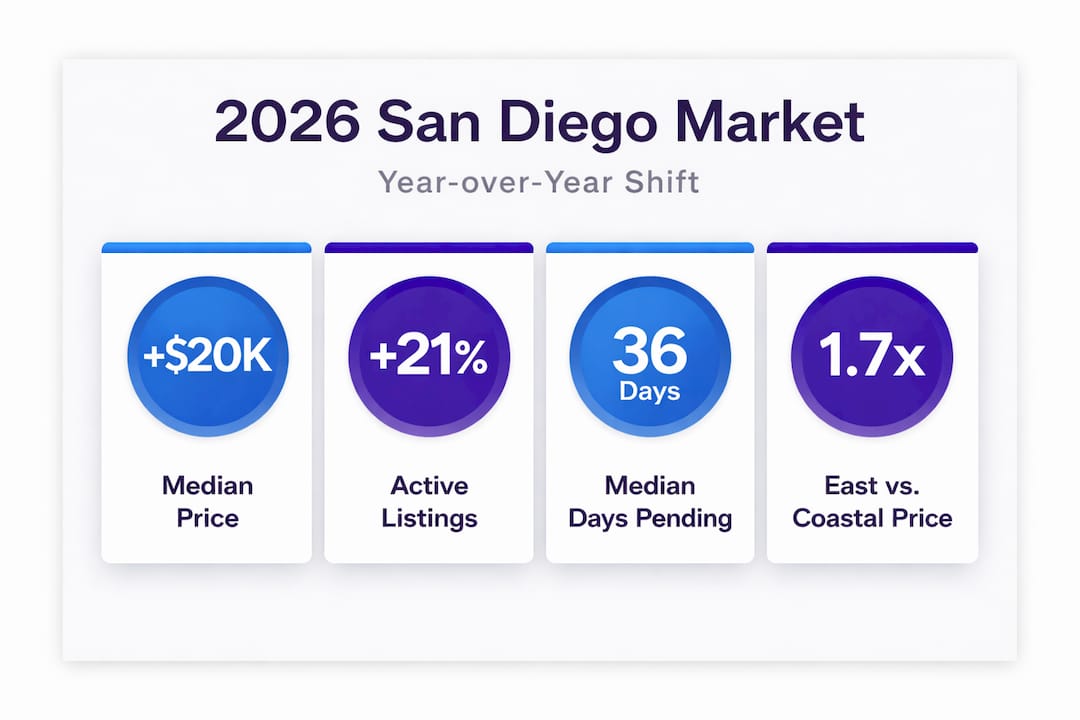
A few things stand out in that data. Inventory is rising, and homes are sitting longer. That's a measurable shift in buyer leverage, even if prices haven't collapsed. The market is softening at the edges while holding firm at the core. Knowing which dynamic applies to your target neighborhood is everything.
Key factors from the historical context worth noting:
- Low inventory has been the primary price support since 2021
- Rate lock continues to limit seller motivation in 2026
- Military, biotech, and tech employment sectors underpin San Diego demand
- New construction starts remain below historical average due to permitting delays and land costs
- Multiple forecasting methodologies including MLS data, Case-Shiller indexes, and economic indicators are producing different predictions, reflecting genuine uncertainty rather than analytical error
If you're researching specific communities, the San Diego neighborhood guide breaks down conditions by area, which matters more than county-wide averages in most purchase decisions.
The data behind the trends: Interpreting price, inventory, and regional shifts
Now that you know how the market evolved, here's how to make sense of the trend data and why it sometimes presents a mixed message.

One of the most common sources of confusion for buyers and sellers is that different data sources tell different stories. That's not a bug, it's a feature of how real estate data works. Understanding the main sources helps you ask better questions.
| Data source | What it measures | Lag time | Best used for |
|---|---|---|---|
| MLS (local) | Current active and sold listings | Near real-time | Neighborhood pricing, days on market |
| Case-Shiller Index | Repeat sales, price change over time | 2 to 3 months | Long-term trend analysis |
| Economic indicators | Employment, GDP, rate forecasts | 1 to 6 months | Macro demand forecasting |
| Zillow/Redfin estimates | Algorithmic price models | Variable | Rough reference, not negotiation basis |
The San Diego housing market is regularly analyzed using all three primary methods, and each surfaces something different. MLS data tells you what's happening this week. Case-Shiller tells you what happened this quarter. Economic indicators tell you what might happen next year. None of them alone gives you the full picture.
Regional differences add another layer of complexity. A county-wide median price of $895,000 doesn't tell you that a coastal condo in La Jolla is pricing differently than a three-bedroom in El Cajon. Communities like San Carlos attract a very different buyer profile than a beach-adjacent neighborhood, and pricing dynamics follow accordingly. Inland neighborhoods tend to be more rate-sensitive because buyers there are often stretching their budgets, while coastal buyers frequently have more equity and cash flexibility.
If you're considering selling in La Mesa, for example, the relevant data set is East County pricing trends, not the county-wide headline number that dominates the news.
Pro Tip: Pull at least three data sources before making any major buy or sell decision. Compare your neighborhood's median price per square foot on the MLS against the most recent Case-Shiller trend for the San Diego metro, then cross-reference with economic outlook data for interest rates. When all three point the same direction, you have higher confidence. When they diverge, slow down and ask why.
The honest answer about 2026 data is that forecasters themselves are split. Most expect modest growth, but a meaningful portion of models show flat prices or slight declines if rates climb or if economic conditions weaken. That honest uncertainty is valuable information, not a problem. It tells you this is a market where preparation and local knowledge matter more than timing luck.
Key factors influencing San Diego's 2026 housing outlook
Once you understand how to read the numbers, it's essential to grasp the forces driving them. Here's what matters most in 2026.
1. Mortgage rate direction Rates have been the single biggest swing factor since 2022. Even a half-point move can shift monthly payments by hundreds of dollars on a San Diego-priced home. Buyers who understand rate strategies can use buydowns, adjustable-rate options, or rate-lock timing to their advantage. Sellers need to price with rate sensitivity in mind.
2. Local employment stability San Diego's job market is unusually diverse: defense contractors, biotech firms, the University of California San Diego ecosystem, and a massive tourism industry. That diversity cushions against single-sector shocks. As long as these sectors hold, buyer demand has a floor. Any significant layoffs in biotech or defense procurement changes the calculus quickly.
3. Inventory trajectory Active listings rose 21% between early 2025 and early 2026. That's still a historically low supply environment, but the trend line matters. If inventory continues to climb, buyer leverage increases and seller expectations need to adjust. If new construction projects like Copper Line in Santee continue to add supply, price pressure in suburban markets may build.
4. Buyer demographic shifts Millennials and older Gen Z buyers represent the largest pool of first-time homebuyers San Diego has ever seen. Many are now in prime earning years. The question is whether San Diego's price points and lending conditions allow them to participate. If they can't afford entry-level options, trade-up sellers lose the chain of buyers they depend on.
5. Policy and regulation changes Zoning reform at the state level, ADU (accessory dwelling unit) rules, and potential property tax changes can all affect supply and investment behavior. Buyers comparing a condo versus a house in 2026 need to factor HOA fee trends, insurance cost inflation, and resale dynamics into the comparison.
"Forecasting models for the San Diego-Carlsbad market blend MLS transaction data, Case-Shiller repeat-sale indexes, and broader economic indicators. Most analysts expect modest growth in 2026, though flat prices or moderate declines remain possible if interest rates rise or economic conditions soften."
Pro Tip: If you're a buyer on the fence, calculate what a rate increase of 0.5% does to your monthly payment on your target price range before deciding to wait. In most cases, the cost of waiting for the "perfect" rate environment is higher than acting now with a clear negotiation strategy.
What this means for buyers and sellers: Strategies in a mixed market
Now that you understand the main forces in play, here's how to make smart moves whatever side of the market you're on.
For buyers:
- Get pre-approved, not just pre-qualified. In a market where listing agents scrutinize offers carefully, a full underwritten pre-approval signals you're serious.
- Target neighborhoods where inventory is rising fastest. More supply means more negotiating room. Check days-on-market data by zip code, not just by county.
- Don't anchor to the 2021 or 2022 peak prices as a benchmark. Price history is context, but today's market is its own environment.
- Ask for seller concessions instead of price reductions when possible. Concessions can fund rate buydowns, which lower your payment immediately.
- Build in inspection contingencies even in competitive situations. The softening market gives you slightly more room to protect yourself.
For sellers:
- Price precisely from the start. Overpriced homes are sitting longer in 2026, and a price reduction often attracts less interest than the original listing, not more.
- Invest in presentation. Buyers have more options now, and first impressions directly affect both speed of sale and final price. Preparing your home for a top-dollar sale often returns three to five times the cost in net proceeds.
- Know your buyer pool. Are you in a neighborhood that attracts move-up buyers, investors, or first-timers? Each group responds differently to pricing and incentives.
- Time your listing strategically. Spring and early summer remain peak seasons in San Diego, but a well-priced home in January can outperform a poorly priced home in May.
Pro Tip: Sellers who are also buying should model both transactions simultaneously. If you're selling in a softening market, you're likely also buying in one. That can actually work in your favor as long as you sequence the transactions correctly.
The mixed signals in the 2026 forecast don't mean paralysis. They mean preparation. The buyers and sellers who do well in uncertain markets are the ones who know their numbers, have a clear goal, and move with confidence when the right moment arrives.
Our take: Why trusting a single trend can cost you in 2026
Here's something most market guides won't say plainly: the single biggest mistake we see buyers and sellers make is treating one statistic as the whole story.
Someone reads that San Diego median prices are up 2.3% year-over-year and decides now is a great time to sell at top dollar in any neighborhood. Or they read one pessimistic headline about rising inventory and pull out of a purchase entirely, only to watch their target home sell to someone else who did their actual homework.
The San Diego housing market has never been a monolith. A coastal craftsman bungalow and a suburban townhouse 15 miles inland are not in the same market, even though they show up in the same county-wide data. We've watched neighborhoods in the same zip code perform completely differently in the same quarter based on school district lines, walkability scores, and even how quickly HOAs respond to maintenance requests.
What insiders know is that the markets defying conventional wisdom in any given year are almost always neighborhoods with a specific, localized story. Maybe a new employer relocated nearby. Maybe a public school got a new principal and test scores jumped. Maybe a road widening project finally completed and commute times dropped. None of that shows up in a forecast model.
The neighborhoods across San Diego each carry their own micro-trends that aggregate data simply can't capture. Our job as local professionals isn't to tell you what the market is doing. It's to tell you what the market is doing right where you want to be.
In 2026, adaptability and local knowledge are your real competitive advantages. The data matters, but context matters more.
Find your edge in San Diego's changing market
The 2026 San Diego housing market rewards preparation and punishes assumptions. If you've read this far, you're already thinking more carefully than most buyers and sellers in this market.

Putting that knowledge to work starts with the right resources. You can browse current San Diego home listings to see what's active, price-reduced, or newly available in your target neighborhoods. If you're buying, the buyer's guide walks you through every step from pre-approval to closing, with local context built in. Sellers can find actionable strategies in the seller's guide, including timing, pricing, and preparation advice specific to the San Diego market. The right move in 2026 starts with a conversation, not a guess.
Frequently asked questions
Will San Diego home prices keep rising in 2026?
Most experts expect modest growth, but some forecasts predict flat prices or slight declines if rates rise or the economy slows, making the outcome highly dependent on broader economic conditions.
What are the main factors impacting San Diego home prices this year?
Interest rates, employment stability, inventory levels, and new development projects are the primary forces shaping San Diego home prices in 2026, with any of them capable of shifting the direction quickly.
Is it a good time to buy or sell a home in San Diego?
The market is genuinely mixed, and the right answer depends on your specific goals, financial position, and target neighborhood, since local conditions vary significantly across the county.
How can I stay ahead of changing market conditions?
Monitor multiple data sources including MLS reports, Case-Shiller trends, and economic outlooks, and work with a local professional who tracks neighborhood-level shifts rather than county-wide averages alone.
Recommended
- Pacific Beach Real Estate Market 2025: Trends Update
- San Diego Real Estate | Neighborhood Guide & Homes
- Is Now the Right Time to Sell Your La Mesa 91942 Home?
- Preparing Your North Park Home for Top Dollar
- Why monitoring real estate trends boosts investor confidence
- Property Selling Trends 2025: 10.3% More Sales & Fast Exit Tips