
A seller concession is a formal agreement where the home seller pays specific closing costs or fees on behalf of the buyer, reducing the cash the buyer needs at closing. The purchase price stays the same. Only the payment responsibility shifts. For buyers stretched thin on upfront cash, understanding seller concessions in real estate can be the difference between closing a deal and walking away from one. This guide covers the seller concession meaning, how concessions work across different loan types, and how both buyers and sellers can use them to their advantage.
What is a seller concession and what costs does it cover?
A seller concession is a credit the seller applies toward the buyer's closing costs at closing, not a reduction in the home's sale price. The industry also uses the term "seller credit" to describe the same tool. Closing costs typically range between 2% and 5% of a property's purchase price. On a $700,000 San Diego home, that translates to $14,000–$35,000 in fees the buyer would otherwise pay out of pocket.
Seller concessions cover a wide range of buyer expenses. Common items include:
- Loan origination fees
- Appraisal fees
- Title insurance premiums
- Prepaid property taxes and homeowner's insurance
- Mortgage discount points (buying down the interest rate)
- Home inspection fees
- Recording fees
One detail buyers often miss: sellers can also offer credits for repairs instead of completing the work themselves. Sellers often prefer repair credits over scheduling contractors because it avoids delays, cost overruns, and potential closing postponements. A credit keeps the transaction moving.
Seller concessions vs. price reductions

These two tools are not the same, and the difference matters financially.
| Factor | Seller Concession | Price Reduction |
|---|---|---|
| Effect on purchase price | None | Lowers purchase price |
| Effect on loan amount | None | Reduces loan amount |
| Effect on property tax basis | None | Lowers tax basis |
| Effect on buyer's cash at closing | Reduces cash needed | Minimal direct impact |
| Effect on seller's net proceeds | Reduces net proceeds | Reduces net proceeds |
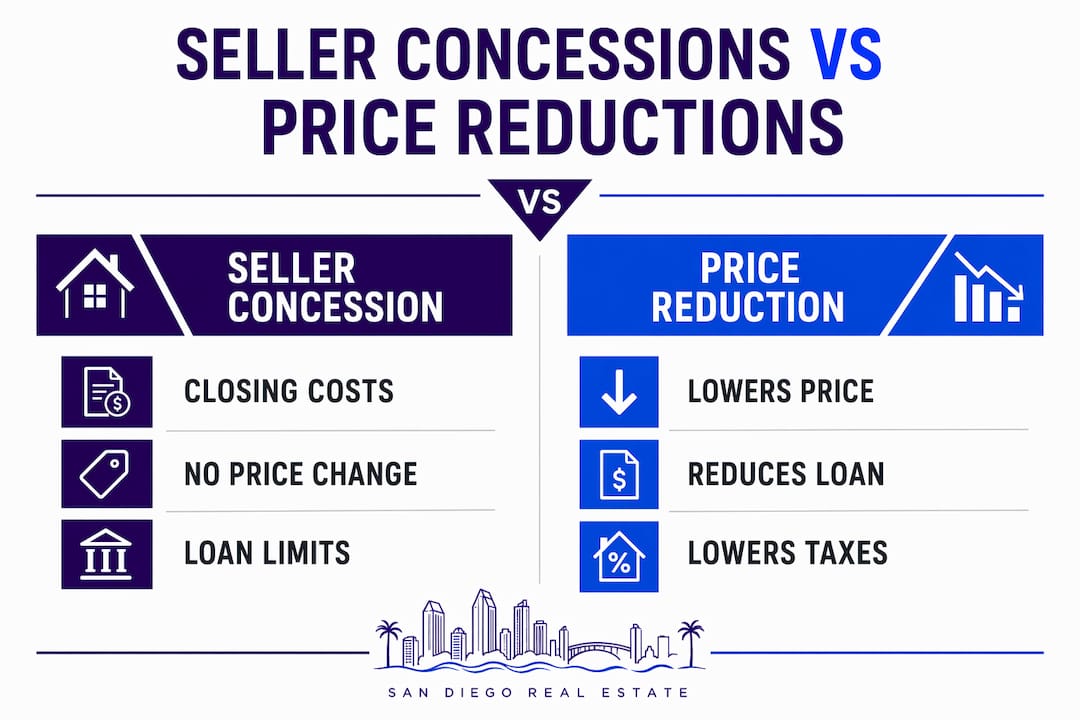
Concessions differ from price reductions in one critical way: a price cut lowers the loan amount and the property's tax basis, while a concession only shifts who pays the closing costs. A buyer who wants a lower monthly payment benefits more from a price reduction. A buyer who needs cash to close benefits more from a concession.
Pro Tip: If you are short on cash but can handle the monthly payment, ask for a concession. If you want to reduce your long-term interest cost, ask for a price cut instead.
How do seller concessions work during negotiation and closing?
Seller concessions are negotiated during the offer phase and documented in the purchase contract. The agreed amount appears as a credit on the closing disclosure. The seller does not write a check. Instead, the concession reduces the net proceeds the seller receives at closing, and the buyer's cash requirement drops by the same amount.
The process follows a clear sequence:
- The buyer's agent requests a specific concession amount in the purchase offer.
- The seller accepts, counters, or rejects the request.
- The agreed concession is written into the contract with a specific dollar amount or percentage.
- The lender reviews the concession against loan program limits.
- The concession appears as a credit on the closing disclosure.
- At closing, the credit offsets the buyer's closing costs directly.
Loan type limits you must know
Lender rules cap how much a seller can contribute. FHA loans allow up to 6%, VA loans allow up to 4%, and conventional loans vary based on down payment size. Exceeding these caps can trigger loan denial. This is not a technicality. Lenders enforce these limits strictly because concessions that exceed actual closing costs cannot convert to cash for the buyer.
Seller concessions cannot exceed the buyer's actual closing costs. If a buyer negotiates a $10,000 concession but only has $8,000 in closing costs, the extra $2,000 simply expires. The buyer does not pocket it. This surprises many first-time buyers who assume a large concession equals extra cash.
Pro Tip: Before writing a concession into your offer, ask your loan officer for the exact limit based on your loan program and down payment. A concession that exceeds the cap can delay or kill your loan approval.
Concessions are more common in buyer's markets or when mortgage rates are high. When sellers face more competition, they use concessions as incentives to attract buyers. In a hot seller's market like San Diego has experienced, concessions are rarer because sellers rarely need to offer them.
What are the benefits and trade-offs of seller concessions?
Seller concessions create a genuine win for buyers who need cash to close. The buyer preserves liquidity, the seller preserves the sale price, and the deal moves forward. Concessions reduce seller net proceeds but can speed closing by making offers more appealing. That trade-off often works in everyone's favor.
Benefits for buyers include:
- Lower cash needed at closing without changing the loan amount
- Ability to buy sooner without waiting to save more
- Option to use freed-up cash for moving costs, repairs, or reserves
- Access to mortgage rate buydowns that reduce monthly payments
Benefits for sellers include:
- Preserving the listed sale price for appraisal and comparable sales purposes
- Avoiding the need to complete repairs before closing
- Making the listing more competitive without a formal price cut
- Closing faster by removing a buyer's cash barrier
"Seller concessions and credits are powerful negotiation tools that create mutually beneficial outcomes in real estate deals, especially in less competitive markets." — Rocket Mortgage
A common misconception is that concessions and price reductions are interchangeable. They are not. A seller who drops the price by $15,000 lowers the loan amount, the tax basis, and the comparable sale data for the neighborhood. A seller who offers a $15,000 concession keeps the price intact and only shifts closing cost responsibility. Sellers who care about their sale price on record almost always prefer concessions over cuts.
Concessions reduce upfront cash needs but do not lower the mortgage loan principal or the property tax basis. That means the buyer's monthly payment stays the same. Buyers should factor this into their decision when weighing a concession against a price reduction.
What buyers and investors should know before requesting concessions
Verify your loan limits before you write a concession into any offer. Buyers should confirm concession limits with their loan officer before requesting credits, because limits change based on loan program, down payment percentage, and occupancy type. Getting this wrong wastes negotiation capital and can delay closing.
Key points to keep in mind:
- Concessions cannot give you cash back. Any amount above your actual closing costs expires at the table.
- Market conditions determine seller willingness. In a slow market, sellers are far more open to concessions.
- A large concession request can weaken an otherwise competitive offer. Balance the two carefully.
- Contract language matters. The concession amount and what it covers must be spelled out clearly to avoid disputes at closing.
- Appraisal impact is real. If the concession is structured incorrectly, it can raise red flags during the lender's review.
Pro Tip: In a competitive market, consider offering a slightly higher purchase price to offset the concession you are requesting. The seller nets the same amount, and you get the cash relief you need at closing. Run the numbers with your agent first.
Real estate investors face the same loan limits as owner-occupants on most conventional products. If you are buying an investment property, concession caps may be lower. Check with your lender before assuming the same rules apply. The San Diego home buying guide for 2026 covers current market conditions that affect how much leverage buyers have in negotiations.
Key Takeaways
Seller concessions are a credit from the seller toward the buyer's closing costs, not a price reduction, and they are capped by loan type and actual closing cost totals.
| Point | Details |
|---|---|
| Seller concession meaning | The seller pays specific buyer closing costs at closing without lowering the purchase price. |
| Loan type limits | FHA allows up to 6%, VA up to 4%, and conventional loans vary by down payment size. |
| No cash back rule | Concessions cannot exceed actual closing costs; any surplus expires and is not paid to the buyer. |
| Concessions vs. price cuts | Price cuts lower the loan amount and tax basis; concessions only reduce buyer cash at closing. |
| Best market conditions | Concessions are most common in buyer's markets or when mortgage rates are elevated. |
What I have learned negotiating concessions in San Diego
Most buyers I work with initially think a seller concession is free money. It is not. It is a reallocation of who pays what at the closing table. That distinction matters because it shapes how you negotiate and what you ask for.
The biggest mistake I see is buyers requesting a concession without first confirming their loan limit. A buyer on an FHA loan has more room than a conventional buyer putting 10% down. If you ask for more than your program allows, the lender flags it and you scramble to restructure the deal. That costs time and sometimes costs you the home.
The second mistake is treating concessions and price reductions as equivalent. In San Diego, where sale prices feed into comparable data for the entire neighborhood, sellers are often more willing to offer a concession than to cut the price. Knowing that gives you real leverage. I have seen deals close cleanly because the buyer asked for a $12,000 concession instead of a $12,000 price cut. The seller said yes immediately because the recorded price stayed intact.
Concessions work best when the market gives buyers some room. Right now, with negotiation tactics shifting as inventory changes, knowing when and how to ask for a concession is as important as knowing what one is. Work closely with your loan officer and your agent before you make any request. The numbers have to line up before the conversation starts.
— Jeff
Working with Jeffsellssandiego on your next purchase
Jeffsellssandiego works with buyers and investors across San Diego to structure offers that include seller concessions when the market and loan program allow it.

Whether you are buying your first home or adding to a portfolio, knowing how to use concessions correctly can save you thousands at closing. Jeffsellssandiego connects buyers with trusted local lenders who know the exact limits for FHA, VA, and conventional loans, and structures offers that hold up through underwriting. Browse current San Diego home listings and reach out to discuss how concessions can work in your next transaction. The buyer's guide on the site walks through the full purchase process from offer to close.
FAQ
What is a seller concession in simple terms?
A seller concession is when the home seller agrees to pay some or all of the buyer's closing costs at closing. The purchase price does not change. Only the payment responsibility shifts.
Are seller concessions negotiable?
Yes, seller concessions are fully negotiable and are agreed upon during the offer phase. The amount is written into the purchase contract and reviewed by the lender before closing.
How much can a seller concede on closing costs?
Limits depend on the loan type. FHA loans cap concessions at 6%, VA loans at 4%, and conventional loans vary based on the buyer's down payment. Exceeding these limits can result in loan denial.
Can a seller concession give the buyer cash back?
No. Seller concessions cannot exceed actual closing costs, and any surplus expires at closing. The buyer receives no cash from unused concession amounts.
When are seller concessions most common?
Seller concessions are most common in buyer's markets or when mortgage rates are elevated, because sellers need stronger incentives to attract and close buyers.