
A seller's market is a real estate condition where the number of buyers exceeds available homes for sale, giving sellers a measurable competitive advantage in price and negotiation. The National Association of REALTORS® defines this supply-demand imbalance as the core driver of faster sales, higher offers, and reduced concessions for sellers. If you are thinking about listing your home or simply trying to read the market, understanding what creates and sustains a seller's market is the most practical knowledge you can have. This guide breaks down the indicators, the economics, and the geographic nuances that determine whether you hold the cards or the buyer does.
What is a seller's market in real estate?
A seller's market occurs when fewer homes exist than buyers actively searching for them, which produces bidding wars, above-asking-price offers, and faster closings. The standard industry term for this condition is a "low-inventory market," though sellers and agents commonly use "seller's market" to describe the same dynamic. When supply shrinks relative to demand, buyers compete against each other rather than against the seller, which shifts nearly every negotiating lever in the seller's favor.

The opposite condition, a buyer's market, occurs when listings outnumber serious buyers. In that environment, sellers reduce prices, offer concessions, and wait longer for offers. The gap between these two states is not abstract. It shows up in your final sale price, your closing timeline, and how many contingencies you are asked to accept.
Realtor.com and Freedom Mortgage both point to months of housing supply as the clearest dividing line. Below six months of supply signals a seller's market. Above six months signals a buyer's market. That single number tells you more about your negotiating position than any headline about interest rates.
How to identify a seller's market in your local area
Recognizing a seller's market requires looking at specific, measurable data points rather than general news coverage. National headlines often lag behind local conditions by months. The metrics that matter most are:
- Months of supply. Freedom Mortgage identifies months of inventory below six as the threshold for a seller's market. A market sitting at two or three months of supply is intensely competitive for buyers.
- Median days on market. Realtor.com flags low days on market as a reliable local indicator. Homes selling in under two weeks consistently signal strong buyer demand.
- Price cut frequency. When fewer than 10 to 15 percent of active listings show a price reduction, sellers are holding firm. Rising price cuts signal a market softening toward buyers.
- Multiple offer frequency. Zillow and Redfin both confirm that multiple offers above asking are a defining characteristic of seller's markets. If your neighbors received five offers in a weekend, your market qualifies.
- List-to-sale price ratio. When homes routinely close above their list price, buyers are paying premiums to win. A ratio above 100 percent is a clear seller's market signal.
Pro Tip: Do not rely on city-wide averages. A neighborhood two miles away can behave completely differently. Pull data from Realtor.com local market reports filtered to your specific zip code and price range before drawing any conclusions about your home's position.
How supply and demand create pricing power for sellers
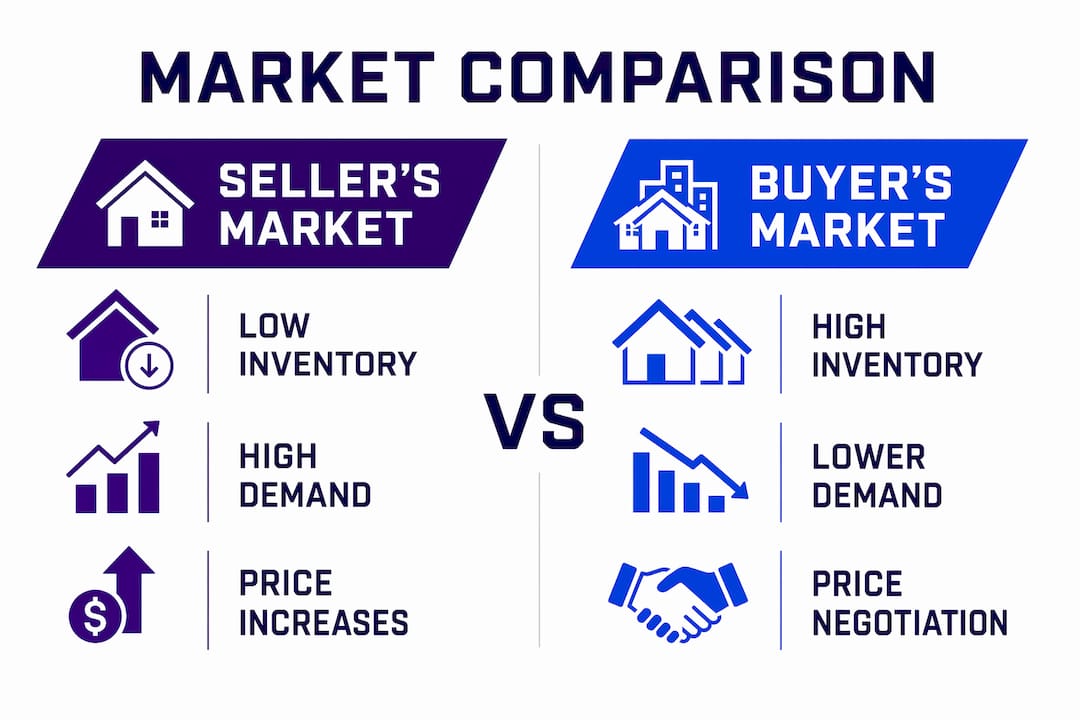
When buyer demand outpaces available inventory, competition among buyers does the pricing work for sellers. Each additional offer a seller receives increases the probability of a sale above list price and reduces the buyer's ability to request repairs, credits, or contingency protections.
The pricing dynamics in a seller's market follow a predictable sequence:
- Inventory drops below equilibrium. Fewer listings mean each home attracts more attention from the same pool of buyers.
- Buyers accelerate their timelines. Fear of losing a home to another buyer pushes buyers to offer quickly and aggressively.
- Offers exceed list price. Zillow confirms that sellers receive above-asking offers regularly in low-inventory conditions, sometimes by five to fifteen percent.
- Sellers reduce or eliminate concessions. Repair credits, closing cost assistance, and inspection contingencies become negotiable from a position of strength.
- Concessions shift from price cuts to targeted incentives. KeyCrew's research shows that seller concessions in strong markets shift toward buyer rate buy-downs rather than outright price reductions, which protects the seller's net proceeds.
"Sellers need to balance pricing power with realistic buyer financing limits to avoid deal collapse." — Zillow home selling insight
That last point is where sellers make costly mistakes. Overpricing beyond what a buyer's lender will appraise creates a gap between contract price and appraised value. Zillow warns that pricing above financing thresholds risks failed appraisals and stalled deals even when demand is strong. The goal is to price at the upper edge of supportable market value, not beyond it.
Seller's market vs buyer's market: what sellers need to know
The difference between these two market types is not just about price. It affects every stage of the transaction, from how you set your list price to what you accept in the final contract.
| Characteristic | Seller's market | Buyer's market |
|---|---|---|
| Inventory level | Below 6 months of supply | Above 6 months of supply |
| Typical offer price | At or above list price | Below list price |
| Days on market | Under 30 days, often under 14 | 60 to 90 days or more |
| Seller concessions | Minimal or none | Common (repairs, credits, closing costs) |
| Buyer competition | Multiple offers, bidding wars | Few competing offers |
| Negotiating leverage | Seller holds most leverage | Buyer holds most leverage |
| Inspection contingencies | Often waived by buyers | Standard and expected |
In a buyer's market, sellers frequently offer to cover a portion of closing costs, accept repair requests after inspection, and reduce their price to attract offers. In a seller's market, those same sellers can decline repair requests, reject contingencies, and choose among multiple competing buyers. The NAR notes that proper preparation and pricing remain critical even when conditions favor sellers, because a poorly presented home still loses to a well-prepared competitor.
The pace difference is equally significant. Homes in seller's markets often go under contract within days of listing. Buyers who hesitate lose. That urgency benefits sellers who are ready to move quickly through inspections and closing timelines.
Why seller's market conditions vary by location
The United States housing market does not move as one unit. CNN Business reports that US housing markets vary widely, with some metros remaining intensely competitive for sellers while others have shifted decisively toward buyers. Understanding this geographic variation is what separates a well-timed sale from a mispriced one.
Several factors drive local variation:
- New construction activity. Markets where homebuilders are active add supply that cools seller leverage. Markets with limited buildable land, like coastal California, maintain tighter inventory.
- Insurance and carrying costs. In states where homeowner's insurance has spiked, some sellers face reduced buyer pools because total ownership costs price out buyers at certain income levels.
- Migration patterns. Sun Belt cities that absorbed large population inflows between 2020 and 2023 are now seeing inventory corrections, while supply-constrained coastal markets remain tight.
- Local employment base. Markets anchored by stable employers in healthcare, government, or technology tend to sustain buyer demand even when national conditions soften.
Realtor.com advises that market shifts happen gradually and sellers should monitor local trends continuously rather than rely on national headlines. A city-level report may show a balanced market while your specific neighborhood sits at one month of supply.
Pro Tip: Realtor.com's local market reports and NAR's metro-level data let you filter by zip code and price tier. Days on market data is only meaningful when compared within the same neighborhood and price range, as Realtor.com notes that DOM metrics require like-for-like comparison for accuracy. San Diego neighborhoods like Pacific Beach and Point Loma can behave very differently from the county average, as Jeffsellssandiego tracks in its Pacific Beach market updates.
Key takeaways
A seller's market gives sellers pricing power and negotiating leverage, but only when they price strategically and prepare their home to attract the strongest offers.
| Point | Details |
|---|---|
| Core definition | A seller's market exists when buyer demand exceeds available inventory, typically below six months of supply. |
| Primary indicators | Watch months of supply, days on market, price cut frequency, and list-to-sale price ratios. |
| Pricing discipline matters | Overpricing risks appraisal failure even in strong demand conditions; price at the upper edge of supportable value. |
| Geographic variation is real | National headlines do not reflect your neighborhood; always analyze zip-code-level data before listing. |
| Concessions shift, not disappear | In seller's markets, concessions move toward buyer rate buy-downs rather than price reductions, protecting net proceeds. |
What I've learned from selling in San Diego's competitive market
I have worked with sellers across San Diego neighborhoods ranging from North Park to Point Loma, and the single most consistent mistake I see is confusing a seller's market with a license to skip preparation. Sellers who hear "it's a hot market" sometimes list without staging, without addressing deferred maintenance, and with a price pulled from wishful thinking rather than comparable sales. Those homes sit. The well-prepared home two streets over sells in a weekend with multiple offers.
The second pattern I see regularly is sellers anchoring to a neighbor's sale price from six months ago without accounting for the fact that local conditions shift faster than most people expect. A San Diego neighborhood that was at two months of supply in January may be at four months by summer. That difference changes your pricing strategy and your negotiating position meaningfully.
My honest advice: use the market conditions to your advantage, but do not let them replace strategy. Price your home at the upper edge of what comparable sales support. Present it well. Respond to offers quickly. And understand that even in a seller's market, the buyer still needs to get a loan approved. Pricing beyond what an appraiser will support turns a strong offer into a dead deal.
The sellers I have seen do best are the ones who treat a seller's market as an opportunity to be strategic, not an excuse to be lazy. That combination of favorable conditions plus disciplined execution is what produces the best outcomes.
— Jeff
Ready to sell in San Diego's market?
Understanding the theory behind a seller's market is one thing. Knowing exactly where your home stands in San Diego's current inventory picture is another. Jeffsellssandiego provides local sellers with precise market analysis, strategic pricing guidance, and hands-on negotiation support built around your specific neighborhood's conditions, not county-wide averages.

Start with a free home valuation to see where your property sits relative to current comparable sales. Then review the seller's guide for a step-by-step breakdown of how to prepare, price, and close your home at maximum value. When you are ready to talk strategy, Jeff is available to walk through your specific situation with no obligation.
FAQ
What is the seller's market definition in real estate?
A seller's market is a real estate condition where buyer demand exceeds available home inventory, typically measured as fewer than six months of housing supply. This imbalance gives sellers pricing power, faster sales, and stronger negotiating leverage.
How do I know if my neighborhood is a seller's market?
Check months of supply, median days on market, and the frequency of price cuts in your zip code using Realtor.com local market reports or NAR metro data. A market with under six months of supply and homes selling in under 30 days is a seller's market.
Does a seller's market mean I can price my home at anything?
No. Zillow warns that pricing above what a buyer's lender will appraise creates deal-killing gaps between contract price and appraised value. Price at the upper edge of what comparable sales support, not beyond it.
How is a seller's market different from a buyer's market?
In a seller's market, inventory is low, homes sell quickly, and buyers often offer above list price with minimal contingencies. In a buyer's market, inventory is high, homes sit longer, and sellers routinely offer concessions like repair credits and closing cost assistance.
Do seller's markets exist everywhere at the same time?
No. CNN Business confirms that US housing markets vary widely by region, with some metros favoring sellers strongly while others have shifted toward buyers. Always analyze local data rather than relying on national market reports.