
A contingency is a specific condition that must be met before a contract, offer, or plan can move forward as written. It shows up in four places most people run into: contracts (where lawyers call it a "condition precedent"), real estate purchase offers, attorney fee agreements, and business risk planning.
- Covered here: contract conditions, real estate offer contingencies, legal contingency fees, and business contingency planning.
- What makes one enforceable: a clearly defined event, a measurable standard, a firm deadline, and a named party responsible for acting.
The Cornell Legal Information Institute frames it the same way courts do: an unmet condition, if the deadline passes, typically lets the affected party walk away without penalty. Financing contingencies commonly run 21 to 30 days. As a San Diego residential agent, I write and negotiate these clauses on nearly every transaction I handle, and the difference between a clean contingency and a messy one usually comes down to precision, not luck.
Key Takeaways
A contingency is an enforceable condition that must be satisfied by a defined deadline, or the protected party can typically cancel without penalty.
| Point | Details |
|---|---|
| Core definition | A contingency is a condition that must be met before a contract or plan proceeds as written. |
| Real estate protections | Inspection, financing, appraisal, home sale, and title/HOA contingencies each protect different risks for buyers. |
| Enforceability elements | A valid contingency needs a precise event, a measurable standard, a firm deadline, and a named responsible party. |
| Good faith matters | Courts expect documented, diligent effort to satisfy a contingency, not just a change of mind. |
| Local support | Jeffsellssandiego helps San Diego buyers and sellers review, negotiate, and remove contingencies during active transactions. |
Table of Contents
- What Does Contingency Mean in Plain Language?
- How Do Contingencies Work Inside a Contract?
- What Are the Most Common Real Estate Contingencies?
- What Is a Contingency Fee in a Legal Context?
- How Do Businesses Use Contingency Planning?
- How Do You Write or Read a Contingency Clause?
- What Do Sample Contingency Clauses Look Like?
- A San Diego Agent's Take on Contingencies
- Get Help Managing Contingencies on Your Next Deal
- Sources
What Does Contingency Mean in Plain Language?
Strip away the legal packaging and a contingency is just a backup plan built into an agreement: "this happens, only if that happens first." It's related to but distinct from two words people often use interchangeably.
- A clause is any provision in a contract. A contingency is one specific type of clause, tied to an uncertain future event.
- A condition is closer in meaning, but "contingency" usually implies the whole party can exit the deal if it fails.
Everyday version: you bring subway fare "just in case" your card fails, that's a personal contingency plan. Contract version: "This offer is contingent on the buyer securing financing within 21 days." Dictionary sources back this up directly. Merriam-Webster defines it as an event that may or may not occur, tied to the idea of preparing for what happens if it does, and Cambridge Dictionary frames it the same way: uncertainty paired with a plan.
How Do Contingencies Work Inside a Contract?
Most contingencies function as a condition precedent: something that has to happen before a party's obligation to perform kicks in. If a home sale is contingent on the buyer obtaining financing, the buyer has no obligation to close until that financing condition is satisfied, waived, or the deadline expires. This is different from a condition subsequent, which cancels an existing obligation after a later event occurs, though in practice most consumer contracts lean on the "precedent" structure.
When a contingency isn't met, a few outcomes are typical:
- Termination without penalty, often with earnest money or a deposit returned in full.
- Renegotiation, where the parties adjust price or terms instead of walking away.
- A cure period, giving the responsible party extra time to fix the issue.
- Waiver, where the protected party voluntarily drops the contingency and proceeds anyway.
Timing matters more than most first-time buyers expect. A financing contingency with a vague "reasonable time" clause invites disputes; one with a specific 21 to 30 day window, as Cornell's Wex definition notes is standard, gives both sides a clock they can actually plan around.
Pro Tip: Courts generally expect "good faith" effort, not perfection. If you're canceling based on a financing contingency, keep your loan application, denial letter, and correspondence. A good-faith documentation standard protects your earnest money far better than simply saying you changed your mind.
What Are the Most Common Real Estate Contingencies?
Home purchase contracts rarely rely on just one contingency. They stack several, each protecting a different risk.
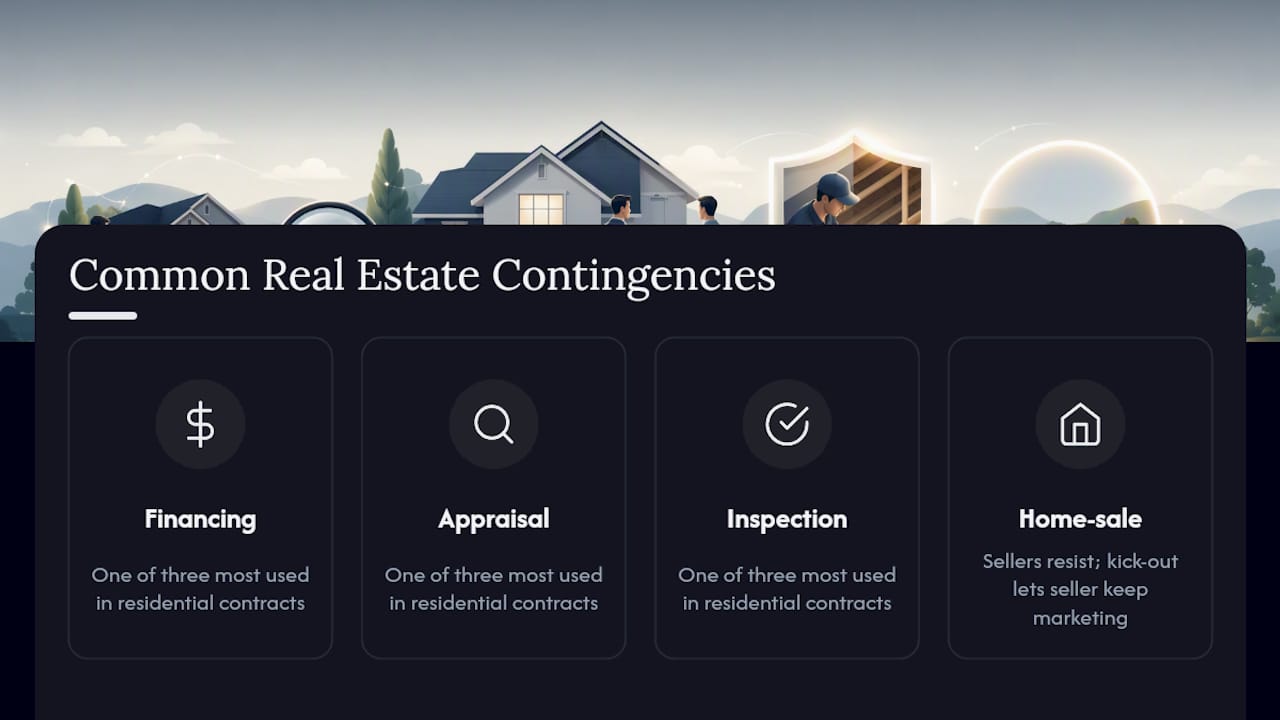
Financing, appraisal, and inspection remain the three most frequently used contingencies in residential contracts, according to Cornell's contingency overview. The home-sale contingency deserves special attention because it's the one sellers push back on hardest, and it's often paired with a kick-out clause that lets the seller keep marketing the property.
What Is a Contingency Fee in a Legal Context?
A contingency fee flips the usual payment model on its head: the attorney gets paid only if the client wins or settles. It's the standard arrangement in personal injury cases, where clients often can't afford hourly billing up front. Fees typically run somewhere in the range of a third of the settlement, though the exact percentage and whether it increases if the case goes to trial varies by firm and jurisdiction.
- Client benefit: no upfront legal fees, and the attorney is financially motivated to win.
- Client risk: losing the case usually means owing nothing for fees, but case expenses may still apply.
- What to confirm in writing: how expenses are handled, whether the percentage changes at trial, and how fees split if multiple attorneys are involved.
How Do Businesses Use Contingency Planning?
Outside contracts, "contingency" describes risk management: preparing for a negative event you can't predict but can plan around. Investopedia's overview of contingency planning frames the goal as resilience, not prophecy. You're not guessing which disaster hits, you're making sure the organization survives whichever one does.
A workable framework has three parts: governance (who decides what during a crisis), resource identification (cash reserves, insurance, credit lines), and risk analysis (testing the plan before you need it). Common tactics include maintaining a liquidity cushion, carrying business interruption insurance, lining up backup suppliers, and having a communications plan ready to go.
Two quick scenarios show the logic. A restaurant loses its main produce supplier overnight, having a second vendor already vetted prevents a menu shutdown. A freelancer loses their biggest client, three to six months of reserves buys time to rebuild the pipeline without panic decisions.
To start simple contingency planning yourself:
- Identify your two or three biggest operational risks.
- Estimate the cash or resource buffer needed to survive each one.
- Write down who does what in the first 48 hours of disruption.
- Review and adjust the plan once a year.
Ready offers templates for organizations that want to formalize this beyond a one-page plan.
How Do You Write or Read a Contingency Clause?
Vague contingency language is where most disputes start. Before signing or drafting one, run it through this checklist:
- Define the triggering event precisely. "Subject to inspection" is weaker than "subject to a licensed inspector's report identifying repairs exceeding $2,000."
- Set a measurable standard. An appraisal contingency should specify "at or above purchase price," not just "a satisfactory appraisal."
- Include a hard deadline. No open-ended "reasonable time" language.
- Name the responsible party. Say exactly who must act, apply for financing, order the inspection, and by when.
- Require written notice. Verbal waivers create he-said-she-said disputes later.
Red flags to watch for: no deadline, subjective language like "buyer's satisfaction," missing notice procedures, or waiver terms that only protect one side. NAR's consumer guide stresses that measurable standards and clear notice procedures are what actually prevent negotiation breakdowns, not the contingency itself. Removing or waiving a contingency should always be documented in writing, since an undocumented waiver can resurface as a dispute months later if the deal falls apart for unrelated reasons.
What Do Sample Contingency Clauses Look Like?
Here are short, adaptable examples. Treat these as starting points, not final language.
- Inspection: "This offer is contingent upon a professional inspection acceptable to buyer, to be completed within 10 days of acceptance. Buyer may request repairs, credits, or cancel with full deposit refund." Satisfied by written approval; unmet triggers cancellation or renegotiation.
- Financing: "This offer is contingent upon buyer securing loan approval within 21 days of acceptance." Waived by written notice; unmet allows cancellation with earnest money returned.
- Appraisal shortfall: "If the appraised value is below the purchase price, buyer may renegotiate price, cover the difference, or cancel." Buyer chooses the remedy in writing.
- Contingency fee: "Attorney's fee shall be 33% of any settlement or judgment recovered, with case costs deducted separately." Confirm in writing whether the percentage rises if the case proceeds to trial.
This is general drafting guidance, not legal advice, so have an attorney review any language before it becomes binding.
A San Diego Agent's Take on Contingencies
I've negotiated contingency removals on both sides of the table, and the pattern is consistent: buyers who document everything keep their leverage, buyers who don't lose it fast. One tactic that works well locally is using the inspection contingency as a negotiation tool rather than a walk-away trigger, request specific repairs or a credit instead of canceling, and you often keep the deal alive on better terms. If you're navigating contingencies as part of a purchase or listing strategy, it helps to have someone reviewing the timeline with you before deadlines sneak up.

Get Help Managing Contingencies on Your Next Deal
Reading a contingency clause correctly is one thing. Negotiating its removal without losing leverage, or protecting your earnest money when a deadline is tight, is where an experienced agent earns their keep. Jeffsellssandiego works directly with San Diego buyers and sellers to review contract language, manage contingency timelines, and negotiate removals that protect your deposit and your position at the table.

Whether you're buying and need to understand what you're agreeing to, or selling and want to manage a buyer's contingent offer without losing momentum, the process works better with someone tracking every deadline on your behalf. Buyers can start with the buyer's guide to understand what to expect, and sellers can review the seller's guide for handling contingent offers and negotiating from a position of strength. If you're ready to see what's available now, browse current San Diego listings and reach out to talk through your specific timeline.
Sources
- contingency | Wex | US Law | LII
- Consumer Guide: Real Estate Sales Contract Contingencies
- Merriam-Webster — contingency
- Understanding contingency: Examples and effective contingency plans
- Ready