
The fastest way to find off-market homes is to pair a connected local agent with a disciplined owner-outreach routine, and lean on public records, driving for dollars, and expired-listing follow-up to fill the pipeline. The single highest-leverage move is starting a weekly source-screen-follow-up cycle now rather than waiting for the perfect list. Everything below is a system you can copy this week.
TL;DR:
- Using a connected local agent and a weekly outreach routine, including driving for dollars and public record searches, significantly increases chances of finding off-market homes.
- Automating lead verification and follow-up through a CRM or property platforms saves time and improves consistency in sourcing efforts.
- Proof of funds or pre-approval is often required before viewing off-market properties, especially for private deals through brokers.
- Off-market deals are generally faster and more confidential but can still sell at market prices or higher due to bidding for exclusivity.
- Building trust with an experienced agent can unlock access to private listings and off-market sales that never reach the MLS.
Table of Contents
- Where to Find Off-Market Homes: The Priority Channels
- A Repeatable Weekly System: Source, Screen, Follow Up
- Tools and Data Sources Worth Paying For
- How to Reach Out to Off-Market Owners Without Blowing It
- Do You Need Proof of Funds for an Off-Market Deal?
- How Jeff Sources Private Listings for Buyers
- When Off-Market Beats the MLS (and When It Doesn't)
- Ready to Access Private Listings? Here's How Jeff Can Help
- Sources
- FAQ
Where to Find Off-Market Homes: The Priority Channels
Not every channel deserves equal time. Some produce a private listing every month; others burn hours for one lukewarm lead.
- Agent networks and pocket listings. Agents with deep local relationships hear about a seller's plans before a sign ever goes in the yard. A pocket listing moves through word of mouth between agents, so the buyer with the best-connected agent gets first look.
- Driving for dollars. Physically scouting neighborhoods for deferred maintenance, overgrown yards, and boarded windows still works, especially paired with a mapping app that logs addresses on the spot.
- Public records and courthouse lists. Pre-foreclosure filings, probate cases, and tax-delinquent rolls surface owners under real pressure to sell, often before they've talked to any agent.
- Direct mail with stacked lists. Combining absentee ownership, tax delinquency, and code violations into one list beats mailing any single signal alone.
- Investor communities and private marketplaces. Local investor meetups and niche marketplaces supplement the above, particularly for wholesale-adjacent deals, though they shouldn't be a primary channel on their own.
Off-market inventory isn't a temporary quirk of a tight market. Investor demand has intensified competition for it in specific price bands, and that competition is reshaping how residential deals get done. Treat sourcing as an ongoing habit, not a one-time hack.
A Repeatable Weekly System: Source, Screen, Follow Up
Scattered effort produces scattered results. A tight, repeatable routine is what separates buyers who close two or three off-market deals a year from buyers who chase leads that never go anywhere.
Start by defining your buy box: price range, property condition, neighborhoods, and exclusions. A narrow buy box with clear rules for what you won't buy saves more time than a longer lead list, because it lets you kill bad leads in seconds instead of minutes.
- Pull stacked lists. Export code-enforcement, vacant-property, and tax-delinquent records from your city's open-data portal or courthouse site.
- Run driving routes. Spend one to two hours weekly in target zip codes, logging distressed properties as you go.
- Fast-screen every lead. Verify ownership, pull three comparable sales, estimate rehab cost, and calculate your maximum allowable offer.
- Sort into buckets. Act now, nurture over the next 90 days, or kill and move on.
- Follow up on a cadence. Nurture leads get a touch every two to three weeks by mail or text until they're ready or dead.
Manual owner research on a single property can eat 15 to 40 minutes when you're checking ownership, mortgage history, and comps by hand. That's the real cost of skipping automation.
Pro Tip: Block the same two hours every week for this routine. Off-market sourcing dies the moment it becomes something you do "when you have time."
Tools and Data Sources Worth Paying For
A spreadsheet works until your lead count passes fifty. After that, a basic CRM paired with a driving-for-dollars app saves real time by automating reminders and tagging leads by status, something a spreadsheet can't do without constant manual upkeep.
- Property-intelligence platforms aggregate ownership, liens, and valuation data in one place, and that aggregation is what actually speeds up lead validation compared with manual pulls.
Whether a paid tool earns its cost comes down to volume. Screening five leads a month, do it by hand. Screening fifty, the subscription pays for itself in the hours it returns.
How to Reach Out to Off-Market Owners Without Blowing It
The message matters more than the medium. A text that opens with "I'm interested in buying your property at [address]" gets far more replies than a generic "Are you interested in selling?" blast.
- Keep calls and texts short, specific to the address, and low-pressure.
- Direct mail should name the property, avoid aggressive language, and give a clear, single call to action.
- Respect opt-out requests immediately and document every contact attempt, including dates and channels used.
- If a seller asks for time or privacy, back off and set a calendar reminder to check in later rather than pushing.
TCPA compliance isn't optional for texts and calls. Keep a simple log of who you contacted, when, and how they responded, both for legal protection and because it makes your nurture cadence far easier to run.
Pro Tip: If a seller asks "how did you get my information," answer honestly. Vague or evasive answers kill trust faster than any script mistake.
Do You Need Proof of Funds for an Off-Market Deal?
Sellers and their agents move fast in private deals, and they call the buyer who can prove they're ready, not the one offering the highest number on paper.
- A proof-of-funds letter or lender pre-approval is often the price of entry just to see certain listings.
- Cash or bridge financing makes sense when speed matters more than the cost of capital.
- A short letter of intent with a real earnest-money commitment signals seriousness without the length of a full contract.
- Brokers handling private deals often curate outreach to a small pool of three to fifteen qualified buyers, and proof of funds is frequently the gatekeeping requirement for getting into that pool at all.
Reputation and a fast yes often beat a marginally higher offer from a buyer nobody trusts to close.
How Jeff Sources Private Listings for Buyers
Running this system solo works, but a local agent with existing relationships shortcuts most of the legwork. A well-connected agent with long-standing relationships in specific local neighborhoods can connect buyers to homes that never touched the MLS, where agents and homeowners sometimes share sales plans privately.
A quiet, off-market sale often comes down to trust: the seller wants to avoid showings, avoid a public listing, and work with someone who already knows the neighborhood's real value. That's the entire case for a connected agent over a cold list.
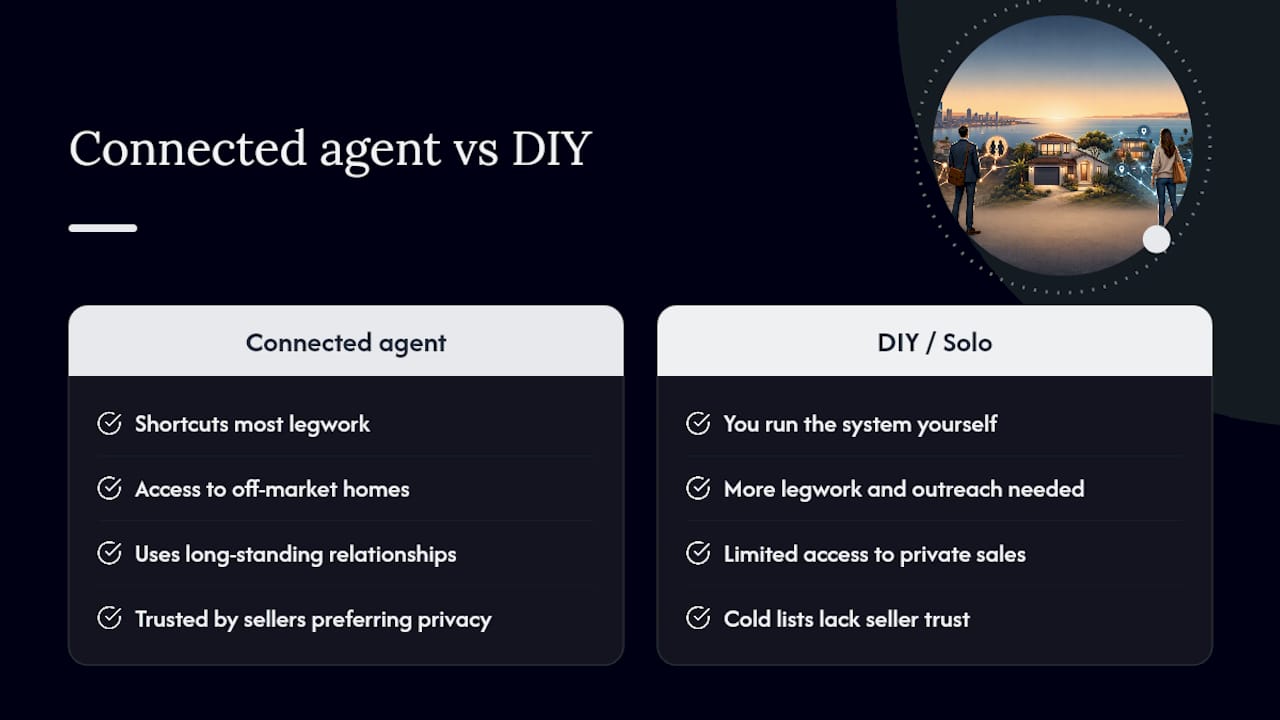
Buyers who want this run for them, rather than DIY, can start with a conversation about their buy box.
— Jeff
When Off-Market Beats the MLS (and When It Doesn't)
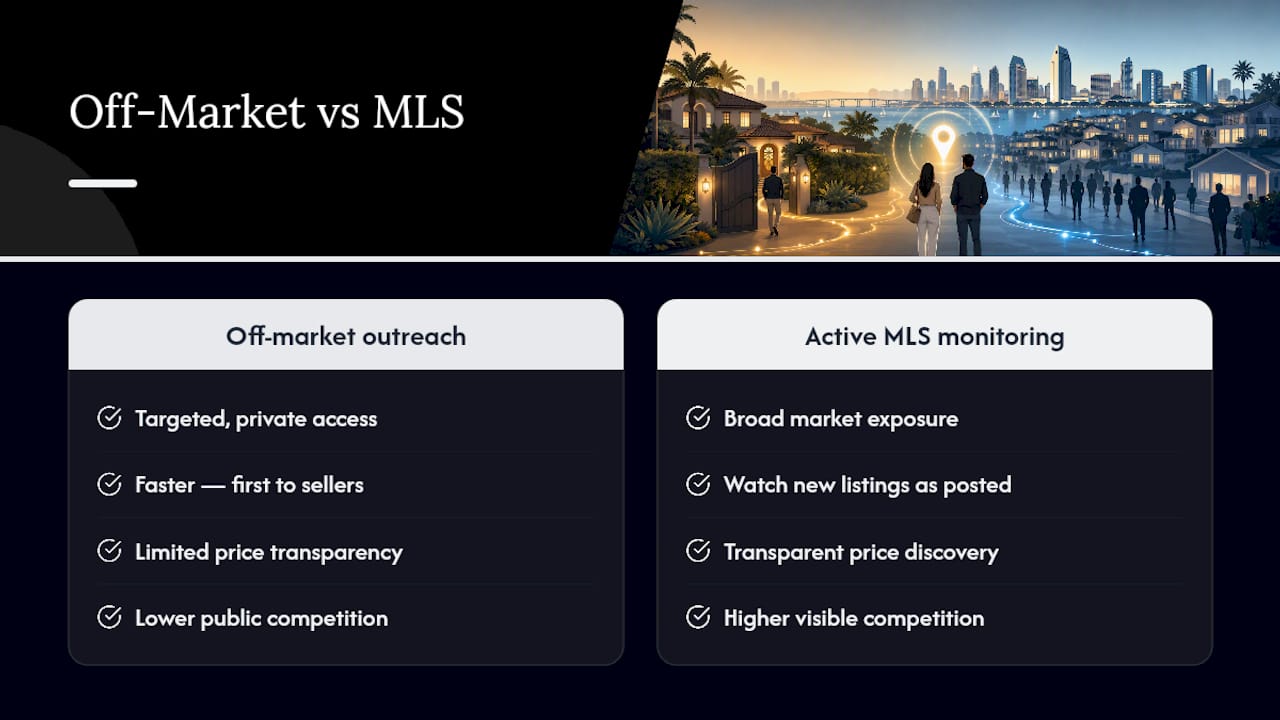
Off-market sourcing wins on speed, confidentiality, and targeted access, which is exactly why investors chase it hard. It's the better lane when you need to move fast, avoid a bidding war, or want first access before a property gets broad exposure.
Owner-occupant buyers chasing a specific school district or neighborhood usually do better watching active MLS inventory, where price discovery and competition are transparent. The smartest approach runs both tracks in parallel: private outreach running in the background while you still monitor new MLS listings the moment they post.
Ready to Access Private Listings? Here's How Jeff Can Help
Jeff Hinds represents buyers directly, which means the private-network outreach described above works on your behalf instead of sitting in a general practitioner's toolbox. That's the real difference between reading this system and having someone run it for you: buyer representation, direct relationships across San Diego neighborhoods, and firsthand knowledge of which streets and buildings tend to sell quietly.

Getting started takes one conversation. Share your buy box, target neighborhoods, price range, must-haves, and Jeff can start surfacing matches, including properties from his own exclusive listings that haven't gone wide. From there, a quick consult covers your financing readiness and timeline so you're positioned to move the moment something private surfaces. Start by browsing current home search options or reviewing the buyer's guide to understand the process before your first call.
Sources
How off-market deals and investor demand are reshaping residential real estate — HousingWire How to Find Off Market Property: Your 2026 Playbook — PropLab Off-market properties — Reonomy resources How off-market CRE deals actually work: A broker's guide — Passive Investments Lessie
- How off-market deals and investors are reshaping residential real estate — HousingWire
- How to Find Off Market Property: Your 2026 Playbook — PropLab
- Off-market properties — Reonomy resources
- How off-market CRE deals actually work: A broker's guide — Passive Investments
FAQ
What's the best way to find off-market homes?
Combine a connected local agent for pocket listings with a weekly routine of driving for dollars, public-record list pulls, and direct mail. No single channel beats the mix.
How do you find homes that were taken off the market?
Expired and withdrawn MLS listings are searchable through your agent's MLS access and are high-priority leads because the owner already showed intent to sell.
Are off-market homes cheaper?
Not necessarily. Many off-market buyers pay market price or even a premium in exchange for confidentiality, speed, and certainty of closing.
Can you buy a house that is off the market?
Yes. Owners sell off-market all the time through direct agent outreach, private networks, or a buyer who contacts them first, often with the help of a buyer's agent who has access to pocket listings.
Do I need proof of funds to see off-market listings?
Often, yes. Brokers and agents handling private inventory frequently limit access to buyers who can show proof of funds or a lender pre-approval upfront.