
A pocket listing is defined as a residential property marketed privately without being listed on the Multiple Listing Service (MLS), shared instead through an agent's personal network or exclusive channels. Unlike a standard MLS listing visible to millions of buyers on platforms like Zillow and Redfin, a pocket listing reaches only a select group of potential buyers. This guide explains exactly how pocket listings work, what the National Association of Realtors (NAR) rules say about them, and whether they serve your goals as a buyer or seller in today's market.
What is a pocket listing in real estate?
A pocket listing is a home for sale that never appears on the MLS, accessible only through the listing agent's network or invitation-only platforms. The term "off-market listing" is the standard industry phrase you'll hear agents use interchangeably, though "pocket listing" has become the widely recognized shorthand. The defining characteristic is limited buyer exposure: instead of syndicating to thousands of real estate websites, the agent controls exactly who learns the property is available.
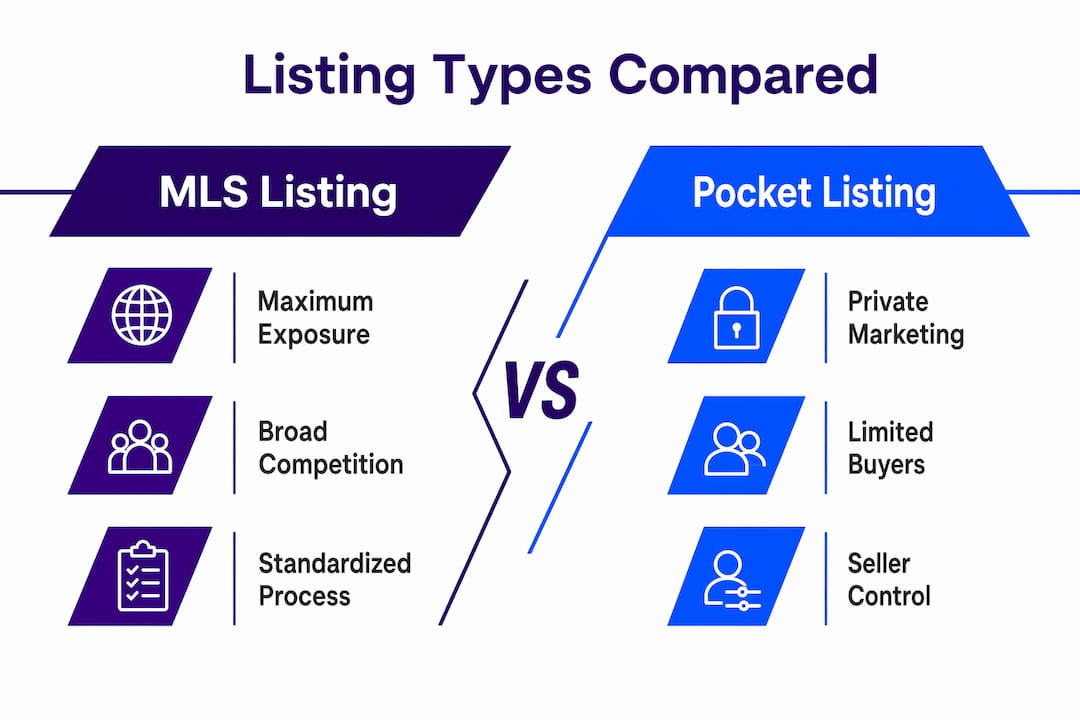
Traditional MLS listings work the opposite way. Once a property hits the MLS, it automatically feeds to Zillow, Redfin, Realtor.com, and hundreds of local real estate sites within hours. That broad syndication creates competition among buyers, which typically drives up the final sale price. A pocket listing deliberately skips that process, trading maximum exposure for maximum privacy and control.

The channels used for pocket listings include an agent's personal buyer list, brokerage-internal networks, private Facebook groups, and invitation-only platforms. Some luxury markets in San Diego and Los Angeles have long used these methods for high-profile sellers who want discretion before committing to a public sale.
How do pocket listings compare to MLS and private listings?
The confusion between pocket listings, private listings, and office exclusives is common. Each category has a distinct level of exposure and a different set of rules.
An MLS listing offers the broadest possible reach. The seller's agent submits the property to the local MLS, which then distributes it to every cooperating brokerage and public-facing portal. Buyer agents across the entire market can show the home, and competitive offers become the norm in active markets.
A pocket listing sits at the opposite end of the spectrum. Buyer visibility is restricted to whoever the listing agent chooses to contact directly. No yard sign, no Zillow page, no open house advertised to the public. The seller gains privacy but sacrifices the competitive bidding environment that MLS exposure creates.
An office exclusive falls in between. The property is shared within a single brokerage but not submitted to the MLS. Buyers represented by other brokerages have no access unless the listing agent reaches out personally. Local MLS rules govern how long an office exclusive can remain off the MLS before mandatory submission kicks in.
| Feature | MLS listing | Pocket listing | Office exclusive |
|---|---|---|---|
| Public exposure | Maximum | None | Brokerage only |
| Buyer pool | All market buyers | Agent's network | Single brokerage |
| Marketing cost | Standard | Minimal | Minimal |
| Price competition | High | Low | Moderate |
| MLS submission required | Yes, immediately | Triggered by public marketing | Time-limited exemption |
The table above makes the trade-off clear. More exposure creates more competition. Less exposure creates more privacy. Neither outcome is automatically better. It depends entirely on what the seller prioritizes.
What rules govern pocket listings, including the Clear Cooperation Policy?
The NAR's Clear Cooperation Policy is the single most important regulation affecting pocket listings. It requires MLS members to submit a listing to the MLS within one business day of any public marketing of the property. That rule effectively limits how long a true pocket listing can stay off the market once the seller starts promoting it.
What counts as public marketing matters enormously here. The policy defines public marketing to include:
- Yard signs visible from the street
- Flyers distributed beyond the agent's immediate network
- General website postings, including the agent's own public website
- Email blasts sent to a broad audience rather than specific known buyers
- Social media posts visible to the general public
Exemptions exist. An office exclusive, where the property is shared only within the listing brokerage, does not trigger the one-business-day clock under most MLS rules. A delayed marketing exemption also allows sellers to request a short window before MLS submission, provided no public marketing occurs during that period.
Pro Tip: Even a single Instagram post visible to the public or a listing on a general real estate website can trigger the Clear Cooperation Policy clock. If you want to keep a property off the MLS, every marketing action must stay within a clearly defined private network.
Geographic enforcement varies. Local MLS rules differ in how strictly they monitor compliance, and some markets have carved out additional exemptions for luxury properties. Agents operating in San Diego need to know the specific rules of the California Regional MLS (CRMLS) in addition to NAR's baseline policy. The safest approach is to document every marketing action and confirm with your agent that no step crosses the public marketing threshold.
What are the advantages and disadvantages of pocket listings?
The case for pocket listings is real, but so are the financial risks. Understanding both sides helps you make a clear-eyed decision.
For sellers, the advantages include:
- Privacy. High-profile sellers, executives, and individuals going through divorce or financial difficulty often prefer that their home sale not become public knowledge.
- Control over showings. Without MLS exposure, the seller controls exactly who enters the home and when, eliminating the parade of unqualified buyers that open houses attract.
- Pre-market price testing. Sellers can test pricing privately before committing to a public list price, avoiding the stigma of price reductions visible on the MLS.
For sellers, the disadvantages are significant:
- Lower sale price. Studies show homes sold off-market sell for about 1.3% less on average than comparable MLS sales. That gap represents real money on a $900,000 San Diego home.
- Reduced competition. Fewer buyers means fewer competing offers. Without a bidding war, sellers rarely achieve the premium that a hot MLS listing generates.
For buyers, the advantages include:
- Access to exclusive inventory. Buyers connected to well-networked agents can see properties before they hit the public market, reducing competition at the offer stage.
- Less bidding pressure. Without dozens of competing buyers, negotiations can be more straightforward and less emotionally charged.
For buyers, the disadvantages are equally real:
- Limited selection. Pocket listings represent a small fraction of total inventory. Relying on them narrows your options considerably.
- Reduced price transparency. Without MLS data, buyers and appraisers have fewer comparable sales to reference, making it harder to verify whether the asking price is fair.
A Dallas-Fort Worth analysis of over 700,000 home sales found that off-market price premiums dropped from 3.3% before the Clear Cooperation Policy to just 0.9% after its implementation. The policy change significantly reduced whatever pricing advantage pocket listings once offered sellers.
Pro Tip: If you are a seller considering a pocket listing, run a comparative market analysis on MLS-listed homes first. The difference between your private offer and what a competitive MLS launch might generate is the real cost of your privacy.
How are pocket listings marketed and accessed?
The practical mechanics of pocket listing marketing rely almost entirely on the listing agent's network and reputation. Pocket listings vary in scope from a single phone call to a select buyer to a coordinated campaign across multiple private channels.
The most common marketing channels include:
- Agent's personal buyer database. A well-connected agent maintains a list of active buyers who have expressed interest in specific neighborhoods or property types. These buyers get a direct call or email before anyone else.
- Brokerage-internal networks. Large brokerages like Compass and Coldwell Banker have internal platforms where agents share off-market inventory with colleagues representing qualified buyers.
- Private buyer groups. Invitation-only groups on platforms like WhatsApp or private Facebook communities circulate off-market properties among vetted buyers and agents.
- Agent-to-agent outreach. A listing agent may personally contact five to ten buyer agents whose clients match the property profile, creating a controlled mini-market.
The listing agent functions as the gatekeeper in every scenario. They decide who learns about the property, in what order, and on what timeline. That control is the entire point for sellers who value discretion. For buyers, it means your access to pocket listings depends almost entirely on the quality and reach of the agent you hire. A buyer working with a newer or less-connected agent will rarely hear about off-market opportunities before they either sell privately or hit the MLS.
What practical steps should buyers and sellers take with pocket listings?
Navigating a pocket listing transaction requires preparation on both sides. The process is less standardized than an MLS sale, which creates both opportunity and risk.
For sellers, follow these steps:
- Define your priority clearly before approaching an agent. Decide whether privacy, price, or speed matters most. That answer determines whether a pocket listing or MLS launch serves you better.
- Consult your agent about pricing your home before going off-market. Without MLS comps from your own sale, you need a solid independent valuation.
- Confirm MLS rules with your agent. Understand exactly what marketing actions will trigger the Clear Cooperation Policy clock in your local MLS.
- Set a deadline. If your pocket listing does not generate a satisfactory offer within a defined window, commit to an MLS launch rather than letting the property sit and lose momentum.
For buyers, follow these steps:
- Ask every agent you interview whether they have access to off-market inventory. An agent with strong brokerage connections and a large personal network is a genuine advantage.
- Get pre-approved before you need it. Pocket listing sellers often move quickly and prefer buyers who can demonstrate financial readiness immediately.
- Research comparable MLS sales independently before making an offer. Without the transparency of a public listing, you need your own data to avoid overpaying.
- Work with an agent who understands buyer strategy in low-inventory environments. Pocket listings require faster decisions and stronger negotiation skills than typical MLS transactions.
Pro Tip: Ask your agent to pull recent sold comps within a half-mile radius before you make any offer on a pocket listing. Without that data, you are negotiating blind in a market where the seller already controls the information.
Key takeaways
Pocket listings trade maximum market exposure for seller privacy and control, and that trade-off carries a measurable financial cost in most markets.
| Point | Details |
|---|---|
| Core definition | A pocket listing is a home marketed privately, never submitted to the MLS. |
| Regulatory constraint | NAR's Clear Cooperation Policy requires MLS submission within one business day of public marketing. |
| Seller price risk | Off-market homes sell for roughly 1.3% less on average than comparable MLS listings. |
| Buyer access | Buyers gain access to pocket listings almost exclusively through well-networked agents. |
| Policy impact on price | Off-market price premiums dropped from 3.3% to 0.9% after Clear Cooperation Policy enforcement. |
My honest read on pocket listings after years in San Diego real estate
I have worked with sellers who had genuinely good reasons to keep their sale private. A divorce, a high-profile job, a health situation they did not want neighbors speculating about. In those cases, a pocket listing made complete sense and the seller understood the potential price trade-off going in. That transparency is what made the decision legitimate.
What concerns me is when sellers pursue a pocket listing because their agent convinced them it creates exclusivity or urgency. That framing is often more about the agent's convenience than the seller's financial outcome. The data from the Dallas-Fort Worth study is hard to argue with. Reduced competition almost always means a lower final price, and the privacy premium rarely closes that gap.
For buyers, pocket listings are genuinely useful if you have the right agent. I have seen buyers in San Diego secure properties in competitive neighborhoods before they ever hit the MLS, simply because their agent had strong relationships with listing agents across the city. That kind of access is real and worth pursuing. But it requires working with someone who has built those relationships over years, not someone who promises off-market access as a sales pitch.
My advice is straightforward. If you are a seller, be honest about what you are trading away. If you are a buyer, invest in finding an agent whose network actually delivers. The pocket listing itself is not the strategy. The agent behind it is.
— Jeff
How Jeffsellssandiego helps you navigate pocket and exclusive listings
Whether you are a seller weighing privacy against price or a buyer trying to access inventory before it hits the public market, Jeffsellssandiego brings deep San Diego market knowledge to both sides of the transaction.

Jeff Hinds works directly with buyers and sellers across San Diego neighborhoods, with established agent relationships that open doors to off-market and exclusive listing opportunities most buyers never see. If you want to maximize your home sale value or find properties before they go public, start by exploring current San Diego listings or reach out directly to discuss your goals.
FAQ
What is the pocket listing definition in simple terms?
A pocket listing is a home for sale that is not listed on the MLS and is marketed privately through an agent's network or exclusive channels. The seller controls who learns about the property and when.
Are pocket listings legal?
Pocket listings are legal, but agents who are MLS members must comply with NAR's Clear Cooperation Policy, which requires MLS submission within one business day of any public marketing. Office exclusives and delayed marketing exemptions allow limited off-market periods under specific conditions.
Do sellers get a better price with a pocket listing?
Most data suggests sellers do not. Off-market homes sell for roughly 1.3% less on average than comparable MLS sales, and a Dallas-Fort Worth study found the price premium from pocket listings dropped to just 0.9% after the Clear Cooperation Policy took effect.
How do buyers find pocket listings?
Buyers access pocket listings almost exclusively through agents with strong personal networks and brokerage connections. There is no public database for off-market properties by definition, so the agent relationship is the only reliable path to this inventory.
What is the difference between a pocket listing and an office exclusive?
A pocket listing is shared through an agent's personal network with no MLS involvement. An office exclusive is shared within a single brokerage but not submitted to the MLS. Both limit buyer exposure, but office exclusives operate under a specific MLS exemption with defined time limits.