
San Diego's housing market is fast, competitive, and unforgiving if you show up unprepared. Knowing how to find buyers in San Diego the right way means more than posting a listing and hoping. Serious sellers and agents need to understand local MLS tools, how to spot qualified cash buyers, what government assistance programs can expand your buyer pool, and which marketing channels actually move homes here. This guide walks through every stage of that process with specifics built for the San Diego market.
Table of Contents
- Key takeaways
- How to find buyers in San Diego using MLS
- Attracting and verifying qualified cash buyers
- Using SDHC programs to expand your buyer pool
- Offline and online marketing strategies for connecting with buyers
- Verifying buyer readiness and closing deals smoothly
- My honest take on finding buyers in San Diego
- Work with Jeffsellssandiego to find the right buyer faster
- FAQ
Key takeaways
| Point | Details |
|---|---|
| MLS exposure is non-negotiable | Listing on SDMLS syndicates your property across buyer portals, maximizing reach fast. |
| Verify every cash buyer | Always confirm proof of funds directly with the issuing institution before moving forward. |
| SDHC programs expand your pool | Local down payment assistance programs qualify more buyers at homes priced up to $1,250,000. |
| Multi-channel marketing wins | Combine MLS, direct mail, social media, and investor networks for the widest buyer reach. |
| Verification protects your deal | Confirming buyer identity, funds, and title company independently prevents fraud and costly delays. |
How to find buyers in San Diego using MLS
The San Diego Multiple Listing Service (SDMLS) is the foundation for any serious buyer search. When an agent submits a listing to SDMLS, listings update in real time and push immediately to buyer-facing portals across the web. That means your property appears on the sites where actual buyers spend their time, within hours of going live.
What makes SDMLS especially powerful in this market is multi-region coverage. San Diego County is diverse, spanning luxury coastal communities, inland family neighborhoods, and everything in between. SDMLS connects agents across these regions, which means a buyer's agent in Chula Vista sees your North Park listing just as quickly as someone across the street. That breadth matters. More agent eyeballs mean more buyer conversations.
Here is what makes a listing perform well once it is on SDMLS:
- Complete and accurate data: Missing square footage, incorrect bedroom counts, or vague neighborhood descriptions push serious buyers away immediately.
- Professional photography: Listings with high-quality images generate significantly more inquiries than those with phone photos.
- Proper neighborhood classification: Misclassified neighborhoods mean your listing misses buyer searches filtered by community.
- Detailed property descriptions: Mention proximity to parks, transit, schools, and recent upgrades. Buyers filter by these details.
- Accurate price positioning: Overpriced listings sit. Use comparable sales to price at or near market value so buyers actually schedule showings.
Pro Tip: SDMLS acts as the lifeblood tool for buyer demand in San Diego. Agents react to new listings within minutes. A polished, complete listing gets shown. A sloppy one gets skipped.
Here is a quick comparison of how listing quality affects buyer engagement:
| Listing element | Low-quality listing | High-quality listing |
|---|---|---|
| Photos | Phone snapshots | Professional photography |
| Description | Basic facts only | Neighborhood context, upgrades, lifestyle |
| Data accuracy | Incomplete or estimated | Verified and complete |
| Price alignment | Above market | At or near comparable sales |
| Buyer inquiries | Below average | Above average |
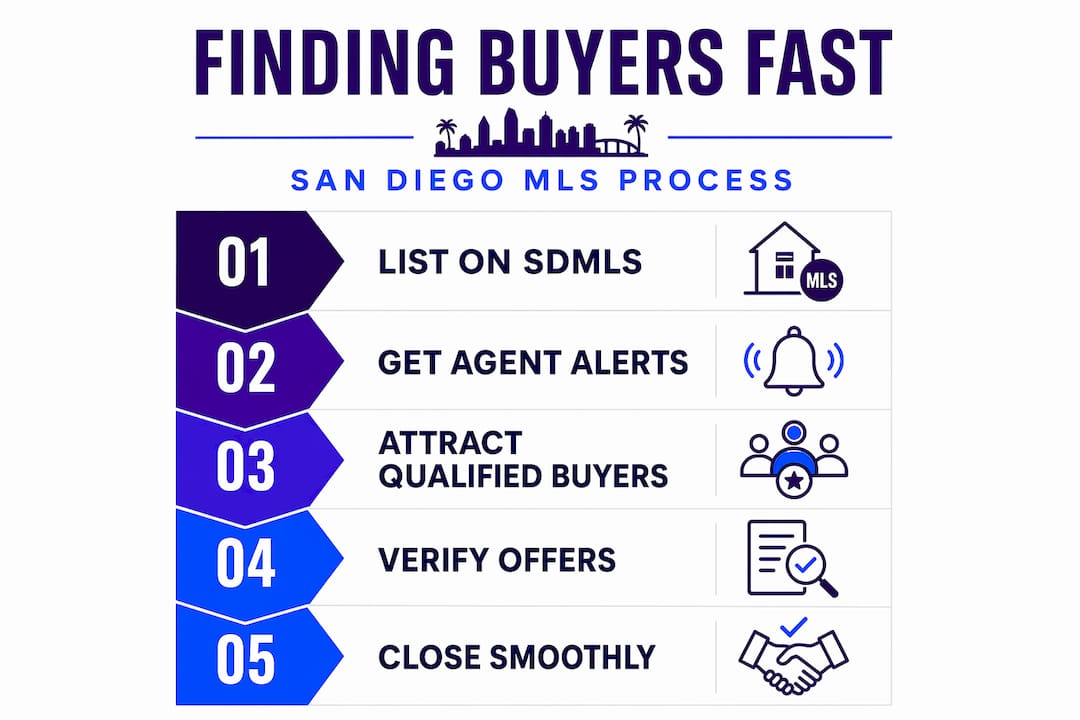
If you are a homeowner working without an agent, consider consulting a local San Diego seller's guide before submitting any listing. The technical details on SDMLS submissions matter more than most homeowners realize.
Attracting and verifying qualified cash buyers
Cash offers are appealing. No financing contingencies, faster closings, fewer surprises. But San Diego has its share of bad actors posing as cash buyers. Learning to identify and verify serious buyers protects both your time and your transaction.
Start with these steps when a cash offer arrives:
- Ask for proof of funds immediately. This should be a bank statement or letter from a financial institution, dated within the last 30 to 60 days.
- Confirm the legal entity making the offer. If the buyer is an LLC or trust, the proof of funds must match that exact entity, not a personal account with the same name.
- Call the issuing institution directly. Use publicly listed contact info, not numbers provided by the buyer. Ask specifically whether the account exists and whether funds are available.
- Request buyer references from previous sellers. Legitimate buyers provide verifiable history, including neighborhoods where they have purchased and seller contacts you can actually call.
- Verify the title company independently. Contact the title company they propose using, confirm the company is legitimate, and confirm their involvement in this transaction. Reputable title companies reduce your exposure to fee manipulation and unresolved title defects.
Pro Tip: If a buyer resists any of these steps, that resistance is your answer. Legitimate cash buyers in San Diego's market move fast but they do not hide their financials.
"Diligence is more important than speed when vetting cash buyers. A deal that falls apart at closing because funds were never real costs far more than taking an extra week to verify." — How to Vet Cash Home Buyers
Sellers navigating complex situations, such as probate or inherited properties, face extra exposure here. Understanding the verification process thoroughly before listing is worth the effort, and resources like a guide to selling inherited homes in San Diego can provide additional context.
Using SDHC programs to expand your buyer pool
One of the most underused strategies for finding real estate buyers in San Diego is making your listing attractive to buyers enrolled in local assistance programs. The San Diego Housing Commission (SDHC) runs programs that materially increase buyer purchasing power, and most sellers ignore them completely.
Here is what you need to know about the two main programs:
- Low-Income First-Time Homebuyer Program: Offers deferred loans and grants to qualifying buyers, including up to 19% of the purchase price as a second trust deed loan plus a $10,000 closing cost grant.
- Middle-Income First-Time Homebuyer Program: Provides a $40,000 deferred down payment loan plus a $10,000 closing cost grant to buyers who meet eligibility.
- Credit score requirement: The middle-income program requires a minimum 640 credit score, no homeownership in the last three years, and a maximum sales price of $1,250,000.
- Loan repayment structure: The middle-income loan amortizes over 120 months starting in Year 6 with no prepayment penalty, making it manageable for working buyers.
- Buyer education: SDHC requires completion of a homebuyer education course, which means buyers entering through this program are more prepared, not less.
How does this help you as a seller or agent? These programs expand the ready-buyer pool precisely where San Diego's high prices create the biggest barrier. A motivated first-time buyer who qualifies for $50,000 in combined assistance is a far stronger candidate than someone still saving for a down payment with no path forward.
Include program eligibility details in your listing notes or buyer marketing materials. Work with agents who understand these programs so they can steer qualified buyers toward your property. Price homes within program limits where possible to stay in consideration for this buyer segment.

Offline and online marketing strategies for connecting with buyers
MLS is the baseline. Getting above average results requires additional effort, and there are specific channels that work well in the San Diego market for connecting with buyers.
Digital channels worth prioritizing:
- Targeted social media ads: Facebook and Instagram allow geographic targeting down to ZIP code. Run ads featuring professional listing photos targeted to San Diego adults in the 28 to 55 age range. The cost per lead is low relative to other paid channels.
- Neighborhood-specific platforms: Nextdoor remains active in San Diego communities. Listing announcements posted there reach actual neighbors who often know buyers looking in the area.
- Google Business presence: If you are an agent, keeping your Google profile updated increases local search visibility when buyers search for agents or listings by neighborhood.
Offline channels that still produce results:
- Attend local real estate meetups and investor events. Wholesaler buyer lists and meetup networks reach off-market buyers who never show up through traditional portals.
- Send direct mail campaigns to feeder neighborhoods. Buyers often come from nearby ZIP codes. A well-designed postcard in Pacific Beach or Mission Hills can reach someone already considering a move.
- Build a buyer database and contact it consistently. Whether you are an agent or a repeat seller, tracking interested buyers and following up monthly keeps you top of mind when they are ready to act.
Pro Tip: Response time matters more than most sellers admit. A buyer who inquires at 7 PM and gets a response at noon the next day has often already moved on. Set up text or email alerts for all inquiries and respond within the hour when possible.
Verifying buyer readiness and closing deals smoothly
Finding interested buyers is one challenge. Getting through closing without delays or surprises is another. Here is a step-by-step process that protects you through both:
- Confirm legal identity first. Before any contract is signed, verify buyer identity and entity with government-issued ID or legal entity documents. Do not skip this for familiar-seeming buyers.
- Review earnest money terms carefully. Standard San Diego contracts include earnest money as a show of good faith. Confirm the amount is reasonable relative to the purchase price and that the timeline for deposit is clear.
- Understand contingencies and deadlines. Financing, inspection, and appraisal contingencies each carry timelines. Know every deadline before signing. Missed dates can unwind deals unexpectedly.
- Keep communication open and documented. All agreement modifications should be in writing. Verbal adjustments between parties create disputes. Use your agent or attorney to document every material change.
- Work with a professional throughout. Sellers who try to manage complex closings solo often find out too late that they missed a disclosure requirement or misread a contingency clause. A local agent familiar with pricing strategy and contract terms is worth every dollar.
Pro Tip: Do not confuse a signed offer with a closed deal. Treat every transaction as incomplete until funds are confirmed and title is transferred. Premature celebration leads to premature mistakes.
My honest take on finding buyers in San Diego
I've watched sellers in San Diego make the same mistake repeatedly. They list on MLS, wait, and assume the market will do the rest. Sometimes it does. More often, the homes that move quickly are the ones where the agent or seller put real work into every layer of the process.
In my experience, the biggest missed opportunity is the SDHC program space. There are motivated, qualified buyers out there who have already completed education courses and secured assistance commitments. Most sellers never market specifically to them. That is leaving a ready-to-close buyer pool untouched.
The cash buyer verification piece is where I've seen deals die the most expensive deaths. Someone accepts an offer, takes the home off market, waits 30 days, and then discovers the proof of funds was from an account the buyer had borrowed against temporarily. By that time, real buyers have moved on.
What actually works is a blend of digital reach, local relationships, and thorough vetting. Use SDMLS to generate exposure. Use local networks and direct mail to access buyers who never show up online. And verify everyone rigorously before committing. San Diego rewards sellers who treat buyer qualification as seriously as buyer outreach.
— Jeff
Work with Jeffsellssandiego to find the right buyer faster

Jeffsellssandiego brings local expertise and a full set of tools to help San Diego homeowners and agents connect with qualified buyers without the guesswork. From SDMLS listing optimization to cash buyer verification support, the process is handled with the kind of local knowledge that only comes from years of residential sales across San Diego neighborhoods.
Whether you are exploring homes for sale and listings to understand the competition, reviewing neighborhood buyer demand, or ready to list your home and want a strategy built around your specific situation, Jeffsellssandiego offers the guidance and tools to get it done. Explore the San Diego neighborhood guide to understand which buyer segments are most active in your area, and reach out directly to build a targeted selling plan.
FAQ
What is the best way to find buyers in San Diego?
Listing on SDMLS is the most effective starting point because listings syndicate immediately to buyer-facing portals across the web. Combining MLS exposure with local networking, targeted social ads, and direct mail produces the best results.
How do I verify a cash buyer in San Diego?
Request a recent proof of funds letter, confirm it matches the legal entity making the offer, and call the issuing financial institution using publicly listed contact information to confirm funds are available before accepting any offer.
Can SDHC programs help me sell my San Diego home faster?
Yes. Marketing your home to buyers enrolled in San Diego Housing Commission assistance programs gives you access to motivated first-time buyers who have completed education requirements and secured down payment support of up to $50,000 combined.
What credit score do buyers need for SDHC middle-income assistance?
The SDHC Middle-Income First-Time Homebuyer Program requires a minimum credit score of 640, no homeownership in the last three years, and a maximum purchase price of $1,250,000.
How do off-market buyer networks work in San Diego?
Off-market buyers are typically accessed through wholesaler buyer lists, real estate investor meetups, and direct mail campaigns. These channels reach buyers who are actively purchasing but not searching through traditional real estate portals.