
Making an offer on a house is the formal process of submitting a written purchase proposal to a seller, including your price, contingencies, and proof of financial readiness. Most buyers treat this step as a simple number exchange. It is far more than that. A well-structured offer signals credibility, reduces the seller's risk, and positions you ahead of competing buyers. This guide breaks down every step, from financial preparation through negotiation, so you can submit with confidence.
How to make an offer on a house: financial preparation first
Your offer is only as strong as the financial proof behind it. 94% of mortgage-using homebuyers obtained a pre-approval letter before submitting offers. That number reflects a simple truth: sellers treat unverified buyers as a risk, not a prospect.
A pre-approval letter confirms that a lender has reviewed your income, credit score, and debt load. It is not a guarantee of funding, but it tells the seller you are a serious, qualified buyer. Without one, most listing agents will not even present your offer to their client.

Beyond pre-approval, you need to understand earnest money. An earnest money deposit typically ranges from 1% to 3% of the offer price. This deposit goes into escrow and signals your commitment. In competitive San Diego markets, a larger deposit can make your offer stand out even when your price matches a competitor's.
Before you write any offer, confirm your funds are liquid and accessible. Delays caused by moving money between accounts or waiting on investment transfers have killed otherwise strong deals.
Key financial steps before submitting:
- Get a pre-approval letter from a licensed lender, not just a pre-qualification
- Confirm your earnest money is in a checking or savings account, ready to wire
- Know your maximum budget, including closing costs, which typically run 2% to 5% of the purchase price
- Review your credit report for errors before the lender does
Pro Tip: Ask your lender for a pre-approval letter specific to the property address. A customized letter reads as more deliberate and prepared than a generic one.
What is the right offer price for a house?
Pricing your offer correctly is the single most consequential decision in the buying process. Analyzing recently sold comparable homes (comps) is the standard method for determining a justified, competitive bid. Sellers rely on actual sale prices, not listing prices, to evaluate whether your offer is reasonable.
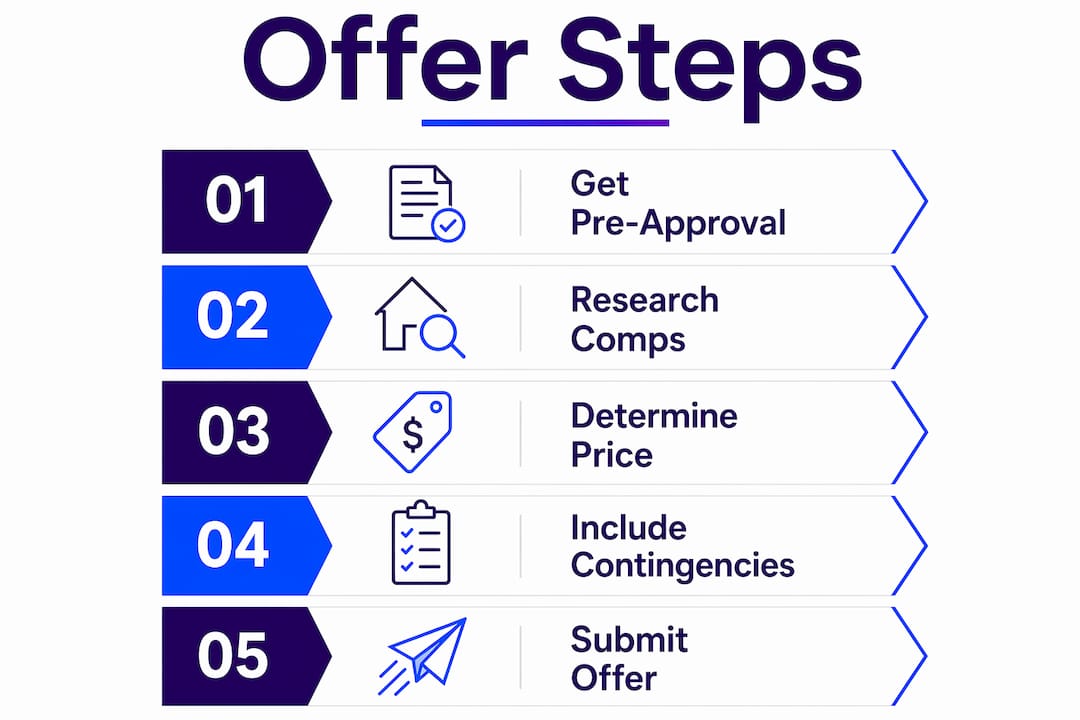
Comps are homes that sold within the past 90 days, in the same neighborhood, with similar square footage, bedroom count, and condition. Your buyer's agent pulls these from the MLS. The goal is to identify a price range the market supports, then position your offer within or above that range based on your goals.
Market conditions shift the math significantly. In a seller's market, where inventory is low and demand is high, offering at or above list price is often necessary. In a buyer's market, you have room to negotiate below asking. San Diego has historically leaned toward seller's market conditions, which means buyers who anchor to list price without checking comps often lose.
| Market condition | Suggested offer strategy |
|---|---|
| Seller's market | At or above list price, fewer contingencies |
| Balanced market | At list price, standard contingencies |
| Buyer's market | Below list price, full contingencies |
| Multiple offers confirmed | Escalation clause, strong earnest money |
Home condition also affects pricing logic. A property with deferred maintenance, an aging roof, or an outdated HVAC system justifies a lower offer. Document those issues before you bid, not after.
Pro Tip: Ask your agent to pull the list-to-sale price ratio for the neighborhood. If homes are consistently selling at 103% of list price, you know the floor before you start.
What contingencies should you include in your offer?
Contingencies are conditions that must be met for the sale to proceed. They protect you as the buyer, but they also introduce uncertainty for the seller. Understanding which ones to include, and when to adjust them, is a core part of making a house purchase offer that wins.
Typical contingencies include financing, inspection, and appraisal, and the inspection contingency alone was used by 66% of buyers in recent surveys. Each one serves a distinct purpose:
- Financing contingency: Protects you if your loan falls through after the offer is accepted. This is non-negotiable for most buyers using a mortgage.
- Inspection contingency: Gives you the right to hire a licensed home inspector and request repairs or credits based on findings. Skipping this is a significant financial risk.
- Appraisal contingency: Protects you if the home appraises below your offer price. Without it, you are contractually obligated to cover the gap in cash.
- Home sale contingency: Allows you to back out if your current home does not sell first. Sellers dislike this one because it introduces a second transaction they cannot control.
Waiving contingencies can make your offer more competitive, but it carries real financial risk if problems surface after closing. The right approach depends on your risk tolerance and how much you know about the property going in. A pre-listing inspection report from the seller, for example, gives you enough information to waive the inspection contingency with more confidence.
Sellers value certainty of closing over the highest price. An offer with fewer contingencies and a strong pre-approval letter often beats a higher offer loaded with conditions.
How do you submit an offer and handle counteroffers?
Submitting an offer means delivering a written purchase agreement to the seller through your agent. Verbal agreements are not legally binding. The offer only becomes a binding contract once both parties sign the formal purchase agreement. Before you can even submit, you are now required to sign a buyer-agent representation agreement with your agent.
The seller has three options after receiving your offer: accept it, reject it, or counter it. A counteroffer is the most common response. It modifies one or more terms, typically price, closing date, or contingencies, and restarts the negotiation clock. You then accept, reject, or counter back.
Tactics that strengthen your position during negotiation:
- Offer a flexible closing date aligned with the seller's timeline. Sellers who need 60 days to move out will favor buyers who accommodate that.
- Write a personal letter to the seller explaining why you love the home. This tactic is not universally effective, but in emotional sales it can tip a close decision.
- Use an escalation clause in multi-offer situations. This automatically increases your bid above competing offers by a set increment, up to your stated maximum.
- Increase your earnest money deposit to signal commitment without raising your offer price.
Pro Tip: In a multiple-offer situation, ask your agent to call the listing agent directly and ask what the seller values most. Sometimes it is price. Often it is a fast close or a specific possession date. Knowing that before you write your offer is a real advantage.
Clear communication between agents matters more than most buyers realize. Misread timelines, missed deadlines, and unclear terms are the most common reasons deals fall apart after acceptance. The due diligence period typically runs 7–10 days after acceptance. During that window, avoid taking on new debt, changing jobs, or missing any documentation requests from your lender.
Key Takeaways
A strong offer combines financial proof, data-driven pricing, and well-chosen contingencies to give sellers confidence and protect buyers from costly surprises.
| Point | Details |
|---|---|
| Pre-approval is non-negotiable | Get a lender-verified pre-approval letter before submitting any offer. |
| Price from comps, not emotion | Use recently sold comparable homes to set a justified, competitive offer price. |
| Contingencies balance risk | Include financing and inspection contingencies unless you have strong reasons to waive them. |
| Earnest money signals commitment | A deposit of 1% to 3% of the offer price shows seriousness and can tip close decisions. |
| Escalation clauses help in bidding wars | Set a clear maximum and let the clause do the incremental work in multi-offer situations. |
What I have learned after years of San Diego offers
The most common mistake I see first-time buyers make is letting excitement drive their number. You fall in love with a house, you picture your furniture in the living room, and suddenly you are offering $30,000 over what the comps support. That emotional premium rarely pays off. The appraisal comes in low, the deal restructures, and you either pay the gap in cash or lose the house anyway.
The buyers who consistently win are the ones who treat the offer as a business decision. They know their comps. They know the seller's timeline. They show up with a clean pre-approval, a meaningful earnest money deposit, and contingencies that are tight but not reckless. That combination tells the seller: this deal will close.
I also see buyers underestimate the value of their agent's relationship with the listing agent. In San Diego's competitive neighborhoods, a quick phone call between agents before an offer is submitted can reveal what the seller actually needs. That information is worth more than any escalation clause. You can read more about common buyer mistakes that derail otherwise strong offers.
The buyers who win are not always the ones with the most money. They are the ones with the clearest, most credible offer on the table.
— Jeff
Working with Jeffsellssandiego to make your best offer
Jeffsellssandiego works with first-time buyers across San Diego to build offers that actually get accepted. That means pulling accurate comps, advising on contingency structure, and communicating directly with listing agents to understand what each seller needs.

Start by browsing current San Diego listings to identify homes that match your budget and goals. When you find a property worth pursuing, Jeffsellssandiego walks you through every step of the offer process, from pre-approval review to final signature. First-time buyers can also explore the buyer's guide for a full breakdown of the purchase process, including what to expect after your offer is accepted.
FAQ
What does a house offer include?
A house offer includes the proposed purchase price, earnest money amount, contingencies, preferred closing date, and any requested seller concessions. It must be submitted in writing to be legally valid.
How much should you offer on a house?
Base your offer on recently sold comparable homes in the same neighborhood. In a seller's market, offering at or above list price is often necessary to compete.
What is an escalation clause in a home offer?
An escalation clause automatically increases your offer above competing bids by a set amount, up to a maximum you define. It helps buyers stay competitive without immediately spending their full budget.
Can you make an offer without a pre-approval letter?
Technically yes, but most sellers and listing agents will not take an unverified offer seriously. Pre-approval confirms your financial readiness and significantly improves your chances of acceptance.
When does a home offer become legally binding?
A home offer becomes legally binding only after both the buyer and seller sign the formal purchase agreement. Verbal agreements carry no legal weight in real estate transactions.