
San Diego's real estate market doesn't reward the unprepared. If you're figuring out how to buy a home in San Diego for the first time, or relocating from another city, you're entering one of the most competitive housing markets in the country. The median home price sits near $900,000, and homes regularly attract multiple offers within days of listing. But here's what most articles won't tell you: with the right preparation, local programs, and a clear process, buying here is more achievable than the headlines suggest.
Table of Contents
- Key takeaways
- Getting your finances ready to buy in San Diego
- Researching San Diego neighborhoods and home types
- Making an offer and handling contingencies
- Completing the purchase: from inspections to closing
- My honest take on buying in San Diego
- Work with Jeffsellssandiego to find your San Diego home
- FAQ
Key takeaways
| Point | Details |
|---|---|
| Financial readiness first | Get pre-approved and understand your true buying range before touring a single home. |
| Local assistance programs exist | SDHC offers up to $40,000 in down payment help for qualifying first-time buyers. |
| Neighborhood research matters | San Diego's communities vary dramatically in price, lifestyle, and long-term value. |
| Contingencies protect your deposit | Always remove contingencies in writing or risk losing your earnest money. |
| Closing has a required timeline | Federal law gives you at least three business days to review the Closing Disclosure before signing. |
Getting your finances ready to buy in San Diego
Before you tour a single property, you need a clear financial picture. San Diego is not the market where you figure out your budget as you go.
What income do you actually need?
Affording the median-priced San Diego home requires a household income of roughly $231,000 under standard lender guidelines. That number surprises most first-timers. Your pre-approval amount is the ceiling, not the target. Look at your monthly obligations, your savings rate, and what payment you could sustain if your income dropped 20%. That exercise alone will sharpen your real number fast.
Mortgage pre-approval and credit
Get pre-approved before you search, not after you fall in love with a house. Pre-approval signals to sellers that you're serious and financially vetted. Pull your credit reports from all three bureaus and dispute any errors before applying. A score above 740 typically gets you the best conventional loan rates, but FHA loans are available with scores as low as 580. For La Jolla mortgage rate tips, local context makes a real difference when comparing lenders.
Down payments and earnest money
The down payment and earnest money are two separate things, and confusing them is one of the most common first-timer mistakes.
- Down payment: typically 3% to 20% of the purchase price depending on your loan type
- Earnest money deposit: usually 1 to 3% of the price, paid upfront to show good faith, and credited toward your total funds at closing (not the purchase price)
- Closing costs: budget an additional 2% to 3% of the purchase price for title fees, lender fees, and prepaid items
Pro Tip: In San Diego, the seller customarily pays for the owner's title insurance policy. Confirm this early since it directly affects how much cash you need at closing.
Local assistance programs worth knowing
The San Diego Housing Commission runs programs that most buyers don't even know exist. Qualifying middle-income households can access up to $40,000 in deferred down payment assistance plus a $10,000 closing cost grant. Income must fall between 80% and 150% of Area Median Income. These programs don't require repayment as long as you meet occupancy requirements, which makes them genuinely useful, not just a marketing line.
Key financial documents to prepare:
- Last two years of federal tax returns
- Two most recent pay stubs
- Two to three months of bank statements
- Current statements for all debt accounts
- Proof of any gift funds if applicable
Researching San Diego neighborhoods and home types
San Diego is not one market. It's a collection of distinct communities with very different price points, commute realities, and lifestyle profiles.

Neighborhoods by budget and lifestyle
The San Diego neighborhoods guide breaks down community options in detail, but here's a practical snapshot to orient your search:
| Neighborhood | Typical price range | Best for |
|---|---|---|
| North Park | $750K to $1.1M | Walkability, arts, young professionals |
| Pacific Beach | $900K to $1.5M | Beach access, outdoor lifestyle |
| Point Loma | $1M to $2M+ | Views, single-family homes, quiet |
| San Carlos | $750K to $1.1M | Families, good schools, inland feel |
| Chula Vista | $550K to $800K | More affordability, newer builds |
Condos and townhomes typically run 20% to 35% less than comparable single-family homes in the same area. If you're learning how to buy a condo in San Diego, factor in HOA fees carefully. Monthly HOA costs between $300 and $700 are common and they affect your debt-to-income ratio during underwriting.
What to evaluate beyond price
San Diego's building approvals move faster than most large California metros, with over 15% of permits approved in eight days. That matters because better supply conditions in certain neighborhoods reduce bidding war pressure. Look at school ratings, walkability scores, and any planned development nearby. A new transit line or commercial project can lift values significantly or disrupt a quiet street. Do the research before you commit, not after.
Evaluation checklist before making an offer:
- School district ratings (even if you don't have kids, they affect resale)
- Average days on market in the last 90 days
- Price per square foot trends over 12 months
- Proximity to your workplace or transit options
- HOA rules and financial health if applicable
Making an offer and handling contingencies
This is where most first-timers either win or lose a home. San Diego is a competitive market, and your offer needs to be structured correctly from day one.
What makes an offer strong here
A strong offer in San Diego goes beyond price. Sellers evaluate your financing type, your contingency timeline, and how clean your terms are. Cash offers still dominate the top tier, but financed offers with a solid pre-approval letter and a short inspection window close competitive gaps significantly.
Here's how to structure your offer step by step:
- Set your offer price based on recent comparable sales, not the list price alone
- Write your earnest money deposit at 1% to 3% of the purchase price to signal commitment
- Include your pre-approval letter from a reputable lender, ideally a local one
- Set contingency timelines that are tight but realistic, typically 7 to 10 days for inspection
- Review the California Residential Purchase Agreement with your agent line by line before signing
- Submit with a personal letter in some cases this can differentiate you in a multiple-offer situation, though fair housing laws require care here
Pro Tip: If you're up against multiple offers, ask your agent for a competitive escalation clause strategy. It lets you automatically beat competing offers up to a ceiling price without going in blind.
Contingencies and why they protect you
California's standard 17-day contingency period covers inspection and disclosures. The contingency window gives you the legal right to cancel and recover your deposit if something serious surfaces. But there's a catch that trips up many buyers.
To protect your earnest money, you must remove contingencies in writing using the California Form CR. Verbal notice is not valid under California law, and missing the written deadline means your deposit could be at risk.
Do not let the deadline slip without a clear decision made in writing. Your agent should track this date on a calendar alongside every other deadline in your contract.
Completing the purchase: from inspections to closing
Offer acceptance is not the finish line. It's the starting gun for the most detail-intensive phase of the process.
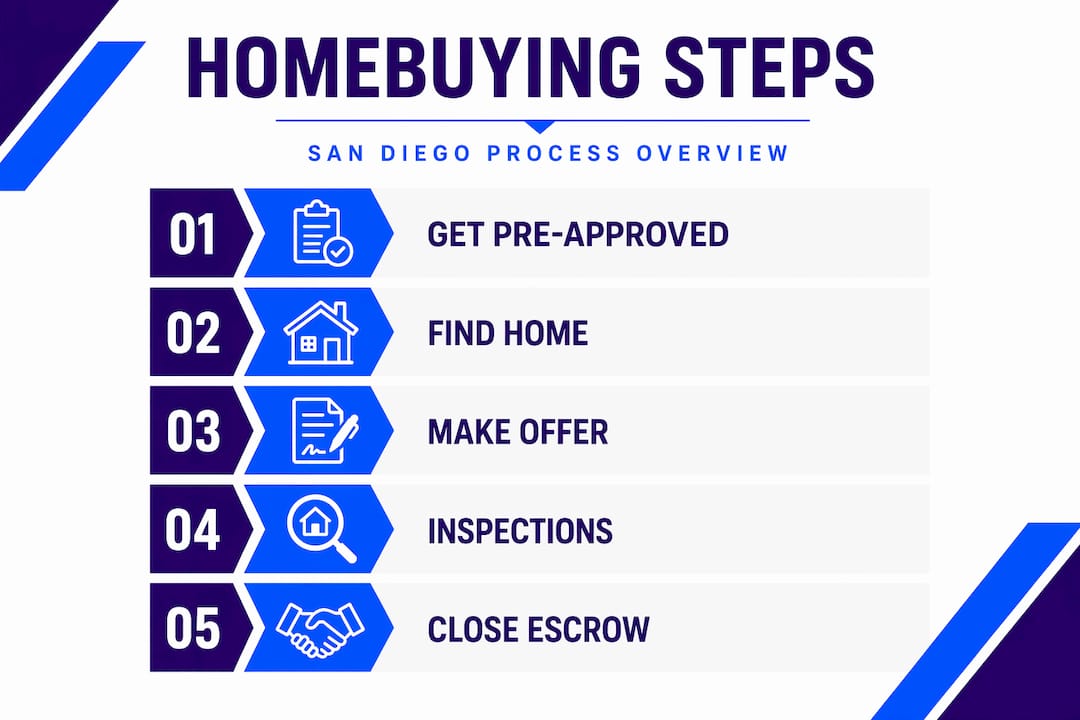
Inspections and disclosures
Never skip the home inspection, regardless of market pressure. Waiving inspections to compete removes one of your strongest protections as a buyer. A general inspection typically costs $400 to $600 and covers the structure, roof, electrical, plumbing, and HVAC. In San Diego, add a sewer lateral inspection and check for termites given the climate conditions. Sellers are required to disclose known defects, but disclosures only cover what the seller knows or should know. Your inspector is your independent set of eyes.
Post-acceptance checklist:
- Schedule general home inspection within 5 days of acceptance
- Order sewer scope and termite inspection separately
- Review seller disclosures alongside inspection findings
- Request repairs or a price reduction if material defects surface
- Submit written contingency removal by the deadline or formally cancel
Finalizing your mortgage
Your lender will order an appraisal after the offer is accepted. If the appraisal comes in below the purchase price, you either renegotiate, cover the gap in cash, or exercise your appraisal contingency to cancel. This is a real scenario in San Diego's market and it happens more than buyers expect.
Underwriting typically takes 2 to 3 weeks. Stay available, respond to document requests same-day, and do not make any major financial changes during this period. No new credit cards, no large purchases, no job changes.
The closing process explained
The Closing Disclosure must arrive at least three business days before closing. If the APR changes by more than 0.125% after the initial disclosure is sent, a new three-day review period restarts. Use those three days to compare every line against your Loan Estimate from when you applied.
| Closing stage | Timeline | What you do |
|---|---|---|
| Appraisal ordered | Days 1 to 7 post-acceptance | Provide access to the property |
| Underwriting review | Days 7 to 21 | Respond to all lender conditions |
| Closing Disclosure received | 3 business days before close | Review and confirm all numbers |
| Final walkthrough | Day before or morning of closing | Verify condition matches contract |
| Signing and funding | Closing day | Sign documents, wire closing funds |
After closing, record title transfers within 24 hours in San Diego County. You can then begin planning any updates or moving timelines with confidence that the property is legally yours.
My honest take on buying in San Diego
I've worked with buyers at every level in this market, and the biggest predictor of success isn't budget. It's preparation. The buyers who struggle most are the ones who start touring homes before they have their financing dialed in, then rush into an offer because they feel behind. San Diego's market punishes that approach.
The SDHC assistance programs genuinely changed outcomes for several clients I've worked with this past year. Most buyers I talk to have never heard of them. A $40,000 deferred loan on a $750,000 purchase doesn't just help with the down payment. It keeps more cash in reserve after closing, which reduces post-purchase financial stress significantly.
I've also seen buyers waive inspection contingencies to win and then discover foundation issues, unpermitted additions, or failing HVAC systems. The short-term win becomes a long-term loss. In my experience, a well-written offer with reasonable contingencies beats an aggressive, contingency-free offer on seller-priced homes more often than buyers expect. Sellers want clean closings, not just high numbers.
The advice I give every client is simple. Research open house questions, understand the Pacific Beach market conditions before committing to a neighborhood, and treat your agent as a strategic partner, not just a door opener. The right local knowledge compresses your timeline and protects your money.
— Jeff
Work with Jeffsellssandiego to find your San Diego home
Buying a home in San Diego requires more than a search app and a wishlist. It takes someone who knows the neighborhoods, watches the inventory daily, and understands how to structure offers that actually win.

Jeffsellssandiego works directly with first-time buyers and relocating professionals through every step of the San Diego property buying process, from pre-approval strategy through closing day. Whether you're searching for a condo in North Park, a single-family home in San Carlos, or exploring what your budget gets you across different areas, the San Diego listings search is the right place to start. You can also explore the full buyer's guide to understand exactly what to expect at each stage. The goal is straightforward: get you into the right home at the right terms, with no surprises at closing.
FAQ
What credit score do you need to buy a home in San Diego?
Most conventional loans require a minimum score of 620, but a score of 740 or above gets you significantly better rates. FHA loans allow scores as low as 580 with a 3.5% down payment.
How much do you need to earn to buy in San Diego?
Affording the median-priced home near $900,000 requires roughly $231,000 in household income under standard lender qualification guidelines.
What is the San Diego property buying process timeline?
From accepted offer to closing typically takes 30 to 45 days with a financed purchase. Cash transactions can close in as little as 10 to 14 days depending on title and escrow scheduling.
Can first-time buyers get down payment help in San Diego?
Yes. The San Diego Housing Commission offers qualifying buyers up to $40,000 in deferred down payment assistance plus a $10,000 closing cost grant for middle-income households.
What happens if I miss a contingency deadline in San Diego?
If you miss the written contingency removal deadline, your earnest money could be at risk. Verbal cancellation is not valid under California law. Always use the written Form CR and track every deadline on a shared calendar with your agent.