
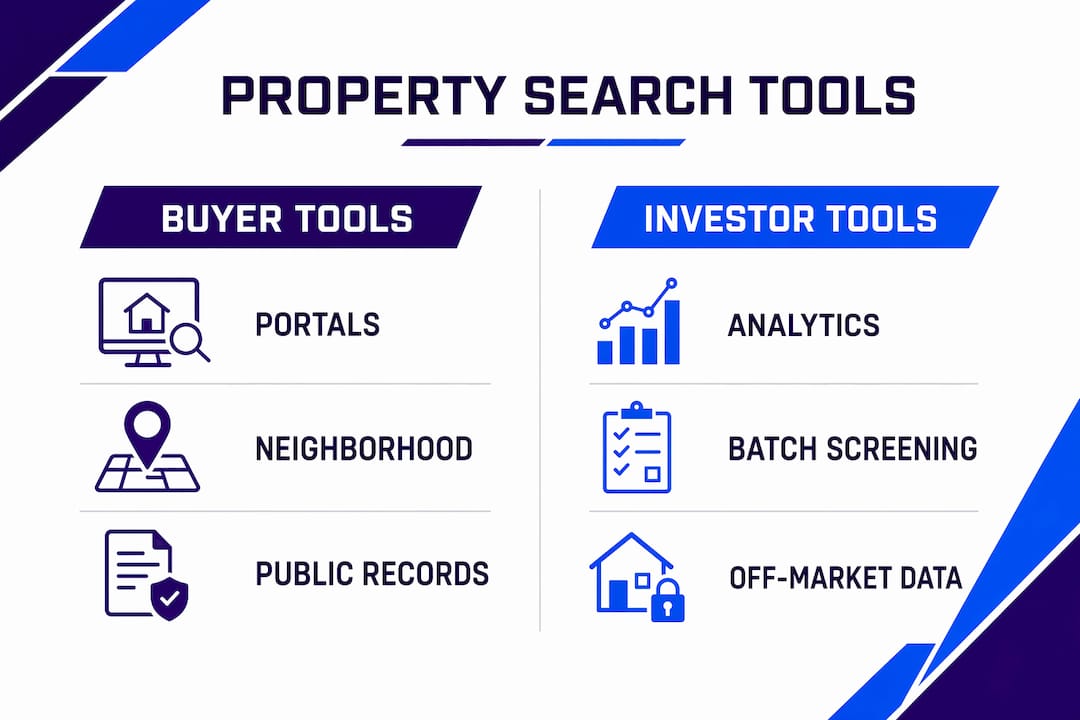
For most U.S. buyers and investors in 2026, the sharpest setup is a national portal for discovery paired with a dedicated analytics or due-diligence platform for verification. No single tool does everything well, but the right combination by job cuts wasted time significantly.
The 2026 shortlist by job:
- Homebuyers (broad search): Zillow or Realtor.com for discovery; Redfin for real-time MLS accuracy
- Investors (screening and ROI): Mashvisor or PropStream for rental estimates, cap rates, and batch screening
- Due diligence (ownership and records): PropertyShark for deed history, tax records, and lien checks
- Neighborhood analysis: Walk Score or NeighborhoodScout for walkability, school ratings, and crime overlays
- Rural and land buyers: LandWatch for parcel-level listings with acreage and zoning data
- Agents and buyer-agent workflows: Market Leader or Altos for IDX alerts, CRM integration, and market trend data
Pro Tip: Experienced buyers often run two or three tools in combination: a broad portal for discovery, a real-time MLS source for accuracy, and an investor analytics product to close blind spots.
Table of Contents
- What are the best property search tools for each job in 2026?
- How do general listing portals actually help you find a home?
- What do investor analytics platforms give you that portals don't?
- What can public-records platforms tell you before you make an offer?
- How do neighborhood analytics tools help you narrow your search?
- What tools do you need to search for land and rural properties?
- Why does it matter which tools your agent uses?
- How do you choose the right property-search tool for your situation?
- When tools aren't enough: a San Diego agent's perspective
- How these picks were chosen: evaluation criteria for 2026
- Key Takeaways
- Working with buyers in San Diego in 2026
- Ready to search San Diego with an agent who knows the market?
- Useful sources and further reading
What are the best property search tools for each job in 2026?
The right tool depends entirely on what you are trying to do. A first-time buyer browsing neighborhoods needs something very different from an investor screening 50 markets for cap rate.

| Best For | Recommended Tool Category | Pricing Model | Key Caveat |
|---|---|---|---|
| Homebuyers | National portal (Zillow, Realtor.com, Redfin) | Free / freemium | Listing freshness varies; Redfin refreshes very frequently, offering near real-time listing updates |
| Investors | Investor analytics platform (Mashvisor, PropStream) | Paid subscription | Cross-check against county records before acting |
| Due diligence | Public-records platform (PropertyShark) | Freemium / paid tiers | Legal interpretation still requires a title professional |
| Neighborhood analysis | Lifestyle analytics (Walk Score, NeighborhoodScout) | Free / paid tiers | Scores reflect averages, not block-level nuance |
| Rural / land buyers | Land-specialist portal (LandWatch) | Free to browse | County parcel data gaps are common in rural areas |
| Agents / buyer workflows | IDX/CRM platform (Market Leader, Altos) | Enterprise / subscription | Agent-curated; selection reflects agent's filter choices |
Combining tools is often the right call. A buyer using a national portal alongside a neighborhood analytics tool covers both listing discovery and lifestyle fit in one workflow. Investors who add a public-records check to their analytics platform catch title issues before they become expensive surprises.
Altos deserves a specific callout here. It tracks active listing prices, days on market, and inventory trends at the ZIP-code level in near real time, which makes it genuinely useful for timing decisions rather than just property discovery.
How do general listing portals actually help you find a home?
National portals are where most searches start, and for good reason. Zillow, Realtor.com, and Redfin aggregate millions of listings across every U.S. market, support map-based browsing, and offer saved-search alerts that notify buyers when new inventory matches their criteria.
What portals do well:
- Broad multi-market discovery with map and radius search
- Pre-market and preview feeds (Zillow Preview launched in March 2026, letting buyers browse homes before they hit the open market)
- Affordability calculators, mortgage rate tools, and school-district overlays built into the search interface
- Mobile apps with strong UX and push notifications for new listings
Where portals fall short:
- Listing data can lag behind MLS feeds on non-Redfin portals; a home may show as active hours after it goes under contract
- Duplicate records and stale listings appear more often on aggregator-heavy portals
- AVM accuracy varies; Redfin Estimate has a low median error rate compared to most public AVMs, but remains a starting point rather than an appraisal, which remains a starting point rather than an appraisal
Pro Tip: Set up saved searches on two portals simultaneously. Redfin's 5-minute refresh cadence means it often surfaces new listings faster than competitors, which matters in fast-moving markets.
Realtor.com added an AR scanning feature in 2026 that lets users point their phone at a house and surface listing details instantly. That kind of tool is genuinely useful for buyers driving neighborhoods, not just browsing from a couch.
Several portals also integrated conversational AI search by 2025–2026, letting buyers describe what they want in plain language rather than toggling filters. The underlying data is the same, but the experience is noticeably faster for buyers who know what they want but struggle with dropdown menus.
| Portal | Update Frequency | AVM Available | Pre-Market Feature | Mobile App |
|---|---|---|---|---|
| Redfin | Every 5 minutes | Yes (1.77% median error on-market) | Limited | Yes |
| Zillow | Varies (hours) | Yes (Zestimate) | Zillow Preview (March 2026) | Yes |
| Realtor.com | Near real-time (MLS-fed) | Yes | Limited | Yes (AR scan feature) |
What do investor analytics platforms give you that portals don't?
Portals show you what is listed. Investor platforms show you whether buying it makes financial sense. That gap is where tools like Mashvisor and PropStream earn their subscription fees.
Core features to expect from an investor analytics platform:
- Rental income estimates (short-term and long-term) based on comparable rentals in the area
- Cap rate and cash-on-cash return calculations at the property level
- Batch screening across multiple markets or ZIP codes simultaneously
- Ownership data, equity filters, and off-market lead generation
Who should pay for a subscription:
- Active investors analyzing more than a handful of properties per month
- Buyers considering house-hacking or short-term rental strategies
- Anyone making offers in markets where rental demand data is thin
Investor-focused platforms like PropStream and DealMachine emphasize batch screening, equity filters, and off-market signals, which are features that simply do not exist on consumer portals. Mashvisor adds a neighborhood-level heatmap that color-codes markets by rental yield, which is a fast way to eliminate underperforming ZIP codes before running deeper numbers.
The critical trade-off: investor platforms aggregate data from multiple sources, and that aggregation introduces lag. Rental estimates reflect recent comparable data, not today's Craigslist market. For any serious acquisition, cross-check pipeline results against county tax records and recent sold comps before locking in a cap-rate assumption. One wrong rent input can flip a deal from profitable to break-even.

Pricing for investor analytics platforms typically runs from a few hundred dollars per month for individual subscriptions to enterprise tiers for teams. Most offer a free trial or a limited free tier, which is worth testing before committing.
What can public-records platforms tell you before you make an offer?
A listing page tells you what a seller wants you to know. A public-records platform tells you what the county actually recorded. That distinction matters most in the due-diligence window between accepted offer and close.
What these platforms surface:
- Deed history and ownership chain (who owned it, when, and for how much)
- Tax assessment history and current tax liability
- Open liens, judgments, and encumbrances
- Recorded easements and right-of-way data
- Foreclosure and pre-foreclosure status
PropertyShark is the most cited due-diligence platform in this category for U.S. markets. It pulls from county recorder offices, tax assessor databases, and court records to build a property profile that goes well beyond what any portal shows. The freemium tier covers basic ownership data; the paid tiers unlock full lien history and comparable sales.
Pro Tip: Before making an offer on any property, run a quick PropertyShark check on the ownership chain. A title with multiple transfers in a short window, or an open lien that the listing agent did not disclose, is a signal to slow down and involve a title professional.
| Platform Type | Data Depth | Typical Cost | Best Use |
|---|---|---|---|
| Public-records platform (e.g., PropertyShark) | Deeds, liens, tax history, ownership chain | Freemium to paid tiers | Pre-offer due diligence |
| County assessor website | Tax records, assessed value | Free | Quick tax liability check |
| Title company report | Full title search, encumbrances | Paid (part of closing costs) | Final legal clearance |
Red flags in records that warrant deeper investigation: ownership transferred multiple times in under 12 months, a lien from a contractor or municipality that is not reflected in the listing price, or a gap in the ownership chain with no recorded deed. None of these are automatically disqualifying, but all of them require a title professional's review before you close.
How do neighborhood analytics tools help you narrow your search?
Listing data tells you the price and the square footage. Neighborhood analytics tell you whether you will actually want to live there. Walk Score, NeighborhoodScout, and similar tools fill that gap with data that portals either omit or bury.
What neighborhood analytics platforms provide:
- Walk Score, Transit Score, and Bike Score at the address level
- School ratings and district boundary overlays
- Crime incident data and trend lines
- Climate and environmental risk scores (flood, fire, heat, wind)
- Demographic and income data at the census-tract level
Multiple apps now include 20–30 neighborhood overlay layers covering crime, commute, walkability, schools, and climate risk, which reflects how central lifestyle fit has become to the search process in 2026.
A data-quality note: Walk Score and school ratings are averages. A neighborhood with a Walk Score of 78 may have one block that scores 90 and another that scores 55. Crime overlays reflect reported incidents, not unreported ones, and the data source matters. NeighborhoodScout uses FBI Uniform Crime Report data, which is more standardized than some app-level overlays that pull from inconsistent local sources.
Pro Tip: Combine map overlays with local sources. A school's GreatSchools rating is a useful filter, but the district boundary map matters more. A home two blocks outside a top-rated district boundary is a different investment than one inside it, even at the same price.
| Tool | Key Data | Free Tier | Standout Feature |
|---|---|---|---|
| Walk Score | Walkability, transit, bike scores | Yes | Address-level scoring |
| NeighborhoodScout | Crime, school, demographic data | Limited | FBI-sourced crime data |
| Climate risk overlays (portal-integrated) | Flood, fire, heat, wind risk | Yes (in major portals) | Property-level risk scores |
NearThere takes a different approach in dense urban markets. Its AI-powered place search lets buyers in New York City search by transit access, school proximity, and visual features like floor-to-ceiling windows, which is a level of specificity that standard filter interfaces cannot match.
What tools do you need to search for land and rural properties?
Land searches break most residential portals. The data types are different, the listing sources are different, and the due-diligence requirements are more complex. A portal built for suburban condos is not going to show you soil classifications or recorded easements on a 40-acre parcel.
What land-specific tools index:
- Parcel boundaries and acreage
- Zoning and land-use codes
- Soil type and agricultural suitability data
- Recorded easements, right-of-way, and access roads
- Water rights and mineral rights (where applicable)
LandWatch is the most widely used land-specialist portal in the U.S. It aggregates rural and agricultural listings that never appear on Zillow or Realtor.com, and it supports parcel-level filtering by acreage, price per acre, and land use. The basic search is free; some premium listing features carry fees.
Pro Tip: For any rural parcel, pull the county GIS parcel map alongside the LandWatch listing. County GIS data often shows easement lines and access roads that the listing description omits entirely.
Practical checklist before visiting a rural parcel:
- Confirm legal access (deeded road access vs. easement vs. no recorded access)
- Check zoning and permitted uses with the county planning department
- Review the county assessor record for tax liability and any back taxes owed
- Identify any recorded easements (utility, pipeline, conservation)
- Verify water source (well, municipal, or surface water rights)
Pros and cons of land-specialist portals:
- Coverage is strong for listed parcels but misses off-market rural land, which often sells through local brokers or word of mouth
- County records variability is real: rural counties often have incomplete or poorly digitized parcel data
- Acreage and boundary data in listings should always be verified against a survey before closing
Why does it matter which tools your agent uses?
The tools an agent uses directly affect what you see and how fast you see it. An agent running a modern IDX platform with CRM integration can push a new listing to your phone within minutes of it hitting the MLS. An agent working off a manual search delivers it when they check their email.
How IDX and CRM tools work for buyers:
- IDX (Internet Data Exchange) gives agents licensed access to the full MLS feed, including listings that never appear on public portals
- CRM platforms let agents set up automated searches tied to a buyer's criteria, with alerts triggered by new listings, price drops, or status changes
- Agent-facing platforms enable client-facing apps, CRM integration, and lead-to-showing workflows that control the search experience end to end
Market Leader and Altos are two platforms agents use to manage buyer searches and track market conditions. Market Leader focuses on lead management and client communication; Altos tracks active listing data and market trends at the ZIP-code level, which agents use to advise buyers on timing.
Pro Tip: Ask any agent you are considering working with which IDX platform they use and how quickly their system alerts you to new listings. In a market where homes go under contract in days, a 24-hour alert delay is a real competitive disadvantage.
The integration angle matters too. Agents using platforms that connect IDX search with mortgage pre-approval tools and e-signature workflows can compress the time from "found it" to "offer submitted" significantly. For buyers who want access to private previews or off-market opportunities, an agent with the right network and tools is the only path in.
How do you choose the right property-search tool for your situation?
Start with the job, not the feature list. The tool that is right for a first-time buyer in a suburban market is not the same one that is right for an investor screening 20 markets for short-term rental yield.
Step-by-step selection checklist:
- Define your job: discovery, investment screening, due diligence, neighborhood analysis, or land search
- Identify the data types you need: listing data, ownership records, rental estimates, parcel data, or neighborhood overlays
- Check update frequency: for active buyers, anything slower than same-day MLS updates is a liability
- Test the free tier before paying: most platforms offer a trial or limited free access
- Verify data sources: ask whether the platform pulls from MLS feeds, county records, or third-party aggregators, and how often each source refreshes
- Check mobile app quality: if you are searching on the go, a weak mobile experience will slow you down
- Confirm customer support: tutorials, live chat, and community forums matter when you hit a data discrepancy
Questions to ask a tool vendor or subscribing agent:
- Where does your listing data come from, and how often does it refresh?
- Do you pull directly from MLS feeds or from a third-party aggregator?
- What is the typical lag between a status change (active to pending) and your platform reflecting it?
- Is there a trial period, and what data is restricted in the free tier?
Red flags that should make you pause:
- No disclosed data source or refresh cadence
- Pricing that is not publicly listed
- AVM figures with no stated methodology or error rate
- Customer support limited to a help-center article with no live option
- Mobile app reviews citing frequent data errors or sync failures
A house-hunting spreadsheet alongside your tool stack is underrated. Tracking what you have seen, the data you pulled, and your notes from each property keeps your search organized when you are comparing 15 listings across three tools.
Pro Tip: The CFPB's AVM quality-control standards set a federal baseline for how lenders must validate automated valuations. When a tool's AVM methodology is vague, that standard is a useful benchmark to reference.
When tools aren't enough: a San Diego agent's perspective
Tools are excellent at surfacing data. They are poor at interpreting what that data means in a specific neighborhood on a specific street in a specific week. That gap is where local agent knowledge earns its keep.
In San Diego, micro-neighborhood dynamics can shift a property's real value by tens of thousands of dollars in ways that no AVM captures. A home in North Park priced at the Zestimate may be underpriced because the AVM missed a recent school-boundary redraw. A home in Point Loma priced above AVM may be entirely justified by a view corridor that the algorithm cannot see.
Where tools consistently miss local nuance:
- Timing: a tool shows a listing is active; a local agent knows the seller had two offers fall through and is now motivated
- Off-market opportunities: private previews and pocket listings never appear on any portal
- Micro-neighborhood value drivers: school boundaries, noise corridors, HOA health, and planned development nearby
- Negotiation context: knowing whether a listing agent is known for firm pricing or open to creative terms
Pro Tip: Combine a VIP agent-led search with two public tools for monitoring: use Redfin for real-time listing alerts and Walk Score to pre-screen neighborhoods, then let your agent handle the interpretation and the offer strategy. That combination covers discovery, lifestyle fit, and local expertise without redundancy.
For buyers working in San Diego's competitive coastal neighborhoods, San Diego-specific search tactics matter as much as the tools themselves. The inventory moves fast, and the difference between a good offer and a winning one often comes down to timing and relationship, not data.
What a local agent adds that tools cannot replicate:
- Real-time market intelligence from active showings and agent-to-agent conversations
- Access to listings before they hit the MLS through professional networks
- Negotiation strategy informed by the specific listing agent's history and the seller's situation
- Coordination with lenders, inspectors, and title companies to compress the timeline
How these picks were chosen: evaluation criteria for 2026
Every tool in this roundup was evaluated against a consistent set of criteria. The goal was to identify which platforms genuinely serve their stated use case, not which ones have the most features or the biggest marketing budgets.
Evaluation criteria:
- Data coverage: MLS access, county records integration, and geographic completeness
- Update frequency: how quickly listing status changes and new inventory appear
- Investor metrics: rental estimates, cap rate calculations, and batch screening capability
- UX quality: web and mobile experience, search filter depth, and alert reliability
- Pricing transparency: publicly listed tiers, trial availability, and value relative to cost
- Customer support: documentation quality, response time, and community resources
Data sources checked:
- Direct MLS feed disclosures from platform documentation
- County recorder and tax assessor records (cross-referenced against platform outputs)
- Product documentation and published feature changelogs for 2025–2026 updates
- Published Investopedia March 2026 roundup for category benchmarking
Testing approach: sample searches were run in multiple U.S. markets, including San Diego County, to compare listing freshness, AVM outputs, and neighborhood data against known county records. Mobile UX was reviewed on both iOS and Android for the major portals.
| Evaluation Dimension | Weight in Selection | Primary Source |
|---|---|---|
| Data coverage and MLS access | High | Platform disclosures, MLS documentation |
| Update frequency | High | Published refresh cadences, user reports |
| Investor metrics depth | Medium (investor tools only) | Platform feature docs |
| Pricing transparency | Medium | Publicly listed pricing pages |
| Mobile UX quality | Medium | Direct testing, app store reviews |
| Customer support quality | Low | Documentation review, support channel testing |
No platform paid for inclusion. Tools were selected based on use-case fit and data quality, not affiliate relationships.
Key Takeaways
The single most effective approach to property search in 2026 is pairing a real-time portal for discovery with a specialized platform for verification, whether that means investor analytics, public records, or neighborhood data.
| Point | Details |
|---|---|
| Match tool to job | Portals for discovery, investor platforms for ROI screening, public-records tools for due diligence. |
| Verify AVM figures | Automated valuations are starting points; cross-check against county records and recent sold comps before acting. |
| Prioritize update frequency | In fast markets, a portal that refreshes every 5 minutes beats one that lags by hours. |
| Land searches need specialist tools | National portals miss parcel data, easements, and zoning; use LandWatch and county GIS for rural parcels. |
| Jeffsellssandiego adds what tools can't | A local San Diego agent provides off-market access, negotiation strategy, and micro-neighborhood context no platform replicates. |
Working with buyers in San Diego in 2026
The tools in this roundup are genuinely good. Redfin's refresh speed, PropertyShark's records depth, Mashvisor's rental heatmaps — these are real capabilities that buyers and investors should use. But after working with buyers across San Diego's neighborhoods, the pattern is consistent: the tools surface the opportunity, and the agent closes it.
A recent buyer came in having done serious homework. They had Redfin alerts set up, had run Walk Score on every neighborhood they were considering, and had pulled PropertyShark records on three properties they liked. That preparation was excellent. What the tools could not tell them was that one of those three properties was about to receive a competing offer from a buyer their agent knew, or that the seller on another property had already turned down two offers and was now open to a creative structure. That intelligence came from the network, not the data.
Tools inform the decision. They do not make it. For buyers who want both the data and the local expertise, the combination is what actually works.
This article reflects general information about property-search tools and is not legal, financial, or investment advice. Confirm current tool features, pricing, and data coverage directly with each platform before making decisions.
Ready to search San Diego with an agent who knows the market?
The tools in this guide will get you further than most buyers get on their own. But in San Diego's competitive coastal market, the buyers who win are the ones who combine good data with an agent who knows which listings are worth moving on fast, and which ones have hidden issues the data does not show.

Jeffsellssandiego offers a VIP home search that pairs personalized listing alerts with direct agent access across San Diego County's neighborhoods, from Pacific Beach to Point Loma to San Carlos. You get the data and the local read, without having to piece together five tools and hope they agree.
If you are buying or selling in San Diego, the buyer's guide is the clearest next step: it walks through the full process, what to expect at each stage, and how Jeffsellssandiego's approach fits your timeline. Reach out directly to start a search built around your specific criteria.
Useful sources and further reading
A short annotated list of the primary sources used for claims in this article, plus additional reading for buyers and investors who want to go deeper.
-
CFPB: Quality Control Standards for Automated Valuation Models — The federal rule setting quality-control requirements for AVMs used by lenders. Useful benchmark when evaluating any platform's valuation methodology.
-
Investopedia: Best Real Estate Apps for March 2026 — Category roundup used for benchmarking app strengths and AVM accuracy claims. Covers best-overall and best-by-use-case picks with methodology notes.
-
Android Hire: Best Real Estate and Mortgage Apps in 2026 — Source for Redfin's 5-minute refresh cadence, 1.77% median AVM error rate, and 2026 AI/conversational search feature launches across major portals.
-
HousingWire: The 14 Best Real Estate Apps for Agents in 2026 — Covers agent-facing IDX and CRM platforms, client app workflows, and how agent tools shape the buyer experience.
-
HudaSoft: Top Real Estate Apps Reviewed for 2026 — Source for investor platform features (batch screening, equity filters, off-market signals) and the 20–30 neighborhood overlay layers now standard in major apps.
-
Realtor.com — Primary MLS-fed portal; used as a reference for listing coverage, affordability tools, and the 2026 AR scanning feature.
-
Zillow — Reference for Zestimate methodology, Zillow Preview pre-market feature (launched March 2026), and portal-level listing coverage.
-
NearThere: AI-Powered NYC Home Search — Example of niche, city-focused AI search by place, transit, and visual property features; cited in the neighborhood analytics section.
-
Jeffsellssandiego: Property Search Tips for San Diego Buyers in 2026 — San Diego-specific search tactics that complement the national tools covered here.
-
Attain RE: Agent Workflows and Local Tools — Partner resource covering agent-delivered search experiences and local workflow tools for buyers comparing DIY and agent-assisted approaches.
Cross-check any listing you are serious about against MLS data or county records before making an offer. Portal data is a starting point, not a final source.