
A settlement statement is the itemized financial document that records every dollar changing hands at a real estate closing — who pays what, who receives what, and the final cash-to-close or net proceeds figure. According to the Consumer Financial Protection Bureau, it serves as the official record of the transaction's debits and credits, and it's the document you'll want to scrutinize before you ever pick up a pen at the closing table. The three forms you're most likely to encounter are the Closing Disclosure (TRID), the HUD-1 settlement statement, and the ALTA settlement statement — each tied to a different transaction type or regulatory framework.
Key Takeaways
A settlement statement is the binding financial record of your closing, and reviewing it carefully before you sign is the single most effective way to protect your proceeds or your cash-to-close.
| Point | Details |
|---|---|
| Know your form | Most mortgage buyers receive a Closing Disclosure; reverse mortgages and cash deals use HUD-1 or ALTA statements. |
| Three-day rule | Lenders must deliver the Closing Disclosure at least three business days before closing — use that window to review. |
| (p.o.c.) items don't change your total | Costs marked "paid outside of closing" are informational only and excluded from your final cash-at-settlement figure. |
| Keep it permanently | Closing costs can adjust your property's cost basis, affecting capital gains taxes when you sell. |
| Jeffsellssandiego reviews statements | A pre-closing agent review catches payoff errors, missing credits, and duplicate fees before they delay your recording. |
Table of Contents
- What type of settlement statement will you actually see?
- Who prepares it and when should you expect it?
- How to read the line items on your settlement statement
- Key checks to run before you sign
- How to get a copy before and after closing
- Where to find official sample forms
- San Diego closing checklist: what to bring and what to confirm
- What a San Diego agent actually does with your settlement statement
- Ready for a settlement statement review before you close?
- Sources
What type of settlement statement will you actually see?
The answer depends on your loan type and when you're closing. Chase's mortgage education resource draws a clean line: the Closing Disclosure is a standardized federal form for most mortgages, while settlement statements are broader transactional breakdowns used for cash purchases or seller-side summaries.
Closing Disclosure (TRID). Effective October 3, 2015, the Closing Disclosure replaced the HUD-1 for most standard residential mortgage transactions. If you're buying with a conventional, FHA, or VA loan originated after that date, this is your form. The lender prepares it, and federal law requires you to receive it at least three business days before closing.
HUD-1 / HUD-1A. The HUD-1 settlement statement still applies to reverse mortgages and certain loan types not covered by TRID. The HUD-1A is a shorter version used when there's no seller (refinances, for example). Both organize charges into numbered line series — a structure explained in detail below.
ALTA settlement statement. Title and settlement companies use ALTA-published templates to produce separate buyer and seller statements that itemize fees and charges in a format the title industry standardized. You may see an ALTA statement alongside a Closing Disclosure in many purchase transactions, particularly in California escrow-based closings.
| Form | Transactions | Who prepares it | When you receive it | Legal/recordkeeping role |
|---|---|---|---|---|
| Closing Disclosure | Purchase/refi mortgages after Oct 3, 2015 | Lender | At least 3 business days before closing | Required federal disclosure; keep permanently |
| HUD-1 / HUD-1A | Reverse mortgages, non-TRID loans | Settlement/escrow agent | At or before closing | Official HUD form; keep permanently |
| ALTA statement | Cash purchases, any transaction | Title/escrow company | At or before closing | Title-industry standard; keep permanently |
Who prepares it and when should you expect it?
The settlement or closing agent typically drafts the statement. In California, that's usually the escrow company. In states that use attorneys for closings, the closing attorney handles it. For TRID-covered loans, the lender prepares the Closing Disclosure portion directly.
The three-business-day rule for the Closing Disclosure is firm: your lender must deliver it at least three business days before the scheduled closing date. That window exists precisely so you can compare it against your Loan Estimate and flag discrepancies before you're sitting at the table. For HUD-1 transactions, the settlement agent is required to provide the completed form at or before settlement, though requesting a draft 24 hours early is standard practice and worth asking for.
Sellers often receive their statement later than buyers — sometimes only on the day of closing. If you're selling, ask your escrow officer or real estate agent for a preliminary seller's statement at least two days out. Catching a payoff error or a missing HOA credit then is far easier than correcting it at the wire.
How to read the line items on your settlement statement
The HUD-1 organizes charges into numbered series. Understanding the structure makes the document far less intimidating.
- 100 series (buyer's gross amount due): Line 101 is the contract sales price. Lines 102–109 cover personal property and other items paid by the buyer.
- 200 series (amounts paid by or on behalf of the buyer): Line 201 is the earnest money deposit. Line 202 is the principal amount of the new loan. Credits from the seller appear here too.
- 300 series (cash at settlement): Line 303 shows the net cash the buyer must bring — or receive — at closing.
- 400/500 series (seller's side): Line 401 mirrors the contract price. The 500 series shows reductions in the seller's proceeds: existing loan payoffs, commissions, and prorated charges.
- 700–1400 series (settlement charges): These lines cover broker commissions (700s), loan fees (800s), prepaid items (900s), escrow reserves (1000s), title charges (1100s), government recording fees (1200s), and additional settlement charges (1300–1400).
The CFPB's HUD-1 explainer clarifies that page two of the HUD-1 lists itemized charges split into borrower and seller columns, while page one consolidates the totals. Prorations — property taxes, HOA dues, prepaid interest — appear as debits or credits depending on whether the seller has overpaid or underpaid relative to the closing date.
Pro Tip: Watch for items marked "(p.o.c.)" — paid outside of closing. These are costs already settled before the closing date, like an appraisal fee paid upfront. Per the HUD-1 official form, (p.o.c.) entries are informational only and do not factor into your final cash-at-settlement figure. Confusing them with live charges is one of the most common reasons buyers think their closing costs changed.

Key checks to run before you sign
Start with the two numbers that matter most: the buyer's cash-to-close and the seller's net proceeds. Verify the math yourself, then confirm the loan amount matches your Loan Estimate or Closing Disclosure exactly.
From there, work through this checklist:
- Duplicate fees: Scan for any charge that appears twice under different labels (processing fee vs. underwriting fee, for example).
- Loan payoff amounts: Confirm the payoff figure matches your most recent mortgage statement, including per-diem interest to the expected closing date.
- Seller credits: Any negotiated repair credit or closing-cost contribution should appear in the 200 series for the buyer and the 500 series for the seller.
- Prorations: Property tax and HOA prorations should reflect the actual closing date, not an estimate from weeks earlier.
- Broker commission: Verify the commission amount and split match what's in your listing or buyer's agreement. For a deeper look at how commission structures work, this commission breakdown is worth a read.
- (p.o.c.) labels: Confirm any item marked paid outside of closing was actually paid and isn't being double-charged.
Red flags requiring immediate follow-up: an unfamiliar lender fee with no corresponding Loan Estimate line, a payoff amount that's higher than your balance by more than a few days of interest, or a seller credit that's missing entirely. Resolve these before signing. As Chase's guidance notes, correcting errors at the table is harder and may delay recording.
How to get a copy before and after closing
- Before closing: Contact your escrow or title officer directly and ask for a preliminary HUD-1, Closing Disclosure, or ALTA statement. Do this at least two business days out.
- At closing: Request a fully executed copy of every document you sign, including the final settlement statement.
- After closing: Your lender retains the Closing Disclosure and is required to provide a copy on request. The title or escrow company keeps the full closing file, typically for several years.
- Long-term storage: Save a PDF copy and a cloud backup. IRS Publication 551 treats certain closing costs as adjustments to your property's cost basis, which affects capital gains calculations when you eventually sell; keep the statement indefinitely.
Where to find official sample forms
The authoritative sources are free and publicly available:
- CFPB: The CFPB's HUD-1 page explains when each form applies and links to consumer guidance.
- HUD: Download the official HUD-1 PDF to see the exact field layout, (p.o.c.) notation, and settlement agent attestation language.
- ALTA: The ALTA settlement statement templates show the title-industry format used in most California escrow closings.
- IRS: Publication 551 covers basis of assets — the tax authority for why your settlement statement matters years after closing.
Save a sample of each form alongside your final executed copy. When you're reading your own statement, having a blank annotated version open side-by-side cuts review time significantly.
San Diego closing checklist: what to bring and what to confirm
San Diego closings run through escrow companies rather than attorneys, and the escrow officer is usually your primary point of contact for statement questions. Typical escrow timelines run for several weeks for a standard purchase.
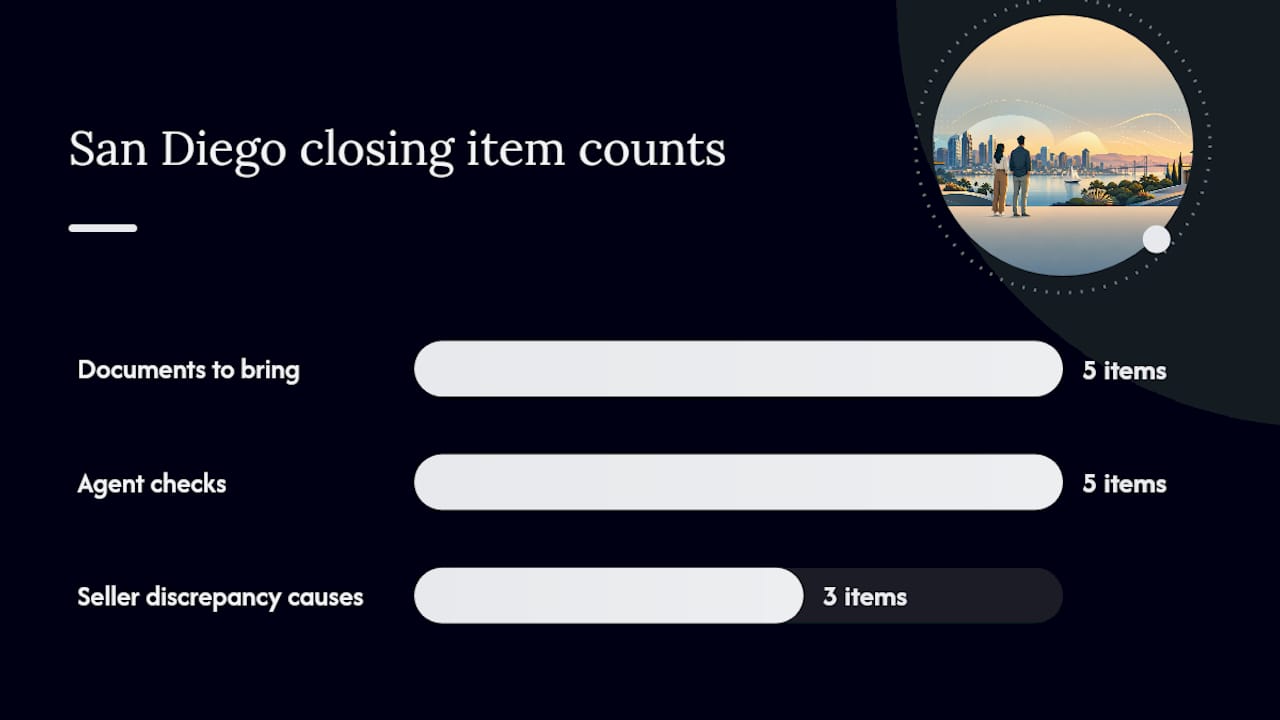
Documents to bring to closing:
- Government-issued photo ID (two forms recommended)
- Proof of funds or wire confirmation for cash-to-close
- Final loan documents if not already signed
- Home warranty paperwork, if applicable
- HOA transfer documents and any prepaid dues confirmation
Agent-side checks Jeffsellssandiego runs for every client:
- Confirm the mortgage payoff figure matches the lender's current statement
- Verify HOA dues and any special assessments are prorated correctly to the closing date
- Cross-check recording fees against San Diego County's current schedule
- Review title exceptions for anything that wasn't disclosed earlier in the transaction
- Confirm any negotiated seller credits appear on both the buyer's and seller's statements
For sellers, reviewing your net proceeds estimate against the final statement is the single most important pre-closing step. Discrepancies between the preliminary net sheet and the final statement almost always trace to a payoff figure, a proration, or a commission entry. The San Diego seller disclosure checklist covers the documentation side of what sellers need to confirm before the statement is finalized.
What a San Diego agent actually does with your settlement statement
Most buyers and sellers treat the settlement statement as a formality. That's a mistake. Every line on that document represents a real dollar moving in a specific direction, and errors — wrong payoff figures, missing credits, duplicate fees — appear more often than you'd expect.
When reviewing a statement for a client, the first check is always the totals: does the buyer's cash-to-close match what the lender quoted, and does the seller's net match the preliminary net sheet? From there, it's a line-by-line comparison against the purchase contract, the HOA statement, and the lender's Closing Disclosure. The CFPB and HUD forms are the reference standards for that cross-check — not a competing document, but the authoritative baseline every number on the statement should reconcile against.
Involving your agent early in the review process, ideally 48 hours before closing, gives everyone time to request corrections without delaying the recording date. That window is the difference between a smooth closing and a scramble.
Ready for a settlement statement review before you close?
Closing on a San Diego home means navigating a document that can run several pages and carry figures in the hundreds of thousands. Jeffsellssandiego offers a no-pressure pre-closing review for buyers and sellers — a focused look at your statement before you sign, so nothing surprises you at the table.

Sellers can start with the Seller's Guide to understand what your net proceeds should look like before the final statement arrives. Buyers can use the Buyer's Guide to walk through closing costs and what to expect on your Closing Disclosure. Reach out directly to schedule a quick review — catching one error before closing is worth more than any amount of post-closing paperwork.
Sources
- What is a HUD-1 Settlement Statement? | Consumer Financial Protection Bureau
- What is a Settlement Statement in Real Estate? | Chase
- Settlement Statement (HUD-1) | HUD
- Settlement Statement (HUD-1) explainer | Consumer Financial Protection Bureau
- ALTA Settlement Statements | ALTA
This article is general information, not a substitute for advice from a qualified financial advisor. Consult a qualified financial professional about your own circumstances before acting on anything here.