
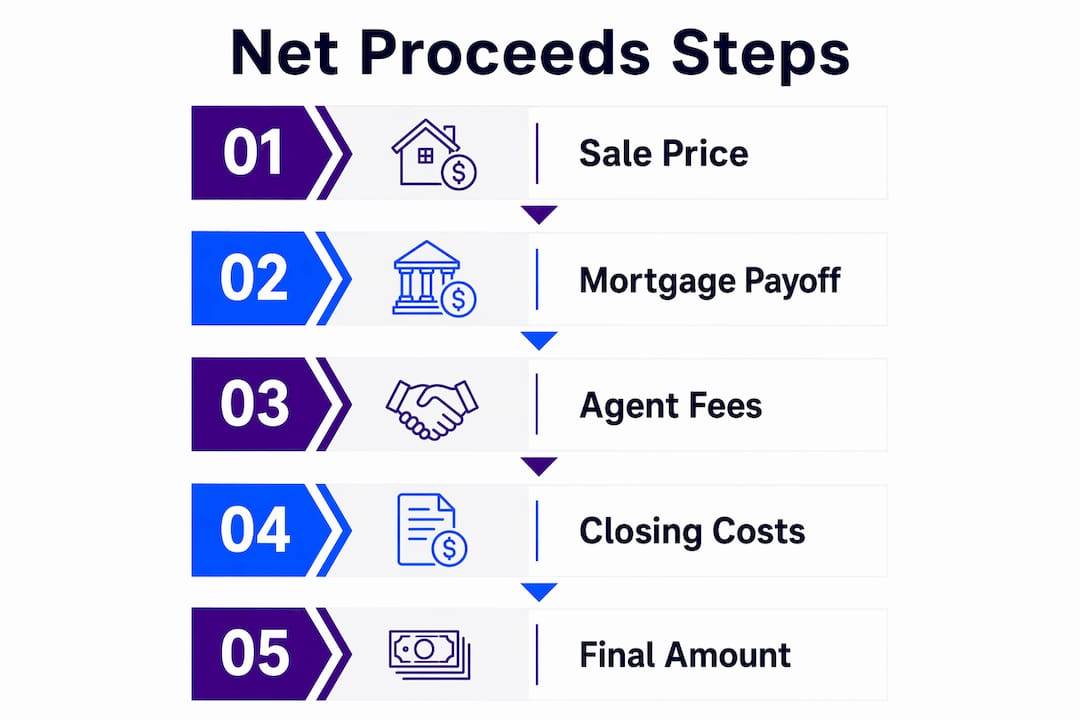
Seller net proceeds are the cash you receive after every cost tied to the sale has been paid. That means the sale price minus your mortgage payoff, agent commissions, closing costs, and any other seller expenses. According to Bankrate, "net proceeds is the amount of money a home seller will receive after deducting all of the costs of a sale." The number is almost always lower than the sale price, sometimes by a lot.
Here is what typically comes out of the sale price before you see a dollar:
- Mortgage payoff: The remaining principal balance, plus accrued interest through the closing date, and sometimes a prepayment penalty
- Agent commissions: Listing agent and, depending on negotiation, buyer's agent fees
- Closing costs: Title insurance, escrow fees, transfer taxes, and attorney fees
- Seller concessions: Credits given to the buyer for repairs or closing cost assistance
- Staging and repair costs: Pre-listing expenses that reduce your final take
Net proceeds are not the same as profit. As Bankrate's chief financial analyst Greg McBride puts it, net proceeds include your down payment and principal already repaid, which are not new earnings. You are getting back money you already put in, plus any appreciation above what you owe.
What actually affects your seller net proceeds
Every line item below chips away at the sale price. Knowing which ones are fixed and which are negotiable gives you real leverage before you list.
- Sale price: The starting point for every calculation. A higher sale price does not automatically mean higher net proceeds if costs scale with it.
- Mortgage payoff balance: The payoff amount includes principal, interest accrued to the closing date, and sometimes a prepayment penalty. It is almost always higher than your current statement balance.
- Agent commissions: Historically a typical percentage of the sale price, often around the mid single digits. Since the 2024 NAR settlement, commission structures are more negotiable, and sellers may pay less than the old standard.
- Title insurance: Sellers in many markets pay for the buyer's title insurance policy, typically around 0.5% of the sale price.
- Escrow fees: Split between buyer and seller in most transactions, though this varies by state.
- Transfer taxes: Calculated as a percentage of the sale price and set by the state or county. California sellers pay these.
- Seller credits: If you agree to cover part of the buyer's closing costs, that amount comes directly off your proceeds.
- Home repairs: Pre-listing fixes or inspection-triggered repairs reduce your net figure, even if they helped you get a better offer.
- Staging costs: Professional staging can boost the sale price, but the expense still reduces net proceeds.
Closing costs for sellers vary significantly by location. According to NerdWallet, total seller costs including commissions typically run 6% to 10% of the sale price.

How to calculate your net proceeds step by step
The math is straightforward once you have the right numbers. Here is how to work through it.
-
Start with the accepted sale price. This is the gross amount the buyer agreed to pay, before anything is deducted.
-
Subtract your mortgage payoff amount. Call your lender for a formal payoff quote, not just your current balance. The payoff figure accounts for interest through the projected closing date and any prepayment fees.
-
Subtract agent commissions. Multiply the sale price by the agreed commission rate. On a $500,000 home at a typical commission rate, that is several thousand dollars.
-
Subtract closing costs. Add up title insurance, escrow fees, transfer taxes, attorney fees, and any other seller-paid costs. These often total a small percentage of the sale price, separate from commissions.
-
Subtract seller concessions and repair credits. Any credits you gave the buyer come off here.
-
Subtract pre-listing expenses. Staging, repairs, and improvements you paid before listing reduce the final number.
-
The result is your net proceeds.
Example calculation using real figures:
A home sells for $500,000. The seller owes $300,000 on the mortgage, pays $15,000 in agent fees, $1,000 in attorney fees, and $4,000 in other closing costs and taxes. Per Bankrate's example, that leaves net proceeds of $180,000.

| Line Item | Amount |
|---|---|
| Sale price | $500,000 |
| Mortgage payoff | ($300,000) |
| Agent commissions | ($15,000) |
| Attorney fees | ($1,000) |
| Closing costs and taxes | ($4,000) |
| Net proceeds | $180,000 |
Actual figures shift based on your local tax rate, what you negotiated on commissions, and whether you offered any buyer credits. Your agent should provide a seller's net sheet before you accept any offer, so you know exactly where you stand.
Pro Tip: Ask your lender for a payoff quote with a closing date two weeks out. Interest accrues daily, so a quote tied to a specific date gives you a more accurate number than your monthly statement.
Why you need to know your net proceeds before you accept an offer
Sellers who focus only on the sale price often get surprised at closing. Knowing your estimated net proceeds in advance changes how you evaluate every offer on the table.
- Set realistic expectations. A $600,000 offer with heavy concessions may net you less than a $580,000 clean offer. The net proceeds calculation is the only fair comparison.
- Budget for your next move. Whether you are buying another home or investing the proceeds, you need to know the actual cash amount, not the headline sale price.
- Negotiate smarter. Understanding which costs are fixed and which are negotiable, like commissions and concessions, lets you push back where it actually matters.
- Avoid a short sale situation. If your mortgage payoff plus costs exceeds the sale price, your proceeds go negative. Knowing this early gives you time to adjust your pricing or negotiate with your lender.
Jeffsellssandiego works through a detailed net sheet with every seller before listing, so there are no surprises when the closing statement arrives. If you want to see what your San Diego home might net, the seller's guide is a good starting point.
Tax and profit considerations every seller should understand
Net proceeds and profit are two different numbers, and mixing them up can lead to a real tax headache.
- Net proceeds include returned equity. When you sell, you get back your down payment and every mortgage payment that went toward principal. That portion is not profit; it is your own money coming back to you.
- Profit is the gain above your tax basis. Your tax basis is generally the purchase price plus the cost of capital improvements you made over the years. The IRS calculates capital gains tax on the gain above that basis, not on your gross sale price or your net proceeds.
- The primary residence exclusion can shelter a large gain. Single filers can exclude up to $250,000 in gain; married couples filing jointly can exclude up to $500,000, provided they meet the IRS ownership and use tests.
- Home improvements raise your basis. A kitchen remodel, new roof, or addition all increase your tax basis, which reduces the taxable gain. Keep every receipt.
- Mortgage payoff details affect your net figure. Accrued interest and any prepayment penalty reduce your proceeds but do not reduce your taxable gain.
- Commission savings can increase your net proceeds. Since the 2024 NAR settlement opened up commission negotiation, sellers who successfully negotiate lower fees keep more at closing.
Pro Tip: Save receipts for every capital improvement you make while you own the home. A $40,000 kitchen renovation added to your basis could save you thousands in capital gains tax when you sell.
Tracking improvements is not just good bookkeeping. The IRS requires accurate basis reporting, and sellers who cannot document improvements often pay more tax than they legally owe.
How to put your net proceeds to work after closing
Knowing your net proceeds figure before closing lets you plan, not just react. Here is how sellers typically use that number.
Compare offers on equal footing. Run a quick net sheet on each offer you receive. A buyer asking for $10,000 in concessions on a higher offer may actually net you less than a lower, cleaner bid. Price alone is a poor filter.
Plan your next purchase. If you are buying another home in San Diego, your net proceeds often become the down payment. Knowing the exact figure weeks before closing lets you get pre-approved at the right loan amount and avoid a gap between transactions. Browsing San Diego listings with a firm proceeds number in hand makes the search far more focused.
Coordinate with a financial advisor. A large proceeds check can trigger tax obligations or affect your investment strategy. Sellers who plan ahead, especially those with gains above the exclusion threshold, avoid scrambling in april when taxes are due.
Negotiate fees with real numbers. Once you know what each cost line does to your bottom line, you can have a specific conversation with your agent about where there is room to move. Staging costs, repair credits, and commissions are all negotiable to varying degrees.
When does the money actually hit your account?
The timing from accepted offer to cash in hand follows a predictable sequence, though the exact length depends on your transaction.
Most residential sales in the United States close within several weeks after an offer is accepted, though cash transactions may close faster. Here is the general sequence:
- Offer accepted. The clock starts. Escrow opens and the buyer deposits earnest money.
- Inspections and contingencies. Typically completed within the first 10–17 days. Any repair credits or price adjustments get finalized here.
- Lender appraisal and underwriting. For financed purchases, the lender orders an appraisal and processes the buyer's loan. This is usually the longest phase.
- Final walkthrough and closing disclosure. A few days before closing, both parties review the final numbers. The closing disclosure shows every fee and the exact net proceeds amount.
- Closing day. Documents are signed, the buyer's funds are wired to escrow, and the lender funds the buyer's loan.
- Proceeds disbursed. After the deed records, escrow releases funds to the seller. Wire transfers typically arrive the same day or the next business day after recording.
California follows a "dry closing" process in some counties, meaning funds are not released until the deed records with the county, which can add a day. Your escrow officer will give you a specific timeline once you are in contract.
Key Takeaways
Seller net proceeds are the actual cash you receive after subtracting the mortgage payoff, agent commissions, closing costs, and other seller expenses from the final sale price.
| Point | Details |
|---|---|
| Net proceeds vs. profit | Net proceeds include returned equity; profit is only the gain above your original purchase price plus improvements. |
| Total seller costs | Closing costs including commissions typically run 6%–10% of the sale price, per NerdWallet. |
| Calculation example | A typical sale with substantial mortgage payoff, commissions, and other costs yields net proceeds well below the sale price. |
| Tax basis matters | Capital gains tax is calculated on the gain above your tax basis, not on net proceeds or the gross sale price. |
| Timing | Most residential closings take 30–45 days; proceeds are typically wired the same day or next business day after the deed records. |