
A seller net sheet is an estimate that starts with your expected sale price and subtracts every cost you owe at closing to show what you'll actually walk away with. Think of it as a financial preview of your closing day, built before you ever accept an offer.
Your net sheet typically covers three categories of deductions:
- Mortgage payoff and per-diem interest — your remaining loan balance plus daily interest that accrues until the loan is paid off at closing
- Real estate commissions and closing costs — the total commission split, plus title and escrow fees and recording charges
- Prorations, HOA payoffs, and negotiated seller credits — property taxes owed through closing, any HOA balance or transfer fee, and repair credits or concessions you've agreed to give the buyer
Get an updated net sheet at your listing appointment and again the moment any offer lands on the table. The Closing Disclosure and ALTA Settlement Statement are the final, legally binding documents you'll sign at closing. The net sheet is your planning tool before you get there. Jeffsellssandiego prepares these for every San Diego seller from day one.
Table of Contents
- What does a seller net sheet actually include?
- How to calculate your estimated net proceeds
- Who prepares a net sheet, and when should you ask for one?
- How does a net sheet differ from your closing documents?
- Agent best practices for using a net sheet effectively
- Where can you get net sheet templates and calculators?
- Key Takeaways
- The net sheet as a negotiation tool, not just a formality
- Get a personalized San Diego net sheet from Jeffsellssandiego
- Useful sources and further reading
What does a seller net sheet actually include?
Common line items on a seller net sheet are consistent across most U.S. transactions, though the dollar amounts vary by state, county, and deal terms. Here's what you'll typically see, and who provides each number:
- Sale price — the starting point; set by you and your agent based on market analysis
- Mortgage payoff — your lender provides a formal payoff statement; this includes the principal balance plus any prepayment fees
- Per-diem interest — daily interest on your loan from the closing date through the payoff date; your lender calculates this, and it changes every day
- Real estate commissions — the total percentage agreed in your listing contract, split between buyer's and seller's agents; your agent provides this figure
- Prorated property taxes — taxes owed from the last payment through closing; the title or escrow company calculates this based on the county tax schedule
- Title and escrow fees — title insurance premiums, escrow service fees, and related charges; the title company provides these
- Recording fees — county charges to record the deed transfer; varies by county and is confirmed by title
- HOA fees and payoff — any unpaid dues, transfer fees, or document fees required by your homeowners association
- Seller concessions and repair credits — dollar amounts you've agreed to credit the buyer; negotiated in the purchase contract
- Home warranty — if you're offering one, typically $400–$700 depending on coverage; your agent or the warranty provider quotes this
- Other lien payoffs — second mortgages, HELOCs, judgment liens, or mechanic's liens; your title company will identify these in the title search
Three items routinely catch sellers off guard: per-diem interest (which can add hundreds of dollars if closing slips by a week), lien payoffs discovered during the title search, and tax prorations that swing significantly depending on where you are in the county's billing cycle. State and local fees vary enough that you should always verify title and recording charges directly with your escrow officer rather than relying on a generic template.

How to calculate your estimated net proceeds
Getting accurate inputs — especially a formal payoff statement and confirmed per-diem date — is the single biggest driver of net sheet accuracy. Here's the process:
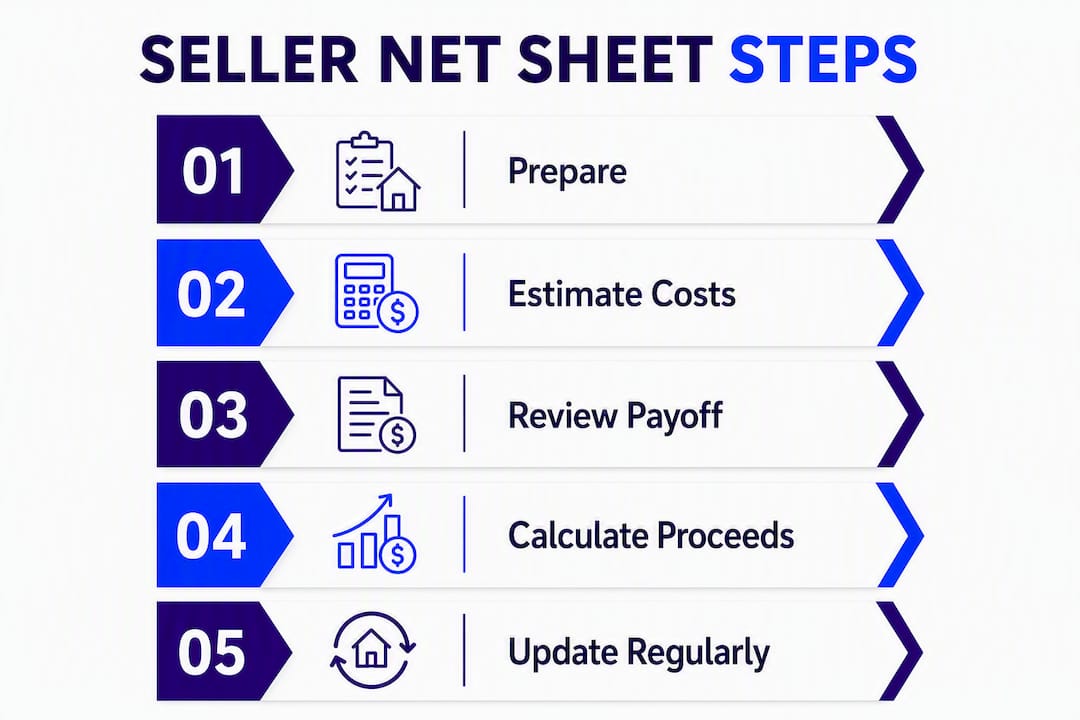
- Set your sale price. This is your starting number. Use your agent's comparative market analysis.
- Subtract your mortgage payoff and per-diem interest. Request a formal payoff statement from your lender, valid through your expected closing date.
- Subtract real estate commissions. Multiply the sale price by the total commission percentage.
- Subtract prorations and closing costs. Add up prorated property taxes, title fees, escrow fees, and recording charges.
- Subtract concessions, credits, and lien payoffs. Include any repair credits, HOA payoffs, or other liens.
- The remaining figure is your estimated net proceeds.
Worked example
| Line Item | Amount |
|---|---|
| Sale price | an example sale price |
| Mortgage payoff (including per-diem) | the corresponding payoff estimate |
| Real estate commission | a typical commission based on the sale price |
| Prorated property taxes | estimated prorated taxes |
| Title and escrow fees | estimated title and escrow fees |
| County recording fees | estimated recording fees |
| HOA transfer fee and payoff | estimated HOA fees and payoffs |
| Repair credit to buyer | example repair credit amount |
| Home warranty | estimated home warranty cost |
| Estimated net proceeds | the resulting net proceeds estimate |

One nuance worth knowing: a $10,000 price reduction doesn't cost you exactly $10,000 in net proceeds. Because commissions are percentage-based, a lower sale price slightly reduces the commission you owe, which partially offsets the reduction. On a 5% commission, a $10,000 price cut saves you $500 in commission, so your net drops by roughly $9,500. That math matters when you're deciding whether to accept a lower offer or push back.
Pro Tip: Request a formal payoff statement from your lender, not just your online account balance. Confirm the exact date the payoff is valid through, and update the net sheet immediately if your closing date shifts even by a few days.
Who prepares a net sheet, and when should you ask for one?
Three parties typically produce net sheets:
- Your listing agent — prepares the initial estimate at the listing appointment using market data, commission rates, and estimated fees
- The title or escrow company — provides more precise fee estimates and can run a formal net sheet once a purchase contract is in place
- A closing attorney — in states where attorneys handle closings (common in the Southeast and Northeast), the attorney's office may prepare the net sheet
Timing matters as much as who prepares it. Presenting a net sheet at the listing appointment helps you decide whether to list, at what price, and how to plan for your next move. After that, update it every time something material changes:
- When an offer arrives — run a fresh sheet for each offer so you're comparing apples to apples
- After any negotiated repair credit or concession
- If the closing date shifts, because per-diem interest changes daily
- Before signing off with escrow, to confirm your numbers are still in range
Tools like Realtor Property Resource (RPR) and many brokerage CRM platforms include net sheet templates. Title and escrow companies are the most reliable source for confirming local fees and formal payoff figures. The final, binding numbers come from the Closing Disclosure or ALTA Settlement Statement, not from any net sheet.
How does a net sheet differ from your closing documents?
Sellers sometimes assume the net sheet they reviewed at listing is the same document they'll sign at closing. It isn't.
- Seller net sheet — an informal estimate prepared by your agent or title company for planning and negotiation; not a legally required form and not binding
The practical difference: your net sheet might show $276,675 in estimated proceeds, but the ALTA at closing reflects the actual payoff amount, the exact proration calculated to the day, and any last-minute fee adjustments. Treat the net sheet as a working forecast and confirm every number on the official closing statement before you sign.
Agent best practices for using a net sheet effectively
A net sheet at the listing appointment does more than show numbers. It builds trust, sets realistic price expectations, and gives sellers a framework for evaluating offers without emotion. Agents who present one upfront reduce last-minute surprises and help sellers compare competing offers on a true net basis, not just headline price.
Questions to ask your agent or title company when reviewing a net sheet:
- Can you get a formal payoff statement from my lender, and what date is it valid through?
- Which fees are your estimates, and which will title confirm?
- Are there any liens on the property that could affect my net?
- How will my net change if the buyer asks for a $5,000 repair credit?
- What happens to my net if closing shifts by two weeks?
Because a net sheet is a living document, update it the moment any material term changes. An offer comes in $15,000 below asking? Run a new sheet. The buyer requests a home warranty? Add it. Closing moves from March to April? Recalculate the per-diem. Sellers who treat the net sheet as a one-time snapshot often get caught off guard at closing.
Pro Tip: Ask your agent to run side-by-side net sheets for competing offers. A higher offer with a large repair credit can net you less than a slightly lower offer with no concessions.
Where can you get net sheet templates and calculators?
- Your listing agent — the most practical first source; a good agent prepares one as part of the listing presentation
When using any template or online calculator, verify four things with your title or escrow officer: county recording fees, state transfer taxes (California charges a documentary transfer tax, for example), HOA payoff amounts, and the per-diem accuracy on your specific loan.
Pro Tip: Never finalize a net sheet using only an online calculator. Ask your title officer to confirm any fee that could move your net proceeds by more than a few hundred dollars.
Key Takeaways
A seller net sheet is an estimate, not a guarantee — its accuracy depends entirely on the quality of the inputs, especially your formal mortgage payoff and local fee data.
| Point | Details |
|---|---|
| Net sheet = estimate | It's a planning tool, not a binding document; final figures come from the Closing Disclosure or ALTA Settlement Statement. |
| Confirm formal payoffs | Always request a lender payoff statement valid through your closing date — online balances are not accurate enough. |
| Update after every change | Revise the net sheet whenever an offer, repair credit, or closing date changes; per-diem interest shifts daily. |
| Compare offers on net, not price | Run a separate net sheet for each offer to see true take-home proceeds, not just headline numbers. |
| Jeffsellssandiego prepares yours | Jeff's team builds San Diego-specific net sheets at listing and updates them through every stage of your sale. |
The net sheet as a negotiation tool, not just a formality
Most sellers treat the net sheet as a paperwork step. The agents who use it well treat it as a negotiation anchor.
When you walk into a listing appointment with a clear net sheet, you're not guessing at your proceeds. You know exactly what a $730,000 sale nets versus a $750,000 sale, and you know what a $10,000 repair credit actually costs you after the commission math. That clarity changes how you negotiate. Sellers who understand their numbers hold firmer on price when it matters and make smarter concession decisions when it doesn't.
The part most sellers miss: the net sheet is most powerful when it's kept current. A sheet from two weeks ago, with a payoff date that's already passed, is worse than no sheet at all because it gives false confidence. The discipline is in updating it every time something moves.
Get a personalized San Diego net sheet from Jeffsellssandiego
Knowing your estimated proceeds is the first real decision in selling your home. Jeffsellssandiego prepares property-specific net sheets for San Diego sellers that account for local title fees, county recording charges, and your actual mortgage payoff, not generic estimates pulled from a national template.

Bring your sale price target, your most recent mortgage statement, and your preferred closing timeline. Jeff's team coordinates directly with title to confirm local fees and pull a formal payoff figure, so your net sheet reflects what you'll actually see on the ALTA at closing. Whether you're pricing a home in San Diego or weighing two competing offers, a current, accurate net sheet is the clearest tool you have.
Ready to see your numbers? Visit the Seller's Guide to request your personalized net sheet.
Useful sources and further reading
- What's a Net Sheet — and Why Every Agent Should Use One — practitioner perspective on how agents use net sheets at listing appointments to build trust and set pricing expectations
- Seller Net Proceeds: What You Actually Walk Away With — Jeffsellssandiego's own deep dive into how net proceeds are calculated for San Diego sellers
- Role of 1031 Exchange in Real Estate — useful if your net proceeds will fund a 1031 exchange and you need to understand the timing and reinvestment requirements