San Diego's documentary transfer tax sits at $1.10 per $1,000 of a home's sale price countywide, split evenly between the county and, inside city limits, the City of San Diego. No large increase has passed into law as of 2026: proposals to raise it substantially remain proposals, not enacted ordinance. Confirm the current rate through the San Diego County Recorder or the municipal code before you close.
TL;DR:
- The current transfer tax rate in San Diego is $1.10 per $1,000 of sale price, split equally between the county and the city when inside city limits.
- For properties outside city limits, only the county's $0.55 per $1,000 applies, often leading to confusion about the actual tax total.
- Transfer tax is typically paid by the seller, but the purchase agreement can assign responsibility to the buyer, with escrow handling the payment and documentation.
- Proper exemption documentation on the deed is essential to avoid delays, especially for transfers between spouses, trusts, or due to family reasons.
- No enacted or approved proposals currently increase the transfer tax beyond $1.10 per $1,000, but potential future hikes could substantially impact high-value transactions.
Table of Contents
- How San Diego Calculates Transfer Tax on a Home Sale
- Who Pays Transfer Tax at Closing in San Diego
- Transfer Tax Exemptions and How to Document Them
- Transfer Tax Exemption Doesn't Mean No Reassessment
- Where the Transfer Tax Increase Debate Actually Stands
- Your Pre-Closing Transfer Tax Checklist
- What I See on Actual San Diego Closings
- Skip the Guesswork Around Proposed Increases
- Get Your Exact Transfer Tax Numbers Before You List or Offer
- Sources
How San Diego Calculates Transfer Tax on a Home Sale
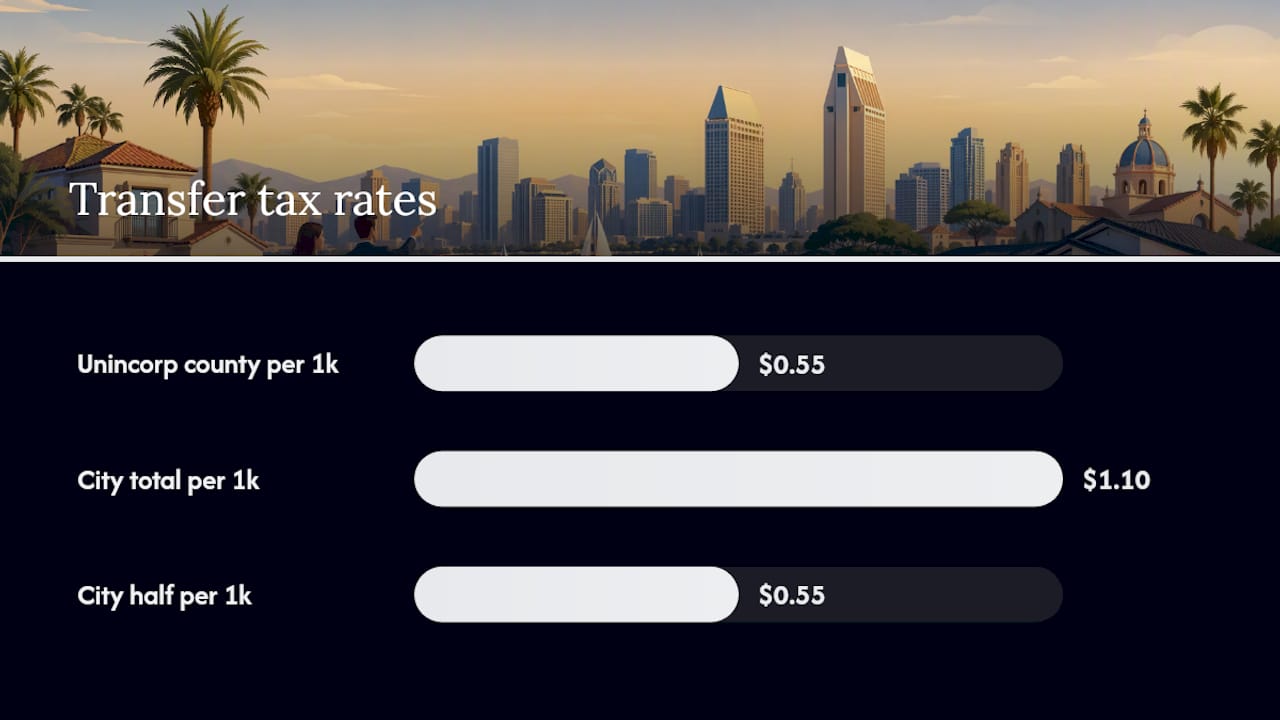
California's Revenue and Taxation Code section 11911 sets the baseline: $0.55 for every $500 of consideration, or any fraction of $500, on conveyances over $100. Convert that to a per-$1,000 figure and you get the number most agents actually quote: $1.10 per $1,000 of sale price. San Diego County collects the full amount at recording, and where the property sits inside San Diego city limits, the municipal code's transfer tax ordinance splits that $1.10 into two even halves. The county keeps $0.55 per $1,000, and the city retains its own $0.55 per $1,000.
That means unincorporated San Diego County parcels only pay the county's $0.55 per $1,000, roughly half of what a comparable sale inside city limits generates. This is the part most closing-cost checklists skip entirely, and it trips up sellers who assume every San Diego transaction faces an identical rate.
The taxable base is the sale price, less any existing liens or encumbrances the buyer assumes rather than pays off. Rounding always goes up to the next full increment, never down.
Here's how the math plays out on a few representative sale prices, using the combined $1.10 per $1,000 rate that applies to sales within San Diego city limits:
| Sale price | Total transfer tax (city rate) | County share only |
|---|---|---|
| $500,000 | $550 | $275 |
| $1,000,000 | $1,100 | $550 |
| $2,000,000 | $2,200 | $1,100 |
- A $500,000 sale inside city limits generates $550 total, with $275 going to the county and $275 to the city.
- A $1 million sale produces $1,100, an amount that surprises a lot of first-time sellers when they see it on the settlement statement.
- On a $2 million sale, the tax hits $2,200, which is real money but still a fraction of a percent of the transaction.
You can cross-check any of these figures using TransferDuty's San Diego calculator, which breaks out the county and city portions separately.
Who Pays Transfer Tax at Closing in San Diego
Southern California custom puts the transfer tax on the seller's side of the ledger, and that's how most San Diego purchase agreements default. But custom isn't law. The California Association of Realtors purchase agreement lets either party negotiate who actually cuts the check, and in competitive multiple-offer situations, buyers sometimes offer to cover it as a way to sweeten their bid without touching the purchase price.
Escrow or title handles the mechanics regardless of who pays. Here's the sequence:
- Escrow calculates the tax owed based on the final sale price at closing.
- The amount gets collected as part of the closing statement, from whichever party the contract designates.
- Title submits payment to the recorder along with the deed.
- The recorder will not accept the deed for recording until the tax is paid in full, or a valid exemption is properly documented.
That last point matters more than most buyers realize. A deed that shows no tax paid and no exemption reason will bounce back unrecorded, which delays the entire transaction and can jeopardize a purchase agreement's closing deadline.
If a transfer genuinely qualifies for an exemption, the deed needs to show "$0" on the tax declaration line along with the specific statutory reason. Leaving it blank isn't the same as claiming an exemption. It just reads as an error.
Pro Tip: Ask your escrow officer for the exact exemption language before signing anything. A one-sentence citation on the deed, like "R&T 11911 gift transfer," is often the difference between same-day recording and a returned document.
Transfer Tax Exemptions and How to Document Them
Several categories of transfer routinely qualify for exemption from San Diego's documentary transfer tax, but the exemption only holds up if the paperwork says so explicitly. Nothing is automatic.
The most common exempt categories include:
- Spousal and domestic partner transfers, including transfers between spouses during marriage or as part of divorce settlements.
- Gift transfers where no money or other consideration changes hands.
- Transfers into or out of a revocable living trust, when the same individual remains the beneficial owner before and after.
- Qualifying corporate reorganizations where entities under common control transfer property between each other.
- Transfers securing or releasing a debt, such as adding a co-borrower to a deed of trust without an actual sale.
Every one of these needs a written statement on the deed or an attached declaration explaining which exemption applies and citing the statutory basis. Escrow companies handle this routinely, but it's worth confirming they've included the right language before the closing date arrives, not after the recorder rejects the document.
A quick checklist for your escrow or title company:
- Confirm the deed states "$0" on the transfer tax line, not a blank field.
- Confirm the attached declaration cites the specific Revenue and Taxation Code exemption.
- Confirm the Preliminary Change of Ownership Report reflects the same transaction type as the deed, since inconsistencies between the two documents are a common source of assessor follow-up questions.
Something worth flagging: the exemption you claim on transfer tax and the exemption (or exclusion) you might separately claim for property tax reassessment are governed by entirely different rules, and qualifying for one does not automatically qualify you for the other.
Transfer Tax Exemption Doesn't Mean No Reassessment
This is where a lot of sellers and even some agents get tripped up: a documentary transfer tax exemption and a property tax reassessment exclusion are two separate legal questions, evaluated by two different offices.
The recorder cares about whether the deed itself triggers transfer tax. The county assessor cares about whether the change in ownership triggers a reassessment of the property's taxable value, based on the Preliminary Change of Ownership Report filed alongside the deed. A transfer can dodge one and still land squarely in the other.
- A transfer into a revocable living trust for the same owner typically skips both transfer tax and reassessment, because the beneficial ownership hasn't changed.
- A parent to child transfer might avoid transfer tax as a gift, but depending on the transfer date and current exclusion rules, it may or may not avoid reassessment.
- An interspousal transfer during a divorce is usually exempt from transfer tax and also generally excluded from reassessment, but the paperwork trail needs to support both claims independently.
If reassessment does apply, it's not retroactive to the sale date in some abstract sense. It takes effect for the property tax year following the change in ownership, and the new assessed value shows up on the next annual tax bill. Anyone budgeting for ongoing costs after a purchase should treat this as a separate line item from the one-time transfer tax hit at closing, since property tax and transfer tax are calculated on entirely different schedules.
Where the Transfer Tax Increase Debate Actually Stands
San Diego has had a live conversation about raising the documentary transfer tax for the past couple of years, and it's worth separating what's been proposed from what's actually enforceable today.
Local reporting has covered proposals that would raise the rate substantially above the current $1.10 per $1,000, generally aimed at higher-value transactions to fund housing or homelessness programs. Voice of San Diego's coverage of one such proposal lays out both the funding argument for a higher rate and the counterargument that a steep increase could dampen an already sluggish sales market by adding thousands of dollars to closing costs on mid to high value homes.
Here's the honest status check: as of this writing, no measure raising San Diego's transfer tax has been enacted into ordinance or approved by voters. Proposals of this kind, especially ones that would require a public vote under California's tax rules, tend to move slowly through advocacy, city council discussion, and potential ballot placement before anything changes at the recorder's counter.
To see what a hypothetical increase would actually cost, run the sensitivity math:
- If a future measure doubled the rate to roughly $2.20 per $1,000, a $1 million sale's transfer tax would jump from $1,100 to $2,200.
- A steeper structure that applied a much higher marginal rate to sale prices above $1 million or $5 million, a model some advocates have floated, could add thousands more on luxury transactions specifically.
- On the $500,000 range, most proposals discussed so far would leave the impact modest in dollar terms, since higher rates tend to target higher price tiers.
The single most reliable way to track whether any of this becomes real is to watch county recorder announcements and city council agendas directly, rather than relying on secondhand summaries that may lag actual legislative movement.
Your Pre-Closing Transfer Tax Checklist
Whether you're listing a home or writing an offer, transfer tax should show up on paper well before closing day, not as a surprise line item.
- Estimate the tax early. Use the $1.10 per $1,000 combined rate (or $0.55 per $1,000 outside city limits) against your expected sale price, and build that number into your seller net-proceeds worksheet or your buyer closing-cost budget.
- Confirm who's paying in writing. Southern California custom defaults to the seller, but your purchase agreement is what actually governs. Get the allocation spelled out explicitly, especially in a competitive offer situation where a buyer might offer to absorb it.
- Loop in escrow early on exemptions. If you believe your transfer qualifies for an exemption, tell your escrow officer before the closing package gets drafted, not the day documents are due to record.
- Bring in an attorney for anything unusual. Trust transfers, corporate reorganizations, or family transfers with mixed considerations often benefit from a quick review by a real estate attorney rather than guessing at the exemption language yourself.
Pro Tip: If you're selling and expecting a tight margin, ask your escrow officer for a preliminary settlement statement two weeks before closing, not two days. Transfer tax errors are easy to fix early and painful to fix the morning of recording.
What I See on Actual San Diego Closings
Every seller net-proceeds sheet I build includes transfer tax as a line item from the very first draft, not an afterthought added once we're under contract. It's a small number relative to commission or repair costs, but it's the one buyers and sellers most often assume someone else is handling.
I've had buyers offer to cover the full transfer tax as a negotiating lever in multiple-offer situations on properties in neighborhoods like Point Loma and San Carlos, where a few hundred dollars mattered less to them than winning the house. Sellers rarely turn that down.
The mistake I see most often isn't about the tax itself. It's escrow discovering an exemption claim wasn't properly documented until the day of recording, which pushes closing by a day or two while everyone scrambles for the right declaration language. That's avoidable with a five-minute conversation two weeks out, and I raise it on every transaction where a trust or family transfer is involved.
Skip the Guesswork Around Proposed Increases
Here's what conventional advice on this topic gets wrong: it treats San Diego's transfer tax like a static, boring line item, and it treats every proposed increase as either imminent or irrelevant, with nothing in between. Neither is accurate. The current $1.10 per $1,000 rate is stable, well-documented, and easy to calculate. The proposed increases are real policy conversations worth tracking, but they are not law, and treating them as settled either way leads to bad planning.
What actually matters is documentation discipline: getting the exemption language right, understanding that transfer tax and reassessment are separate questions, and confirming who pays before you're staring at a settlement statement. Those three things cause more closing delays than the tax rate itself ever will.
If you're selling or buying in San Diego this year, prioritize getting your numbers reviewed by someone who does this daily, not someone estimating from a generic guide.
— Jeff
Get Your Exact Transfer Tax Numbers Before You List or Offer
A generic online calculator gets you close. What you actually need before listing or writing an offer is a net-proceeds projection built around your specific address, your loan payoff, and whatever exemption or negotiation scenario applies to your sale, and that's where working directly with an agent who handles San Diego closings every week beats a spreadsheet every time.

I build transfer tax into every seller net sheet from day one, coordinate directly with escrow to confirm exemption language before it becomes a recording problem, and walk buyers through exactly what they're paying at closing before they sign an offer. If you're planning a sale, start with a free home valuation that factors in your real closing costs, not just a market estimate. If you're buying, the Buyer's Guide walks through how closing costs, including transfer tax, actually get allocated in a San Diego purchase agreement. Either way, reach out before you list or write an offer, not after.
Sources
For the exact statutory language on documentary transfer tax collection and recording procedures, the San Diego County Recorder's office is the primary authority. The City of San Diego's municipal code and its Article 7 ordinance text spell out the city-specific portion of the tax. To follow the ongoing policy debate over proposed increases, Voice of San Diego's reporting tracks the arguments on both sides. For quick math on a specific sale price, TransferDuty's calculator breaks down the county and city shares side by side.
This article is general information, not a substitute for advice from a qualified financial advisor. Consult a qualified financial professional about your own circumstances before acting on anything here.
- Recording — San Diego County Recorder/Clerk
- CHAPTER 3. REAL PROPERTY TRANSFER TAX — San Diego municipal code (amLegal)
- Terra Lawson-Remer's Property Transfer Tax Hike Will Worsen the Housing Crisis — Voice of San Diego
- San Diego Real Estate Transfer Tax Calculator — TransferDuty
- Article 7: Documentary Transfer Tax on The Sale of Real Property — City of San Diego muni code PDF