In California, you transfer home ownership by signing a new deed and recording it with the county recorder's office. That single act, recording the deed, is what legally moves title from one person to another and puts the world on notice. Before you draft anything, though, check your mortgage. Recording a deed without contacting your lender first can trigger a due-on-sale clause that makes your entire loan balance due immediately.
Here is what you need to know right away:
- The deed is the instrument. A signed but unrecorded deed leaves the new owner exposed to competing claims. Recording makes the transfer part of the public record and establishes priority.
- Check the mortgage first. Per Fannie Mae guidance, transferring a deed does not remove the original borrower's liability on the loan. Contact your mortgage servicer before recording anything.
- Prop 13 and Prop 19 matter. California's property tax reassessment rules can significantly raise a new owner's annual tax bill unless a qualifying exemption applies.
- Name accuracy is non-negotiable. Even a nickname versus a legal name can break the chain of title and cause a recording rejection.
Jeffsellssandiego works with San Diego homeowners through exactly these situations every week. The sections below walk through every step, cost, and decision point you need.
Table of Contents
- How to transfer home ownership in California: the step-by-step legal process
- What deed type should you use in California?
- What does a California home transfer actually cost?
- How existing mortgages and title insurance affect your transfer
- Special situations: gifts, divorce, trusts, inheritance, and LLC transfers
- Do you need a lawyer or title company, or can you handle this yourself?
- California county recorder filing checklist: what to bring and what to expect
- How a San Diego residential agent can help with a title transfer
- Key Takeaways
- What I see go wrong in San Diego transfers, and how to avoid it
- Working with Jeffsellssandiego on your San Diego property transfer
- Authoritative sources and county links
How to transfer home ownership in California: the step-by-step legal process
The process has a clear sequence. Skipping steps, especially the lender check and the name verification, is where most problems start.
-
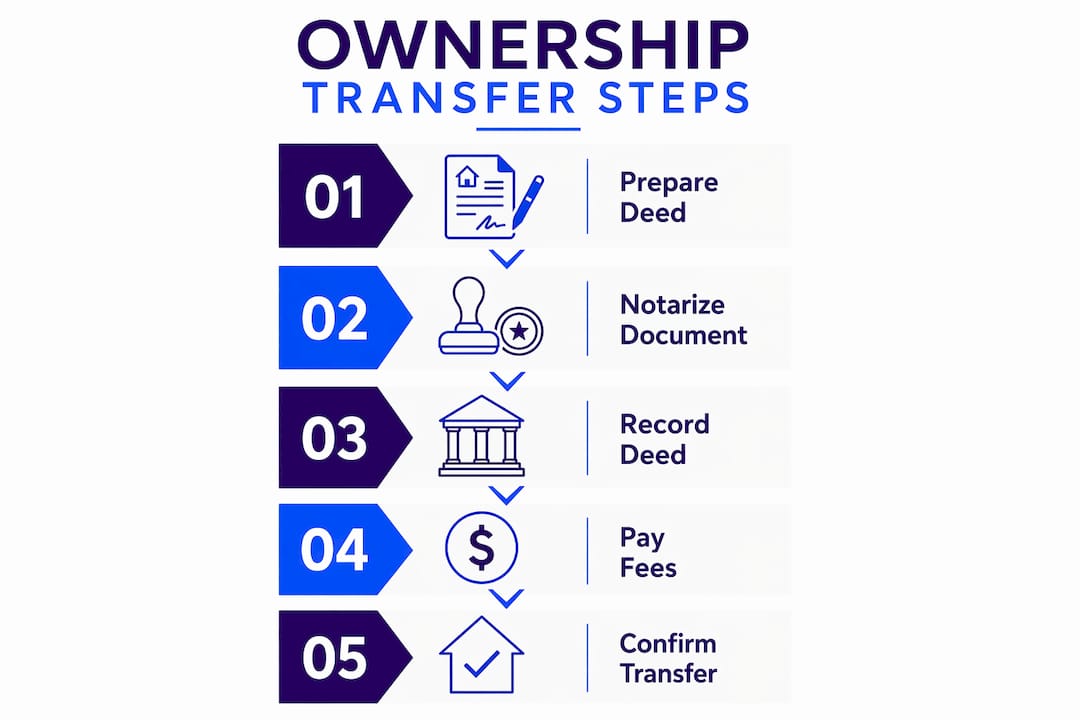
Decide on the transfer method. Are you selling, gifting, moving the property into a trust, adding a spouse, or removing a co-owner after a divorce? The method determines the deed type, the tax consequences, and whether lender approval is required.
-
Gather exact legal names and the legal description. Pull the current recorded deed from the county recorder's office or your title documents. Copy the grantor's name character-for-character. The legal description (not just the street address) must be reproduced verbatim on the new deed, along with the Assessor's Parcel Number (APN) from your property tax records. Minor name discrepancies like "Bob" instead of "Robert" can cause rejection or future title-search problems.
-
Contact your mortgage servicer. Do this before drafting the deed. Ask whether the transfer triggers a due-on-sale clause, whether a protected exception applies, and whether a loan assumption or release of liability is available.
-
Order a preliminary title report. A title company runs a search of public records to surface any liens, encumbrances, or chain-of-title gaps. This step is optional for simple family transfers but strongly recommended for anything more complex.
-
Choose the deed type and vesting. Select the correct deed (quitclaim, grant deed, transfer-on-death, or trust transfer) and decide how the new owner or owners will hold title: joint tenancy, tenancy in common, or community property with or without right of survivorship.
-
Prepare the deed. There are no standard, one-size-fits-all forms for California deed transfers. An attorney or title company drafts the deed to the specific facts of your transaction.
-
Sign before a notary public. The grantor (the person transferring ownership) must sign in front of a licensed notary. The notary's acknowledgment is required for recording in California.
-
Record with the county recorder. Submit the notarized deed, the Preliminary Change of Ownership Report (PCOR), the recording fee, and a return address to the county recorder's office. In-person, mail, and e-recording options are available depending on the county.
-
Receive the recorded copy and follow up. The recorder stamps and returns the deed, typically within a few days to a few weeks depending on the county and submission method. After recording, update your homeowner's insurance policy and notify the county assessor if you want to claim or transfer a homeowner's exemption.
Timeline at a glance: Deed preparation takes one to several days with an attorney. Notarization is same-day. County recording in San Diego County typically runs one to three weeks for mail submissions and faster for e-recording.
Pro Tip: Before drafting the new deed, pull the current recorded deed and confirm the grantor's name is spelled exactly as it appears there, including middle names or initials. Include the full APN and copy the legal description verbatim. A single character mismatch can result in rejection at the recorder's window.

What deed type should you use in California?
Choosing the wrong deed is not just a paperwork problem. It can leave a new owner without warranty protection, complicate a future sale, or fail to achieve the estate-planning goal you had in mind.
Quitclaim deed
A quitclaim deed transfers whatever interest the grantor has, with zero warranties. If the grantor has a clouded title or an undisclosed lien, the grantee gets that problem too. Quitclaims are common between spouses, between family members, and for moving property into a trust, precisely because those parties trust each other and are not paying market value. Using one in an arm's-length sale is a red flag: the buyer gets no warranty and typically cannot obtain standard owner's title insurance without a title search.
Grant deed (general warranty deed)
A grant deed is the standard instrument for most California home sales. The grantor warrants that they have not previously conveyed the property to anyone else and that the title is free from encumbrances they created. It provides stronger protection than a quitclaim and is what title companies expect in a conventional sale.
Special warranty deed
Similar to a grant deed but the warranty covers only the period the grantor owned the property. Common in commercial transactions and some estate sales, less so in residential transfers.
Life estate deed
The grantor retains the right to live in and use the property for their lifetime, then ownership passes automatically to the named remainderman. It avoids probate but creates complications if the grantor later wants to sell or refinance, since the remainderman's interest is already recorded.
Transfer-on-death (TOD) deed
California allows a revocable transfer-on-death deed that names a beneficiary to receive the property automatically at the owner's death, bypassing probate. The owner retains full control during their lifetime and can revoke the deed at any time. TOD deeds must be recorded before the owner's death to be effective and are subject to eligibility rules.
Trust transfers
Moving property into a revocable living trust is one of the most common estate-planning moves in California. The transfer is typically done with a grant deed or quitclaim deed from the individual to themselves as trustee. It avoids probate and, if structured correctly, does not trigger reassessment under Prop 19.

Vesting: how ownership is held matters as much as the deed type
| Vesting Form | Who It Fits | What Happens at Death | Divorce Impact |
|---|---|---|---|
| Joint tenancy | Co-owners who want automatic survivorship | Surviving owner inherits automatically, no probate | Severs joint tenancy; converts to tenancy in common |
| Tenancy in common | Co-owners with unequal shares or separate estate plans | Each share passes through the owner's estate | Each owner's share is divisible and transferable |
| Community property | Married couples in California | Passes per will or intestate succession | Subject to equal division rules |
| Community property with right of survivorship | Married couples wanting both tax benefits and survivorship | Surviving spouse inherits automatically | Treated as community property in divorce |
- Joint tenancy requires all owners to take title at the same time, in the same deed, with equal shares. A later transfer by one owner can sever it.
- Tenancy in common allows unequal shares and separate wills, making it the default for unmarried co-buyers.
- Community property with right of survivorship gives married couples a potential stepped-up basis on the entire property at the first spouse's death, which is a significant capital-gains advantage.
What does a California home transfer actually cost?
Costs fall into four categories: recording fees, transfer taxes, title and escrow charges, and potential tax consequences. None of them are trivial, and a few can be surprisingly large.
Recording fees and documentary transfer tax
Recording fees vary by county and are generally modest but can differ significantly depending on the county and the number of pages in the deed. California counties also charge a documentary transfer tax, generally calculated at $1.10 per $1,000 of the property's value (or the equity transferred), though some cities layer on an additional municipal tax. San Diego County follows the state rate, but cities like Los Angeles have significantly higher combined rates.
Property tax reassessment: Prop 13 and Prop 19
Under Proposition 13, a property's assessed value is locked at its purchase price and can increase by no more than 2% per year. A transfer that triggers reassessment resets that base to current market value, which can mean a dramatically higher annual tax bill in a market where values have appreciated significantly.
Prop 19 (effective February 16, 2021) changed the rules for family transfers significantly:
- Parent-to-child or grandparent-to-grandchild transfers no longer automatically avoid reassessment.
- To qualify for the Prop 19 exclusion, the child must use the transferred property as their primary residence within one year, and the exclusion caps the benefit at $1,000,000 above the parent's assessed value.
- Transfers between spouses generally do not trigger reassessment.
- Transfers into a revocable living trust where the transferor remains the beneficial owner also avoid reassessment.
If a transfer does not qualify for an exclusion, the property is reassessed at current market value, and the new owner's annual tax bill reflects that.
Federal gift tax and capital gains basis
When you gift a home, the recipient takes your cost basis (carryover basis). If you paid $300,000 for a home now worth $900,000 and gift it, the recipient's basis is $300,000. When they sell, they owe capital gains tax on the full appreciation. Inherited property, by contrast, typically receives a stepped-up basis to the date-of-death value, which can eliminate decades of embedded gain.
Gifts above the annual federal exclusion threshold require filing IRS Form 709. The IRS gift tax rules set an annual per-recipient exclusion; amounts above it count against your lifetime exemption. Consult a CPA before gifting a high-value property.
Practical cost ranges
| Cost Item | Typical Range | Notes |
|---|---|---|
| Recording fee | $25–$225+ | Varies by county and page count |
| Documentary transfer tax | $1.10 per $1,000 of value | Plus city tax where applicable |
| Preliminary title report | — | Recommended for most transfers |
| Owner's title insurance | — | One-time premium; protects new owner |
| Escrow/closing fees | — | For full escrow; less for simple family transfers |
| Attorney or deed preparation | $300–$1,500+ | Depends on complexity |
A note on who pays: In a sale, transfer taxes and closing costs are negotiated. In a gift or family transfer, the grantor often covers recording fees and deed preparation. There is no legal requirement either way.
How existing mortgages and title insurance affect your transfer
This is the section most people skip, and it is the one most likely to cause a financial emergency.
The due-on-sale clause
Most mortgage notes contain a due-on-sale clause that gives the lender the right to demand full repayment if the property is transferred without their consent. Recording a deed does not remove the original borrower's liability on the mortgage. The original borrower remains personally liable even after a deed transfer, and the lender can accelerate the loan unless a protected exception applies.
Protected transfers under the Garn-St. Germain Act
Federal law limits when lenders can enforce due-on-sale clauses. Protected transfers include:
- Transfers resulting from the death of a borrower to a relative who will occupy the property
- Transfers to a spouse or children where the borrower remains in the home
- Transfers into a revocable living trust where the borrower remains the primary beneficiary and occupant
- Transfers incident to divorce or legal separation
Even for protected transfers, contacting the mortgage servicer in advance is the right move. Servicers sometimes flag transfers they were not notified of, and getting written confirmation protects you.
Title insurance does not follow the deed
The previous owner's title insurance policy does not transfer to a new owner. A new owner's title insurance policy is a one-time premium that protects against hidden defects: forged signatures in the chain of title, undisclosed heirs, recording errors, and liens that did not surface in the title search. For any non-family or non-trust transfer, buying an owner's title policy is worth the cost. Even in family transfers, a title search is a reasonable precaution if the property has changed hands multiple times or has a complex history.
Action items before recording:
- Contact your mortgage servicer and ask specifically whether the transfer triggers the due-on-sale clause
- Ask about loan assumption options or a formal release of liability if the new owner is taking over payments
- Order a preliminary title report to surface any recorded liens or encumbrances
- Confirm whether you need an owner's title insurance policy for the new owner's protection
- Check whether recorded liens survive the deed transfer (they do, unless paid off or released)
Special situations: gifts, divorce, trusts, inheritance, and LLC transfers
Most title transfers fall into one of five categories, and each has its own set of traps.
1. Gifting a home to a family member
Gifting a house is legally straightforward but tax-complicated. The recipient takes the donor's carryover basis, which means embedded capital gains travel with the gift. If the home has appreciated significantly, the recipient may owe substantial capital gains tax when they eventually sell. Prop 19 adds another layer: the child must occupy the property as their primary residence within one year to qualify for the reassessment exclusion, and even then the exclusion has a cap. A CPA review before gifting a high-value home is not optional.
For the mechanics of selling an inherited home in San Diego, the process differs from a gift transfer in important ways, particularly around basis and probate.
2. Divorce transfers
When a court orders a property transfer as part of a divorce settlement, the transfer is generally protected from due-on-sale enforcement under the Garn-St. Germain Act. However, the spouse who is removed from the deed remains on the mortgage unless the remaining spouse refinances. That is a real liability problem: if the remaining spouse stops paying, the removed spouse's credit is still at risk. Refinancing into a new loan in the remaining spouse's name alone is the cleanest solution, though it requires qualifying independently.
3. Trust transfers
Moving a home into a revocable living trust is one of the most effective ways to avoid probate in California. The transfer is typically done with a grant deed or quitclaim deed from the individual to themselves as trustee ("John Smith, Trustee of the John Smith Living Trust dated January 1, 2025"). Done correctly, it does not trigger reassessment, does not trigger the due-on-sale clause under federal law, and does not require lender approval, though notifying the servicer is still good practice. The trust document itself must be properly drafted and executed before the deed transfer.
4. Inherited property
Inherited property passes through a will or intestate succession, not a deed signed by the decedent. If the property goes through probate, the court issues an order that the executor records. If it passes via a trust or a TOD deed, the successor trustee or beneficiary records an affidavit of death and the relevant trust or TOD deed. The key tax advantage: inherited property typically receives a stepped-up basis to the date-of-death fair market value, which can eliminate decades of embedded capital gains.
- Consult a probate attorney if the estate is going through formal probate
- Order a preliminary title report to confirm no liens or encumbrances exist before distributing
- File the appropriate affidavit of death with the county recorder promptly
5. Transfers to an LLC or business entity
Transferring a residential property to an LLC is the scenario most likely to trigger lender action. Most residential mortgage notes prohibit transfer to a business entity, and the Garn-St. Germain protections do not apply. The lender can accelerate the loan. Additionally, the transfer may trigger full reassessment under Prop 19 rules. If you are moving a property into an LLC for liability or estate-planning reasons, get an attorney involved before recording anything, and contact the lender first.
Do you need a lawyer or title company, or can you handle this yourself?
The honest answer: it depends on the complexity of the transfer, the presence of a mortgage, and how much financial exposure you are comfortable with.
When DIY is reasonable
- Transferring between spouses with no mortgage and no title complications
- Adding or removing a spouse from title after marriage or divorce where the mortgage is being refinanced simultaneously
- Moving a property into your own revocable living trust (with a properly drafted trust already in place)
- A simple parent-to-child gift where both parties understand the tax consequences
Even in these cases, title transfer carries significant legal and financial risks, and using a real estate attorney or specialized title company is the safer path. Online deed templates are not tailored to your county's requirements or your specific chain of title.
When you need a professional
- Any arm's-length sale (always use escrow and title)
- Transfers involving a mortgage where the due-on-sale clause may apply
- Divorce transfers where one party remains on the mortgage
- Transfers to an LLC or business entity
- Properties with multiple liens, tax liens, or a complicated chain of title
- Transfers involving competing heir claims or an estate in probate
- Any transfer where you are unsure of the current vesting or the exact legal description
Quick reference:
- DIY may be okay: Spouse-to-spouse with no mortgage; property into your own trust (trust already drafted); simple family gift with full understanding of tax consequences
- Hire a pro: Mortgage involved; arm's-length sale; divorce; LLC transfer; multiple liens; probate; competing claims; any situation where you are not certain of the chain of title
Pro Tip: The cost of a real estate attorney to prepare and review a deed, typically $300–$1,500, is almost always less than the cost of fixing a recording rejection, a broken chain of title, or a lender acceleration. Spend the money upfront.
California county recorder filing checklist: what to bring and what to expect
Getting rejected at the recorder's window wastes time and can delay a closing. Here is what you need.
Documents to bring or submit
- Original signed and notarized deed (grant deed, quitclaim deed, or other instrument)
- Preliminary Change of Ownership Report (PCOR): Required in California for most transfers; the assessor uses it to determine whether reassessment applies
- Legal description and APN: Copied verbatim from the current recorded deed; the APN from property tax records helps the recorder identify the parcel
- Recording fee: Check the county recorder's current fee schedule; San Diego County's fees are listed on the county's official website
- Return address: The recorder mails the stamped deed back to this address
- Supporting affidavits (if applicable): Affidavit of death of joint tenant, trustee's affidavit, or other instruments depending on the transfer type
- Preliminary title report: Not required for recording but strongly recommended to confirm no liens or encumbrances exist before you transfer
How to submit
| Submission Method | Typical Turnaround | Notes |
|---|---|---|
| In-person (counter) | Same day or next day | Fastest; bring exact fee or check |
| 2–4 weeks | Include self-addressed stamped envelope for return | |
| E-recording (via title company) | 1–3 business days | Most title companies offer this; fastest for complex transactions |
Common rejection reasons
- Name mismatch between grantor on new deed and grantee on the previously recorded deed
- Missing or incomplete notary acknowledgment
- Incorrect or incomplete legal description
- Missing PCOR or incorrect PCOR completion
- Insufficient recording fee
After recording
Once the recorder returns the stamped deed, take three follow-up steps:
- Update your homeowner's insurance. Notify your insurer of the ownership change. Some policies require endorsement or reissuance when ownership changes.
- File for the homeowner's exemption. If the new owner will occupy the property as their primary residence, file a claim for the homeowner's exemption with the county assessor. California's homeowner's exemption reduces the assessed value for property tax purposes.
- Verify recording online. Most California county recorders allow you to search recorded documents by name or APN. Confirm the deed appears in the public record.
For San Diego County specifics, including current fee schedules and e-recording options, the San Diego County resources page on Jeffsellssandiego's site has local context, and the county recorder's official site has the current forms and fee schedule.
How a San Diego residential agent can help with a title transfer
A real estate agent is not a substitute for a real estate attorney or a title company, and any good agent will tell you that directly. What an experienced San Diego agent brings is coordination, local knowledge, and a network of trusted professionals who handle these transactions every day.
Here is where Jeffsellssandiego adds practical value in a transfer:
- Ordering preliminary title reports through established title company relationships, often faster than going direct
- Coordinating with the mortgage servicer to confirm whether the transfer triggers a due-on-sale clause and what documentation the lender needs
- Connecting clients with trusted real estate attorneys and CPAs who specialize in California property transfers, Prop 19 planning, and estate-related transactions
- Advising on local recorder nuances in San Diego County, including current turnaround times, e-recording options, and PCOR completion requirements
- Flagging common neighborhood-level title issues such as easement disputes, HOA lien histories, and chain-of-title gaps that show up in older San Diego neighborhoods
San Diego County has its own recording office procedures, and turnaround times shift with volume. An agent who works San Diego transactions regularly knows when to push for e-recording versus mail submission, and which title companies have the fastest turnaround for specific transfer types.
Pro Tip: If your transfer involves heirs, a trust, or a property that has changed hands multiple times, ask your agent to order a full title search, not just a property profile. The difference in cost is modest; the difference in what surfaces can be significant.
When Jeffsellssandiego encounters a transfer that needs legal expertise beyond the agent's scope, the referral goes to a vetted real estate attorney or specialty title examiner, not a generic online service. That matters when the stakes are a property worth several hundred thousand dollars or more.
For transfers that are part of a broader sale, the seller's guide on Jeffsellssandiego's site walks through the full selling process, including how title and escrow work in a standard San Diego transaction.
Key Takeaways
Recording a new deed with the county recorder is the single act that legally transfers home ownership in California, but the mortgage check, name verification, and Prop 19 analysis must happen before you sign anything.
| Point | Details |
|---|---|
| Record the deed to complete the transfer | An unrecorded deed leaves the new owner exposed to competing claims and has no legal priority. |
| Contact your lender before recording | Transferring a deed does not remove mortgage liability; a due-on-sale clause can make the full balance due immediately. |
| Prop 19 limits family transfer exemptions | Parent-to-child transfers only avoid reassessment if the child occupies the home within one year, with a $1,000,000 cap on the benefit. |
| Name and legal description accuracy is critical | Even a nickname versus a legal name can break the chain of title and cause recording rejection. |
| Jeffsellssandiego coordinates San Diego transfers | Jeff connects clients with title companies, attorneys, and CPAs, and handles local recorder logistics for San Diego homeowners. |
What I see go wrong in San Diego transfers, and how to avoid it
The mistakes that create real problems in California title transfers are almost always the same ones, and they are almost always avoidable.
Name formatting errors are the most common. A client comes in with a deed they drafted themselves, and the grantor's name reads "Mike Johnson" when the recorded deed says "Michael R. Johnson." The county recorder rejects it. Now there is a delay, a redraft fee, and sometimes a second notarization. Pulling the current recorded deed and copying the name exactly takes five minutes and prevents all of that.
Skipping the lender contact is the second most common mistake, and it carries the highest financial risk. Clients assume that because the transfer is between family members, the lender will not care. Some lenders do not act on protected transfers, but some do, and the ones that do can accelerate the loan. A five-minute phone call to the servicer before recording eliminates that risk entirely.
Missing the Preliminary Change of Ownership Report is the third. California requires it for most transfers, and failing to file it can result in a penalty from the assessor's office and a delay in determining whether a Prop 19 exclusion applies.
Many transfers are genuinely routine if you follow the checklist and contact the lender early. The ones that go sideways almost always involve one of those three skipped steps. Get the names right, call the lender, and file the PCOR, and you have handled the biggest risks before you even walk into the recorder's office.
Working with Jeffsellssandiego on your San Diego property transfer
Transferring a home title in San Diego involves more moving parts than most people expect: the county recorder's specific requirements, the mortgage servicer's approval process, Prop 19 reassessment analysis, and the right title company or attorney for your situation. Getting one of those wrong can cost far more than the transfer itself.

Jeffsellssandiego offers hands-on coordination for San Diego homeowners navigating a title transfer, whether you are gifting a property to a child, moving it into a trust, or transferring as part of a sale. That means ordering preliminary title reports through established local relationships, connecting you with vetted real estate attorneys and CPAs, and handling the local recorder logistics so nothing gets rejected or delayed. If you are also thinking about what comes next, whether that is listing the property or searching for your next home, Jeff can help with that too. Reach out for a no-obligation consultation and get a clear picture of what your specific transfer requires before you sign anything.
Authoritative sources and county links
These are the primary resources to verify details, download forms, and confirm current fee schedules for California property transfers.
| Resource | What It Covers | Why It's Useful |
|---|---|---|
| Fannie Mae: Changing or Transferring Ownership | Mortgage implications of deed transfers | Explains due-on-sale clauses and protected transfer categories |
| California BOE: Ownership and Deed Recording | Prop 13/Prop 19 reassessment rules | Official state guidance on when reassessment applies |
| IRS: Gift Tax | Federal gift tax filing thresholds | Required reading before gifting a high-value property |
| California State Bar: Lawyer Referral | Finding a certified real estate attorney | Official referral directory for California attorneys |
| Cornell LII: Deed | Legal definition and types of deeds | Authoritative legal reference for deed law |
| Cornell LII: Quitclaim Deed | Quitclaim deed specifics | Explains what a quitclaim does and does not warrant |
| LegalClarity: How to Transfer a Deed | Step-by-step deed preparation and recording | Practical how-to with legal description and APN guidance |
For San Diego County specifically:
- The San Diego County Assessor/Recorder/County Clerk's official website has current recording fee schedules, PCOR forms, and e-recording instructions. Search "San Diego County Recorder" to reach the official county site directly.
- The mortgage lien guide from Platinum Capital Advisors explains how recorded liens survive deed transfers and why a title search matters before any transfer.
This article is general information, not legal or tax advice. Property transfer laws and tax rules change, and your situation may involve facts that affect the outcome. Confirm current rules with the California Board of Equalization, the IRS, your county recorder, or a qualified real estate attorney and CPA before proceeding.