
Property taxes in San Diego catch a lot of buyers off guard. You close on a home, move in, and then a bill arrives that looks nothing like what you budgeted. This san diego property tax guide exists to change that. Whether you are buying your first home or have owned property here for years, understanding how your tax bill is calculated, when it is due, what exemptions you qualify for, and how to fight a bad assessment can save you real money. The details matter here because San Diego real estate taxes are not a single number. They are a layered system with local variables that differ block by block.
Table of Contents
- Key Takeaways
- Understanding San Diego property tax rates
- When and how to pay your property taxes
- Property tax exemptions in San Diego
- How to appeal your San Diego tax assessment
- Consequences of unpaid property taxes
- My take on navigating San Diego property taxes
- Work with someone who knows the numbers
- FAQ
Key Takeaways
| Point | Details |
|---|---|
| Base rate plus local add-ons | San Diego property taxes start at 1% but your actual rate depends on your specific Tax Rate Area. |
| Proposition 13 protects most owners | Prop 13 caps value increases at 2% annually for about 92% of San Diego properties. |
| Two payment deadlines matter most | Secured installments are due November 1 and February 1, with hard delinquency cutoffs on December 10 and April 10. |
| Exemptions reduce your bill directly | The Homeowners' Exemption saved 455,621 San Diego homeowners a combined $31.8 million in 2025. |
| Appeals have a narrow window | You must file between July 2 and December 1 with an original signature. No e-filing is accepted. |
Understanding San Diego property tax rates
San Diego property taxes, formally known as ad valorem taxes, are based on assessed value rather than market value in most cases. The foundation is a 1% base tax rate set by California law. But that 1% is only the starting point. On top of it, your bill includes voter-approved bond measures for school districts, community facilities, and local infrastructure. These additions vary widely depending on exactly where your property sits.
That is where Tax Rate Areas, or TRAs, become critical. San Diego County contains hundreds of distinct TRAs, and each one carries its own combination of levies. A home in Chula Vista may have a materially different effective rate than a similar home in Encinitas, even if they sold for the same price. The TRA Search tool from San Diego County lets you filter by fiscal year, city, and school district to find the exact rate for any parcel. If you are shopping for a home, this tool should be part of your due diligence before you make an offer.
California property tax rates are anchored by Proposition 13, which remains one of the most consequential tax laws in the country. It limits annual increases in assessed value to 2% for 92% of properties in San Diego. That means a longtime homeowner who bought in 2002 is paying taxes on a much lower assessed value than the current market would suggest. When a property changes hands, it gets reassessed at the new purchase price. That reassessment is what triggers the tax increase new buyers often experience.
- The base California property tax rate is 1% of assessed value
- Local voter-approved bonds and assessments add to that base rate by TRA
- Proposition 13 caps annual assessed value growth at 2% for most owners
- A change of ownership triggers a full reassessment at purchase price
- Special districts like Mello-Roos can add significant costs in newer developments; learn more about HOA special assessments that stack on top
Pro Tip: Before you budget for a home purchase, look up the property's exact TRA on the county's Tax Rate Area Search tool rather than assuming your rate matches your neighbor's. A half-percent difference in effective rate on a $900,000 home is $4,500 per year.
When and how to pay your property taxes
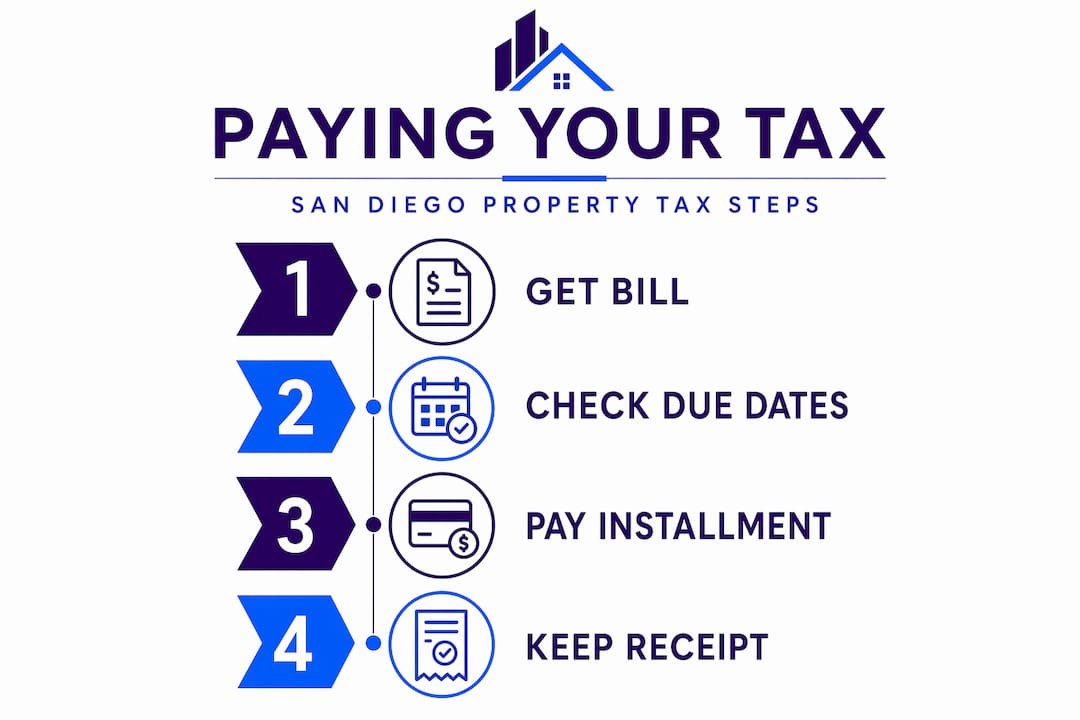
San Diego County collects property taxes through two secured installments each year. The first installment is due November 1 and becomes delinquent after December 10. The second installment is due February 1 and becomes delinquent after April 10. Missing either deadline triggers an automatic 10% penalty with no grace period. The county does not send reminders before penalties apply, so the calendar is your responsibility.
Beyond the two standard secured installments, you may also receive supplemental tax bills. These are generated after a reassessment, which happens when you purchase a home or complete new construction. The supplemental bill covers the difference between the old assessed value and the new one, prorated from the date of the event. Supplemental bill deadlines shift based on when they are mailed: bills sent July through October follow the standard December 10 and April 10 schedule, while bills mailed November through June follow different delinquency dates.
Here is a step-by-step breakdown of your payment options:
- Online portal. The San Diego County Treasurer-Tax Collector website accepts credit cards, debit cards, and e-checks. Credit card payments carry a service fee, so e-check is the lower-cost option.
- Mail. Send your check with the payment stub to the Treasurer-Tax Collector. Mail it early enough to be postmarked before the delinquency deadline, not just dropped in a box on the due date.
- Phone. The county offers an automated phone payment system. Have your parcel number and payment information ready before you call.
- In person. You can pay at the Treasurer-Tax Collector's office in downtown San Diego during business hours.
- Escrow accounts. If you have a mortgage with an impound account, your lender collects monthly amounts and pays the county directly. Verify this is working correctly after you close. Servicer errors happen.
Pro Tip: If you recently purchased a home and your lender uses an escrow impound account, call them after closing to confirm they have received your new tax bill. Supplemental bills almost never go to the lender automatically, and that one can catch you off guard.
Property tax exemptions in San Diego
San Diego property taxes explained correctly always include a conversation about exemptions, because most homeowners leave money on the table by not applying. The Homeowners' Exemption is the most widely used. It reduces your assessed value by $7,000, which saves you roughly $70 to $140 per year depending on your TRA. That may sound modest, but it is automatic in subsequent years once you apply and it compounds over time. In 2025, that exemption collectively saved 455,621 San Diego homeowners a combined $31.8 million.
Beyond the standard exemption, San Diego offers additional programs worth knowing:
- Disabled Veteran Exemption. Qualifying veterans with a service-connected disability rating can receive a much larger exemption, up to $196,262 in assessed value reduction or more for 100% disabled veterans. The county actively works to connect eligible veterans with this program.
- Property Tax Postponement for Seniors. California's State Controller's Office administers a program that allows qualifying seniors aged 62 and older, as well as blind or disabled owners, to defer property taxes as a lien on the property until it is sold.
- Calamity Relief. If your property suffers damage from a disaster, you can apply for a temporary reduction in assessed value during the repair period.
To claim the Homeowners' Exemption, you must file with the San Diego County Assessor's Office. The standard deadline is February 15 of the year following your purchase, though late filings may still receive a partial benefit. Veteran exemptions have their own application timeline. The key point is that none of these happen automatically. You have to ask.
How to appeal your San Diego tax assessment

A formal San Diego tax assessment appeal is not a casual conversation with the county. It is a legal proceeding with strict rules, and procedural errors can disqualify a valid case before it is even reviewed.
The appeal filing window opens July 2 and closes December 1. Applications must be received by 5:00 p.m. on December 2 or postmarked by midnight on December 1. There is no e-filing option. Your application must carry an original signature. This is one area where many homeowners assume the process mirrors other online submissions, and that assumption costs them their appeal.
Follow these steps to build a strong case:
- Determine your dispute. You are arguing that the county's assessed value exceeds the property's fair market value as of January 1 of the tax year. Pull comparable sales data from the same period, not today's prices.
- Gather supporting evidence. Comparable sales, an independent appraisal, and documentation of any property defects or damage all strengthen your position. Start collecting this well before July.
- Get your parcel number. Your Assessment Appeals application requires the correct APN. It is on your property tax bill.
- File by mail or in person. Send your signed application to the Assessment Appeals Board. Track your mailing if you send it close to the deadline.
- Prepare for the hearing. The county assessor's office will present their valuation. You present yours. Evidence quality and specificity matter more than persistence.
Many homeowners skip the formal appeal because they assume an informal conversation with the assessor's office will produce the same result. It rarely does for contested cases. The formal process gives you legal standing. Use it.
Pro Tip: Even if your appeal is successful, you still owe the original billed amount while your appeal is pending. Pay your bill on time to avoid penalties, then receive a refund if the appeal reduces your assessed value.
Consequences of unpaid property taxes
Unpaid property taxes in San Diego do not stay still. They grow. After July 1 following the second installment deadline, the county moves your account to default status. At that point, a $33 redemption fee applies immediately, and monthly penalties of 1.5% begin accruing. That compounds to 18% per year. On a $10,000 tax bill, that is $1,800 in penalties annually before any other fees.
Here is what the escalation timeline looks like:
| Stage | Timing | What Happens |
|---|---|---|
| First installment delinquent | After December 10 | 10% penalty applied automatically |
| Second installment delinquent | After April 10 | Additional 10% penalty applied |
| Default status | July 1 | $33 redemption fee plus 1.5% monthly penalties begin |
| Tax sale eligibility | 5 years after default | Property may be sold at public auction |
The county's 2026 online tax re-offer auction has registration opening April 13 with a $1,000 refundable deposit and a $35 processing fee. The auction itself runs May 8 through 13, 2026, with more than 400 properties up for sale. Buying at a tax auction can be an opportunity for investors, but for an owner facing that auction, it represents a total loss of the property and equity.
- You can redeem a defaulted property by paying all back taxes, penalties, and fees before the auction closes
- Contacting the Treasurer-Tax Collector early gives you more options and often leads to payment arrangements
- Setting up an escrow impound account with your lender is the most reliable prevention tool
My take on navigating San Diego property taxes
I have worked with buyers and sellers across San Diego County for years, and the number of people who arrive at closing without understanding their future tax bill is striking. The confusion is not their fault. California property tax rates sound simple on paper, and then you add TRAs, supplemental bills, Mello-Roos, and school bonds, and the number suddenly looks very different from what anyone estimated.
What I have found is that buyers who take 15 minutes before making an offer to look up the actual TRA rate for a property make better financial decisions than those who rely on a generic 1.2% rule of thumb. I have also seen clients successfully appeal assessments and recover hundreds of dollars per year, simply because they filed correctly and on time. The appeal process feels intimidating but it is methodical. If you have evidence, it works.
The other thing I cannot overstate is escrow coordination. I have seen tax penalties hit clients because a lender's impound account did not capture the supplemental bill after closing. Confirm directly with your servicer. Do not assume it is handled.
San Diego is a great place to own property. Knowing the rules of how property taxes in San Diego work does not just protect you from penalties. It helps you make smarter buying decisions from day one.
— Jeff
Work with someone who knows the numbers
If you are buying a home in San Diego and want to understand exactly what your tax bill will look like before you close, Jeffsellssandiego is built for that conversation. Jeff brings neighborhood-level knowledge to every transaction, including how tax rates shift across different communities and what exemptions you should apply for the moment you take title.

Whether you are searching for your first home or evaluating an investment in a specific part of the county, the San Diego home listings on the site let you explore active properties across every price point. Jeff also has a dedicated buyer's guide that covers the financial side of purchasing, from closing costs to ongoing ownership expenses like property taxes. Reach out directly to get a clear picture of what ownership will actually cost in the neighborhoods you are considering. Local expertise is not a luxury here. It pays for itself.
FAQ
What is the base property tax rate in San Diego?
The base rate is 1% of assessed value, as set by Proposition 13. Your actual effective rate is higher because local bonds and assessments are added on top, and these vary by Tax Rate Area.
When are San Diego property tax payments due?
The first installment is due November 1 and becomes delinquent after December 10. The second installment is due February 1 and becomes delinquent after April 10, with an automatic 10% penalty applied immediately after each deadline.
How do I appeal my San Diego property tax assessment?
You must file a formal application with the Assessment Appeals Board between July 2 and December 1. The appeal requires an original signature and cannot be submitted electronically. Supporting evidence like comparable sales data or an appraisal strengthens your case.
What is the Homeowners' Exemption and how do I get it?
The Homeowners' Exemption reduces your assessed value by $7,000 and must be applied for through the San Diego County Assessor's Office. The standard deadline is February 15 following your purchase date, and it renews automatically in subsequent years.
What happens if I do not pay my San Diego property taxes?
After July 1 following the second installment deadline, your account moves to default with a $33 redemption fee and 1.5% monthly penalties that can reach 18% per year. Properties left in default for five years become eligible for sale at a public tax auction.