
A closing attorney is a licensed lawyer who manages all legal aspects of a real estate transaction to protect the validity of the property transfer. The role of attorney in closing covers everything from reviewing the purchase contract before signatures to recording the deed with the county after funds change hands. For San Diego homebuyers and sellers, understanding what a closing attorney actually does, and when you need one, can prevent costly mistakes on one of the largest financial decisions of your life. California does not require an attorney at closing by law, but the legal complexity of residential transactions makes their involvement worth serious consideration.
What are the essential duties of an attorney during closing?
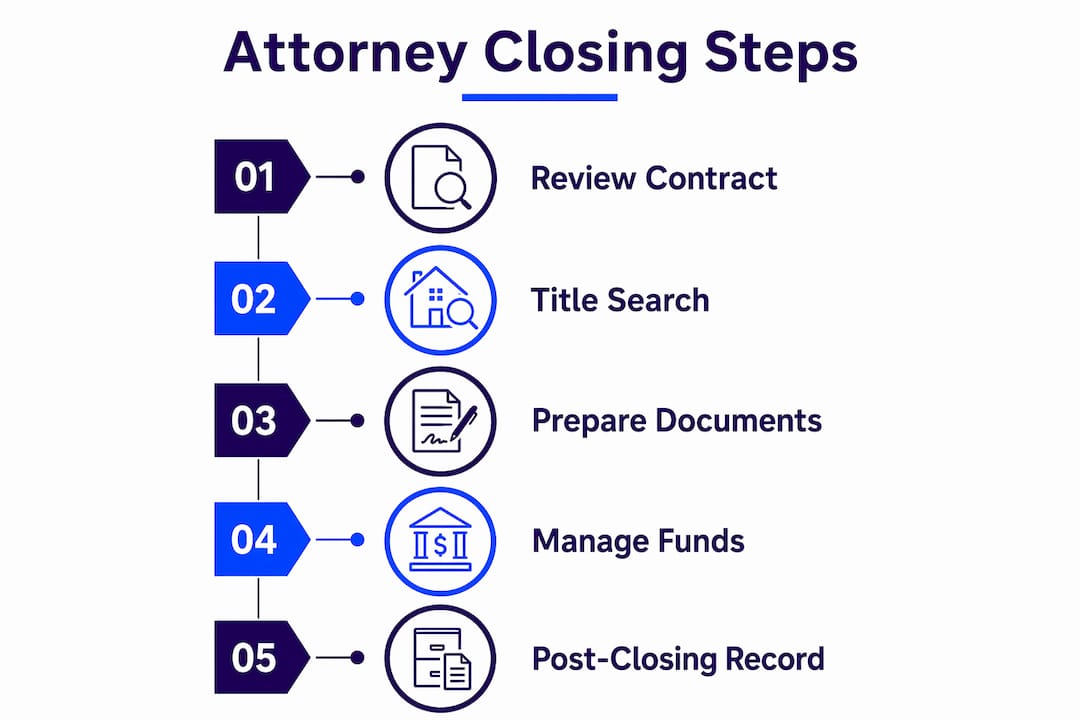
Closing attorney duties typically include reviewing contracts, conducting title searches, preparing closing documents, managing trust accounts, disbursing funds, and recording deeds after closing. Each of these tasks carries legal weight that a title company or transaction coordinator cannot fully assume.
Contract review and title search
The attorney reads the purchase agreement for legal accuracy before you sign anything. They flag terms that expose you to liability, such as vague contingency language or one-sided repair clauses. A title search follows, where the attorney examines public records to confirm the seller holds clear ownership and to identify any liens, judgments, or encumbrances attached to the property.
Document preparation and fund management
Once the title is clear, the attorney prepares the deed, the settlement statement, and any other documents required to transfer ownership legally. They also manage client funds through trust accounts, keeping your money separate from all other parties' funds until disbursement is authorized. Attorneys in mandatory states disburse funds through Interest on Lawyers Trust Accounts, known as IOLTA accounts, which provide a higher level of fiduciary security than a standard escrow arrangement.

Post-closing recording
After signing, the attorney submits the deed and mortgage documents to the appropriate county recorder's office. Recording creates the official public record of ownership transfer. Without this step, the buyer's ownership is legally incomplete.
- Contract review: Identifies unfair or ambiguous terms before you are bound by them
- Title search: Confirms clean ownership and uncovers hidden liens
- Document preparation: Produces legally valid deeds, disclosures, and settlement statements
- Fund management: Holds and disburses proceeds through protected trust accounts
- Deed recording: Files documents with the county to finalize the public ownership record
Pro Tip: Ask your attorney to walk you through the settlement statement line by line before closing day. Errors in closing cost calculations are more common than most buyers expect, and catching them early saves time and money.
How do state laws affect the role of an attorney in closing?
As of march 2026, 14–15 U.S. states require a licensed attorney to conduct or supervise residential real estate closings by law. California is not one of them.
Attorney-mandatory states vs. title states
In attorney-mandatory states such as Massachusetts, Georgia, and South Carolina, a licensed attorney must be physically present and in control of the closing. Experts confirm that "witness-only" roles are insufficient in these jurisdictions. The attorney must exercise full legal competence throughout the process, not simply observe.
A separate category exists in five states including Kentucky, Maryland, North Dakota, Virginia, and West Virginia. In those states, attorneys must prepare or certify specific documents even if they are not required to conduct the closing in person. This is sometimes called the attorney-for-title or attorney-for-documents model.
Where California and San Diego stand
California is a title state. Title companies and escrow officers handle most closings without an attorney present. That does not mean attorneys are unnecessary. It means their involvement is optional, and buyers and sellers must choose to hire one independently.
San Diego transactions often involve complex disclosure requirements under California Civil Code, multi-unit properties, trust-held titles, and non-standard contract terms. Each of these situations benefits from attorney review. The absence of a legal mandate does not equal the absence of legal risk.
| Jurisdiction model | Attorney required? | Who handles closing? |
|---|---|---|
| Attorney-mandatory state | Yes, by law | Licensed attorney |
| Attorney-for-docs state | Partial, for specific documents | Attorney plus title company |
| Title state (California) | No | Escrow officer or title company |
Pro Tip: Even in California, you can hire a real estate attorney to review your purchase contract before you sign. This one-time review typically costs far less than resolving a legal dispute after closing.
How does an attorney interact with other real estate professionals during closing?
The closing attorney, the title company, the transaction coordinator, and the real estate agent each serve a distinct function. Understanding those distinctions helps San Diego buyers and sellers build the right team.
Transaction coordinators manage deadlines and file organization but do not replace the legal duties of a closing attorney. A coordinator tracks contingency removal dates and collects signatures. An attorney interprets what those contingencies mean legally and advises on the consequences of waiving them.
Here is how the key roles divide in a typical San Diego closing:
- Real estate agent: Negotiates terms, advises on market conditions, and guides the client through the offer and counteroffer process
- Transaction coordinator: Manages paperwork timelines, collects disclosures, and keeps all parties on schedule
- Title company or escrow officer: Holds funds in escrow, issues title insurance, and coordinates the mechanics of fund transfer
- Closing attorney: Reviews all legal documents, resolves title defects, advises on legal rights and obligations, and records the deed
The attorney's function sits above the others in legal authority. A title company can issue insurance against title defects, but only an attorney can advise you on whether to accept a title with a known defect or negotiate its removal. That distinction matters when a lien or easement surfaces late in the transaction.
Working with a full-service real estate agent who coordinates well with legal professionals reduces friction and keeps the closing on track. Jeffsellssandiego works alongside attorneys and title professionals regularly to give San Diego clients a complete support structure.
What should homebuyers and sellers expect on closing day?
Closing day is the final step where documents are signed, funds are transferred, and ownership officially changes hands. An attorney present at closing manages the legal side of each of these actions.
A typical closing day with attorney involvement includes:
- Identity verification: The attorney confirms all parties are who they claim to be, a step that protects against fraud
- Document explanation: The attorney walks signers through each document, explaining legal obligations in plain language before anyone signs
- Fund disbursement: The attorney releases proceeds from the trust account to the seller, pays off any existing mortgage, and distributes remaining funds to the appropriate parties
- Error correction: If a document contains an error, the attorney has the authority to correct it on the spot rather than delay closing
- Recording confirmation: After signing, the attorney submits the deed and mortgage to the county recorder and confirms the filing
Modern closings may occur via remote signing and video conferencing, with attorneys maintaining full control to meet state bar requirements. This is increasingly common in San Diego, where buyers relocating from other states often cannot attend in person. Remote closings are legally valid when the attorney supervises the process and verifies identity through approved digital methods.
One common pitfall on closing day is signing documents without reading them. Attorneys prevent this by slowing the process down intentionally. Their job is to make sure you understand what you are agreeing to, not simply to get signatures on paper as fast as possible.
Why hiring a closing attorney benefits San Diego homebuyers and sellers
Attorney involvement in a San Diego closing delivers concrete legal protection that no other professional on the team can provide. The benefits go beyond paperwork.
A closing attorney catches contract terms that expose you to financial risk. They identify title defects before they become your problem after closing. They confirm that all California disclosure requirements are met, which protects sellers from post-sale litigation. For buyers, they verify that the property's legal description matches what you are actually purchasing, a detail that matters especially with multi-unit or mixed-use properties in San Diego neighborhoods.
Many clients mistakenly believe the settlement attorney acts as their personal advocate. In many states, the attorney serves as a neutral facilitator rather than a representative of either party. San Diego buyers and sellers who want dedicated legal representation should hire their own attorney separately, rather than relying on a shared closing attorney to protect their individual interests.
The real estate disclosure process in California is detailed and legally consequential. An attorney who understands local disclosure law adds a layer of protection that a standard escrow closing does not include.
Pro Tip: When selecting a closing attorney in San Diego, look for someone with active California State Bar membership and specific experience in residential real estate, not just general practice. Ask how many residential closings they have handled in San Diego County in the past year.
Key Takeaways
The role of attorney in closing is to provide legal oversight that protects both buyers and sellers throughout the property transfer process, from contract review through deed recording.
| Point | Details |
|---|---|
| Core attorney duties | Attorneys review contracts, search titles, prepare documents, manage funds, and record deeds. |
| California is a title state | Attorney involvement is optional in San Diego but strongly recommended for complex transactions. |
| Attorneys vs. other professionals | Only an attorney can give legal advice; title companies and coordinators cannot replace that function. |
| Neutral facilitator role | Many closing attorneys serve both parties impartially rather than as a dedicated advocate for one side. |
| Remote closings are valid | Attorneys can supervise closings via video conferencing while maintaining full legal control and compliance. |
What I have learned about attorneys and San Diego closings
After working through hundreds of San Diego transactions, I have seen one pattern repeat itself: buyers and sellers who skip attorney review almost always regret it when something goes wrong. And something goes wrong more often than people expect.
The transactions that concern me most are the ones that look simple on the surface. A straightforward single-family home sale in a clean neighborhood can still carry a recorded easement, an unpaid HOA lien, or a vague contract clause that creates a dispute after keys change hands. An attorney catches those issues before they become expensive problems.
What I tell my clients is this: California does not require an attorney, but that does not mean you should not have one. The cost of a one-time legal review is small compared to the cost of resolving a title dispute or a contract misunderstanding after closing. The complexity of San Diego real estate, with its mix of trust-held properties, multi-unit buildings, and California-specific disclosure rules, makes legal guidance genuinely useful, not just a formality.
The rise of remote and digital closings has made attorney involvement even more relevant. When you are signing documents on a screen without anyone physically in the room, having a licensed attorney supervise the process is the clearest protection you have that everything is legally valid.
— Jeff
Working with the right team for your San Diego closing
Buying or selling a home in San Diego involves more moving parts than most people anticipate. Legal review, title work, escrow coordination, and agent guidance all need to work together for a clean closing.

Jeffsellssandiego works with buyers and sellers across San Diego County to build the right professional team for every transaction. Whether you are searching for your next home or preparing to list, having experienced guidance from contract to closing makes a real difference. Search current listings to see what is available in your target neighborhoods, or visit the San Diego neighborhood guide to learn more about the areas where Jeffsellssandiego works every day.
FAQ
What is the role of attorney in closing?
A closing attorney manages the legal aspects of a real estate transaction, including contract review, title searches, document preparation, fund disbursement, and deed recording. Their function is to confirm the property transfer is legally valid and complete.
Is a closing attorney required in California?
California does not require an attorney at residential real estate closings. Title companies and escrow officers handle most transactions, but buyers and sellers can hire an attorney independently for legal review and protection.
What is the difference between a closing attorney and a title company?
A title company issues title insurance and manages escrow funds. A closing attorney provides legal advice, interprets contract terms, and can represent your legal interests in ways a title company is not licensed to do.
Can a closing attorney supervise a remote closing?
Yes. Modern remote closings conducted via video conferencing are legally valid when an attorney maintains full supervision and meets state bar requirements throughout the process.
Does the closing attorney represent the buyer or the seller?
In many transactions, the closing attorney serves as a neutral facilitator for both parties rather than as a dedicated advocate for either side. Buyers or sellers who want personal legal representation should hire their own attorney separately.