
Most homeowners assume all real estate agents work roughly the same way. You list, they market, someone buys. But that assumption costs sellers money, time, and deals every year. Understanding why choose full service agents matters comes down to one question: do you want someone handling paperwork, or someone legally committed to protecting your financial interests through every step of the transaction? The difference is significant, and this article breaks down exactly what that looks like in practice.
Table of Contents
- Key takeaways
- Why choose full service agents over other options
- What fiduciary duty actually means for sellers
- The deal management work most sellers never see
- How full service agents maximize your sale price
- Understanding commissions and contract terms
- My honest take on full service representation
- Sell smarter with Jeffsellssandiego
- FAQ
Key takeaways
| Point | Details |
|---|---|
| Fiduciary duty protects you | Full service agents are legally obligated to prioritize your interests above all others, including their own. |
| Services go far beyond marketing | Pricing strategy, deal coordination, deadline management, and negotiation are where real value is created. |
| Commissions are negotiable | Agent compensation is set by contract, not law, so terms can be discussed and agreed upon upfront. |
| Discount models carry hidden risks | Limited service agents lack full fiduciary obligations, leaving sellers exposed during critical transaction phases. |
| Local expertise moves the needle | Accurate pricing and qualified buyer targeting directly affect your final sale price and terms. |
Why choose full service agents over other options
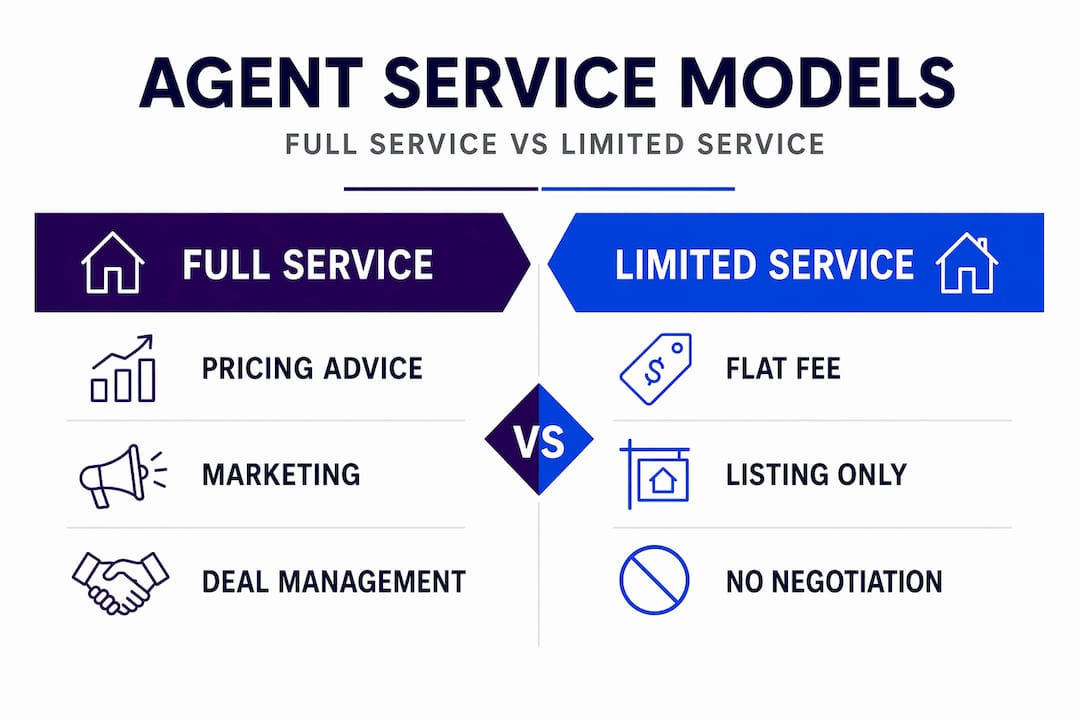
A full service real estate agent handles every phase of your home sale from start to finish. That includes pricing analysis, professional photography, MLS listing, showing coordination, offer review, negotiation, and closing management. You are not buying access to a platform. You are hiring a licensed professional whose legal obligations run to you.
Compare that to discount or limited service models. These agents often charge flat fees or reduced commissions in exchange for a narrower scope of work. You might get MLS exposure but handle showings yourself. You might negotiate your own offers with no professional guidance. Listing agreements govern agent compensation and services and are negotiable, meaning the written contract defines exactly what you are getting.
Here is a direct comparison of the three most common agreement types:
| Agreement Type | Who Can Sell | Agent Commission Trigger | Seller Protection Level |
|---|---|---|---|
| Exclusive right-to-sell | Agent only | Any sale, regardless of source | Highest |
| Exclusive agency | Agent or seller | Agent-sourced sales only | Moderate |
| Limited service | Seller primarily | Specified tasks only | Lowest |
The full service real estate advantages become clearest when you look at what each model leaves out. Limited service agreements often exclude negotiation support, transaction coordination, and fiduciary representation. Those are not extras. They are the parts of the process where sellers lose the most money.
What fiduciary duty actually means for sellers
The word "fiduciary" sounds like legal jargon, but what it means for you is straightforward. Your agent is legally required to act in your best interest in every decision, communication, and negotiation throughout the transaction. That obligation covers five core duties:
- Loyalty: Your agent works for you, not the buyer, not the other agent, and not their own commission.
- Confidentiality: Information you share about your financial situation, timeline, or motivation cannot be disclosed to the other side.
- Disclosure: Anything that could affect your decision must be brought to your attention, including problems with the deal or the buyer.
- Accounting: All funds and documents related to your transaction are handled with full transparency.
- Reasonable care: Your agent must perform their work with professional competence, not just good intentions.
Limited service agents or transactional brokers lack full fiduciary duties, which means they are not legally bound to prioritize your outcome over competing interests. When a buyer's agent asks yours a question about your motivation to sell, a fiduciary agent knows what to say and what not to say. A transactional broker may not have the same obligation.
Residential home sales average over $400,000 in the current market. At that financial stake, having a professional who is legally on your side is not optional. It is the foundation of sensible representation.
Pro Tip: Ask any agent you interview to explain their fiduciary obligations to you in plain language. How they answer tells you a lot about how they will represent you when things get complicated.
The deal management work most sellers never see
Marketing gets the attention. Deal management is where transactions actually succeed or fail. This is one of the most underappreciated advantages of using full service agents, and it deserves a detailed breakdown.
Here is what a full service agent manages after an offer is accepted:
- Inspection coordination: Scheduling the inspection, reviewing the report, and advising you on which repair requests are reasonable versus which you should push back on.
- Appraisal management: Preparing documentation to support your sale price if the appraisal comes in low, which is more common than most sellers expect.
- Deadline tracking: Purchase agreements contain a series of contingency deadlines. Missing one can give the buyer an exit or, worse, expose you to legal liability.
- Communication between parties: Buyers, buyer's agents, lenders, title companies, escrow officers, and inspectors all need information at specific times. Your agent keeps that flow organized.
- Repair negotiation: When inspection results come back, a skilled agent negotiates credits or repairs strategically rather than accepting every demand.
- Closing preparation: Final walk-through issues, last-minute lender conditions, and document signings all require active coordination up to the final day.
Most errors in home selling come not from poor marketing but from mishandling these deal management tasks. A buyer who does not hear back in time may walk. A missed contingency deadline can collapse an escrow that was otherwise solid.
Pro Tip: When evaluating agents, ask specifically how they handle a low appraisal or a buyer requesting $20,000 in repairs. Their answer reveals whether they are a marketer or a deal manager.

Sellers who focus only on getting their home on Zillow are missing the bigger picture. The listing gets buyers interested. The agent keeps them at the table and protects your money through everything that follows.
How full service agents maximize your sale price
Pricing a home is not a math problem. It is a strategy. Full service agents bring up-to-date tools and local expertise that directly affect how much you walk away with. Here is how that works in practice:
- Comparative market analysis: Your agent pulls recent sales of similar homes in your specific neighborhood, adjusting for condition, upgrades, and market timing to find a defensible and competitive price.
- Strategic list price: Pricing slightly below market can generate multiple offers and drive the final price above asking. Pricing too high causes the listing to sit, which signals weakness to buyers.
- MLS cooperation: A full service agent actively markets to buyer's agents who bring qualified clients, expanding the pool of serious buyers who see your home.
- Offer evaluation: It is not just about the highest number. Contingencies, financing type, and closing timeline all affect the real value of an offer.
The goal is not just one offer. The goal is the best possible offer from the most qualified buyer. A full service listing agreement that includes a detailed marketing plan and offer strategy is the backbone of that outcome.
For sellers in San Diego, local market knowledge matters even more. Comparable sales in Del Cerro look nothing like sales in Carmel Valley. Understanding your specific pricing strategy is the difference between leaving money on the table and maximizing your position.
Understanding commissions and contract terms
Cost is a real consideration, and the benefits of full service agents need to hold up against the fee. Here is what you actually need to know:
- Agent compensation is set by contract, not regulated by law, so it is negotiable from the start of your conversation.
- Commission-based agents are motivated to sell your home for the highest possible price because their fee scales with your outcome.
- Flat-fee models can look attractive upfront, but they rarely include the full scope of services that protect your financial position.
- NAR 2024 rules require written compensation disclosure before you sign, so you will know exactly what you are agreeing to.
The math often favors full service representation even when the commission appears higher. A skilled negotiator who secures $15,000 more than your asking price more than covers the fee difference over a limited service agent who leaves that money unclaimed. Sellers focused only on the percentage sometimes miss what the percentage actually buys them.
You can learn more about how listing agreements work and what to expect from the scope of services before you commit to any agreement.
My honest take on full service representation
I have worked with sellers across San Diego through straightforward sales and through transactions that nearly fell apart three different times before closing. What I have learned is that the marketing side of this job is the part sellers see. The part that actually saves them money happens in conversations and decisions that never make it into a listing presentation.
I have seen sellers lose thousands of dollars because an agent did not know how to counter a low appraisal or failed to catch a contingency deadline slipping by. These are not rare events. They happen regularly, and they almost always happen when the agent was not fully engaged in the transaction as an advocate.
What I believe homeowners undervalue most is confidentiality. When a buyer's agent calls and asks "how motivated is your seller?" the answer to that question directly affects how much money you put in your pocket. A fiduciary agent knows that your motivation, your timeline, and your financial situation are none of the other side's business. An agent without that obligation may not draw that line clearly.
The sellers I have worked with who got the best outcomes were the ones who treated the agent selection as seriously as the pricing conversation. You are not picking someone to post photos online. You are picking someone to manage one of the largest financial transactions of your life. That distinction matters more than most people realize until they are already in the middle of a deal.
— Jeff
Sell smarter with Jeffsellssandiego
If you are a homeowner in San Diego thinking about selling, the decision about who represents you shapes everything that follows. At Jeffsellssandiego, full service representation means you get a dedicated advocate from the first pricing conversation through the final signature at closing.

Jeff Hinds brings local San Diego market expertise, a hands-on approach to deal management, and a clear commitment to protecting sellers' financial interests through every phase of the transaction. Whether you are preparing to list, evaluating your timing, or just starting to research your options, the seller's guide is a good place to start. You can also browse current listings to get a feel for how full service marketing looks in practice. When you are ready to talk through your specific situation, reach out directly for a no-pressure consultation.
FAQ
What does a full service real estate agent actually do?
A full service agent handles every aspect of your home sale, including pricing, marketing, showing coordination, offer negotiation, and closing management. Their legal fiduciary obligations require them to prioritize your financial interests throughout the entire transaction.
Should I choose a full service agent over a discount agent?
For most sellers, yes. Limited service agents lack full fiduciary duties and often exclude negotiation and deal coordination, which are the phases where sellers most commonly lose money.
Are full service agent commissions negotiable?
Yes. Commission rates are set by contract, not by law, and are always negotiable before you sign a listing agreement. The written agreement specifies exactly what services you receive and what compensation the agent earns.
What is an exclusive right-to-sell agreement?
It is the most common listing agreement type, where the broker earns a commission regardless of who ultimately brings the buyer. It provides the broadest level of agent protection and is standard in most MLS-listed transactions.
How do full service agents help maximize my sale price?
They use current market data, strategic pricing, and MLS cooperation to attract qualified buyers, then apply negotiation skills during offers and inspection responses to protect your net proceeds at every stage.