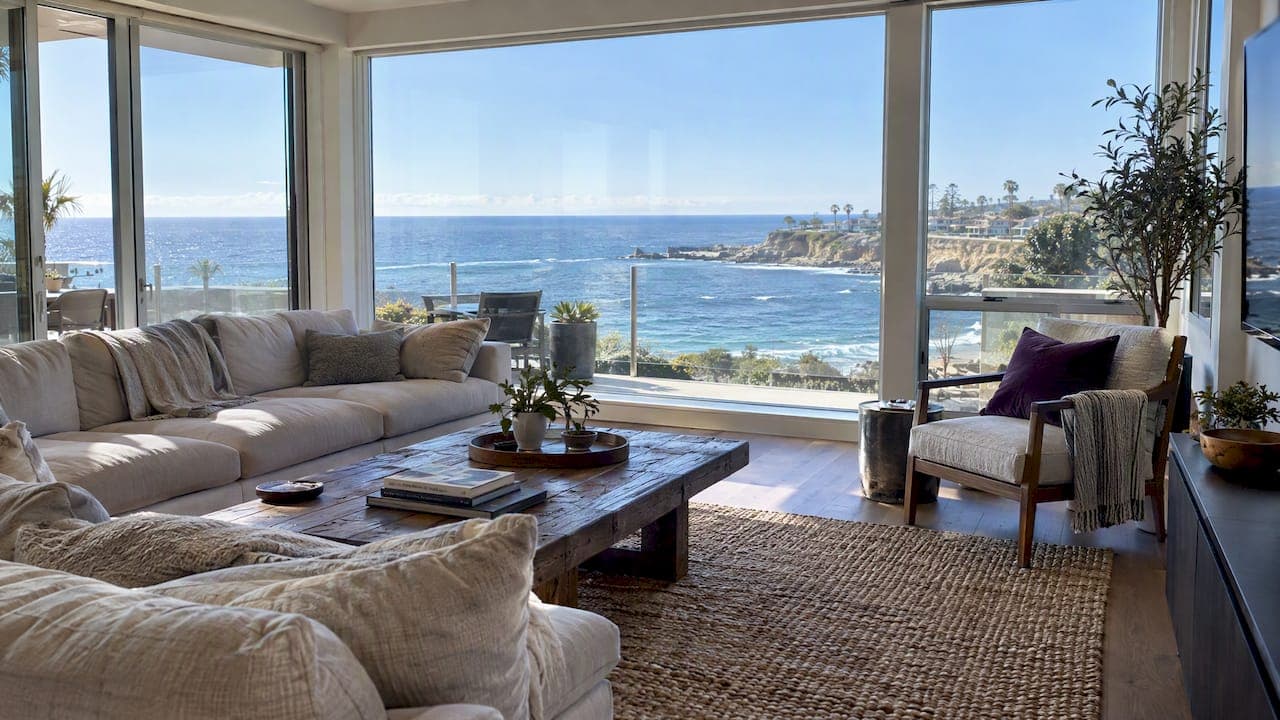
An ocean view can add anywhere from nothing to well over a third of a San Diego home's value. The gap depends on how clear the view is, how close you are to the water, and whether the view will still be there in ten years. Peer-reviewed research puts unobstructed views at a 15 to 40% premium and partial views at 0 to 20%. This guide shows how to read that range as a buyer or a seller.
TL;DR
- A clear, unobstructed ocean view typically adds 15 to 40% to value in premium coastal neighborhoods. A partial or "peek" view often adds 0 to 20%.
- Distance matters as much as the view. Homes within 500 feet of the shoreline have shown valuations over 100% higher than similar homes six miles inland, and the effect fades quickly with distance.
- Buyers overpay most often when the view is vulnerable: a neighboring lot that can be redeveloped, a bluff that is retreating, or a line of sight that depends on a tree.
- Sellers earn the premium by proving it: view photos at the right time of day, a clear read of what is protected, and pricing based on comparable view sales, not coastal averages.
Table of Contents
- What "ocean view premium" actually means
- How much a view adds, by quality
- Where the premium shows up around San Diego County
- The prestige effect: why some addresses carry more
- The risk side of the premium
- If you are buying a view home
- If you are selling a view home
- Our perspective
- Work with us on a view home
- FAQ
- Sources
What "ocean view premium" actually means
The phrase gets used for two different things, and mixing them leads to bad pricing.
The first is the coastal premium: what you pay to be near the water at all. It covers beach access, the breeze, the walkable village, and the address. The second is the view premium: what you pay on top for seeing the Pacific from the house. A condo two blocks from the sand with a sliver of blue from the bathroom window has the first and almost none of the second. A bluff-top home with a wall of glass has both.
The academic research on this is useful because it separates the two. The Springer study of coastal housing values found that homes within 500 feet of the shoreline carried a premium of roughly 102% against comparable homes about six miles inland. From 500 to 1,000 feet, the premium was about 63%. Past that it dropped fast and was essentially gone near the six-mile mark. That is a nonlinear curve: the first few blocks do most of the work.

The study is older than today's market, so treat the percentages as a shape, not a quote. What holds up is the pattern. Proximity gets you most of the premium, and a good view adds a meaningful layer on top.
How much a view adds, by quality
Within premium coastal neighborhoods, the same research found a wide spread by view quality:
| View type | Typical added value | What buyers see |
|---|---|---|
| Unobstructed, wide, horizon-line | 15 to 40% | Open water from main living areas |
| Partial or filtered | 0 to 20% | Water visible past rooftops or trees |
| Peek or secondary-room only | Often near 0% | Blue from one bedroom or a stairwell |
A few practical points follow from that table.
Where you see it from matters. A view from the kitchen, living room, and primary bedroom is worth far more than the same view from a guest bathroom. Appraisers and buyers weigh the rooms where people spend their day.
Width and horizon matter. A view that includes the horizon line and open water reads as "ocean." A view of a harbor, a golf course with water in the distance, or a canyon with a glimpse of the sea reads differently and prices differently.
Day and night matter. A view that works at sunset but fades behind marine layer most mornings is still a view. But buyers who tour at 10 a.m. in May will form a different opinion than buyers who tour at 6 p.m. in September.
Standard valuation misses it. Local appraisers note that standard appraisal models lean heavily on price per square foot, which does not capture a view well. That is why view homes need hand-picked comparables, not a formula.
Where the premium shows up around San Diego County
The price of a view is tied to the neighborhood it sits in. Recent figures from the August 2026 city-by-city medians show how different the luxury coast is from one town to the next:
| Community | Median sale price | Price per sq ft | Days on market |
|---|---|---|---|
| Rancho Santa Fe | $4,880,000 | $909 | 51 |
| Del Mar | $3,635,000 | $1,410 | 13 |
| Cardiff by the Sea | $2,840,000 | $1,576 | 33 |
Look at the price per square foot, not the median. Rancho Santa Fe has the highest median because the homes are large and sit on acreage, but it is inland, so a good part of the price is land and privacy, not a view. Cardiff by the Sea has a lower median and a higher price per foot, which is what a smaller coastal home with a water view tends to look like.
The pace of sales tells a second story. In the October 2026 report on $2M+ homes, median list prices reached $8.0M in Rancho Santa Fe, $4.5M in Del Mar, and $3.0M in La Jolla. Homes at that level are taking longer to sell: about 198 days in La Jolla and 252 in Del Mar, versus 70 in Cardiff by the Sea. Those figures measure listings at the top of the market, so they run higher than the sold medians in the table above. Both are real. They describe different slices.
What this means for you:
- If you are buying, a long time on market at the top end gives you room to negotiate, especially on homes where the view is the only selling point.
- If you are selling, a premium view does not guarantee a quick sale. Pricing slightly above what the comparable view sales support is the most common reason a home sits.
If you want a closer look at one of the most view-driven markets, our guide to the La Jolla housing market breaks down current prices and the moves we see buyers and investors making. For the north county coast, see our take on the Del Mar housing market, where supply is tight and hazards matter. And for the top of the range, our look at San Diego's $10M+ sales shows how the luxury market has split.
The prestige effect: why some addresses carry more
Some of the premium is not about the view at all. It is about what surrounds the home. Luxury coastal living in San Diego is shaped by a handful of landmarks, among them the Fairmont Grand Del Mar, La Valencia in La Jolla, and Beach Village at The Del in Coronado. Streets near places like these tend to sit in the highest price-per-square-foot pockets of the county, because the village, dining, and walkability come with the address.
That is worth knowing because it changes how you compare. Two homes with the same view can differ in price by a wide margin if one is a five-minute walk from a village and the other needs a car for everything. When we run comparables, we separate "view value" from "location value" so you can see which one you are paying for.
The risk side of the premium
A view is only an asset if it lasts. This is where buyers lose money, and where sellers can lose credibility.
View permanence
Luxury appraisers describe the most common pitfall as overpaying for a view home where the view is exposed to future obstruction. The fix is what they call view permanence: checking local zoning, the redevelopment potential of neighboring parcels, and bluff stability before deciding whether the premium is justified by long-term value.
In practice, before you make an offer on a view home, check:
- Height and zoning of the lots in your sightline. Can a neighbor add a second story or tear down and rebuild larger?
- Vacant lots and teardown candidates. A one-story home below you is a view at risk. A protected open space is not.
- Vegetation. Trees on neighboring property can grow into a view, and trees you rely on may not be yours to keep.
- Easements and view covenants. Some communities have them. Some do not. Ask for the documents early.
Bluff edges and setbacks
For bluff-top homes, the legal bluff line matters. San Diego defines the coastal bluff edge in its Land Development Code, and the line drives mandatory setbacks for new construction. A geotechnical evaluation for a La Jolla bluff project, filed with the City of San Diego, shows the level of detail involved: property lines do not account for bluff retreat, and geologic work is required to find a safe building area.
Setback rules have been changing, so do not rely on a number you read in an old article or a listing. Ask for the current requirement for the specific parcel, and ask for any geotechnical report the seller has. If you plan to add on or rebuild, a licensed geotechnical engineer and the City's development review are the right people to consult before you price in the extra square footage.
Sea-level rise and disclosure
Coastal premium comes with coastal exposure. The California Coastal Commission's residential adaptation guidance uses a 75-year planning horizon and uses Solana Beach's blufftop neighborhoods as one of its examples. It points to possible limits on future shoreline armoring and, over time, challenges in providing services such as water and sewer in hazard-prone areas. If you are buying in the Coastal Overlay Zone, read the disclosures closely and ask your agent and your insurance broker what applies to the specific address.
If you are buying a view home
The goal is to pay for the view you will actually keep. Here is how we approach it with buyers.
- Define the view you want. Horizon, harbor, sunset, city lights, or a mix? Each prices differently, and knowing your priority keeps you from overpaying for the wrong one.
- Tour at more than one time of day. Go once in the morning and once near sunset. Look from every room that matters.
- Pull view-specific comparables. Price per square foot alone will mislead you. We compare homes with similar view width, similar distance to the water, and similar rooms with the view.
- Investigate permanence. Zoning, neighboring lots, vegetation, and, for bluff homes, geotechnical history.
- Read the disclosures and the reports. Hazard, bluff, and insurance questions belong before the offer, not after the inspection period starts.
- Decide what the premium is worth to you. Some buyers happily pay a 30% premium for a view they will enjoy for twenty years. Others do better buying one street back and spending the difference on the house.
A useful middle path is the "second row" home: one street back, with a partial view, at a price that reflects the 0 to 20% range instead of the 15 to 40% range. For many buyers, that is the best value on the coast.
If you want help finding the right one, our VIP Home Search sets up personalized listings by neighborhood, and our Buy With Confidence service covers the process from first showing through closing.

If you are selling a view home
Sellers sometimes assume the view will sell the house on its own. It helps, but buyers in this segment are careful, and the data shows that top-end homes can take months to sell.
- Price on view comparables. A home with a partial view priced like a home with a full horizon view is the most common reason listings stall.
- Show the view honestly. Photograph it in good light, and be accurate about what is visible from which rooms. Buyers who feel misled by the photos will discount the home further.
- Document permanence. If your view is protected by open space, a height limit, or a recorded covenant, say so. If you have a geotechnical report for a bluff property, have it ready.
- Prepare the disclosures early. Hazard and Coastal Overlay Zone items are easier to handle when they are in the first packet than when they surface in negotiation.
- Plan for a longer timeline at the top end. At $2M and above, the market has slowed in several communities. A realistic schedule protects you from price cuts made out of impatience.
Start by finding out what your home is worth today with our Home Valuation, then plan your sale with Sell With Strategy.
Our perspective
We have worked the San Diego market for more than two decades, and the same pattern comes up in every cycle: people pay for the view they saw on one afternoon and then learn what it depends on.
Our advice is to treat a view like any other asset and ask what could change it. We look at what can be built next door, what the bluff is doing, and what the disclosures say. Then we look at what comparable homes with a comparable view have sold for, not what the listing says. Sometimes that confirms the asking price. Sometimes it shows that a home one street back is the better buy.
For sellers, we are just as direct. A view earns its premium when it is real, documented, and priced against the right comparables. We would rather tell you that your partial view supports a 10% premium and sell your home on schedule than promise 30% and watch it sit.
Whoever you are in this transaction, you should have calm, precise guidance and an agent who picks up when you call.
— Jeff
Work with us on a view home
Whether you are looking for a home with water in the window or deciding how to price the one you own, we start with the numbers and the specifics of the address. You can browse current listings, see exclusive listings, or contact us through our home page to talk through your plans. For La Jolla and Point Loma, our neighborhood guides are a good first stop.
FAQ
How much more is an ocean view home worth in San Diego?
In premium coastal neighborhoods, research shows unobstructed views adding roughly 15 to 40% and partial views adding 0 to 20%. The exact figure depends on the width of the view, the rooms it is visible from, and the distance to the water. A local agent should pull view-specific comparables for the address.
Is a partial ocean view worth paying extra for?
Sometimes, but usually a smaller premium than buyers expect. A peek of water from a secondary room often adds little, while a filtered view from the main living area can add real value. Compare it with similar homes that sold with the same type of view.
Can an ocean view disappear after I buy?
Yes. Neighboring redevelopment, tree growth, and bluff changes can all affect a view. Appraisers recommend checking zoning, neighboring parcels, and bluff stability before you pay a premium. Ask your agent to review these items before you make an offer.
Does a bluff-top location add risk?
It can. San Diego sets coastal bluff edge and setback rules that limit where you can build, and geologic evaluations are part of the process. For a specific property, talk with a licensed geotechnical engineer and review the seller's disclosures.
Sources
- Springer: coastal proximity and view effects on housing values
- Hello San Diego: San Diego home prices by city, August 2026
- Hello San Diego: San Diego luxury home market, October 2026
- U.S. News: San Diego hotels
- Spry Home Appraisal: luxury home appraisal in San Diego
- City of San Diego: Land Development Procedures, coastal bluff edge
- City of San Diego: geotechnical evaluation, La Jolla
- California Coastal Commission: residential adaptation guidance