
La Jolla is running as a buyer-favorable market as of mid-2026, with median listing prices sitting in the high millions and homes taking longer to sell than they did a year ago. If you're a buyer, that translates into real negotiating room on inspection and price. If you're selling, expect to price carefully and market harder than you would have in 2022.
TL;DR:
- Days on market have increased to approximately 43 to 60 days, indicating a shift toward a buyer’s market, especially outside high-demand pockets like Shores and Muirlands.
- Inventory growth and longer sale times mean sellers have less pricing power, but well-priced properties can still close near asking with a 97% sale-to-list ratio.
- Rental demand remains strong, with median rents around $8,350 per month, making La Jolla attractive for investors despite slower home sales.
- Different neighborhoods within La Jolla show varying dynamics; Shores and Muirlands favor sellers, while Village and condo areas offer better negotiation leverage for buyers.
Table of Contents
- La Jolla Housing Market Snapshot: Prices, Inventory, and Rent
- How Do La Jolla Neighborhoods Compare?
- What Do Current La Jolla Real Estate Trends Mean for Investors?
- Smart Offer Strategy for Buying in La Jolla Right Now
- How to Evaluate a La Jolla Property Before You Buy
- Why La Jolla Housing Demand Is Holding Despite Higher Rates
- Who's Actually Buying in La Jolla Right Now?
- Risks Every La Jolla Buyer Should Know About
- How La Jolla Stacks Up Against the Broader San Diego Market
- A Local Agent's Take on Reading La Jolla's Market Right Now
- How Jeff Sells San Diego Helps You Act on These Numbers
- Sources
- FAQ
La Jolla Housing Market Snapshot: Prices, Inventory, and Rent
The numbers tell a consistent story right now: more time on market, softer urgency, and prices holding near the top of the range without much room to push higher. The rolling 12-month median sales price in the 92037 zip code sits at $3,574,000, according to the North San Diego County REALTORS® local market update. Realtor.com's June 2026 neighborhood data puts the median listing price slightly lower, around $3,397, which is typical since listing prices usually run ahead of what actually closes.
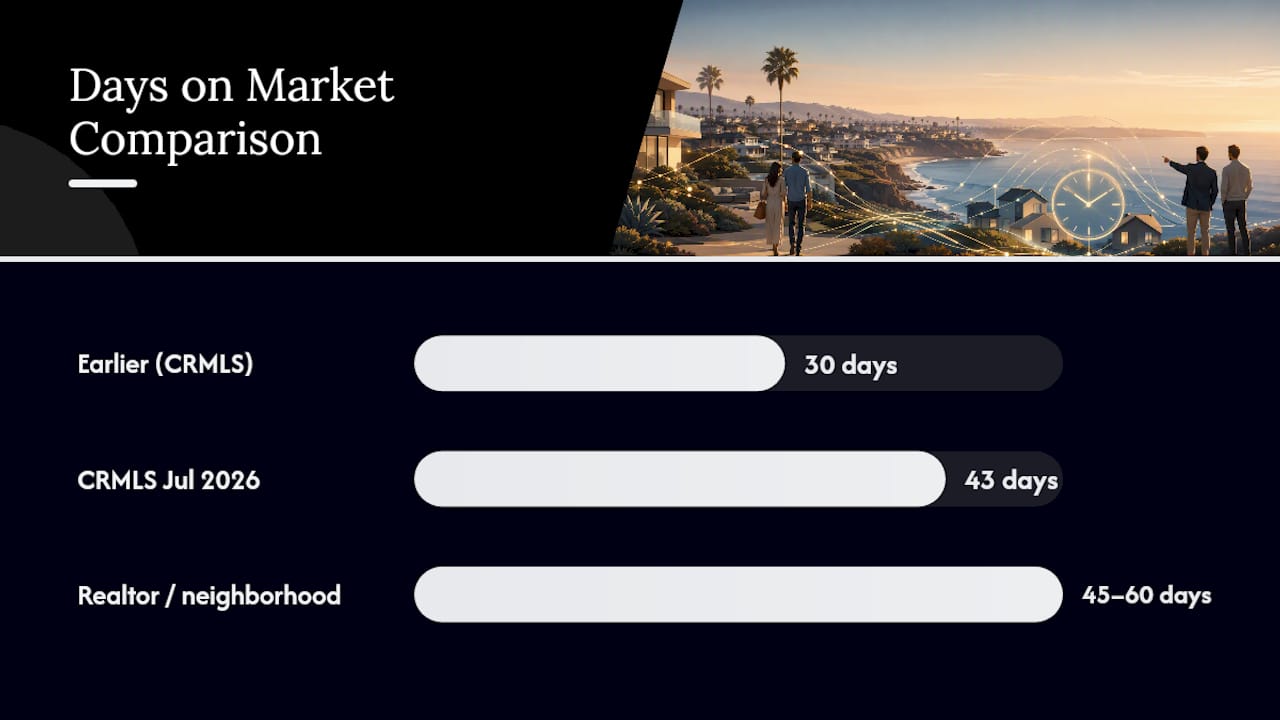
Days on market is the number worth watching closest. CRMLS reports median days on market until sale climbed from 30 to 43 days in its July 2026 snapshot, while Realtor.com's broader neighborhood figure lands near 45 days. A separate local market report tracking La Jolla puts average days on market even higher, closer to two months in some sample periods in some sample periods, and explicitly calls La Jolla a buyer's market for mid-2026.
Rental demand tells a different story. Median rent sits around $8,350 per month, a level that keeps La Jolla attractive to investors even while sales activity cools.
| Metric | Figure | Source |
|---|---|---|
| Median sales price (92037, rolling 12mo) | $3,574,000 | CRMLS/NSDCAR |
| Median listing price | $3,397 | Realtor.com |
| Days on market (until sale) | 43 (up from 30) | CRMLS/NSDCAR |
| Days on market (neighborhood avg) | 45–60 | Realtor.com / Search Listings SD |
| Sale-to-list ratio | ~97% | Realtor.com |
| Median rent | $8,350/mo | Realtor.com |
Key drivers behind these figures:
- Inventory has grown enough to give buyers more choices and more leverage on price.
- Sale-to-list ratios near 97% mean well-priced, move-in ready homes still close to asking.
- Days on market has widened across nearly every data source tracking the zip code.
- Rent growth has stayed firm even as sales have slowed, a split that matters for investors weighing hold versus flip strategies.
How Do La Jolla Neighborhoods Compare?
La Jolla isn't one market. It's a collection of very different micro-markets stacked inside a single zip code, and treating them as interchangeable is how buyers overpay or underbid.
- La Jolla Shores: Beachfront and near-beach properties push the median listing price to around $5.6 million. Liquidity is thinner here because inventory is limited and buyers tend to wait for the right property rather than settle.
- Muirlands: This inland, view-oriented enclave runs even higher, with median listings near $8.1 million. Large lots and custom construction drive the premium, and days on market can stretch long for the most unique properties.
- La Jolla Village: The walkable core near the coast shows the widest price spread, with median listings ranging roughly from $799,000 to $3 million depending on the exact block and property type. Condos and older cottages pull the low end down.
- Bird Rock: A smaller, tighter submarket that tends to move faster than the Village core, thanks to consistent demand from buyers wanting walkable beach access without Shores-level pricing.
Right now, the Shores and Muirlands favor sellers on truly unique properties, while the Village and condo-heavy pockets favor buyers who can negotiate on days-on-market leverage. The La Jolla neighborhood guide breaks down individual streets and listing clusters in more detail if you're narrowing in on a specific pocket.
What Do Current La Jolla Real Estate Trends Mean for Investors?
Rising days on market and growing inventory usually mean one thing: sellers are losing some pricing power, even in a market as tight as La Jolla. But the shift is gradual, not dramatic, and it comes with a caveat worth repeating. High-end coastal zip codes have small sample sizes, so a handful of luxury closings can swing a monthly median by hundreds of thousands of dollars. CRMLS itself flags this volatility risk in its local market update, and it's worth remembering before reacting to any single month's numbers.
Mortgage-rate sensitivity is the other lever. Higher rates stretch monthly payments on a $3 million-plus purchase fast, which is part of why days on market has widened. Buyers waiting for rate relief are effectively adding supply to the market by staying on the sidelines.
For investors, three takeaways stand out:
- Yield focus over appreciation bets. With median rent near $8,350 a month, cash-flow-oriented buyers should run the numbers on rental yield before assuming price appreciation will do the heavy lifting.
- Longer hold horizons make more sense right now. A softening sales pace rewards patient capital over quick flips.
- Renovation math needs a hard look. Buying a dated property below median and renovating can beat paying a premium for a already-updated home, but only if the numbers include realistic labor and materials; getting estimates from interior door and closet replacement experts in San Diego can help refine renovation budgets.
Pro Tip: Before making an offer on anything priced as a "renovation opportunity," get a contractor bid in writing. Coastal permitting timelines in San Diego often run longer than buyers expect, and that delay eats into any investment return.
Red flag for speculative buys: properties sitting well above 60 days without a price cut are often overpriced relative to current comps, not just waiting for the right buyer.
Smart Offer Strategy for Buying in La Jolla Right Now
A 97% sale-to-list ratio doesn't mean every home sells at full price. It means the well-priced ones do, and everything else has room to negotiate.
- Anchor your offer to recent comps, not the listing price. With days on market widening, sellers who priced aggressively six weeks ago may already be open to a reset.
- Use inspection contingencies strategically. In a slower market, you have leverage to request repairs or credits rather than waiving contingencies to compete.
- Get fully underwritten preapproval before you tour, not after. Coastal properties in this price range often require jumbo financing, and rate locks matter more when the loan amount is large. The guides on top mortgage rates in La Jolla and getting the best mortgage terms walk through the specific steps.
- Move fast on true outliers, wait on everything else. A well-priced Shores or Bird Rock listing under median can still draw competition. A Village condo sitting past 45 days usually has more room to negotiate than urgency to act.
Pro Tip: Ask your agent to pull the CRMLS days-on-market history for a specific listing, not just the neighborhood average. A property that's been relisted after an expired contract often has more negotiating room than one that's brand new to market.
How to Evaluate a La Jolla Property Before You Buy
Run through this before you get emotionally attached to any listing:
- Does the price per square foot match recent closed comps in that specific submarket, not just the La Jolla median?
- What's the realistic renovation or repair cost, backed by a contractor estimate rather than a guess?
- Are HOA fees and rules reasonable for condos, and do they restrict rentals if you're buying as an investor?
- At $8,350 median rent, does the math work? A $3.4 million purchase renting near median implies roughly a 2.9% gross yield before expenses, which is thin unless you're betting heavily on appreciation.
- Watch for red flags: unresolved structural issues, HOA litigation, or comps that only work if you cherry-pick the highest recent sale.
Why La Jolla Housing Demand Is Holding Despite Higher Rates
La Jolla's economy leans heavily on UC San Diego, Scripps Research, and a dense cluster of biotech and life-sciences employers nearby, which keeps a steady stream of high-income buyers in the pipeline regardless of broader mortgage-rate swings. That employment base is part of why prices have stayed elevated even as days on market stretched out. These aren't buyers stretching to qualify. Many are paying cash or putting down 40% or more, which insulates La Jolla from the rate sensitivity that hits entry-level markets harder.
Tourism and second-home demand add another layer. La Jolla's beaches and shopping village draw buyers who want a part-time coastal residence, and that demand doesn't disappear when rates rise; it just shifts negotiating leverage slightly toward buyers who can act without financing contingencies.
The push and pull between local high-wage employment and national rate pressure is exactly why La Jolla's slowdown looks more like a cooling than a correction. Prices haven't dropped meaningfully. They've just stopped climbing as fast, and homes take longer to find the right buyer. That's a very different dynamic than markets driven primarily by mortgage-dependent first-time buyers, where rate hikes hit demand almost immediately.
Who's Actually Buying in La Jolla Right Now?
Three buyer profiles dominate La Jolla transactions this year, and each has different priorities worth understanding if you're competing against them or trying to sell to them.
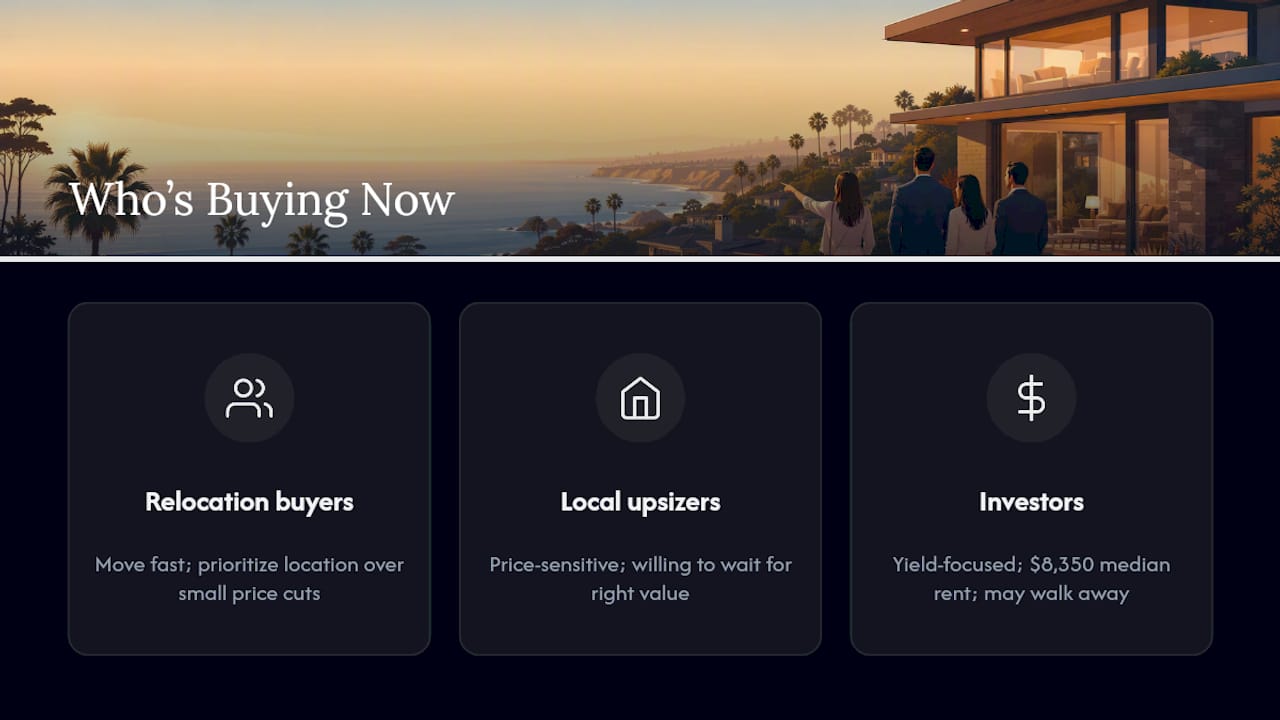
Cash-heavy relocation buyers are moving from higher-tax states or selling businesses elsewhere and treating La Jolla as a lifestyle upgrade. They tend to move fast on properties that check every box and care less about negotiating a few percentage points than about securing the right location.
Local upsizers are longtime San Diego County residents trading up from nearby neighborhoods once their equity and income support it. This group is more price-sensitive and more willing to wait for the right value, since they're not relocating under time pressure. If you're weighing whether now is the moment to trade up, the considerations around upsizing into a dream home are worth reviewing before you list your current place.
Investors and second-home buyers are drawn by the $8,350 median rent and La Jolla's enduring appeal as a vacation destination. This group watches yield numbers closely and is the most likely to walk away from a listing that doesn't pencil out, which is part of why days on market has widened for overpriced investment-grade properties specifically.
Risks Every La Jolla Buyer Should Know About
Coastal geography that makes La Jolla desirable also creates real risk factors buyers need to price into their decision. Bluff erosion affects certain stretches of coastline, and properties near the bluffs can face insurance complications or future geological assessments that don't show up in a standard listing description.
Insurance availability is the risk drawing the most attention lately. California's broader home insurance market has tightened, and coastal properties, especially older construction, can face higher premiums or more limited carrier options than buyers expect. Get an insurance quote during your due diligence period, not after you've waived contingencies.
Regulatory risk also matters for anyone eyeing rental income. Short-term rental rules vary by specific area within San Diego, and HOA restrictions in condo buildings can bar rentals altogether regardless of city policy. Confirm both before assuming a property will cash-flow as a vacation rental.
Finally, the small-sample volatility mentioned earlier cuts both ways. A market that can jump on a handful of luxury sales can also look artificially soft if a few lower-priced condos closed in the same reporting window. Treat any single month's median with some skepticism and look at the trend across several months instead.
How La Jolla Stacks Up Against the Broader San Diego Market
La Jolla trades at a steep premium to San Diego County overall, and that gap is the whole investment thesis for buyers choosing between the two. San Diego County's countywide median sits well below La Jolla's $3.4 million to $3.57 million range, reflecting the fact that La Jolla combines beachfront scarcity, top-tier schools, and proximity to UC San Diego and the region's biotech corridor in a way few other zip codes can match.
That premium comes with tradeoffs. Rental yields tend to run lower in La Jolla than in more affordable San Diego neighborhoods, since rents don't scale up at the same rate as purchase prices. An investor chasing pure cash flow will often find better numbers inland or in South Bay submarkets. An investor betting on long-term appreciation and scarcity value, particularly in Shores or Muirlands, is making a different bet: that limited coastal supply keeps values resilient even through rate cycles that hit less desirable markets harder.
The practical takeaway is not that La Jolla is better or worse than San Diego overall. It's a different kind of investment; lower yield, higher barrier to entry, but historically more resilient pricing during downturns because so little new coastal inventory can ever be built.
A Local Agent's Take on Reading La Jolla's Market Right Now
Numbers only tell you so much. I track La Jolla through CRMLS updates, Realtor.com's neighborhood data, and local market reports every month, and the pattern I keep seeing is buyers anchoring to the median when they should be anchoring to the specific submarket and the specific seller's situation.
When you tour a property, ask how long it's been listed, whether it was previously listed and pulled, and what comparable sales actually closed in that micro-pocket in the last 90 days, not the last year. Ask your agent to pull the actual days-on-market history, not just a summary number. A seller who's been on market 45 days with no offers is in a very different negotiating position than one who just listed last week, even if both properties look identical on paper.
— Jeff
How Jeff Sells San Diego Helps You Act on These Numbers
Reading market data is one thing. Winning the right offer or pricing your home correctly in a slower La Jolla market is another. Jeff Sells San Diego brings over two decades of San Diego-focused experience to exactly this problem: knowing which La Jolla comps actually apply to your situation and which negotiation levers work when days on market stretch past 45.

If you're buying, Buy With Confidence walks you through offer strategy, financing coordination, and property search support tailored to current conditions. If you're selling, Sell With Strategy covers pricing and marketing built for a market where overpricing costs you weeks, not days. Curious what your La Jolla property is worth in today's numbers? Start with a Home Valuation to get a current estimate grounded in real comps, not guesswork. Buyers looking for a more curated, high-touch process can explore VIP Home Search for concierge-level support. Whichever side of the transaction you're on, reach out and get a straight answer on where your specific property or target neighborhood stands right now.
Sources
- Local Market Update for July 2026 Provided by the North San Diego County REALTORS®
- Realtor
- La Jolla Housing Market Jun '26: $3.0M Median | Search Listings SD
FAQ
Is La Jolla a buyer's or seller's market right now?
La Jolla is trending toward a buyer's market in 2026, with days on market rising to around 43 to 45 days and inventory growing. That said, well-priced properties in high-demand pockets like the Shores still draw competitive offers close to asking.
What is the median home price in La Jolla?
The rolling 12-month median sales price in the 92037 zip code is $3,574,000, while the median listing price is closer to $3,397. The gap reflects typical negotiation between list and sale price.
How long do homes stay on the market in La Jolla?
Median days on market has climbed to roughly 43 to 45 days as of mid-2026, up from around 30 days previously. Some local reports show averages stretching to 52 to 60 days in certain sample periods.
What is the average rent in La Jolla?
Median rent in La Jolla is around $8,350 per month, a level that keeps the area attractive to investors despite high purchase prices.
How much does Jeff Sells San Diego charge for buyer or seller representation?
Pricing details for services like Buy With Confidence, Sell With Strategy, and VIP Home Search are available directly on the client's website. Reach out through the buyer services page or seller services page for specifics tied to your situation.