
Pricing a San Diego property wrong is one of the most expensive mistakes you can make, whether you're buying or selling. Set the price too high and your listing sits, collects days on market, and signals desperation to every buyer who eventually sees it. Price too low and you leave real money on the table in a market where a single percentage point can mean tens of thousands of dollars. San Diego's neighborhoods, from coastal Pacific Beach to inland La Mesa, each behave like their own mini-market. This guide walks you through exactly how to price strategically, using local data, proven steps, and the kind of hyper-local insight that actually moves properties.
Table of Contents
- Essential factors influencing San Diego property values
- Preparation: Gather data for a strong pricing foundation
- Step-by-step: Calculate the ideal asking price
- Verification and adjustment: Test, monitor, and respond
- A seasoned perspective: Why San Diego property pricing demands hyper-local expertise
- Ready to price or buy with confidence? Connect with a San Diego expert
- Frequently asked questions
Key Takeaways
| Point | Details |
|---|---|
| Local factors matter most | Unique features, neighborhood demand, and amenities drive price more than generic models. |
| Use data, not guesswork | Comps, DOM, and market trends offer a pricing advantage and reduce costly mistakes. |
| Adjust proactively | Monitor market reaction and be ready to revise pricing for a quicker, more profitable sale. |
| Expert help pays off | Local real estate expertise can help you maximize your property’s sale price and avoid pitfalls. |
Essential factors influencing San Diego property values
With the risks established, let's start with what genuinely shapes property values in the San Diego market. Understanding these factors is the real foundation of any pricing strategy.
San Diego is not a single market. It's dozens of micro-markets stacked on top of each other, each with its own demand drivers, buyer profiles, and price sensitivities. A three-bedroom home in Point Loma will price very differently from a similar home in El Cajon, even if the square footage and finishes are identical. Location nuances, school districts, commute corridors, and lifestyle amenities all play a measurable role.
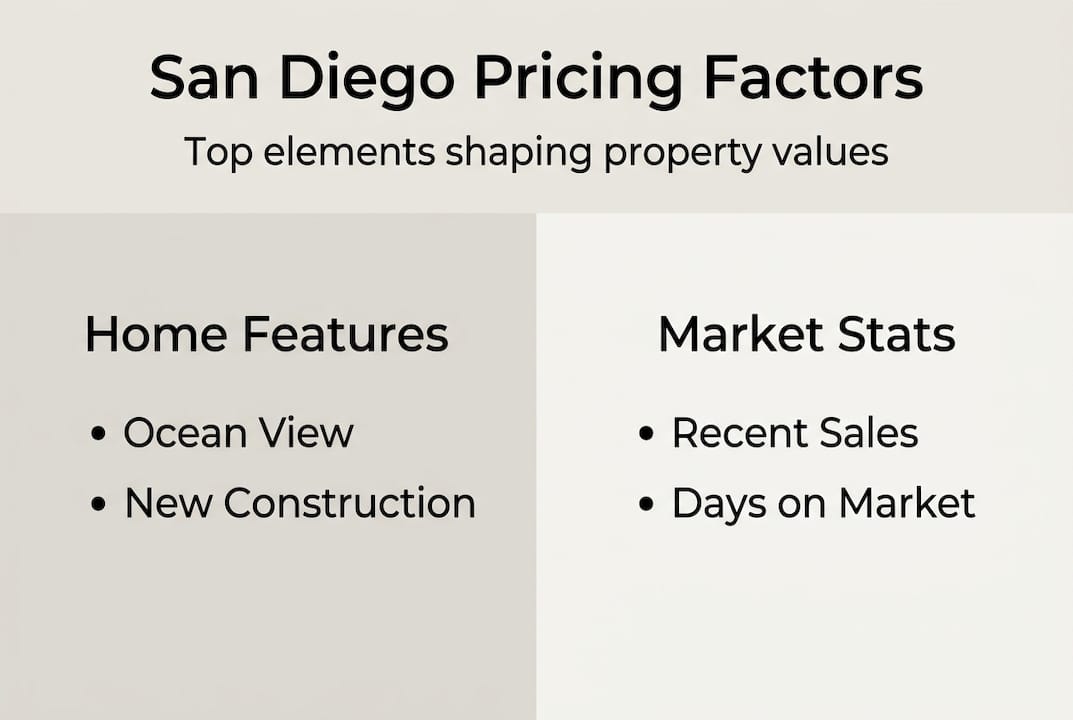
Key value drivers in San Diego:
- Ocean and bay views: Properties with unobstructed water views can command 15 to 30% premiums over comparable homes without views.
- Beach proximity: Walkability to the beach in neighborhoods like Pacific Beach or Ocean Beach adds significant buyer demand and price floor support.
- School district ratings: Homes zoned for top-rated schools in areas like Poway Unified or Del Mar Union consistently attract premium offers.
- Build quality and finishes: Custom builds with high-end kitchens, smart home systems, and energy-efficient upgrades fetch more per square foot.
- Lot size and usable outdoor space: In a city where outdoor living is year-round, a flat, usable backyard adds real value.
As the 2026 buying guide notes, unique properties command premiums but require expert comparative market analysis (CMA) adjustments to price accurately. A standard automated estimate simply cannot account for a partial ocean view or a corner lot with a canyon backdrop.
Condos add another layer of complexity. Understanding condo vs house costs is critical because HOA fees, reserve fund health, and building age all directly affect what a buyer is willing to pay. A condo with a $900 monthly HOA in a building with deferred maintenance will price well below a similar unit in a well-managed complex with a $400 HOA.
| Property type | Key pricing factor | Typical premium or discount |
|---|---|---|
| Ocean view single family | View quality and unobstructed sightlines | 15 to 30% premium |
| Top school district home | District rating and proximity | 8 to 15% premium |
| Condo with high HOA | Monthly fee and reserve health | 5 to 15% discount |
| New construction | Modern features and warranties | 20 to 30% premium |
| Inland resale home | Condition, updates, and lot | Market baseline |
New construction in San Diego consistently sells at a 20 to 30% premium over resale. Buyers pay for the warranty, modern layouts, and energy efficiency. This matters when you're pricing a resale: you're competing against brand-new product, so condition and presentation become even more critical.
Pro Tip: Browse the San Diego neighborhood guide to understand which areas are trending up and which are softening before you commit to a price. Micro-market awareness is your biggest competitive advantage. For example, Point Loma home values have shown consistent resilience due to limited inventory and strong lifestyle appeal.
Preparation: Gather data for a strong pricing foundation
Once you grasp what drives values, the next step is gathering the right data to inform your price. Skipping this step is like navigating without a map.

Comparable sales, commonly called comps, are the backbone of any pricing decision. A comp is a recently sold property that closely matches yours in size, location, condition, and features. The goal is to find at least three to five closed sales within the past 90 days, within a half-mile radius, and within 10 to 15% of your home's square footage.
Step-by-step checklist for assembling pricing data:
- Pull closed sales from the MLS for the past 60 to 90 days in your immediate neighborhood.
- Filter by similar bed and bath count, square footage within 15%, and comparable lot size.
- Note the original list price versus the final sale price to calculate the list-to-sale ratio.
- Record days on market (DOM) for each comp. DOM tells you how quickly demand is absorbing supply.
- Check for price reductions on each comp. Multiple reductions signal the original price was too high.
- Review active listings as your competition and pending sales as leading indicators.
- Factor in seller concessions, which are credits given to buyers at closing, since these reduce the net sale price.
Days on market is one of the most underused data points. According to San Diego housing market trends, properties at 60-plus DOM are strong signals of seller motivation and often lead to price reductions or buyer credits in the range of 2 to 5%. As a seller, you want to price right the first time to avoid becoming that statistic. As a buyer, spotting those listings is your opportunity.
| Data point | What it tells you | How to use it |
|---|---|---|
| Closed sale price | True market value | Baseline for your CMA |
| Original list price | Seller's initial expectation | Reveals pricing accuracy |
| Days on market | Demand absorption rate | Gauge market temperature |
| Price reductions | Mispricing signals | Identify negotiation leverage |
| Seller concessions | Net price adjustment | Adjust comp values downward |
San Diego-specific resources matter here. Tracking Pacific Beach market trends gives you a real-time read on one of the city's most active coastal segments. For inland markets, reviewing La Mesa pricing trends shows how different the demand curve can look just 15 miles from the coast.
Pro Tip: Don't rely on Zillow's Zestimate as your comp source. It's a starting point at best. In San Diego's micro-markets, automated valuations routinely miss by 8 to 12% because they can't account for the view from the back patio or the fact that the street floods every January.
Step-by-step: Calculate the ideal asking price
With your data gathered, you're ready to calculate the price using a proven, step-by-step approach. This is where preparation turns into strategy.
How to calculate your strategic list price:
- Establish your baseline. Average the price per square foot from your three to five best comps. This gives you a market-validated starting point.
- Adjust for condition. If your home has a recently renovated kitchen and new flooring while your comps don't, add value. Industry practice typically assigns $10,000 to $30,000 for a full kitchen remodel in San Diego, depending on the neighborhood's price tier.
- Adjust for lot and location. A corner lot, cul-de-sac position, or canyon view adds value. A property backing up to a busy road or under a flight path loses value. Be honest here.
- Adjust for size differences. If your comp is 200 square feet larger, subtract the price-per-square-foot value for that difference from your baseline.
- Account for HOA fees. For condos, every $100 per month in HOA fees above the neighborhood average can reduce buyer purchasing power by roughly $15,000 to $20,000 in loan qualification. Price accordingly.
- Apply a market condition adjustment. In a seller's market with low inventory, you can price at or slightly above the adjusted comp value. In a softening market, pricing at the midpoint of your comp range is safer.
- Sanity-check against active competition. Your list price needs to make sense relative to what buyers are currently seeing. If you're priced $50,000 above every active listing with similar features, buyers will simply skip yours.
"The right price isn't the highest price you can imagine. It's the highest price the market will actually pay, on the timeline that works for you."
For pricing unique San Diego homes with features like canyon views or custom architecture, standard comp adjustments often fall short. This is where a skilled agent's CMA becomes invaluable. As confirmed in the 2026 single-family home guide, condos face downward pressure from HOA fees and rising inventory, which means the calculation for a condo seller is fundamentally different from a single-family home seller.
Pro Tip: Price to a psychological threshold. In San Diego, pricing at $999,000 instead of $1,010,000 keeps you visible to buyers searching under $1 million, which is a significantly larger buyer pool. That $11,000 difference in list price could mean a faster sale at a stronger final number.
Verification and adjustment: Test, monitor, and respond
After calculating your price and listing, it's crucial to actively monitor the market's response and make adjustments to maximize your outcome. Listing is not the finish line. It's the starting gun.
The first two weeks after listing are the most critical window. Buyer activity, showing requests, and offer activity in this period tell you whether your price is landing correctly. Here's what to watch:
- Showing volume: In an active San Diego market, a well-priced listing should generate 5 to 10 showings in the first week. Fewer than 3 showings in 10 days is a warning sign.
- Offer timing: Multiple offers within the first week confirm strong pricing. No offers after two weeks suggest a price adjustment is needed.
- Agent feedback: Collect written feedback from every showing. If agents consistently cite price as the objection, the market is telling you something.
- Online engagement: Track views and saves on Zillow and Realtor.com. High views with low showing conversion often means the photos or presentation need work, not necessarily the price.
- Competing listings: If a similar home lists at a lower price after you go live, your positioning shifts immediately.
According to current San Diego market data, buyers in softening segments actively negotiate credits of 2 to 5% rather than price reductions. Offering a closing cost credit can be more effective than a price cut because it preserves your sale price on record while giving the buyer real financial relief.
Common pricing mistakes to avoid:
- Waiting too long to reduce. Every week over 30 DOM costs you negotiating leverage.
- Making tiny reductions that don't move the needle. A $5,000 reduction on a $900,000 home is invisible to buyers. A $25,000 adjustment gets attention.
- Ignoring condo-specific pressures. Understanding HOA assessments and condo value is essential because a pending special assessment can derail a sale entirely if it surfaces during escrow.
- Forgetting closing cost impacts. Reviewing Point Loma closing cost tips gives sellers a clearer picture of their net proceeds, which affects how aggressively they need to price.
The goal is not to chase the market down. The goal is to price correctly from day one so you never have to.
A seasoned perspective: Why San Diego property pricing demands hyper-local expertise
Stepping back from the process, here's what most pricing guides miss when it comes to San Diego real estate.
National automated valuation models (AVMs) like Zestimates and bank appraisal tools are built on broad data sets. They work reasonably well in cookie-cutter suburban markets where homes are similar and sales are frequent. San Diego is the opposite of that. You have hillside homes where the view adds $200,000 of value that no algorithm can see. You have blocks within the same zip code where one side sells for 20% more because of a school boundary line.
I've seen sellers lose $40,000 to $60,000 by trusting an online estimate over a real CMA. I've also seen buyers overpay because they didn't understand that a San Diego neighborhood's micro-market was softening while the headline city data looked strong. The data is only as useful as the local context you apply to it.
Real pricing expertise in San Diego means knowing which streets flood, which HOA buildings have litigation pending, which school boundaries shifted last year, and which neighborhoods are seeing investor activity that inflates comps. No national model knows that. Only someone working this market daily does.
Ready to price or buy with confidence? Connect with a San Diego expert
If you want to take the guesswork out of pricing or buying, here are resources to fast-track your success.
Pricing a San Diego property well requires more than a formula. It requires someone who knows the streets, the schools, the HOA buildings, and the buyer pool. Whether you're a seller trying to maximize your return or a buyer trying to avoid overpaying, having the right local guidance makes a measurable difference.

Explore current San Diego home listings to understand what the competition looks like right now. If you're purchasing, the San Diego buyer's guide walks you through every step with local context built in. Sellers can get a clear roadmap through the San Diego seller's guide, including how to prepare, price, and negotiate for the strongest possible outcome. Reach out today and let's build a pricing strategy that actually works for your specific property.
Frequently asked questions
What is the best way to find accurate comps in San Diego?
Work with a local real estate expert who understands micro-neighborhood trends, since unique properties need expert CMA adjustments that automated tools consistently miss.
How do HOA fees impact a condo's price in San Diego?
High HOA fees reduce buyer purchasing power and lower demand, and condos face downward pressure from both rising fees and increasing inventory in many San Diego buildings.
Should I price higher to leave room for negotiation?
In softer segments or when DOM exceeds 60 days, a modest buffer can work, but overpricing backfires fast since buyers negotiate 2 to 5% credits rather than chasing inflated list prices.
How much more do new homes sell for compared to resales?
New homes in San Diego typically command a 20 to 30% premium over resale properties, driven by modern layouts, energy efficiency, and builder warranties that resale homes simply can't match.