Buying or selling a home in San Diego without understanding neighborhood differences is like picking a restaurant by city alone. The median home price across San Diego County sits around $1.1 million in early 2026, but that number hides a staggering range. You could spend $703,000 in City Heights or $3.55 million in La Jolla, and both are technically "San Diego." This guide breaks down the neighborhoods that matter most, the price realities, the lifestyle trade-offs, and the steps you need to take to find your best fit in one of California's most competitive housing markets.
Table of Contents
- How much does it cost to live in San Diego?
- What makes San Diego neighborhoods unique?
- San Diego neighborhood spotlights: Price, lifestyle, and trade-offs
- How to choose the right San Diego neighborhood for you
- Beyond the data: What most San Diego neighborhood guides miss
- Ready to take the next step?
- Frequently asked questions
Key Takeaways
| Point | Details |
|---|---|
| Home prices vary widely | San Diego neighborhoods range from the $700Ks to over $3.5M for median home prices. |
| Lifestyle is neighborhood driven | Features like schools, walkability, and amenities shape quality of life—beyond just the price tag. |
| Buyers and sellers need local data | Rely on neighborhood-specific trends and market stats for smart decisions, not just city averages. |
| Every area has trade-offs | Consider factors like HOA fees, commute, and future value; no single neighborhood is the best for everyone. |
How much does it cost to live in San Diego?
San Diego is not a single real estate market. It is dozens of micro-markets layered on top of each other, each with its own pricing logic and demand drivers. The county-wide median for a single-family home runs between $1.09 million and $1.14 million in early 2026, but that figure is nearly meaningless unless you pair it with a specific neighborhood.
What actually moves prices in San Diego? A few core factors consistently explain the gap between affordable and expensive:
- Proximity to the coast: Homes within a mile or two of the ocean command a significant premium in nearly every market cycle.
- School district quality: Top-rated districts like Del Mar Union and Poway Unified push surrounding prices higher because buyer demand concentrates there.
- Walkability and urban amenities: Neighborhoods with dense retail, dining, and transit access attract premium buyers, especially younger households.
- Inventory levels: The San Diego home prices overview shows that premium neighborhoods often have fewer than two weeks of available inventory, which means multiple offers and fast decisions.
- HOA and zoning constraints: Planned communities with HOAs restrict supply and maintain uniformity, which keeps values stable but adds monthly cost.
Here is a snapshot of how prices break down across key neighborhoods in 2026:
| Neighborhood | Approx. median home price | Key feature |
|---|---|---|
| City Heights | $703,000 | Most affordable entry point |
| North Park | $1.13 million | Urban walkability and arts scene |
| Pacific Beach | $1.3 million+ | Beach access and rental appeal |
| Carmel Valley | $1.6 to $2 million+ | Top schools, suburban safety |
| La Jolla | $3.55 million | Coastal luxury and prestige |
The North Park market stats illustrate how urban renewal drives appreciation. A neighborhood once considered affordable has now crossed the $1 million threshold as demand from younger buyers and investors continues to outpace supply. Meanwhile, Pacific Beach market trends show that beach proximity keeps values elevated even when broader market conditions soften.
The competitive landscape matters just as much as the price. Low inventory in premium areas means you often have one shot at making an offer. If you wait a week to decide, the home is gone. Understanding where you stand financially before you start touring homes is not optional. It is the baseline.
What makes San Diego neighborhoods unique?
Price tells you what you will pay. Neighborhood character tells you how you will actually live. These two things are related but not the same, and buyers who focus only on price often end up unhappy with their purchase within two years.
San Diego neighborhoods break into a few broad lifestyle categories:
- Family-focused suburbs: Carmel Valley, Rancho Bernardo, and Scripps Ranch offer newer construction, strong schools, and safe streets. The trade-off is longer commutes and a quieter social scene.
- Coastal lifestyle: La Jolla, Del Mar, and Coronado deliver ocean access, prestige, and long-term value stability. The price of entry is simply the highest in the county.
- Urban walkable: North Park, Hillcrest, and South Park attract buyers who want restaurants, bars, and community within walking distance. These areas draw younger households and renters looking for vibrancy.
- Mixed character neighborhoods: Point Loma, Mission Hills, and Normal Heights offer a blend of older architecture, community identity, and moderate prices compared to coastal equivalents.
Niche ranks Carmel Valley third among the best places to live in the San Diego metro area, with University City at second and La Jolla at seventh. The ranking factors include school ratings, safety, amenities, and cost of living combined. No single neighborhood wins every category, which is exactly why your priority list matters so much.
The Point Loma neighborhood profile is a great example of a neighborhood that punches above its visibility. It offers coastal adjacency, a strong community identity, and generally lower prices than La Jolla with a character that many buyers find more authentic. Similarly, walkable living in Mission Hills appeals to buyers who want urban convenience without the intensity of downtown, in a setting defined by Craftsman architecture and tree-lined streets.
"The biggest mistake buyers make is shopping for a neighborhood they saw on Instagram rather than one that actually matches how they live day to day."
Pro Tip: Write down your five non-negotiable priorities before you tour a single home. Commute time, school rating, walkability, yard size, and price ceiling are the five most common. Once you have your list, you can cut neighborhoods that fail on three or more criteria without spending a weekend driving around.
Safety, school ratings, commute patterns, and community feel are not details you can research fully online. They require time in the neighborhood, conversations with residents, and honest reflection about how your lifestyle actually works, not how you wish it worked.
San Diego neighborhood spotlights: Price, lifestyle, and trade-offs
Let's look at three neighborhoods that represent very different ends of the San Diego market and what each one actually delivers to buyers in 2026.
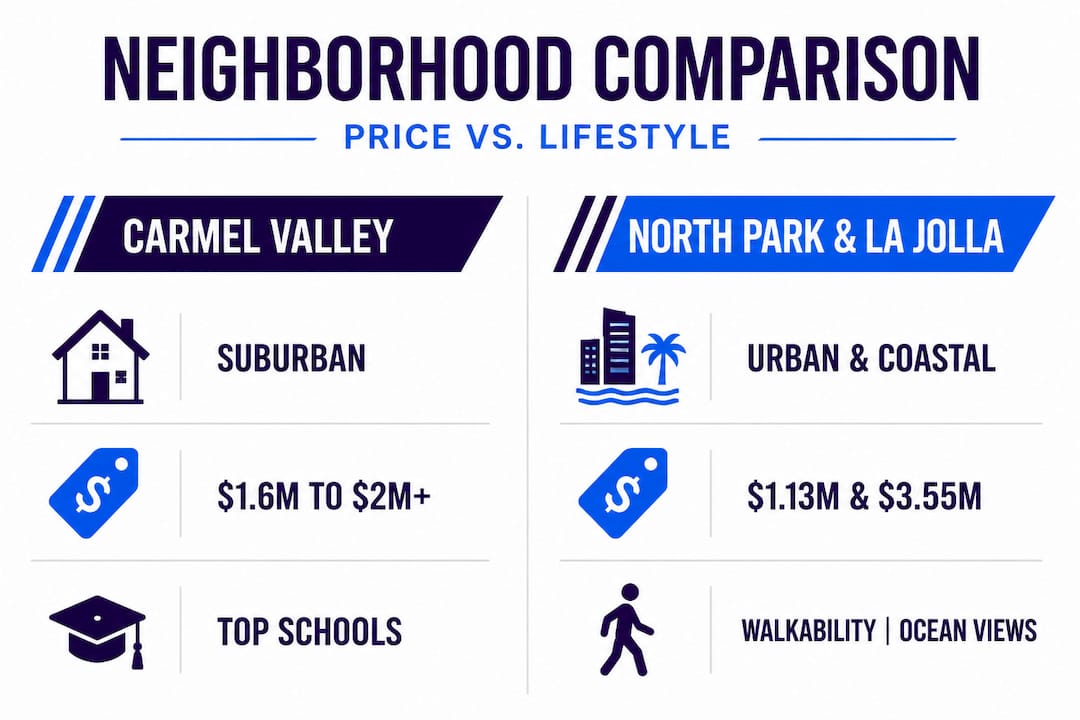
Carmel Valley sits in the northern part of the city and is widely considered the benchmark for family-focused suburban living. Median prices run $1.6 to $2 million plus, reflecting the premium placed on Del Mar Union schools, master-planned streets, and low crime rates. HOA fees are common here and can add $300 to $600 per month depending on the community. The suburban feel is real. You will need a car for almost everything. But for families prioritizing school quality and safety above all else, few neighborhoods in Southern California compete.
North Park is a completely different experience. Its median home price sits around $1.13 million, making it one of the more accessible urban neighborhoods in the city. The North Park neighborhood insights show a market driven by young professionals, creatives, and investors attracted to its walkability, restaurant density, and character homes. Craftsman bungalows and Spanish Revival properties dominate the housing stock. The trade-off is that gentrification has pushed out some of the original community character, and ongoing development creates mixed results for long-term residents.

La Jolla is in its own category. The median home price reaches $3.55 million, and the village atmosphere, bluff-top ocean views, and proximity to UC San Diego and top-tier medical employers justify that price for buyers who can afford it. The La Jolla real estate guide shows strong long-term appreciation history. La Jolla does not follow the same cycle as the broader market. When prices dip elsewhere, La Jolla tends to hold value longer because demand from high-net-worth buyers persists through economic downturns.
| Feature | Carmel Valley | North Park | La Jolla |
|---|---|---|---|
| Median price | $1.6 to $2M+ | $1.13M | $3.55M |
| Top strength | Schools, safety | Walkability, culture | Ocean views, prestige |
| Main drawback | Car-dependent, HOA fees | Gentrification risk | Very high price of entry |
| Best for | Families | Young professionals | Luxury, long-term hold |
| Lifestyle feel | Planned suburban | Urban village | Coastal elite |
Pro Tip: If you are comparing Carmel Valley and La Jolla purely on price per square foot, you may find Carmel Valley delivers more usable space for the dollar. But if long-term appreciation and neighborhood stability over a 10 to 15 year hold are your priority, La Jolla's track record is hard to argue with.
Each of these neighborhoods serves a specific buyer profile. The mistake is trying to force your lifestyle into a neighborhood that was built for someone else's priorities.
How to choose the right San Diego neighborhood for you
The neighborhood decision is where most buyers benefit most from a structured approach rather than just touring open houses on weekends. Here is a step-by-step process that works:
-
List your hard limits first. Maximum commute time, minimum school rating, price ceiling, and property type (condo vs. house) are non-negotiable filters. The condo vs. house considerations guide helps clarify why this choice affects both your lifestyle and resale potential in ways that most buyers underestimate.
-
Research neighborhoods using localized data. City averages from headline reports do not reflect what you will actually encounter. The best places to live rankings on Niche provide school ratings, safety grades, and resident reviews by specific neighborhood, not just by city.
-
Visit at different times. A neighborhood on a Sunday afternoon feels completely different from the same neighborhood at 7 a.m. on a Tuesday. Traffic, parking, noise, and foot traffic patterns all change throughout the week.
-
Compare appreciation history, not just current price. A home priced at $900,000 in a neighborhood that appreciated 35% over five years is a stronger investment signal than a $700,000 home in an area that appreciated 8% over the same period.
-
Talk to current residents. Neighbors will tell you things that no website will publish, including what has changed recently, what projects are planned nearby, and whether the neighborhood association is active or inactive.
-
Pressure-test your trade-offs. If you prefer North Park's lifestyle but the schools do not meet your needs, ask yourself honestly whether private school tuition fits your budget. If not, that trade-off may not work as well in practice as it looks on paper.
-
Work with an agent who specializes in those specific zip codes. General San Diego market knowledge is common. Granular neighborhood expertise, including off-market activity, upcoming listings, and micro-price trends, is rare and genuinely valuable.
Pro Tip: Always request MLS-level data for the specific streets or zip codes you are targeting. Neighborhood-level pricing can vary by $200,000 or more within the same zip code depending on which side of a school boundary or major road you are on.
Beyond the data: What most San Diego neighborhood guides miss
Most neighborhood guides treat San Diego real estate like a static snapshot. They show you current prices, give you a school rating, and send you on your way. What they rarely address is how quickly neighborhoods can shift, and what that means for your investment and your daily life.
North Park was a buyer's market bargain a decade ago. It has since crossed the million-dollar threshold, and the gentrification that made it attractive to investors also displaced some of the cultural authenticity that made it appealing in the first place. That cycle is not over. Neighborhoods like City Heights and parts of Southeastern San Diego are now seeing early-stage reinvestment, which creates opportunity but also risk if you misread the timeline.
School boundary changes are one of the most overlooked risks in San Diego real estate. Families buy in a specific neighborhood specifically because of a school assignment, only to see the district redraw boundaries two or three years later. Always verify the current boundary directly with the school district, not just from the listing description.
HOA fees deserve a closer look too. A Carmel Valley home that seems moderately priced may carry $400 to $600 per month in HOA fees, which adds $4,800 to $7,200 annually to your housing cost. Over a five-year hold, that is $24,000 to $36,000 in fees that do not build equity.
The long view matters most. La Jolla's consistent value over multiple market cycles is not an accident. It reflects a combination of limited buildable land, high-income buyer demand, and a coastal location that cannot be replicated. That stability is worth something to buyers who plan to hold for a decade or more. For buyers with a 3 to 5 year horizon, the equation changes, and neighborhoods with more growth potential may serve them better.
My honest take after working in this market is that buyers who spend more time on neighborhood selection than on finishes and fixtures end up happier with their purchase. You can renovate a kitchen. You cannot renovate a commute or a school district.
Ready to take the next step?
Choosing a San Diego neighborhood is one of the most consequential decisions in your real estate journey, and detailed neighborhood research gives you a genuine edge in a competitive market.

Whether you are narrowing down your shortlist or ready to make a move, having the right tools and local expertise makes the difference between a home that fits your life and one that just fits the budget. You can search San Diego homes by neighborhood, price, and property type to see what is currently available. For deeper context on each community, the San Diego neighborhood guide covers school ratings, market trends, and lifestyle details across the entire city. And when you are ready for personalized advice that goes beyond what any guide can offer, reach out directly so we can match your priorities to the right neighborhood together.
Frequently asked questions
What is the cheapest neighborhood to buy a home in San Diego?
City Heights has one of the lowest median prices at around $703,000 in early 2026, making it one of the most accessible entry points for buyers in the city.
What are the safest neighborhoods in San Diego for families?
Carmel Valley is safer than 92% of San Diego neighborhoods and consistently earns top marks for schools, making it a strong choice for families with school-age children.
Which San Diego area is best for young professionals?
North Park's walkable urban lifestyle makes it a top pick for young professionals who want easy access to restaurants, nightlife, and a strong sense of community without a long commute.
How competitive is the San Diego real estate market in 2026?
Inventory remains tight, especially in premium coastal and family neighborhoods, which means buyers who are financially prepared and move quickly tend to win more often in this market.