
Noncontingent offers work in San Diego's tight inventory pockets, but they shift real financial risk onto the buyer. Sellers benefit most, since a clean offer removes their exit risk and speeds up closing. Buyers with verified financing or deep cash reserves are the right candidates. The safer path usually involves partial mitigations rather than a full waiver, which the sections below walk through, along with a local agent's take on when waiving actually makes sense.
TL;DR:
- Waiving contingencies in San Diego can lead to losing earnest money if the deal falls through due to financing, appraisal, or inspection issues, especially without verified underwriting.
- A fully underwritten loan commitment or a short, well-structured contingency window can provide similar buyer certainty as a full waiver while reducing financial risk.
- Buyers should prepare by gathering all necessary documents, pre-ordering inspections and appraisals, and communicating with agents early to create competitive, safer offers.
- Full underwriting verification, paired with a shortened contingency period, often matches the seller’s confidence level in a noncontingent offer without the high exposure risk.
- Sellers prefer offers with verified underwriting and limited contingencies, but rarely accept a bare noncontingent offer without proof of funds or loan commitment.
Table of Contents
- What Is a Noncontingent Offer in San Diego Real Estate?
- What Are the Real Risks of Waiving Contingencies?
- Why Do Sellers Prefer Noncontingent Offers?
- Are There Safer Alternatives to a Full Waiver?
- How Should Buyers Prepare a Competitive, Safer Offer?
- How Has a Noncontingent Offer Played Out in San Diego?
- Why the "Just Waive Everything" Advice Misses the Point
- How Jeff Helps San Diego Buyers Compete Without Overexposure
- Sources
What Is a Noncontingent Offer in San Diego Real Estate?
A noncontingent offer, sometimes called a clean offer, removes the conditions that normally let a buyer cancel a purchase without penalty. It's not the same thing as an all-cash offer. A financed buyer can still submit a noncontingent offer, they've just agreed to close regardless of what the appraisal, inspection, or loan process turns up.
Most San Diego contracts include four standard contingencies, and waiving each one carries a different consequence:
- Financing contingency: protects the buyer if the loan falls through. Waive it, and a denied loan can still force the deal to close or forfeit earnest money.
- Appraisal contingency: protects against a low valuation. Waive it, and the buyer must cover any gap between the appraised value and the purchase price in cash.
- Inspection contingency: allows cancellation or repair credits based on findings. Waive it, and the buyer accepts the home's condition as is.
- Sale contingency: lets a buyer back out if their current home doesn't sell. Waive it, and they're on the hook to close even without that sale proceeds.
The confusion buyers run into most: assuming "noncontingent" means "cash." A well-qualified, financed buyer with full underwriting behind them can look just as strong on paper.
What Are the Real Risks of Waiving Contingencies?
Waiving contingencies converts theoretical risk into dollar-figure exposure. Here's what buyers are actually signing up for:
- Earnest money forfeiture. If a buyer can't close, whether from a job loss, a lender pulling out, or cold feet, the seller can typically retain the earnest money deposit as damages.
- Underwriting denial after contract. A preapproval isn't a guarantee. If full underwriting later finds an issue, a buyer without a financing contingency has no built-in escape.
- Appraisal shortfalls. If the home appraises below the offer price and there's no appraisal contingency, the buyer must bridge that gap out of pocket or risk default.
- Inspection surprises. Waived inspection contingencies mean foundation issues, aging HVAC systems, or drainage problems become the buyer's financial problem, discovered after closing rather than before.
Legal guidance on non-contingent purchase agreements makes clear that waiving standard contingencies increases a buyer's exposure to losing earnest money and facing potential damages claims, which is why contract language matters as much as the decision itself. Even in a strong market, that exposure doesn't disappear. It just gets accepted upfront in exchange for a better shot at winning the home.
Why Do Sellers Prefer Noncontingent Offers?
Certainty is worth more to most sellers than a slightly higher number with strings attached. A contingent offer that falls through days before closing means relisting, restarting marketing, and absorbing extra time on market, none of which sellers want in a transaction they thought was done.
Noncontingent offers solve three seller problems at once:
- Closing certainty: fewer conditions mean fewer paths for the deal to collapse.
- Faster, more predictable timelines: without inspection negotiations or appraisal contingencies to resolve, escrow moves on a tighter schedule.
- Lower reputational and carrying risk: every day a home sits back on the market after a failed deal signals something to the next round of buyers.
That said, sellers and their agents rarely take a clean offer at face value. They'll ask for proof of funds, a lender's underwriting letter, or a loan commitment before trusting that "noncontingent" isn't just a negotiating bluff.
Are There Safer Alternatives to a Full Waiver?
You don't have to choose between a full waiver and losing the house. Several middle-ground tactics keep an offer competitive while limiting how much risk you're actually carrying.
- Shorten contingency periods instead of removing them. Compressing an inspection or loan contingency window to 7 to 10 days often satisfies a seller's urgency while keeping your legal protection intact.
- Get full underwriting certification before you write the offer. A lender-issued loan commitment, not just a preapproval letter, tells the seller your financing is already verified down to income, assets, and employment. That kind of underwriting certification gives sellers confidence comparable to an all-cash buyer, because the underwriter has already done the hard part.
- Replace a sale contingency with bridge financing or a HELOC. If your purchase depends on selling your current home, tapping equity ahead of time removes that dependency entirely.
- Order a pre-offer inspection when the listing allows it, or negotiate a short, limited post-offer inspection period instead of waiving it outright.
- Set an appraisal-gap coverage amount in advance so you know your ceiling if the valuation comes in low, rather than deciding under pressure during a 48-hour response window.
Pro Tip: Ask your lender for a written underwriter clearance letter, not just a preapproval. It's a stronger signal than most buyers realize, and it costs you nothing but a few days of paperwork.
How Should Buyers Prepare a Competitive, Safer Offer?
Preparation is what separates a smart noncontingent strategy from a reckless one. Before you waive anything, get these pieces in place:
- Pull your financial documents together first: two months of bank statements, proof of funds, and a lender's full underwriting approval, not a quick prequalification.
- Compress your timeline in advance. Line up your inspector and your appraiser so both can move within days of acceptance instead of weeks. FHFA has noted that appraisal-time flexibilities are often underused, which means faster appraisal scheduling is usually available if you or your lender push for it.
- Package the offer properly. A phone call to the listing agent ahead of submission, paired with a clean written offer and attached lender documents, builds trust that a bare-bones PDF never will. Reviewing a step-by-step offer guide before you submit helps avoid the small mistakes that cost negotiating leverage.
- Loop in an attorney when you're waiving anything beyond a shortened timeline. California allows narrow exceptions, like delayed disclosures, that can still let a buyer cancel, but only if the contract language preserves that option.
Understanding how a loan contingency actually works before you decide to waive it is worth the fifteen minutes it takes to read.
How Has a Noncontingent Offer Played Out in San Diego?
A recent listing in North Park drew multiple offers within the first weekend, several of them noncontingent on price alone. The one that won wasn't the highest bid. It was a fully underwritten buyer who shortened the inspection window to seven days and attached a lender commitment letter instead of a bare preapproval.
The seller didn't need the absolute top number. They needed to know the deal wouldn't fall apart three weeks later. That underwriting letter did more work than an extra $10,000 would have.
Jeff recommends a full waiver only when a buyer has verified underwriting and enough reserves to cover an appraisal gap without financial strain, as noted by experienced professionals at Ryan Case Realtor. For everyone else, a shortened contingency period paired with strong lender documentation gets nearly the same competitive edge with far less downside. Buyers exploring current opportunities can browse Jeff's home search listings to see what's active in North Park and beyond.
Why the "Just Waive Everything" Advice Misses the Point
Most articles on this topic treat noncontingent offers as a binary: waive and win, or protect yourself and lose the house. That framing sells buyers short. The research backs a more useful conclusion: certainty, not price, is what actually moves sellers, and certainty can be built without abandoning every legal protection you have.
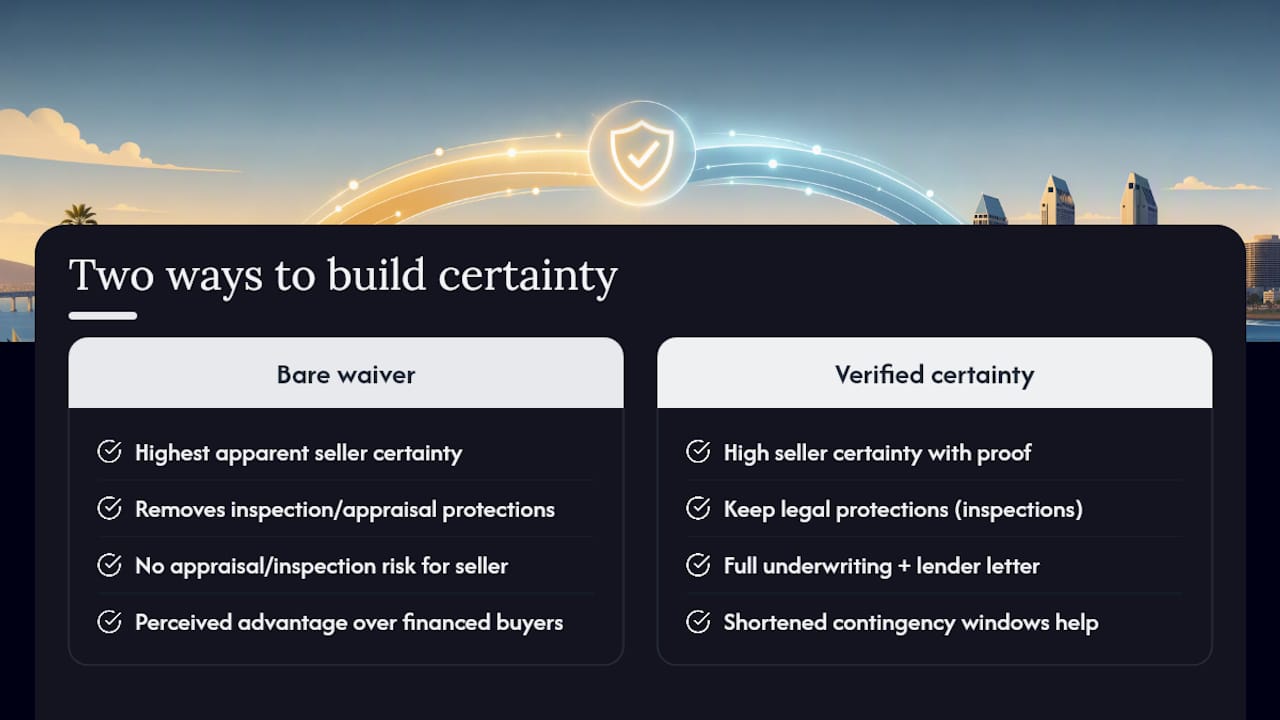
Full underwriting, a shortened contingency window, and a well-packaged offer often close the gap with a bare waiver almost entirely. Conventional wisdom underrates how much a lender commitment letter changes seller perception, and it overrates the marginal advantage of waiving an inspection contingency outright.
If you're weighing this decision, prioritize verified financing before anything else. A buyer who's fully underwritten and willing to shorten timelines is, in practice, competing at nearly the same level as an all-cash buyer, without taking on the appraisal or inspection risk that a full waiver invites. Get that piece right first. The rest is negotiation.
— Jeff
How Jeff Helps San Diego Buyers Compete Without Overexposure
Jeffsellssandiego is the alternative to guessing your way through a bidding situation. Rather than telling you to waive everything and hope, Jeff coordinates full underwriting with vetted local lenders, packages your offer so listing agents take it seriously on the first call, and times inspections and appraisals to match a compressed closing window.

That combination, verified financing plus a tightly managed timeline, tends to beat a blind waiver without carrying the same exposure. If you're weighing an upcoming offer or just want to understand what a competitive, protected offer looks like in your target neighborhood, start with Jeff's VIP Home Search to get a strategy built around your specific budget and timeline before you write anything.
This article is general information, not a substitute for advice from a qualified financial advisor. Consult a qualified financial professional about your own circumstances before acting on anything here.
Sources
- FHFA blog: Underutilization of appraisal time adjustments
- Understanding a Non-Contingent Offer in Real Estate — Scarinci Hollenbeck
- Remove the Finance Contingency in San Diego, California — IQRate Mortgages