
Buying your first home in San Diego is achievable when you follow a clear, expert-backed process covering finances, mortgage choices, and negotiation tactics. This first time home buyer guide defines exactly what you need to prepare, from credit scores to closing day, so you enter the market with confidence rather than guesswork. San Diego's median home prices and competitive inventory make preparation non-negotiable. The buyers who succeed here are the ones who treat this process like a project, not a wish. This guide gives you the framework to do exactly that.
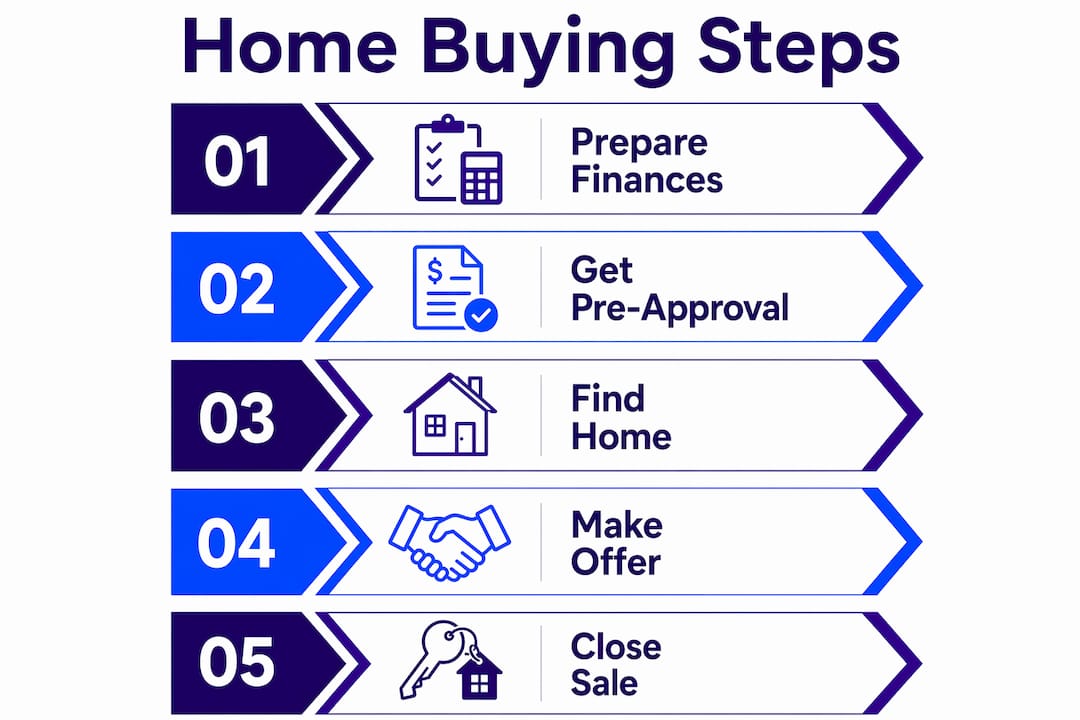
What financial preparation does a first-time buyer need?
Financial preparation is the single factor that separates buyers who close deals from those who lose them. Before you tour a single property, your credit score, debt load, and documentation need to be in order. Lenders use these three inputs to decide how much they will lend you and at what rate.
Credit score thresholds matter more than most buyers realize. Conventional loans require a minimum score of 620, while FHA loans may accept scores as low as 580. That 40-point gap can mean the difference between a 3% down payment and a 3.5% down payment, which adds up to thousands of dollars on a San Diego purchase. Pull your credit report from Equifax, TransUnion, and Experian before you do anything else, and dispute any errors immediately.

Your debt-to-income ratio (DTI) is equally critical. Lenders prefer your total monthly debt payments stay at or below 36% of your gross monthly income. If you carry significant student loans, car payments, or credit card balances, pay down the highest-balance accounts first to move that ratio in the right direction.
Upfront costs catch many first-timers off guard. Budget for down payments between 3% and 20% of the purchase price, plus closing costs of roughly 2% to 5%. Moving expenses and immediate repairs can add another $1,000 to $5,000 or more on top of that. In San Diego, where median prices sit well above the national average, even a 3% down payment represents a substantial sum.
Here is the documentation you will need to gather before applying for pre-approval:
- Two years of federal tax returns and W-2s
- Recent pay stubs covering the last 30 days
- Two to three months of bank and investment account statements
- Government-issued photo ID
- Proof of any additional income sources (rental income, alimony, freelance work)
- A list of current debts and monthly obligations
Pro Tip: Check your credit score at least six months before you plan to buy. That window gives you time to dispute errors, pay down balances, and potentially move into a better loan tier without rushing.
For San Diego-specific context, Southern California buyers often face higher property tax assessments and HOA fees that affect monthly affordability calculations. Factor those into your budget from day one.
How do mortgage options and pre-approval impact your buying power?
Your loan type determines your down payment, your monthly payment, and how sellers perceive your offer. Multiple loan paths exist to homeownership with less than 20% down, and first-time buyers in San Diego have access to all of them.
Here is a ranked breakdown of the most common options:
- VA loans: Zero down payment required, no private mortgage insurance (PMI), and competitive interest rates. Available to eligible veterans, active-duty service members, and surviving spouses. San Diego's large military population makes this the most powerful tool many buyers overlook.
- USDA loans: Zero down payment for properties in eligible rural and suburban areas. Some San Diego County zip codes qualify, so check the USDA eligibility map before ruling this out.
- FHA loans: 3.5% down with a 580+ credit score, or 10% down with a score between 500 and 579. FHA loans carry mortgage insurance premiums for the life of the loan, which increases total cost.
- Conventional loans: As low as 3% down for first-time buyers with a 620+ credit score. PMI applies until you reach 20% equity, but it can be canceled, unlike FHA mortgage insurance.
Pre-approval is not just a number on a letter. Full mortgage pre-approval requires a detailed review of your income, assets, and credit by an underwriter, and it is the only document that genuinely reassures a seller that your financing is solid.
The distinction between pre-qualification and pre-approval matters enormously in San Diego's competitive market. Pre-qualification is a quick estimate based on self-reported information. Pre-approval is a verified commitment. Pre-approval signals seriousness to sellers and is vital when you are competing against multiple offers, which is the norm in desirable San Diego neighborhoods like North Park, Clairemont, and Chula Vista.
For a deeper breakdown of how pre-approval works and what lenders actually evaluate, the pre-approval process guide at Lofi Rate covers the mechanics clearly. Work with a local lender who knows San Diego's market rather than a national online lender. Local lenders often have faster turnaround times and relationships with listing agents that can give your offer an edge.
What are the best strategies to find and evaluate homes in San Diego?
Finding the right home in San Diego requires a clear set of priorities before you start scrolling listings. Without a defined list of must-haves and deal-breakers, you will waste time on properties that look good online but fail in person.
Start by separating your criteria into two categories: non-negotiables and preferences. Non-negotiables might include school district, commute distance, or minimum square footage. Preferences include things like a garage, updated kitchen, or proximity to the beach. This distinction keeps you from falling in love with a home that does not actually fit your life.
| Feature | Condo | Single-Family Home |
|---|---|---|
| Purchase price | Generally lower in San Diego | Higher entry cost |
| HOA fees | Common, often $300 to $600/month | Rare or none |
| Maintenance responsibility | Exterior handled by HOA | Owner responsible for all |
| Appreciation potential | Solid in urban neighborhoods | Historically stronger long-term |
| Privacy | Shared walls and common areas | More separation from neighbors |
HOA financial health deserves serious scrutiny. Request the HOA's reserve fund study and meeting minutes before making an offer. An underfunded HOA can hit you with a special assessment of thousands of dollars after you close. This is a San Diego-specific risk in condo-heavy neighborhoods like Mission Valley and Downtown.
When evaluating fixer-uppers versus turnkey homes, be honest about your budget for repairs. A $50,000 discount on a fixer sounds attractive until you get contractor bids. In San Diego's labor market, renovation costs run high. Get at least two contractor estimates before factoring a fixer-upper into your offer strategy.
Pro Tip: Set up automated alerts on Zillow, Redfin, and the MLS through your agent so you see new listings within hours of them going live. In San Diego, desirable homes in the $700,000 to $900,000 range routinely receive offers within 48 to 72 hours.
Work with an agent who specializes in the specific San Diego neighborhoods you are targeting. Neighborhood-level knowledge, things like which streets flood, which HOAs are financially healthy, and which blocks are up-and-coming, is not available on any app.
How can first-time buyers negotiate effectively and manage the closing process?
Negotiation in San Diego is not about getting the lowest price. It is about structuring an offer that wins while protecting your financial position. Focusing only on list price is a common mistake. Monthly affordability and seller concessions are where the real leverage lives.
Key elements of a competitive offer include:
- Earnest money deposit: Typically 1% to 3% of the purchase price in San Diego. A higher deposit signals commitment.
- Seller concessions: You can request the seller cover a portion of your closing costs, buy down your interest rate, or credit you for known repairs. This reduces your out-of-pocket expense at closing without necessarily changing the purchase price.
- Contingencies: Include an inspection contingency and a financing contingency. In a hot market, some buyers waive these, but doing so carries real risk. Discuss the tradeoffs with your agent before removing any contingency.
- Closing timeline: Sellers often prefer a 30-day close. If you can match that timeline with a solid pre-approval, your offer becomes more attractive even if it is not the highest price.
Closing costs range between 2% and 7% of the home price and can sometimes be negotiated or rolled into the loan, though rolling them in increases your monthly payment. For San Diego-specific strategies on reducing what you pay at the table, the closing cost breakdown from Jeffsellssandiego covers hidden savings that most buyers miss.
Collaborating with listing agents rather than taking an adversarial approach yields better deal terms and access to inside information in competitive markets. Your buyer's agent should be communicating with the listing agent before you submit an offer to understand the seller's priorities, timeline, and any competing interest.
Pro Tip: Ask your agent to call the listing agent before submitting your offer. A two-minute conversation can reveal whether the seller wants a fast close, has already received other offers, or has specific terms they care about. That intelligence is worth more than any negotiating tactic.
On closing day, bring a government-issued ID, your certified check or wire transfer confirmation, and a pen. Review the Closing Disclosure document at least three days before closing and flag any fees that differ from your Loan Estimate.
Which ongoing costs should first-time homeowners plan for?
Homeownership costs do not stop at the mortgage payment. Planning for the full monthly picture prevents the financial stress that catches many new owners off guard in their first year.
Your monthly housing expense in San Diego will likely include:
- Principal and interest: The base mortgage payment calculated at closing.
- Property taxes: California property taxes are assessed at roughly 1.1% to 1.25% of the purchase price annually, divided into two payments per year.
- Homeowner's insurance: Budget $100 to $200 per month depending on location and coverage level.
- PMI: If your down payment is below 20% on a conventional loan, expect to pay 0.5% to 1.5% of the loan amount annually until you reach 20% equity.
- HOA fees: If applicable, these range widely. In San Diego condos, $300 to $600 per month is common.
- Maintenance reserve: Set aside 1% of the home's value annually for repairs and upkeep. On a $750,000 home, that is $7,500 per year, or about $625 per month.
Refinancing is worth monitoring after your first year. If interest rates drop meaningfully from your original rate, refinancing can reduce your monthly payment or shorten your loan term. Track rates through resources like Bankrate or your original lender's rate alerts.
Key takeaways
Buying your first home in San Diego requires financial preparation, the right loan type, a verified pre-approval, and a negotiation strategy built around monthly affordability rather than list price alone.
| Point | Details |
|---|---|
| Credit and DTI first | Get your score above 620 and DTI below 36% before applying for any loan. |
| Pre-approval over pre-qualification | Only a full underwriter-reviewed pre-approval carries weight with San Diego sellers. |
| Know your loan options | VA and USDA loans offer zero down; FHA and conventional start at 3% to 3.5%. |
| Negotiate beyond price | Seller concessions on closing costs and rate buydowns reduce out-of-pocket costs. |
| Budget for total ownership costs | Property taxes, HOA fees, insurance, and maintenance add significantly to your monthly payment. |
What I've learned working with San Diego's first-time buyers
Most first-time buyers I work with arrive believing two things that are simply not true. First, that they need a 20% down payment. Second, that getting pre-qualified is the same as being pre-approved. Many buyers mistakenly believe a 20% down payment is mandatory, but lower down payment loans have been available for years. Clearing up those two misconceptions alone changes how buyers approach the market.
What I have also seen is that emotional readiness matters as much as financial readiness. Buyers who wait for the "perfect" market conditions in San Diego often wait for years. Prices here do not follow national trends cleanly. The buyers who win are the ones who get their finances in order, get fully pre-approved, and move decisively when the right property appears.
Local agent relationships are not a nice-to-have. They are a competitive advantage. I have seen buyers win offers at the same price as a competing bid simply because their agent had an established relationship with the listing agent and communicated clearly. That is not luck. That is preparation meeting opportunity.
If you are feeling overwhelmed by the steps to buying a house, start with one thing: pull your credit report today. Everything else follows from knowing where you stand financially.
— Jeff
Start your San Diego home search with Jeffsellssandiego
Jeffsellssandiego works exclusively with buyers and sellers in San Diego's residential market, which means every recommendation is grounded in current local conditions, not national averages.

If you are ready to move from research to action, browse active San Diego listings updated daily through Jeff's home search portal. For buyers who want to go deeper on strategy, the investor-tested buyer strategies guide covers approaches that give first-timers a real edge in competitive situations. When you are ready for personalized guidance, reach out directly through Jeffsellssandiego's buyer resources to get started.
FAQ
What credit score do I need to buy a home in San Diego?
Conventional loans require a minimum score of 620, while FHA loans accept scores as low as 580. A higher score typically qualifies you for better interest rates, which matters significantly on San Diego's higher-priced properties.
How long does the home buying process take for first-timers?
Most first-time buyers should expect three to six months from serious preparation to closing, with the closing period itself taking 30 to 45 days after an accepted offer.
Is a 20% down payment required to buy in San Diego?
No. VA and USDA loans require zero down payment for eligible buyers, FHA loans start at 3.5% down, and conventional loans are available at 3% down for first-time buyers. The 20% threshold only eliminates PMI on conventional loans.
What is the difference between pre-qualification and pre-approval?
Pre-qualification is a quick estimate based on self-reported financial information. Full pre-approval involves a verified review of your income, assets, and credit by an underwriter, and it is the only version that carries real weight with sellers in a competitive market like San Diego.
What ongoing costs should I budget for beyond my mortgage payment?
Plan for property taxes at roughly 1.1% to 1.25% of the purchase price annually, homeowner's insurance, potential PMI, HOA fees if applicable, and a maintenance reserve of approximately 1% of the home's value per year.