
If a San Diego property sits inside a Mello-Roos district, you'll see a separate special tax line on the property tax bill, distinct from the standard 1% rate. Don't trust the listing sheet on this one. Pull the property's 10-digit Secured Tax Parcel number (APN) and run it through the County's Special Assessments lookup before you write an offer.
TL;DR:
- Check the property's 10-digit parcel number on the tax bill or via Parcel Quest to confirm Mello-Roos assessments through the county lookup.
- Mello-Roos typically funds infrastructure like schools, roads, and safety facilities in new neighborhoods, with final bond payments often extending into the 2030s.
- Two homes in the same area may have different Mello-Roos charges due to classification factors like square footage or lot size, which can outpace initial estimates.
- Buyers can prepay Mello-Roos, but often paying a seller credit is more cost-effective since prepayment costs can outweigh remaining bond payments.
- Mello-Roos remains outside Proposition 13 limits, affecting total housing costs and mortgage qualification, and should be disclosed early in the transaction process.
Table of Contents
- What Is Mello-Roos in San Diego, and How Do You Check for It?
- What Mello-Roos Actually Funds and How the District Works
- Why Two Neighbors Can Pay Different Mello-Roos Amounts
- Does Mello-Roos Ever Go Away, and How Do You Get a Payoff Number?
- How Mello-Roos Changes Your Offer, Financing, and Escrow Paperwork
- The Official Tools You Need for Due Diligence
- Where Mello-Roos Came From, and Why San Diego Has So Much of It
- How Mello-Roos Differs From Other San Diego Property Taxes
- Is Mello-Roos Good or Bad for San Diego Homeowners?
- Does Mello-Roos Hurt Resale Value in San Diego?
- Do Lenders Treat Mello-Roos Differently When You Refinance?
- Jeff's Local Agent Perspective on Mello-Roos Homes
- Let Jeff Run the Mello-Roos Numbers Before You Make an Offer
- Sources
What Is Mello-Roos in San Diego, and How Do You Check for It?
Checking takes ten minutes if you know where to look. The tax bill itself is the fastest starting point, since the county attaches the parcel number right on the document, but you can also pull it through Parcel Quest if you only have the address.
Here's the sequence:
- Locate the 10-digit Secured Tax Parcel number, usually printed near the top of the property tax bill or available through a Parcel Quest search.
- Enter that APN into the San Diego County Special Assessments lookup, which returns assessed valuation, the base tax rate, and every special assessment tied to the parcel.
- Read the results line by line. A Mello-Roos or CFD entry will list a district name, a dollar amount, and often a contact phone number for the administering agency.
- Screenshot or save the PDF for your escrow file. You'll want it on hand when you negotiate or when your lender asks questions.
Before you rely on anything else, ask the seller or the escrow officer for payoff information and the direct contact for the district. MLS sheets and agent remarks get this wrong constantly, not out of dishonesty but because the data changes and nobody double checks it. The Special Assessments lookup is the one source that settles the question definitively when a listing or disclosure leaves it ambiguous.
What Mello-Roos Actually Funds and How the District Works
Mello-Roos is the common name for a Community Facilities District, or CFD, a special property tax created under the Mello-Roos Community Facilities Act of 1982. California cities and counties use it to raise money for infrastructure in areas that were undeveloped or under-resourced when the district formed.
The money typically pays for:
- New schools, roads, and utility infrastructure in growing neighborhoods
- Fire stations, parks, and other public safety facilities
- Sometimes ongoing maintenance tied directly to those improvements
What it generally can't do is fund unrelated city services on an open-ended basis. Every district operates under a Rate and Method of Apportionment, or RMA, a formal document created alongside an Assessment Engineer's Report when the district forms. The RMA is the actual rulebook: it classifies parcels, sets the tax formula, and dictates how the charge escalates over time. If you want to understand what you're actually paying and why, the RMA is where that answer lives, not the tax bill summary.
Why Two Neighbors Can Pay Different Mello-Roos Amounts
Mello-Roos tables distinguish between the "assigned" special tax and the "maximum" special tax the RMA permits the district to levy. The assigned amount is what actually shows up on your bill in a given year; the maximum is the ceiling the district could charge if it needed to.
Classification usually drives the number more than market value does. Common bases include:
- Unit type (single-family detached versus attached or multifamily)
- Square footage of the structure
- Lot size or frontage, depending on how the RMA was written
Two houses on the same street, built by the same developer, can carry different Mello-Roos bills because one has an extra 300 square feet or sits on a larger lot. The City of San Diego's special tax rate pages publish the Assigned Special Tax tables for city-administered districts, which is where you confirm the actual classification and rate for a specific parcel.
Pro Tip: Remodels and additions sometimes outpace the classification on file. If a home was expanded after the original building permit, verify the square footage the RMA is actually using before you assume the current tax reflects the current house.
Does Mello-Roos Ever Go Away, and How Do You Get a Payoff Number?
Mello-Roos taxes exist to pay off bonds, and bonds mature. That means the charge isn't permanent, though the timeline varies district by district. City of San Diego administration reports and CFD filings show specific districts, including Santaluz, Liberty Station, and Black Mountain Ranch, with anticipated final levy years landing anywhere in the 2020s through the 2030s depending on when the bonds were issued.
Property owners generally have the right to prepay the special tax lien outright. Here's how that process usually works:
- Contact the district's administrator, listed on the tax bill, or reach out to NBS Government Finance Group, which handles CFD administration and payoff calculations for many San Diego districts.
- Request a written payoff quote, which typically requires the APN and a short processing window.
- Route the payoff figure through escrow if you're mid-transaction, since a prepayment shifts the ongoing tax obligation off the buyer entirely.
A seller who prepays before closing hands the buyer a cleaner bill going forward. That's worth factoring into any negotiation.
How Mello-Roos Changes Your Offer, Financing, and Escrow Paperwork
Mello-Roos needs to enter your monthly housing cost math the same way property tax and HOA dues do, because it affects your debt-to-income ratio just as directly. Underwriters look at total housing cost, not just the base mortgage payment, so a home with a $2,400 annual Mello-Roos charge changes what you actually qualify for.
Tell your lender about the special tax early, not during underwriting. Confirm whether the charge is fixed, escalating, or scheduled to step down, since that affects how the lender treats it for qualification purposes.
On the escrow side, a few things matter:
- Mello-Roos shows up as a line item separate from the 1% ad valorem tax, and title reports should reflect it as a lien against the property.
- Delinquent Mello-Roos payments can trigger the same foreclosure exposure as delinquent property taxes, so confirm current payment status before closing.
- Build language into your purchase contingency requiring written confirmation of the district, the current assigned tax, and payoff eligibility.
Pro Tip: If a Mello-Roos amount feels high relative to comparable homes without it, ask for a price adjustment or a seller credit rather than a request to prepay. Prepayment often costs more upfront than the present value of the remaining payments, so a credit toward closing costs is frequently the better deal for a buyer. When you're calculating total transaction costs alongside this, it helps to also review how transfer tax and preclosing costs stack up in San Diego.
The Official Tools You Need for Due Diligence
Three resources cover almost every question that comes up during escrow. The County Special Assessments lookup returns the parcel's full assessment breakdown by APN. The County Assessor's Mello-Roos page maintains the active district list and general guidance. The City of San Diego's special tax rate pages publish RMA documents, Assigned Special Tax tables, and district maps for city-administered CFDs.
For payoff requests specifically:
- Check the tax bill for the district's direct contact number first.
- If the district uses an outside administrator, NBS Government Finance Group handles many San Diego CFD prepayment calculations.
- Save every PDF and confirmation email to the escrow file as you go, not at the end.
Where Mello-Roos Came From, and Why San Diego Has So Much of It
California voters passed Proposition 13 in 1978, capping property tax increases and cutting off the traditional funding stream cities relied on to build infrastructure for new development. Senators Henry Mello and Mike Roos authored the legislative fix four years later: the Mello-Roos Community Facilities Act of 1982, which let local governments form special districts and issue bonds backed by a new special tax on properties within the district.
San Diego's explosive suburban growth through the 1980s, 1990s, and 2000s made it a natural fit for the mechanism. Developers building out master-planned communities in areas like Santaluz, Black Mountain Ranch, and Liberty Station needed roads, schools, and fire stations built before residents moved in. Rather than the city fronting that cost, CFDs let the new homeowners fund it themselves through the bond-backed special tax.
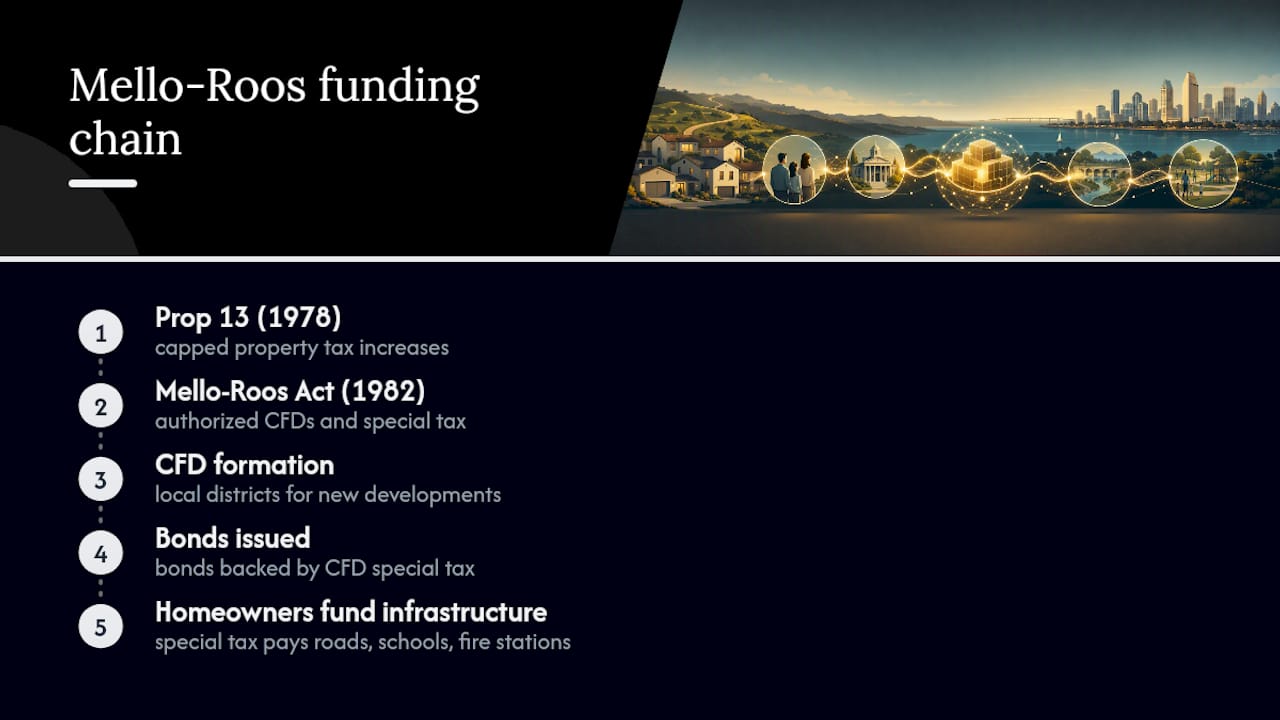
That history explains a pattern buyers notice quickly: older, established San Diego neighborhoods rarely carry Mello-Roos, while newer master-planned communities almost always do. It's not random. Developments built after roughly 1990 in expanding parts of the county, think Rancho Bernardo's newer pockets, Del Sur, or parts of Otay Mesa, were largely built using CFD financing as the default infrastructure tool rather than the exception. If you're house hunting in a community built in the last three decades, assume a CFD exists until the county lookup proves otherwise.
How Mello-Roos Differs From Other San Diego Property Taxes
The base property tax in California is capped at 1% of assessed value under Proposition 13, with modest annual increases allowed. Mello-Roos sits entirely outside that cap because it's a special tax, not an ad valorem tax, which is exactly why the City of San Diego's CFD FAQ is careful to describe it as a separate charge.
A few other San Diego assessments get confused with Mello-Roos, but they work differently:
- HOA dues are private contractual obligations to a homeowners association, not a government tax, and they don't appear on the county tax bill at all.
- Regular assessment districts (sometimes called 1915 Act bonds) fund specific infrastructure too, but they're calculated differently and often carry a fixed payoff schedule rather than a classification-based RMA.
- Maintenance assessment districts typically fund ongoing services like landscaping or street lighting in a defined area, and the charge tends to be flatter and smaller than a CFD special tax.
Confusing the two leads people to assume Mello-Roos will rise and fall like their base tax does. It won't, because it isn't calculated the same way at all.
Is Mello-Roos Good or Bad for San Diego Homeowners?
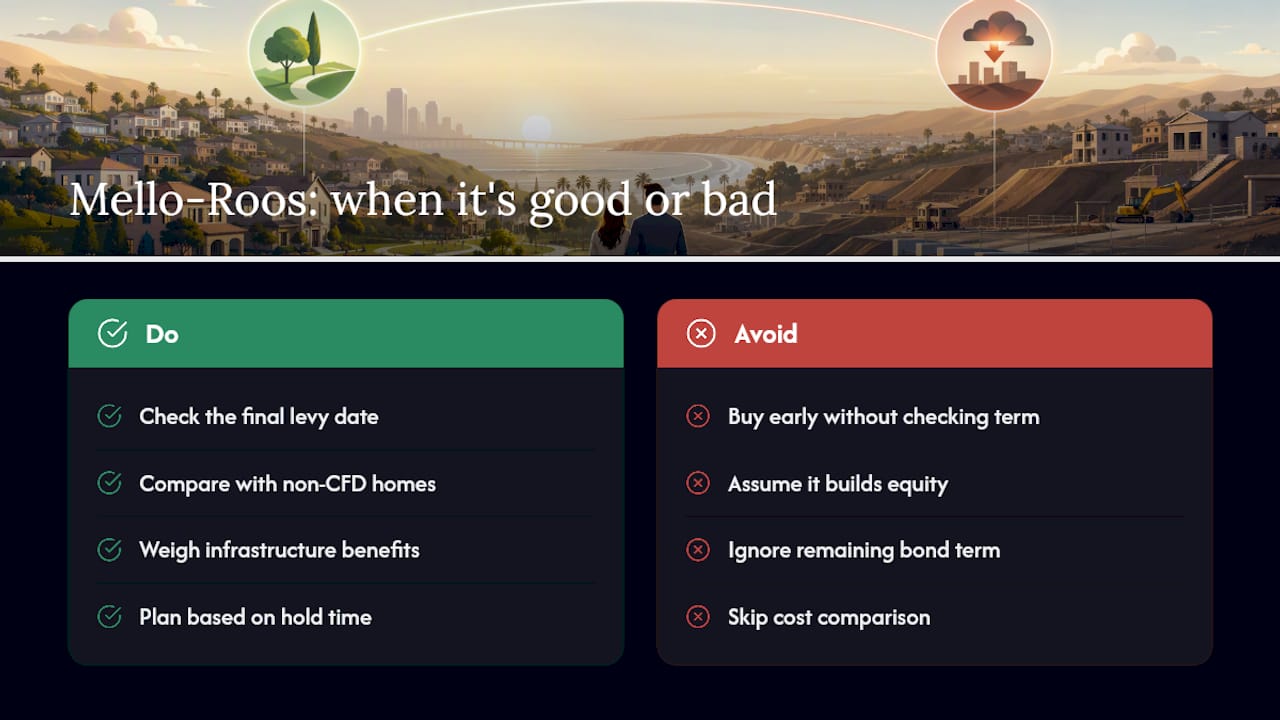
The honest answer is that it depends heavily on what your money bought and how long you plan to stay. On the upside, Mello-Roos financing is often the reason a newer San Diego community has good schools, wide roads, and parks that an older neighborhood without a CFD might lack. The infrastructure exists because someone paid for it, and in a CFD, that someone is the homeowners who benefit from it directly.
The drawback is straightforward: it's an extra annual cost on top of your base property tax, and it doesn't build equity the way a mortgage payment does. Mello-Roos charges add real money to your housing cost over a multi-decade bond term, and amounts vary across districts in San Diego.
There's also a timing element worth understanding. Buyers who purchase early in a district's life pay the tax for longer before the bonds mature, while buyers who purchase a home in a district nearing its final levy year get the benefit of the infrastructure without paying for it much longer. That's part of why checking the anticipated final levy date matters just as much as checking the current amount.
For homeowners planning to stay long-term, the calculus often favors the infrastructure trade-off, particularly in master-planned communities where the alternative would have been slower, patchier development. For someone planning to sell within a few years, the CFD's remaining term becomes a bigger factor in whether the tax is a minor annoyance or a genuine cost to weigh against comparable homes without one.
Does Mello-Roos Hurt Resale Value in San Diego?
Mello-Roos rarely tanks a sale outright, but it absolutely affects how buyers compare two otherwise similar homes. When a buyer is weighing a $950,000 home with a $2,800 annual CFD charge against a comparable home without one, that difference gets folded into their total cost of ownership, and sharp buyers will negotiate accordingly.
Marketability tends to hold up better in established, amenity-rich CFD communities where buyers can see exactly what the tax funded, including interior doors replacement, walkable parks, well-regarded schools, wide arterial roads. It holds up worse when the tax feels disconnected from any visible benefit, or when the assigned amount is unusually high relative to similar homes in the same submarket.
Sellers in a Mello-Roos district benefit from getting ahead of the question rather than letting a buyer discover it during escrow. Pulling the Assigned Special Tax table and having payoff figures ready before listing removes a point of friction that otherwise surfaces late in negotiations, sometimes after a buyer has already fallen for the house.
Do Lenders Treat Mello-Roos Differently When You Refinance?
Underwriters count Mello-Roos as part of your total housing expense when calculating debt-to-income ratio, whether you're purchasing or refinancing. That means a refinance appraisal and loan file need to reflect the current special tax accurately, not an outdated figure from when you first bought.
A few things commonly trip up refinances in Mello-Roos districts:
- If your special tax has stepped up since your original purchase (many RMAs include scheduled escalations), your new DTI calculation will reflect the higher number, which can tighten how much cash-out or new loan amount you qualify for.
- Some lenders request documentation directly from the district or from NBS Government Finance Group confirming the current assigned tax and remaining bond term, especially if the automated tax estimate on the loan file looks inconsistent with the county record.
- If you've prepaid your Mello-Roos lien since purchase, make sure that payoff is documented and reflected in your new loan file, since an outdated system might still show the old recurring charge.
None of this typically blocks a refinance, but it can slow one down if the paperwork isn't clean. Pulling your current Special Assessments lookup report before you apply saves a round trip with your loan officer later.
Jeff's Local Agent Perspective on Mello-Roos Homes
Every buyer tour in a newer San Diego community should include the same three moves: photograph the tax bill, pull the parcel's Special Assessments report, and request the RMA's Assigned Special Tax table before making an offer. Skipping any of those three is how buyers end up surprised at underwriting instead of during the second showing.
When I'm advising a buyer on a Mello-Roos home, I weigh three things against each other: what the district actually built, how many years are left on the bond, and whether the assigned tax fits comfortably into their monthly budget without straining the deal. A district with ten years left on a well-built elementary school reads very differently than one with twenty-five years remaining and thin amenities. Buyers who understand that distinction negotiate from a stronger position, and sellers who get ahead of it close faster.
— Jeff
Let Jeff Run the Mello-Roos Numbers Before You Make an Offer
An experienced local agent can pull the Special Assessments report, check the RMA's Assigned Special Tax table, and request a district payoff quote before you write an offer, so you negotiate with real numbers instead of guesses from a listing sheet.

That kind of verification usually takes a phone call and a short turnaround from the district administrator, and it becomes part of the negotiation strategy from day one rather than a scramble during escrow. If you're actively searching, start with the current home search listings filtered to San Diego communities, or grab the Buyer's Guide for a fuller rundown of what to check before you tour a home in a CFD. Either way, reach out and Jeff will walk the Mello-Roos details for any specific property before you decide it's worth an offer.
Sources
- Mello‑Roos | County of San Diego Assessor | Recorder | County Clerk
- Special Assessments | San Diego County
- Special Tax Rates | City of San Diego Official Website