
Prequalification is a quick, informal estimate of what you might be able to borrow, based mostly on numbers you report yourself. Preapproval is a documented lender review, usually with a hard credit check, that carries far more weight with sellers because it's backed by verified paperwork. Use prequalification when you're months out and just want a budget number. Use preapproval when you're actively touring homes and ready to write offers. Either way, no letter guarantees your final loan.
TL;DR:
- A prequalification is based on self-reported data and carries little weight with sellers, making it useful only for early planning.
- Preapproval involves verified documents and a hard credit check, providing a conditional loan commitment that buyers can confidently present to sellers.
- Preapproval typically takes about 10 business days, remains valid for 30 to 90 days, and is essential in competitive markets like San Diego.
- Buyers should seek a detailed preapproval letter specifying loan terms to improve their chances in multiple-offer situations.
- Getting preapproved before actively shopping helps avoid losing desirable homes to buyers with stronger, verified financing already in hand.
Table of Contents
- Prequalification vs Preapproval: What Prequalification Actually Means
- Preapproval vs Prequalification: What Makes Preapproval Different
- Comparing Prequalification and Preapproval Side by Side
- When Should You Get Prequalified vs Preapproved?
- How to Get Preapproved: A Step-by-Step Checklist
- Why Sellers and Agents Care About Your Preapproval Letter
- A San Diego Buyer's Agent's Take
- What the Conventional Advice Gets Wrong
- How Jeff Can Help You Turn Preapproval Into an Accepted Offer
- Sources
Prequalification vs Preapproval: What Prequalification Actually Means
Prequalification is the financial equivalent of a napkin sketch. You tell a lender your income, debts, assets, and how much you're hoping to put down, and they run those numbers through a quick calculation, often with only a soft credit check. Nothing gets verified. No pay stub gets pulled up. No tax return gets read.
That's exactly why it's useful early on. If you're a year out from buying and just want to know whether you're looking at lower or higher priced homes, prequalification answers that in minutes.
Lenders typically want to know:
- Approximate annual income and employment status
- Current debts (car loans, student loans, credit cards)
- Estimated savings or assets for a down payment
- Desired loan amount or purchase price range
The catch: because none of it is verified, a prequalification letter carries almost no weight with a seller. It's a planning tool, not a bargaining chip.
Preapproval vs Prequalification: What Makes Preapproval Different
Preapproval flips the process. Instead of self-reported estimates, a lender pulls your actual financial documents, runs a hard credit check, and issues a conditional commitment for a specific loan amount. It's still not a guarantee, but it's a lender saying, "We've looked at your real numbers, and here's what we'd likely lend you."
Getting there usually means handing over:
- Recent pay stubs (last 30 days)
- W-2s or tax returns from the past two years
- Bank and investment account statements
- Government-issued photo ID
- Documentation of any additional income (bonuses, freelance work, rental income)
Pro Tip: Pull your own credit report before applying. Fixing a reporting error before a lender sees it can save your score points and your preapproval terms.
Turnaround is typically fast. Many lenders issue a decision within about 10 business days, and letters usually stay valid for 30 to 90 days. Preapproval is conditional, not final. Underwriters still need to review the actual property, confirm nothing changed in your finances, and clear the loan before closing.
Comparing Prequalification and Preapproval Side by Side
| Factor | Prequalification | Preapproval |
|---|---|---|
| Purpose | Early budget estimate | Shows sellers you're a serious, funded buyer |
| Documentation required | Self-reported income, debts, assets | Pay stubs, W-2s or tax returns, bank statements, ID |
| Credit check type | Usually soft pull | Usually hard pull |
| Speed | Minutes | Up to about 10 business days |
| Validity period | No formal expiration, but estimates go stale | Typically 30 to 90 days |
| Value when making an offer | Low, mostly for personal planning | High, often required by listing agents |
The takeaway is straightforward: prequalification tells you what you might afford, while preapproval tells a seller you can actually close. If you're going to compete for a home this quarter, the preapproval letter is the one that matters at the negotiating table.
When Should You Get Prequalified vs Preapproved?
Timing depends on where you are in the search, not just your budget.
- Six or more months out? Prequalify. It's free of a hard credit hit and gives you a working number to plan around.
- Actively touring homes or planning to bid within a month? Get preapproved. Listing agents in competitive markets often won't schedule a showing, let alone accept an offer, without one.
- In a fast-moving market like much of San Diego? Skip straight to preapproval. Homes here can get multiple offers within days, and a prequalification letter simply won't compete.
Pro Tip: If your search stretches past 90 days, call your lender before your letter expires. An outdated preapproval can quietly weaken your offer without you realizing it.
How to Get Preapproved: A Step-by-Step Checklist
Getting preapproved isn't complicated, but it does reward preparation.
- Gather your documents first. Pay stubs, W-2s or two years of tax returns, bank statements, and photo ID. Freelancers and self-employed buyers should also pull profit-and-loss statements.
- Shop two or three lenders. Ask each one directly whether their "preapproval" involves a hard credit check and full document review, since lenders don't always use the terms the same way. One lender's preapproval might be another's glorified prequalification.
- Submit and wait for underwriting. Expect a hard credit pull and a real review of your financials, with most lenders responding within roughly 10 business days.
Pro Tip: Shopping multiple mortgage lenders within a short window, usually 14 to 45 days depending on the credit scoring model, gets treated as a single inquiry by credit bureaus. Rate shopping doesn't have to cost you points.
A few things speed the process along: keep your documents organized in one folder before you start, avoid opening new credit accounts, and don't make large purchases or transfer big sums between accounts while your application is pending. Underwriters notice, and unexplained deposits can stall your file.
Why Sellers and Agents Care About Your Preapproval Letter
A verified preapproval tells a seller your financing is far less likely to collapse mid-escrow, which is exactly why listing agents ask for one before they'll even negotiate.
When an offer lands with a preapproval attached, agents typically check:
- The approved loan amount and whether it covers the offer price
- Any contingencies noted on the letter
- The issue date and expiration window
- Whether the lender is local or reputable, since some agents give more weight to lenders they've worked with before
Preapproval isn't the finish line, though. Appraisals can come in low, underwriting can flag something new, and a sudden job change or a big purchase can unravel a deal that looked solid on paper. Final approval still requires a complete application and full underwriting, even after preapproval.
A San Diego Buyer's Agent's Take
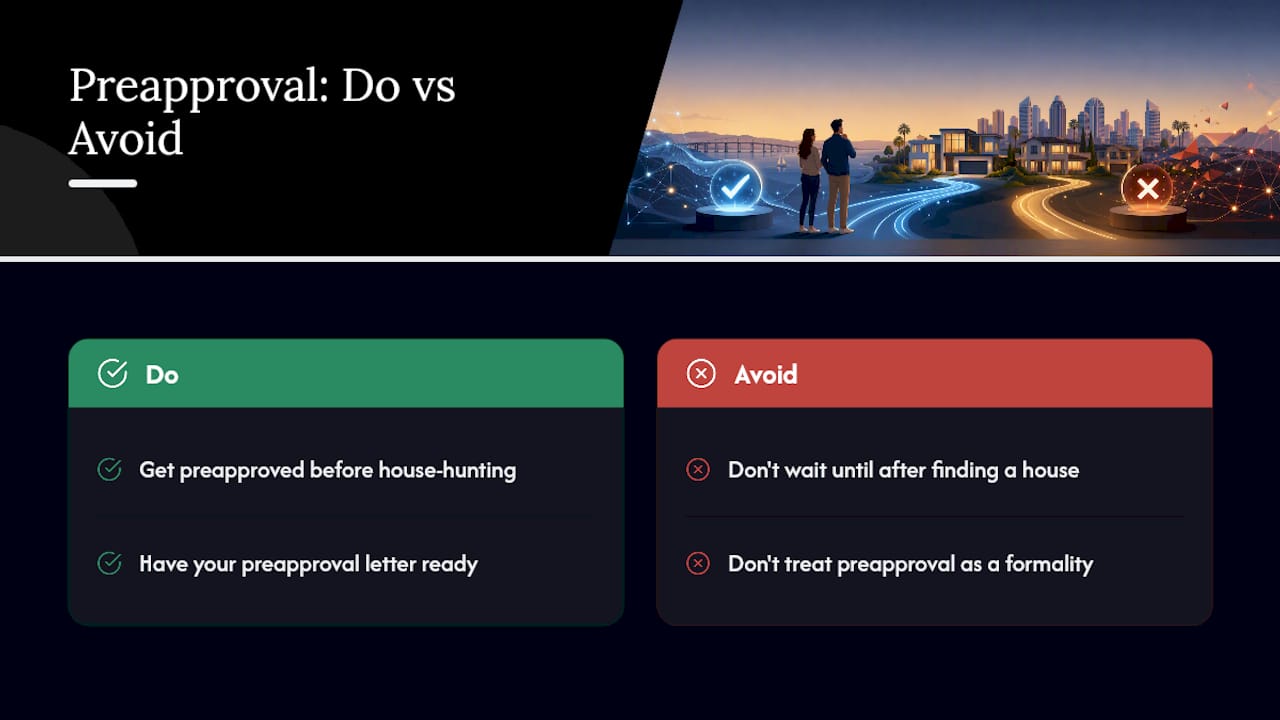
Working with buyers across San Diego, the mistake I see most often is treating preapproval like a formality to knock out after finding a house. By then it's too late; you've lost the listing to someone who already had a letter in hand. I tell clients: get preapproved before you fall in love with a property, not after.
What the Conventional Advice Gets Wrong
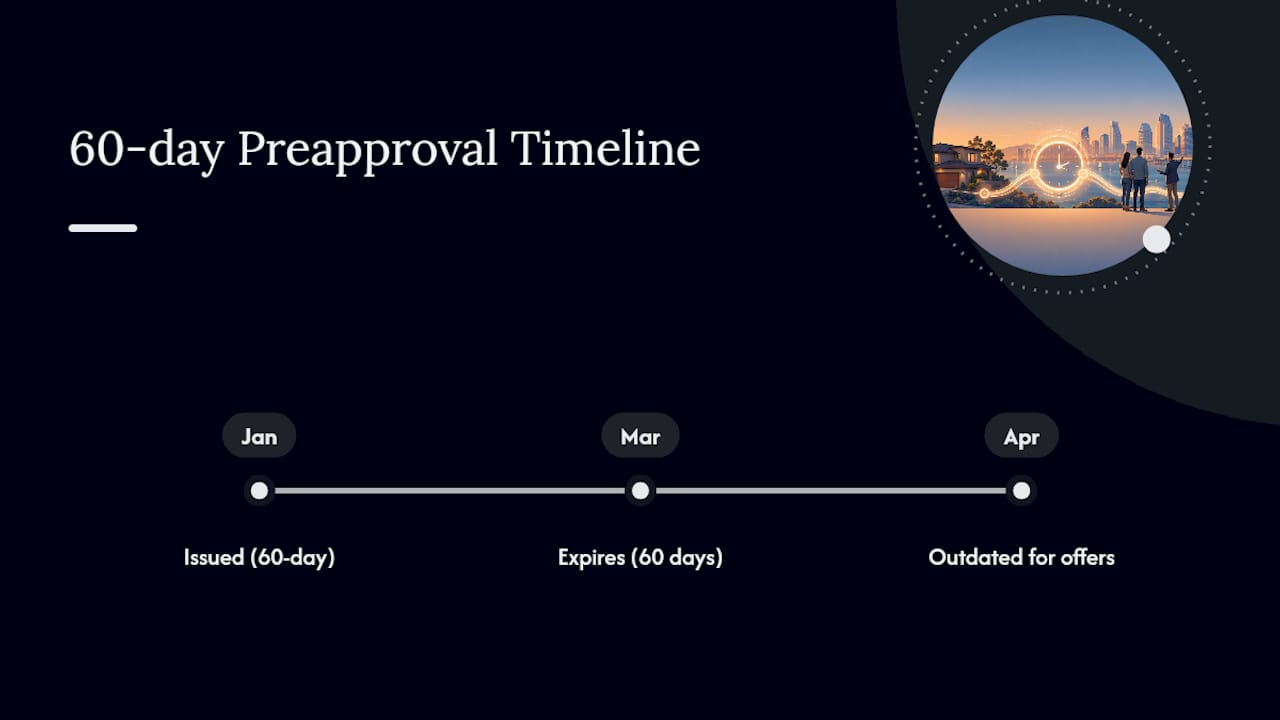
Most guides treat preapproval as a box to check once, early in the process, and then forget about. That advice misses how time-sensitive these letters actually are. A 60-day preapproval issued in January is dead weight by April, and showing up with expired paperwork can quietly undercut an otherwise strong offer.
The bigger gap, though, is in how preapproval letters get written. A generic one-line preapproval saying "buyer is approved for $600,000" reads very differently to a listing agent than one specifying the loan program, the estimated rate, and confirmation that it's underwritten to actual income documentation. In competitive San Diego neighborhoods, that level of detail is often what separates the offer that gets a callback from the one that gets ignored.
If there's one thing buyers should prioritize first, it's this: don't ask your lender for "a preapproval." Ask for one detailed enough that a seller's agent can't poke a hole in it. That's the letter that wins multiple-offer situations, not the one that just checks a box.
— Jeff
How Jeff Can Help You Turn Preapproval Into an Accepted Offer
A strong preapproval letter only helps if it's paired with someone who knows how to position it in front of sellers, and that's where local representation earns its keep. Local real estate agents work directly with buyers to time financing steps against real listings, not generic timelines, so offers land with the documentation sellers actually trust.

If you're preapproved or close to it, the next move is simple: start looking at what's actually available. Browse current San Diego listings with Jeff, or review the full Buyer's Guide for a walk-through of what happens between preapproval and closing day.
Sources
For federal guidance on mortgage protections, see HUD and FDIC. For lender-specific process details, see Bank of America, SoFi, and Lower.
- Preapproved vs Prequalified: What's the Difference? | SoFi
- What’s the difference between a prequalification letter and a preapproval letter? | CFPB
- Mortgage prequalification vs. preapproval | Bank of America
- Mortgage preapproval vs. prequalification | Lower