
Pricing your home to sell is the process of using objective market data to set a list price that attracts qualified buyers and maximizes your net proceeds. Get it right, and your home sells fast and at full value. Get it wrong, and you face weeks of silence, price cuts, and a final sale price lower than you could have achieved from day one. The industry standard tool for this is the Comparative Market Analysis, or CMA. Every pricing decision you make should start there, not with what you paid for the home, not with what you need to clear, and not with what your neighbor thinks it's worth.
How to price your home to sell using a CMA
A Comparative Market Analysis is a structured comparison of your home against recently sold properties, active listings, and expired listings in your area. It is the foundation of every defensible list price. Agents use it to identify where your home sits in the current market, and you should understand how to read one before you agree to any number.
The three components of a CMA each tell a different story:
- Recently sold comps show what buyers actually paid, not what sellers asked. These are the most reliable data points.
- Active listings reveal your competition. If similar homes are sitting unsold, that tells you something about where the market ceiling is right now.
- Expired listings are the most underrated signal. A home that failed to sell is direct evidence of a price the market rejected.
When comparing your home to comps, adjust for square footage, lot size, bedroom and bathroom count, condition, and location within the neighborhood. A home two blocks from a busy road is not the same comp as one on a quiet cul-de-sac, even if the floor plans match. Local pricing nuances in San Diego neighborhoods like Allied Gardens and Del Cerro make these adjustments especially important.
The CMA has limits. It reflects the past, not the future. If the market is shifting quickly, sold data from 90 days ago may already be stale. A skilled agent reads the trend, not just the number.

What are the main home pricing strategies?
Once you have a CMA, you choose a strategy. The right one depends on your timeline, your home's condition, and current market conditions.
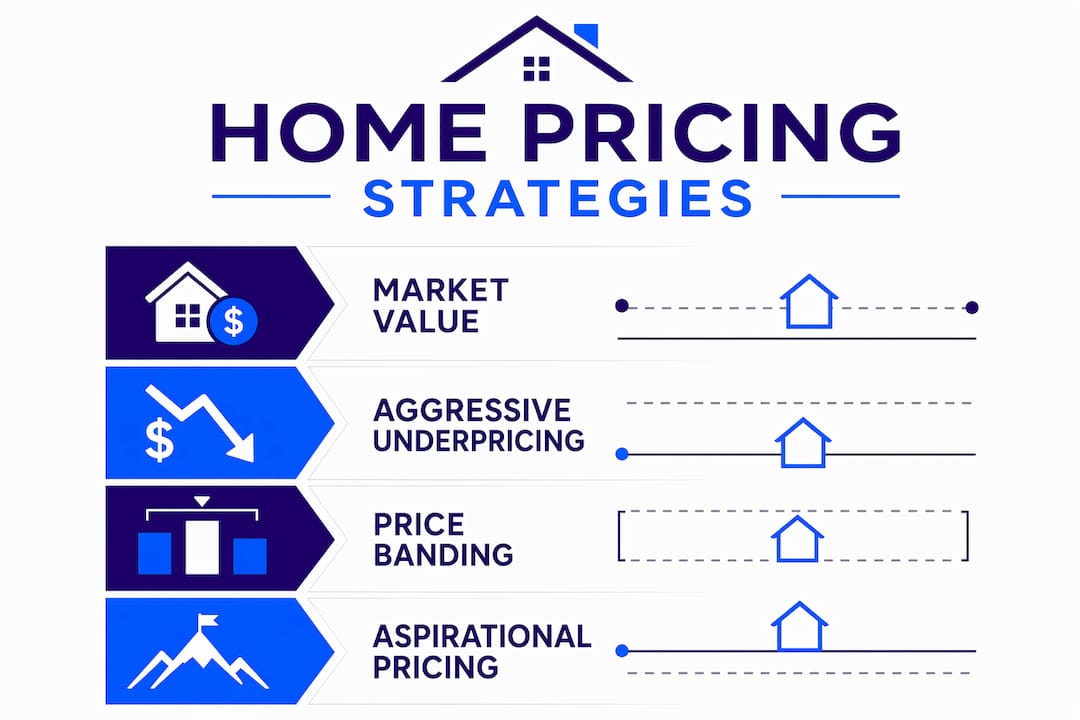
1. Market value pricing
Setting your list price within 2–3% of your CMA value is the most defensible approach in most markets. Overpricing by 10% can eliminate up to 70% of interested buyers. That is not a small risk. Market value pricing produces predictable outcomes: steady showings, qualified offers, and a clean transaction.
2. Aggressive underpricing
Pricing 5–15% below market value is a deliberate tactic to create urgency. Aggressive underpricing expands your buyer pool to 75–90% of active searchers and increases the likelihood of a bidding war. This works best in low-inventory markets where multiple buyers are competing for the same type of home. San Diego has seen this play out repeatedly in desirable neighborhoods.
3. Price banding
Value range pricing lists your home across a range, such as $450,000 to $500,000, rather than a single number. This captures buyers filtering at different price thresholds and signals flexibility. It works well in uncertain markets where buyer sentiment is mixed.
4. Aspirational pricing
This is the strategy to avoid. Aspirational pricing means listing above what the CMA supports because you believe your home is special or because you want room to negotiate. Aspirational pricing based on seller emotion consistently leads to extended days on market and eventual price reductions that leave you worse off than a correct list price from the start.
Pro Tip: Never build in a negotiation buffer by overpricing. Buyers today are well-informed. An overpriced home signals that you are out of touch with the market, and many buyers will simply skip it.
How does home condition affect your list price?
Your home's condition creates the range within which your CMA price sits. Two homes with identical square footage and location can have meaningfully different values based on what has been updated and what has been neglected.
Updated kitchens and bathrooms carry the most weight with buyers. Curb appeal matters more than most sellers expect because it drives the first impression that determines whether a buyer even walks through the door. Staging your home effectively can reinforce that impression and support a higher price point.
The critical reality about renovations: home improvements typically add 40–60% of their cost in market value, not dollar for dollar. A $30,000 kitchen remodel may add $15,000 to $18,000 in value. That gap matters when you are deciding whether to renovate before listing or price accordingly and sell as-is.
Deferred maintenance works in the opposite direction. Buyers and their inspectors will find it. A roof that needs replacement, aging HVAC, or visible water damage will either kill a deal or result in a price concession larger than the repair cost would have been.
Pricing below digital search thresholds
Over 96% of buyers use online home search platforms, and 70% filter by round-number price increments. That single fact should shape how you set your list price. Pricing at $499,900 instead of $500,000 keeps you visible to every buyer searching up to $500,000. Pricing at $500,000 removes you from that search entirely.
Pro Tip: Always price just below the nearest $25,000 or $50,000 increment. The difference of $100 in list price can mean thousands of additional buyers see your home in search results.
When should you reduce your price after listing?
The market gives you feedback immediately. You just have to read it correctly.
Correctly priced homes receive 2–4 showings per week in the first two weeks. Fewer than that is a clear signal that your price is above where the market wants to be. Offers, or the absence of them, confirm it.
The sequence for reading early market feedback:
- Days 1–7: Track showing requests. Low volume in the first week is an early warning sign.
- Days 7–14: Review agent feedback. If multiple agents report the same concern, the market is telling you something consistent.
- Days 10–21: Make your first price adjustment if showings are low and no offers have arrived. Acting within 10–15 days prevents your listing from going stale.
- Size of reduction: Make it meaningful. A 3–5% reduction resets buyer attention. A $2,000 drop on a $600,000 home signals indecision and does nothing to generate new interest.
The worst outcome is a series of small, hesitant price cuts over several months. Each reduction signals desperation, and buyers begin to wonder what is wrong with the property. A single well-timed, meaningful reduction almost always outperforms a slow bleed of tiny adjustments.
Homes that sell with a single strategic reduction achieve 95–97% of their initial list price. Homes with multiple small reductions often settle at 88–90%. That gap is real money.
Key Takeaways
Pricing your home correctly from day one is the single most powerful factor in achieving a fast sale at the highest possible price.
| Point | Details |
|---|---|
| Start with a CMA | Use sold comps, active listings, and expired listings to set a defensible list price. |
| Choose the right strategy | Market value pricing within 2–3% of CMA works for most sellers; underpricing by 5–15% can trigger bidding wars. |
| Factor in condition honestly | Renovations add roughly 40–60% of their cost in value; deferred maintenance costs more in concessions than repairs. |
| Price below digital thresholds | List at $499,900, not $500,000, to stay visible in online buyer searches used by over 96% of buyers. |
| Reduce early and decisively | A single 3–5% reduction within 10–21 days outperforms multiple small cuts and protects your final sale price. |
What I've learned about pricing after years in San Diego
The biggest pricing mistake I see San Diego sellers make is not greed. It is fear. Fear that they will leave money on the table if they price at market value. So they add a buffer, list high, and then watch the home sit while better-priced properties sell around them.
San Diego is not a forgiving market for overpriced homes. Buyers here are sophisticated. They are watching the market closely, and they know when a home is priced above its value. An overpriced listing does not generate lowball offers. It generates silence.
The sellers who do best are the ones who trust the data, price accurately from the start, and let competition do the work. I have watched homes priced correctly at $750,000 receive multiple offers and close above asking. I have also watched homes listed at $820,000 sit for 90 days and eventually sell at $740,000. The math on aspirational pricing almost never works out the way sellers hope.
My advice: get a thorough CMA, understand what the data says, and price with confidence. If you want to maximize your sale proceeds, the price you set on day one is the most important decision you will make in the entire selling process.
— Jeff
Pricing your home right with Jeffsellssandiego
Jeffsellssandiego works with San Diego homeowners to build pricing strategies grounded in current market data, not guesswork or emotion. Every seller gets a detailed CMA, a clear explanation of the local competitive landscape, and a pricing recommendation tied to your specific goals and timeline.

Whether you are selling in North Park, La Mesa, Allied Gardens, or anywhere across San Diego County, the right price is out there in the data. Jeffsellssandiego helps you find it and act on it with confidence. Browse current San Diego listings to understand where your home fits in the market, or visit the seller's guide to see exactly how the pricing and selling process works from start to finish.
FAQ
What is a CMA and why does it matter for pricing?
A Comparative Market Analysis compares your home to recently sold, active, and expired listings to establish a defensible list price. It is the most reliable tool for setting a price the market will accept.
How do I know if my home is priced too high?
Fewer than 2 showings per week in the first two weeks is a strong signal that your price is above market. No offers after 14 days confirms it.
When is the best time to reduce my list price?
Make your first reduction within 10–21 days of listing if showings are low and no offers have arrived. A 3–5% reduction is large enough to reset buyer interest without signaling desperation.
Does renovating before selling always increase my price?
Renovations typically add 40–60% of their cost in market value, not dollar for dollar. Focus on kitchens, bathrooms, and curb appeal for the best return.
Why does pricing just below $500,000 matter more than pricing at $500,000?
Over 96% of buyers search online using round-number price filters. Pricing at $499,900 keeps your home visible to every buyer searching up to $500,000, while $500,000 removes you from that filter entirely.