
Knowing how to time a home sale is the single most controllable factor in how much money you walk away with. In San Diego's competitive residential market, the difference between listing in late spring versus mid-fall can mean thousands of dollars in your pocket. This guide covers the optimal months, the best day of the week to list, local San Diego market forces, and the prep steps that make your timing actually work.
What is the best season to list a home in San Diego?
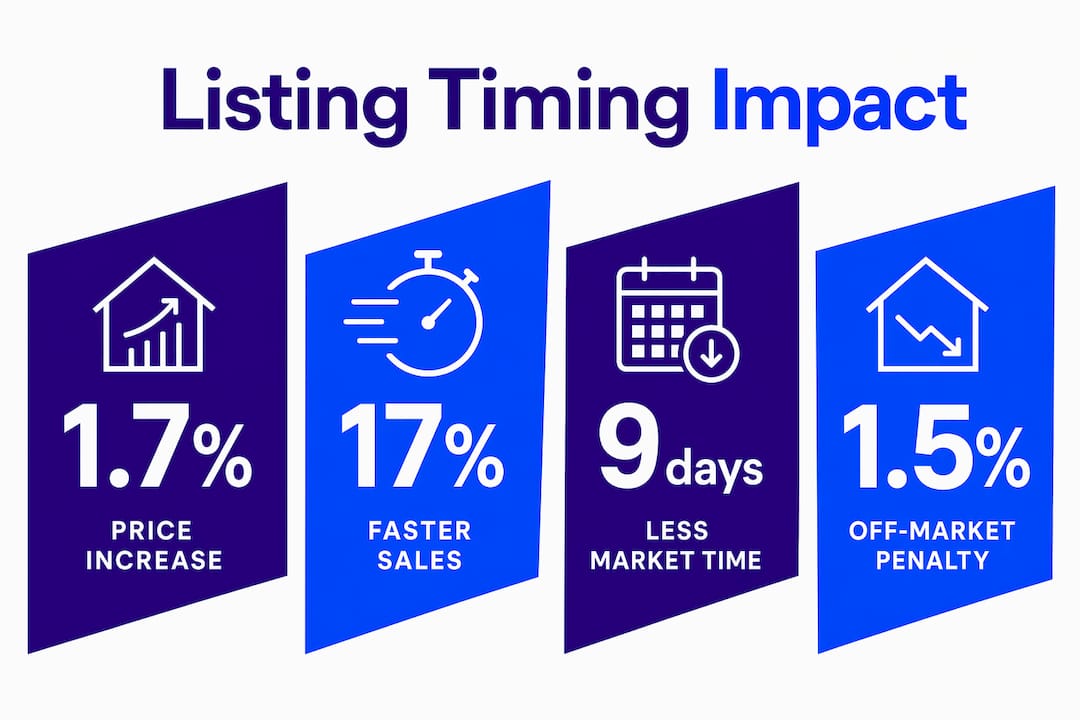
Late spring is the peak window for home sellers nationally and in San Diego specifically. Homes listed in late May sell for about 1.7% more than average, which translates to roughly $6,000 more on a typical home. That premium exists because buyer motivation peaks before summer, when families want to close, move, and settle before the new school year starts.
San Diego reinforces this national pattern with its own local dynamic. The city's large military and defense sector generates consistent relocation activity in late spring and early summer. Buyers in these industries often have firm move-by dates, which means they act quickly and compete aggressively on well-timed listings.
Homes listed during peak weeks sell around 17% faster than average, cutting roughly 9 days off the typical time on market. Fewer days on market means less carrying cost, fewer price reductions, and stronger negotiating leverage.
The table below shows how listing timing affects outcomes across key metrics.
| Listing window | Price outcome | Speed outcome |
|---|---|---|
| Late May (national peak) | ~1.7% above average | Fastest sales of the year |
| April to early May | Near peak, strong demand | 10–15% faster than average |
| June to July | Moderate, summer slowdown begins | Average pace |
| August to October | Below peak, buyer pool shrinks | Slower, more price cuts |
| November to February | Weakest demand period | Longest time on market |
Pro Tip: If you cannot list in late May, april is your next best window. Buyer demand builds through the spring and peaks in late May, so listing in april still captures most of the seasonal advantage.
Local market conditions can shift the ideal listing week by several weeks in either direction. A sudden drop in San Diego inventory in march, for example, can pull peak demand earlier than the national average suggests.

How does the day of the week affect your listing results?
The day you publish your listing on the MLS matters more than most sellers realize. Thursday is the optimal listing day because it gives buyers and agents the weekend to schedule showings while the listing still feels fresh. Listings that go live on sunday or monday sit through a full week before the next high-traffic weekend, losing momentum and appearing stale.
Here is why the Thursday advantage holds up in practice:
- Buyer planning cycles: Most buyers browse listings thursday evening and friday morning, then schedule showings for saturday and sunday. A thursday listing lands exactly when attention is highest.
- Agent scheduling: Buyer's agents block weekend showing slots on thursday and friday. A listing that appears wednesday night or thursday morning gets into those schedules. A monday listing often does not.
- Listing freshness: Thursday listings maintain freshness through the weekend without the "why has this been sitting?" perception that builds after 7 or more days.
- Offer timing: Sellers who list on thursday frequently receive offers by sunday evening, compressing the negotiation window and reducing the chance of a buyer backing out after extended deliberation.
- Competitive positioning: If competing listings go live on friday or saturday, your thursday listing already has a head start in buyer search results.
Pro Tip: Schedule your professional photography session for tuesday or wednesday so your agent has time to upload photos, write the description, and submit to the MLS for a thursday morning launch.
The combination of a late spring listing date and a thursday publication day is the strongest timing setup available to San Diego sellers. Neither factor alone is as powerful as both working together.
How do local San Diego factors shape your optimal timing?
San Diego's real estate market does not move in perfect sync with national averages. School year cycles are a primary driver of buyer motivation for families, and San Diego Unified School District's calendar means families need to close by late june or early july to settle before the fall semester. That creates a hard deadline that pushes serious family buyers to act in april and may.
Neighborhood-level inventory is the other major local variable. In areas like North Park, Mission Hills, and La Jolla, listing inventory can tighten dramatically in early spring, which pulls peak demand earlier than the national model predicts. Checking local market trends for your specific zip code before committing to a listing date is not optional. It is the difference between riding a wave and missing it.
Personal circumstances also drive timing decisions. Life events like job changes or growing families often force sellers to list outside the ideal window. That is a real constraint, and it does not mean you cannot sell well. It means you need to compensate with stronger preparation, sharper pricing, and better marketing.
Here is a practical process for building your personal timing plan:
- Identify your target listing date. Work backward from late may or early april as your anchor point.
- Check neighborhood inventory. Ask your agent to pull active listing counts for your zip code over the past 12 months. Identify when inventory was lowest and demand was highest.
- Map the school calendar. San Diego Unified's last day of school typically falls in mid-june. Families need 30–45 days to close after going under contract, so they must be in contract by early may to meet that deadline.
- Account for your prep time. Most homes need 6–10 weeks of preparation before they are ready to list. Count backward from your target date.
- Build in a buffer. Repairs take longer than expected. Contractors cancel. Add two weeks of buffer to every prep timeline.
- Confirm with a local agent. A Realtor who works your specific neighborhood can tell you whether this year's inventory pattern matches the historical model or diverges from it.
What prep steps align your home with the right listing window?
Preparation and timing are inseparable. A home that is not ready cannot benefit from a peak listing window. The work needs to start 2–3 months before your target listing date.
The most common preparation mistakes San Diego sellers make are starting too late and underestimating the cost of deferred maintenance. Buyers in San Diego's price range are sophisticated. They notice peeling paint, aging HVAC systems, and worn flooring. Addressing those issues before listing prevents price reductions later.
| Preparation task | Timeline before listing | Impact on sale |
|---|---|---|
| Deep clean and declutter | 8–10 weeks out | Sets baseline for staging |
| Repairs and deferred maintenance | 8–10 weeks out | Prevents inspection renegotiations |
| Professional staging | 2–3 weeks out | Increases perceived value |
| Professional photography | 1 week out | Drives online click-through rates |
| MLS listing submission | Thursday morning | Maximizes buyer exposure |
Homes sold off-market sell for a median of 1.5% less than fully listed homes. That penalty exists because off-market sales skip the competitive bidding that MLS exposure creates. Full MLS exposure is not a technicality. It is a direct driver of your final sale price.
Hire your agent before you start prep work, not after. A good local agent will walk your home, identify which repairs actually move the needle for buyers in your price range, and tell you which ones are not worth the cost. That guidance alone can save you thousands in unnecessary spending.
What are the most common timing mistakes San Diego sellers make?
Timing errors are more common than most sellers expect, and they are expensive.
- Waiting too long for "perfect" conditions. Sellers who hold out for a market peak that never arrives often list in fall or winter, when buyer demand drops and price reductions become necessary.
- Listing off-market to "test the price." Off-market listings skip MLS exposure and cost sellers a median 1.5% on the final price. There is no such thing as a free test.
- Rushing to list without prep. A home that hits the market with visible deferred maintenance signals desperation to buyers. It attracts lowball offers and extended negotiation.
- Ignoring neighborhood-level data. National timing advice does not account for the fact that your specific San Diego neighborhood may peak two to four weeks earlier or later than the national model.
- Letting personal urgency override all strategy. Life events sometimes force a sale. When that happens, compensate with better marketing and sharper pricing rather than abandoning timing strategy entirely.
Key Takeaways
Timing a San Diego home sale correctly requires combining national seasonal data, local inventory patterns, and a Thursday listing day to maximize both price and speed.
| Point | Details |
|---|---|
| Late May is the price peak | Homes listed in late May sell for about 1.7% more, or roughly $6,000 above average. |
| Thursday is the best listing day | Thursday listings capture weekend buyer traffic while maintaining listing freshness. |
| San Diego school cycles matter | Family buyers must close by late June, making April and May the strongest demand months locally. |
| MLS exposure is non-negotiable | Off-market sales cost sellers a median 1.5% on final price due to reduced buyer competition. |
| Prep starts 2–3 months early | Repairs, staging, and photography must be complete before the target listing date, not after. |
What I've learned about timing a San Diego home sale
Most sellers come to me focused on the number: what will my home sell for? The better question is when and how will you put it in front of the right buyers. Those two decisions shape the number more than almost anything else.
I have seen sellers in North Park and Mission Hills leave real money on the table by listing in september because they "heard the market was still hot." It was not. Buyer pools shrink after summer, and those sellers ended up cutting their price twice before going under contract. The data on late spring is not a suggestion. It is a pattern that repeats year after year in San Diego.
The Thursday listing day is the detail most sellers overlook. It sounds minor. It is not. I have watched listings go live on a monday and sit through a full week with minimal traffic, then suddenly get attention the following weekend when they already feel like old news. Thursday changes that dynamic completely.
My honest advice: treat your listing date like a product launch. You would not launch a product without a plan, a prepared product, and a targeted audience. Your home is no different. Start prep work 10 weeks out, confirm your neighborhood's inventory cycle with a local agent, and hit the MLS on a thursday in late april or may. That combination gives you the best realistic shot at a strong price and a fast sale.
— Jeff
Selling your San Diego home with the right timing and support
Timing your sale correctly is only half the equation. The other half is execution: professional photography, full MLS exposure, and a pricing strategy that reflects your specific neighborhood's demand cycle.

Jeffsellssandiego works with San Diego homeowners to build a sale plan that fits both the market calendar and your personal timeline. Whether you are in North Park, La Mesa, or anywhere across San Diego County, the seller resources at Jeffsellssandiego cover every step from prep to close. For a closer look at what your neighborhood's market is doing right now, the San Diego neighborhood guide breaks down local demand patterns by area so you can list with confidence.
FAQ
When is the best time to sell a home in San Diego?
Late april through late may is the strongest window for San Diego sellers. Homes listed during this period benefit from peak buyer demand, school-year urgency among families, and national seasonal momentum.
What day of the week should I list my home?
Thursday is the best day to publish your listing. It positions your home in front of buyers and agents as they plan weekend showings, keeping the listing fresh through the highest-traffic days.
Does listing on the MLS really affect my sale price?
Yes. Homes sold off-market sell for a median of 1.5% less than fully listed homes. Full MLS exposure drives buyer competition, which directly raises your final sale price.
How far in advance should I start preparing my home to sell?
Start 2–3 months before your target listing date. Repairs, staging, and professional photography all take more time than sellers expect, and rushing any of them hurts your result.
Can I still sell well if I cannot list in late spring?
Yes, but you need to compensate. Sharper pricing, stronger marketing, and full MLS exposure can offset a less-than-ideal listing window. Working with a local agent who knows your neighborhood's specific demand cycle is the most effective adjustment you can make.