
Escrow prorates the current year's property tax bill between buyer and seller at closing, splitting it based on days or months of ownership. Separately, San Diego County issues a supplemental tax bill directly to the new owner if the sale price pushes the assessed value higher than what the seller was paying. That supplemental bill isn't part of proration and isn't optional. The county's fiscal year runs July 1 through June 30, and supplemental bills land outside the normal two-installment cycle.
TL;DR:
- The supplemental tax bill is issued only to the new owner after a sale, based on the assessed value increase and the remaining fiscal months, often arriving months later.
- Property tax proration at closing adjusts for the days the seller or buyer owned the property, based on the current year's tax bill, without involving the supplemental tax or affecting the county's original bill.
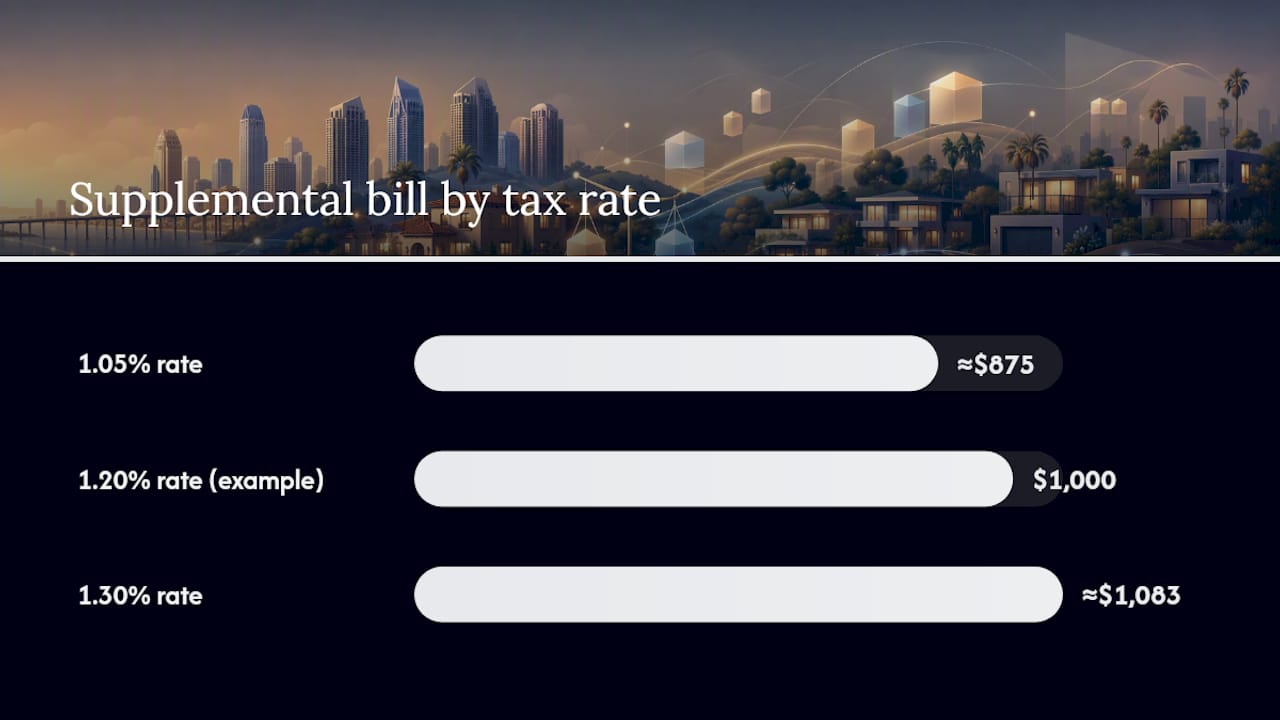
- The supplemental tax rate varies between approximately 1.05% and 1.30%, influenced by voter bonds and assessments, so buyers should confirm their specific rate before calculating their bill.
- Escrow and title companies handle the proration, and their calculations are final; misunderstandings often occur if instructions do not explicitly clarify who pays each installment.
- Buyers should verify their parcel's tax bill and assessments before making an offer, set aside reserves for potential supplemental taxes, and confirm payment responsibilities before closing.
Table of Contents
- What tax proration and supplemental property tax actually mean in San Diego
- How the county calculates your supplemental tax bill
- How proration shows up on your closing statement
- Tax deadlines and penalties every San Diego buyer should know
- A pre-close and post-close checklist to avoid surprises
- What to do if a supplemental bill arrives, positive or negative
- What I tell every San Diego client about tax surprises
- How I help you get ahead of supplemental tax surprises
- Where to verify these numbers yourself
- Sources
What tax proration and supplemental property tax actually mean in San Diego
Proration and supplemental tax get confused constantly, and understanding tax proration in San Diego starts with treating them as two separate transactions with two separate purposes.
Proration is a math exercise escrow performs at closing. Property tax in California is billed annually for a fiscal year that runs July 1 to June 30, but almost no closing happens on that exact date. So escrow divides the year's tax bill by the number of days or months each party owned the home, then credits or charges each side accordingly. If a seller already paid the full installment covering a period after the sale closes, the buyer owes the seller for those remaining days. It's an accounting adjustment, not a new tax.
Supplemental tax is different. California's Prop 13 caps how fast assessed value can rise on paper, but a sale resets that cap to the actual purchase price. When your purchase price exceeds the seller's old assessed value, San Diego County reassesses the parcel and issues a supplemental tax bill for the gap, billed only to the new owner, mailed separately from the regular tax bill.
The two interact but don't overlap:
- Proration settles who pays what share of the existing tax bill at closing.
- Supplemental tax bills the increase created by the sale itself, and it arrives later, often months after you've moved in.
- Only the current owner receives supplemental billing. There's no splitting it with a previous owner after the fact.
How the county calculates your supplemental tax bill
San Diego County uses a fixed formula, and once you know it, the math takes about thirty seconds.
Pro Tip: Pull your parcel's Tax Rate Area before you make an offer. It takes two minutes and tells you exactly what rate applies to the math below.
- Subtract the prior assessed value from the new assessed value (typically your purchase price) to get the increase.
- Multiply that increase by the number of months remaining in the fiscal year (through June 30), divided by 12.
- Multiply the result by your parcel's applicable tax rate, pulled from the county's TRA search tool.
Here's a real-world version. Say a home was assessed at $450,000 under the previous owner, and you buy it for $700,000 in February, closing with four months left in the fiscal year. The increase is $250,000. Prorated for 4 of 12 months, that's $83,333. Apply a combined rate around 1.2%, which is typical once you factor in voter-approved bonds and any Mello-Roos assessments layered on top of the 1% Prop 13 base, and you land on a supplemental bill close to $1,000.
That 1.2% figure isn't universal. Effective buyer-facing rates in San Diego commonly run between roughly 1.05% and 1.30% depending on your specific TRA, and Mello-Roos districts can push it higher still. Look up your exact rate before you assume the math above applies to your parcel, as it can vary depending on voter-approved bonds and special assessments.
How proration shows up on your closing statement
Escrow and title, not the county, do the actual work of splitting the tax bill. The Treasurer-Tax Collector has no mechanism to adjust or divide a bill between buyer and seller once it's issued. Whatever escrow calculates gets recorded as a credit or debit on the settlement statement, and that entry is final.
A few scenarios play out constantly in San Diego closings:
- The seller already paid the current installment in full. The buyer reimburses the seller through escrow for the days remaining in that period after closing.
- The seller hasn't paid yet, and the installment is about to become delinquent. Escrow typically withholds funds from the seller's proceeds and pays it directly, or credits the buyer to cover it after closing.
- The buyer has a lender with an impound account for future tax payments, but that impound account almost never covers a supplemental bill, since it's calculated and mailed after the sale, sometimes long after the loan was funded.
Pro Tip: Read your escrow instructions line by line before signing. If the document doesn't explicitly state who covers which installment, don't assume your lender or escrow officer caught it. Ask directly.
This is where Case Escrow's guidance on getting proration terms in writing matters most. If closing lands close to a delinquency date and the paperwork is vague, buyers sometimes end up paying twice, once through the seller's proration credit and again when the county's bill catches up.
Tax deadlines and penalties every San Diego buyer should know
Missing a date on your annual property tax bill triggers automatic penalties. There's no grace period and no waiver for "I didn't know I owed it."
San Diego County runs its fiscal year from July 1 to June 30, split into two installments:
- First installment: due November 1, delinquent after December 10.
- Second installment: due February 1, delinquent after April 10.
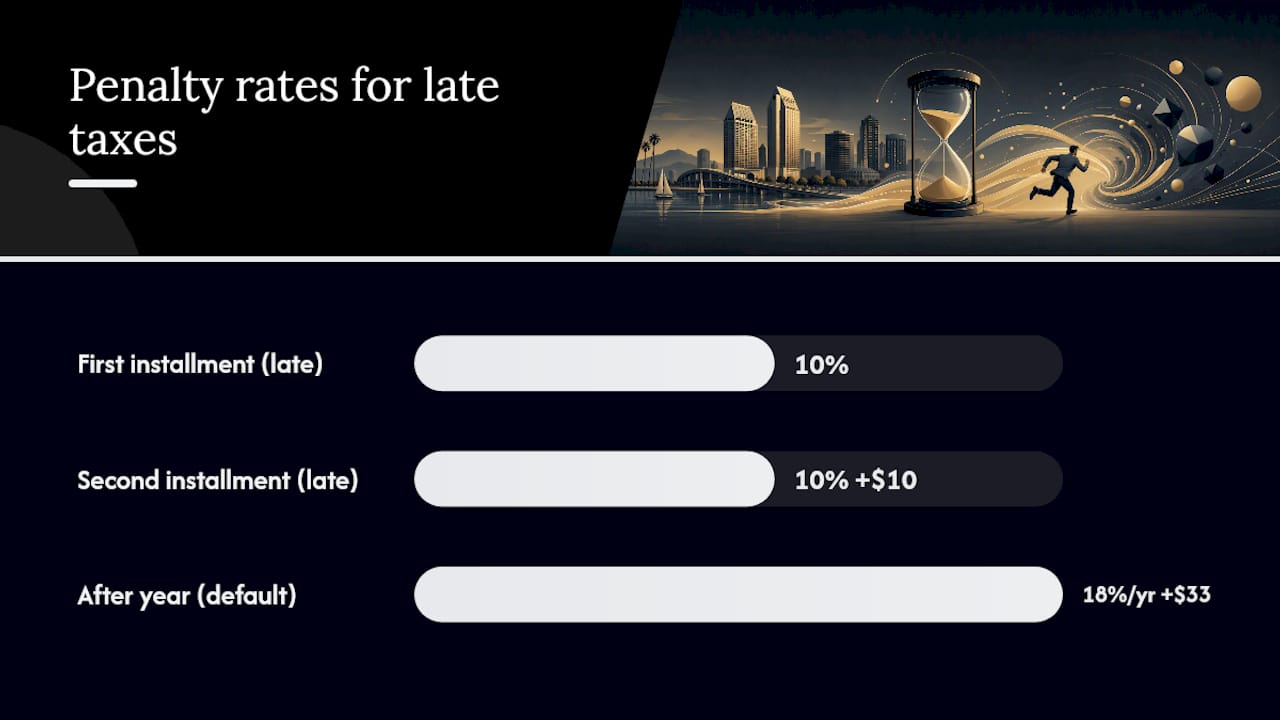
Miss the first deadline and you're hit with a 10% penalty automatically. Miss the second, and it's 10% plus a $10 cost. Let the whole year lapse past June 30 without payment, and the parcel goes into default, accruing 1.5% monthly (18% annualized) plus a $33 redemption fee on top of the original penalties.
Supplemental bills follow a completely different clock. They're typically mailed six to twelve months after the reassessment triggered by your purchase, sent straight to the new owner, and never routed through a lender's impound account. If you're budgeting month to month assuming your mortgage payment covers everything tax related, a supplemental bill can catch you off guard well into your first year of ownership.
A pre-close and post-close checklist to avoid surprises
Most of the supplemental tax panic I see could have been avoided with three phone calls before closing. Here's what I walk clients through.
- Before you write an offer, pull the parcel's current tax bill and its Tax Rate Area, then compare the seller's assessed value against your likely purchase price. A big gap is your early warning sign.
- If the gap is significant, set aside cash reserves, generally 0.25% to 0.50% of the purchase price is a reasonable starting point, so a supplemental bill doesn't ambush your budget six months in.
- In escrow instructions, confirm explicitly which party pays which installment, and get written confirmation of any payoff amounts requested from the seller's lender.
- After closing, enroll in the county's e-notification service, verify with your lender whether your impound account covers anything beyond the standard bill, and mark your calendar for when a supplemental bill might arrive.
Pro Tip: Ask your escrow officer directly: "Will the county send a supplemental bill on this sale, and who is it going to?" If they can't answer clearly, push until they do.
None of this is complicated. It just requires someone to ask the right questions before the ink dries, not after a bill shows up in your mailbox.
What to do if a supplemental bill arrives, positive or negative
Not every supplemental bill increases what you owe. If the new assessed value comes in lower than the prior one, say the sale price was below the previous assessment, you'll receive a negative supplemental bill, which functions as a refund and can be applied to other open balances on the parcel.
If you believe the reassessment is wrong, you can appeal, but you'll need documentation: the assessment notice, comparable sales data, and a clear basis for disputing the new value. Start by contacting the Treasurer-Tax Collector's office directly, then check your escrow file for any relevant instructions that might affect the timeline. Payment plans are available if the amount owed creates a genuine hardship.
What I tell every San Diego client about tax surprises
The same three mistakes show up over and over. Buyers assume their lender's impound account covers everything, so a supplemental bill blindsides them. Escrow instructions get signed without anyone confirming who pays which installment. And nobody sets aside a cash cushion when the purchase price is well above the seller's old assessed value.
Before I write an offer for a client, I want the seller's current tax bill, the parcel's TRA, and a clear sense of the assessed value gap. Before closing, I want written confirmation in escrow instructions of exactly who covers what. It's five minutes of due diligence that saves a five-figure headache.
— Jeff
How I help you get ahead of supplemental tax surprises
Escrow paperwork and county tax rules aren't something you should be untangling for the first time during your own closing. When I represent buyers and sellers in San Diego, I pull the parcel's tax bill and Tax Rate Area before we ever write an offer, and I review the escrow instructions line by line so proration terms are locked in writing, not assumed.

That upfront work is the difference between a smooth closing and a surprise bill landing in your mailbox eight months later. If you're buying or selling in San Diego and want someone checking these details before they become your problem, start with my buyer's guide or browse current San Diego listings to see what's available now. Reach out and we'll walk through your specific parcel's tax situation before you're locked into anything.
Where to verify these numbers yourself
- Supplemental tax bill details and the New Homeowners Property Tax Guide
- Tax Rate Area search tool for your parcel's exact rate
- A San Diego property tax calculator for planning ahead of a purchase
Sources
- Supplemental Property Taxes — San Diego County Treasurer-Tax Collector
- New Homeowners Property Tax Guide — San Diego County Treasurer-Tax Collector (PDF)
- San Diego County Property Tax Calculator — California Property Tax Almanac