For most San Diego homeowners, Farmers, AAA, Nationwide, Travelers, and Mercury offer the strongest mix of coverage and price, with USAA and Armed Forces Insurance leading the pack for military families. The city average runs about $149 a month, and AAA is commonly cited as the cheapest widely available option at roughly $88 a month for comparable coverage. Other pricing models put the annual average closer to $1,714, which tells you how much a policy's numbers shift depending on dwelling value, ZIP code, and which perils you include.
One thing trips up almost every new buyer here: none of those figures include earthquake or flood coverage. Standard homeowners policies in California exclude both by default, so if you want protection against the ground moving or the ocean creeping closer, you're buying it separately. Get quotes from at least three carriers before you decide anything, and ask each one directly about wildfire mitigation credits, because that's where San Diego homeowners quietly overpay.
Key Takeaways
San Diego homeowners insurance costs vary widely by ZIP code, and getting adequate coverage requires separate earthquake and flood policies plus at least three standardized quotes.
| Point | Details |
|---|---|
| City-average cost | Runs around $149 a month, with AAA often cheapest near $88 monthly. |
| Coverage gaps | Standard policies exclude earthquake and usually flood; both require separate riders or policies. |
| Wildfire pricing driver | San Diego rates rose about 27% year over year due to wildfire risk. |
| Shop with standardized inputs | Request three quotes using the same dwelling value, deductible, and endorsements for a fair comparison. |
| Public backstops exist | The California FAIR Plan and CEA offer limited coverage when private insurers decline. |
| Local agent guidance matters | Jeffsellssandiego helps San Diego buyers weigh neighborhood-level insurance risk before making an offer. |
Table of Contents
- Best Homeowners Insurance Companies in San Diego
- How Do You Choose the Right Homeowners Policy?
- What Doesn't Standard Home Insurance Cover in San Diego?
- Why Do Quotes Vary So Much Between ZIP Codes?
- Where Should You Buy Homeowners Insurance in San Diego?
- What San Diego Homeowners Get Wrong About Insurance
- A Different Kind of Support for San Diego Buyers and Sellers
- Frequently Asked Questions About San Diego Homeowners Insurance
- Sources
Best Homeowners Insurance Companies in San Diego
Shopping for home insurance quotes in San Diego means comparing carriers that treat wildfire zones, older housing stock, and coastal exposure very differently from one another. Some insurers pull back entirely in high brush-risk ZIP codes; others specialize in exactly those properties. Here's how the major players stack up.
| Insurer | Best For | Cost Signal | Claims/Financial Strength | CA Availability Notes |
|---|---|---|---|---|
| Farmers | Flexible endorsements, agent access | Competitive, varies by ZIP | Strong regional reputation | Widely written across San Diego County |
| AAA | Value-focused shoppers | Often cheapest option locally | Solid regional standing | Member-based; broad SoCal footprint |
| Nationwide | Buyers wanting bundling options | Competitive in many ZIPs | Stable national carrier | Selective in high wildfire-risk areas |
| USAA | Military members and families | Strong value when eligible | Consistently high satisfaction scores | Membership required (military-linked) |
| Travelers | Claims-paying reputation | Mid-range | Strong AM Best rating | Available through independent agents |
| Mercury | Older San Diego homes | Often lower for older properties | CA-focused underwriting | California-founded, deep local knowledge |
| State Farm | Bundling and agent access | Broad, varies widely | Large agent network | Widely available, but selective in fire zones |
| Armed Forces Insurance | Military families and veterans | Competitive for eligible members | Long track record with military niche | Membership-based eligibility |
| Chubb | High-value homes | Premium pricing | Excellent, high-net-worth focus | Available for higher-value properties |
| Bamboo Insurance | Wildfire-exposed properties | Varies by risk | Newer specialty carrier | Fills gaps where standard carriers decline |
| Allstate | Familiar agent-based service | Broad range | Established national reputation | Selective underwriting in fire-prone ZIPs |
A few things stand out once you dig past the headline rates. Farmers and Nationwide tend to offer the deepest bench of optional endorsements, which matters if you want extended replacement cost or scheduled personal property coverage. Mercury built its reputation writing policies for older California homes that other national carriers underwrite more conservatively. Chubb and Bamboo sit at opposite ends of the same problem: Chubb protects high-value properties that need coverage limits far above standard policies, while Bamboo exists specifically because standard carriers have pulled back in wildfire-exposed canyons and hillside communities.
- USAA and Armed Forces Insurance consistently post the highest satisfaction numbers among eligible households, but eligibility is limited to military-connected families.
- AAA and Mercury tend to price competitively for standard-risk, standard-age homes without unusual rebuild costs.
- Travelers carries a strong claims-handling reputation, which matters more after a wildfire event than a low quote ever will.
- Some carriers quietly decline new business in specific ZIP codes rated high for brush fire exposure, regardless of the insurer's advertised statewide availability.
Pro Tip: Before requesting quotes, ask each carrier point-blank whether they're currently writing new policies in your ZIP code. Several national names quietly stopped accepting new applications in San Diego's highest wildfire-risk zones, and you don't want to find that out after wasting an hour on the phone.
Every carrier above is evaluated on public rate filings, third-party aggregator data from Policygenius and The Zebra, and known underwriting patterns in California's wildfire-exposed regions. Some national carriers common in other states barely appear in San Diego listings because they've restricted new business here, not because they're unavailable nationally.
How Do You Choose the Right Homeowners Policy?
Getting an accurate quote means starting with the right numbers, not the cheapest headline price. Run through this before you compare a single offer:
- Calculate true replacement cost, not market value. San Diego construction costs have outpaced home valuations for years, so automated online estimates routinely undershoot what it actually takes to rebuild.
- Set personal property limits based on a real inventory, not the default percentage most policies auto-assign.
- Check liability limits against your actual assets, especially if you have a pool, trampoline, or rental unit on the property.
- Confirm loss-of-use coverage covers enough months of temporary housing if wildfire or fire damage forces you out.
- Ask about endorsements for water backup, service line coverage, and extended replacement cost above policy limits.
When you talk to an agent or carrier, ask direct questions: What's my property's official wildfire zone designation? Has this carrier issued nonrenewal notices in my ZIP code recently? Do I need separate CEA earthquake coverage, and does my lender require flood insurance?
Watch for these red flags before signing anything:
- Vague or unexplained exclusions buried in the policy language
- A surcharge far above what comparable ZIP codes are quoted
- Any hint the carrier has issued nonrenewals nearby in the past 12 months
- A replacement-cost estimate that seems suspiciously low for your home's age and square footage
What Doesn't Standard Home Insurance Cover in San Diego?
Standard homeowners policies in California exclude earthquake damage entirely, and most exclude flood and coastal erosion too. That's not a technicality. It's the single most misunderstood part of buying property insurance here, and it catches new homeowners off guard every year.
Earthquake coverage runs through the California Earthquake Authority, typically purchased as a rider through your existing carrier. Recent policy changes have pushed toward higher deductibles and lower personal property limits, especially for older homes, so read the fine print before assuming a CEA policy covers what you think it does.
Wildfire risk drives the sharpest cost swings. San Diego's average annual premium climbed roughly 27% year over year largely because of wildfire exposure, and pricing varies dramatically between adjacent ZIP codes depending on brush density and Santa Ana wind exposure. The upside: insurers increasingly offer documented discounts for defensible space, Class A roofing, and ember-resistant vents, and those upgrades often cut premiums more than homeowners expect.
Flood and coastal erosion sit in their own category. FEMA flood map updates have pulled some coastal and low-lying San Diego properties into mandatory flood-insurance zones that weren't required a decade ago. If your lender flags a flood zone during underwriting, you'll need a separate policy before closing, full stop.
- Earthquake: separate CEA policy, higher deductibles common on older homes
- Flood/coastal erosion: separate policy, often lender-mandated after FEMA remapping
- Wildfire: covered by standard fire policy, but pricing and availability vary sharply by ZIP
Why Do Quotes Vary So Much Between ZIP Codes?
Two homes three miles apart can get wildly different quotes, and it's rarely random. Carriers price against brush-hazard maps, distance to fire stations, roof material, and rebuild cost per square foot, all of which shift block by block in San Diego's canyon-and-mesa terrain.
To compare quotes fairly, standardize your inputs before requesting them:
- Use the same dwelling replacement-cost figure across every quote request
- Request the same deductible level from each carrier
- Ask each insurer to quote the same endorsements (earthquake rider, extended replacement cost, water backup)
- Ask specifically how bundling home and auto affects your premium, since the discount varies by carrier
Pro Tip: If your quote comes back high because of a wildfire-zone designation, ask the carrier whether they'll re-underwrite after a documented mitigation inspection. Some will lower your rate once you show proof of defensible space or roof upgrades, but only if you ask.
If your rate jumps at renewal without explanation, request a mitigation-credit review before you accept it or start shopping elsewhere. That single phone call resolves more premium disputes than most homeowners realize.
Where Should You Buy Homeowners Insurance in San Diego?
Local independent agents tend to know which carriers are actually still writing new policies in specific wildfire-exposed neighborhoods, which matters more here than in most markets. Buying direct from a carrier's website works fine for straightforward, low-risk properties, but aggregator sites are best used for comparison shopping, not final purchase.
- Local agent: best for wildfire zones, older homes, or unusual underwriting situations
- Direct carrier: fine for standard-risk homes with straightforward coverage needs
- Aggregator sites: useful for comparing multiple quotes quickly, less useful for complex properties
If private insurers decline coverage outright, the California FAIR Plan provides limited fire coverage as a last resort, but it requires a separate policy for liability and other standard protections. Buyers in escrow should request insurance quotes the moment an offer is accepted, since lenders won't fund without proof of coverage, and wildfire-zone properties can take longer to bind than a standard policy.
Jeff's Local Perspective: Insurance in San Diego Real Estate Deals
Insurance status can stall an escrow fast. Lenders won't fund without binding proof, and coastal or hillside properties sometimes need extra lead time for underwriting.
- Coastal ZIP codes often carry lower wildfire risk but higher flood/erosion costs
- Inland canyon properties usually see the opposite tradeoff
- Buyers eyeing wildfire-zone homes should get an insurance quote before writing an offer, not after
For deeper guidance on timing these pieces around a purchase, Jeff's San Diego home buying and selling guide walks through what lenders expect during escrow.
What San Diego Homeowners Get Wrong About Insurance
The conventional advice, get three quotes and pick the cheapest, isn't wrong, but it's incomplete for this market. San Diego's real risk isn't the monthly premium. It's the nonrenewal notice that shows up two years after you bought the house, once a carrier reassesses your ZIP code's wildfire exposure.
Most homeowners shop hardest at purchase and then never revisit their coverage again. That's backwards here. California's wildfire-driven rate pressure means your risk profile, and your carrier's appetite for it, can shift within a few years even if nothing about your house changed. The smarter move is treating your policy like a rolling negotiation: document mitigation work, ask for re-underwriting after upgrades, and check CEA and FAIR Plan eligibility before you're forced to.
If you're buying a home right now, don't treat insurance as a closing-week errand. Pull a quote before you write an offer, especially on anything near open space or a canyon rim. It can change your numbers more than the interest rate does.
A Different Kind of Support for San Diego Buyers and Sellers
Comparing Farmers, AAA, Mercury, and the rest tells you a lot about your monthly premium, but it doesn't tell you which neighborhoods carry hidden insurance costs before you ever sign a purchase agreement. That's where working with a local agent pays off in a way an insurance quote tool never will. Jeffsellssandiego helps San Diego buyers and sellers understand exactly how wildfire zones, coastal flood requirements, and rebuild costs affect a specific property, before that property becomes a stressful surprise during escrow.

Unlike shopping insurance carriers directly, working with an agent means someone is already tracking which San Diego neighborhoods face rising premiums or nonrenewal patterns, and can flag that before you fall in love with a house that's expensive to insure. If you're actively searching, start with Jeff's home search tool to see current San Diego listings alongside the local context that actually affects your total cost of ownership.
Frequently Asked Questions About San Diego Homeowners Insurance
What is the average cost of homeowners insurance in San Diego? Estimates put the city average around $149 a month, though other sources place the annual average closer to $1,714. The gap comes down to dwelling value, deductible, and which endorsements are included.
Which company offers the cheapest home insurance in San Diego? AAA is frequently cited as the lowest-cost option among widely available carriers, though Mercury and State Farm also price competitively for standard-risk homes.
Does my San Diego homeowners policy cover earthquake damage? No. Standard policies exclude earthquakes entirely. You need a separate policy through the California Earthquake Authority, typically purchased as a rider through your existing carrier.
Do I need flood insurance in San Diego? Only if your property sits in a FEMA-designated flood zone or your lender requires it, which has become more common after recent flood map updates for coastal and low-lying areas.
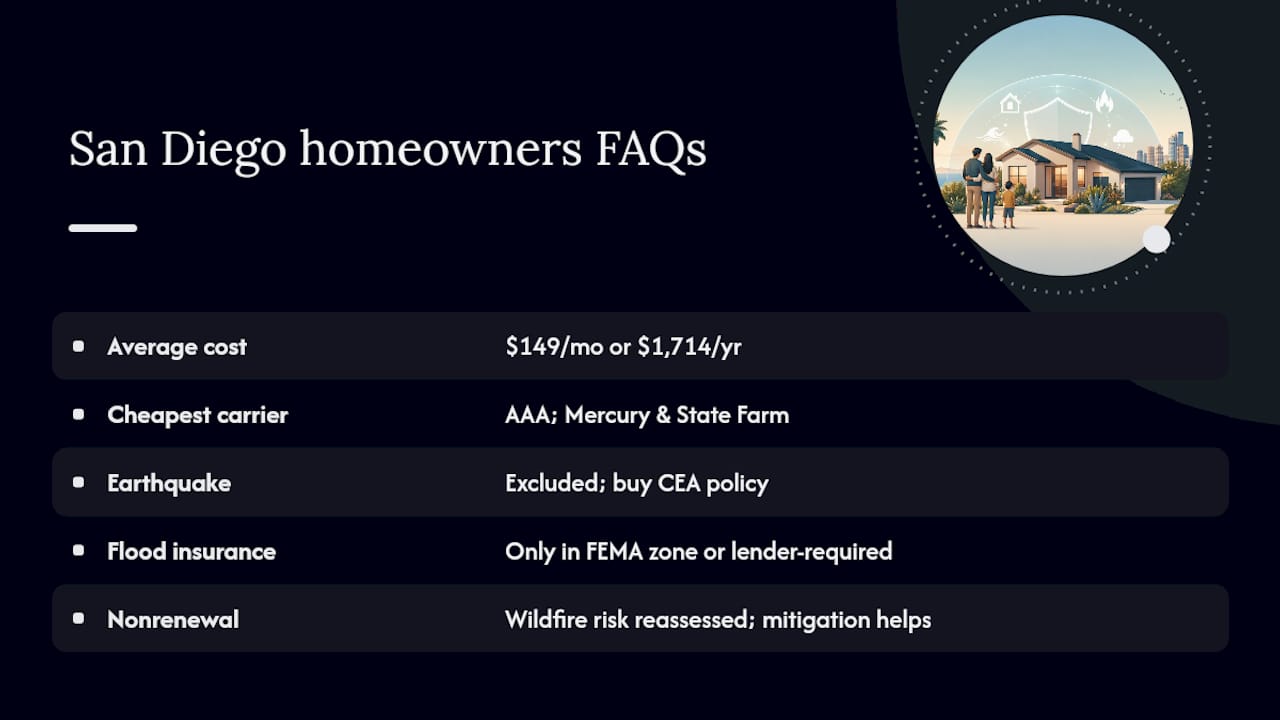
Why did my home insurance nonrenewal notice arrive without warning? Carriers reassess wildfire risk periodically, and a ZIP code's risk rating can change even if your property hasn't. Documenting mitigation work like defensible space or roof upgrades can sometimes prevent or reverse a nonrenewal decision.
Sources
- Best homeowners insurance in San Diego, CA — Policygenius
- Home/Residential Insurance — California Department of Insurance
- Best Home Insurance Quotes in San Diego, CA — The Zebra