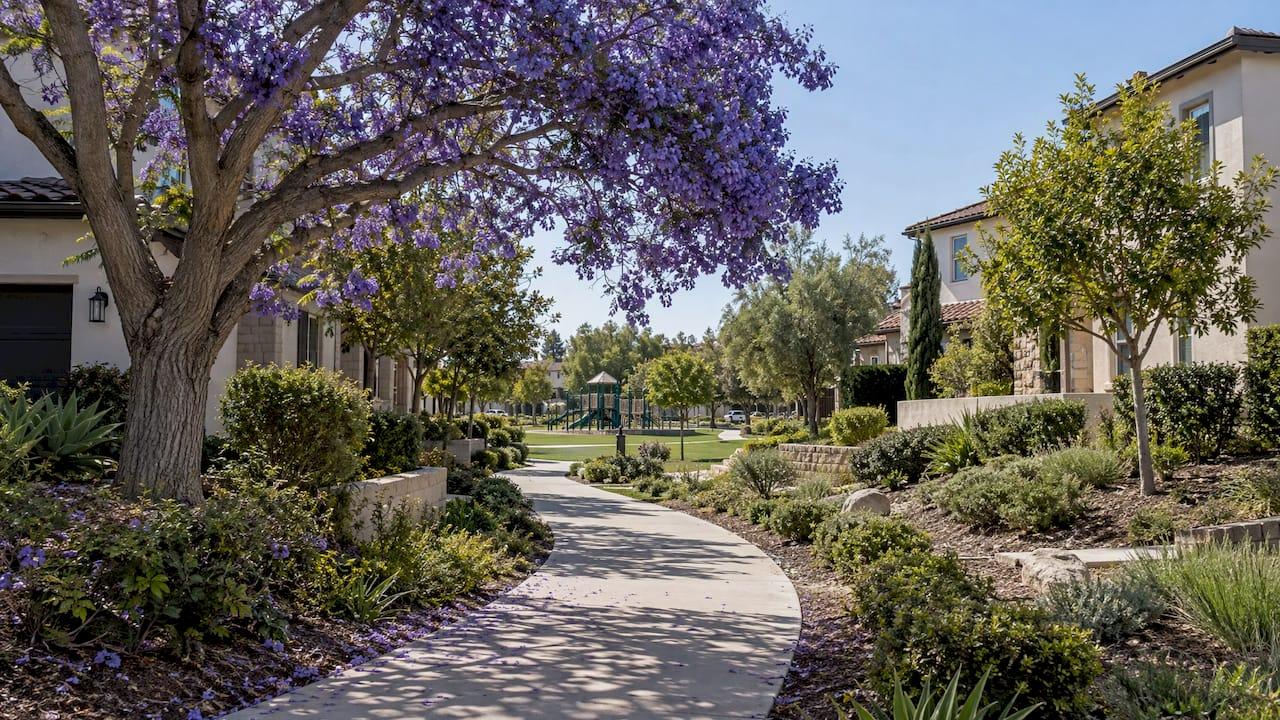
A master planned community is a large development designed from the ground up, with homes, parks, trails, amenities and often schools or retail planned together. San Diego County has established examples such as Rancho Bernardo, newer ones such as North River Farms in Oceanside and 3Roots in Sorrento Mesa, and proposed ones such as Fanita Ranch in Santee. This guide covers how they differ from gated communities, which ones to know, and what to check before you buy.
TL;DR
- A master planned community is built as one coordinated project with shared amenities. A gated community is defined by controlled access. The two can overlap, but they are not the same thing.
- San Diego County options range from townhomes in the low $800,000s at 3Roots to single-family homes starting in the mid $1,000,000s at North River Farms, per the builders.
- Many of these communities come with HOA dues, and some also carry a Mello-Roos special tax. Request the governing documents and budget early.
- Not every "San Diego" community sits inside city limits. Confirm the jurisdiction, since it affects services and taxes.
- If you are buying or selling in one, a local agent can help you compare communities and price against true comparables.
Table of Contents
- What makes a community "master planned"
- San Diego master planned communities worth knowing
- How to tell if a community is inside San Diego city limits
- What to check before you buy: HOA, taxes and age rules
- Choosing the right community for your goals
- Our perspective
- Working with a San Diego agent on your purchase or sale
- Pricing a home in a master planned community
- FAQ
- Sources
What makes a community "master planned"
Planetizen describes master planned communities as self-contained, unified developments with clear boundaries, a full range of land uses, employment opportunities and public facilities. They are frequently built on the edge of existing metro areas, and some are created for adults over 55. Planetizen also notes the split in how they are judged: some reproduce separated land uses and car dependency, while many are designed with mixed uses and easy access to shared centers and public facilities.
In practice, a San Diego buyer will notice three things: one overall plan, shared amenities such as pools, clubhouses and trails, and a master association that maintains them.

Master planned vs. gated vs. PUD
These terms get mixed up in listings, so here is a quick way to separate them.
| Term | What it means | What to expect |
|---|---|---|
| Master planned community | A large project planned as a whole, with integrated parks, amenities and sometimes retail or schools | Shared amenities, a master association, dues |
| Gated community | Controlled access through gates or guardhouses, with an emphasis on security and exclusivity | Can be a master planned community or a small enclave |
| Planned unit development (PUD) | A zoning designation that allows flexible land use and design for a smaller development | Several PUDs can sit inside one master planned community |
The PUD distinction comes from FirstService Residential, which explains that a master planned community is developed over many years and can contain multiple PUDs. The description of gated communities as access-controlled and security-focused comes from Madison Mortgage Guys. If gates are your priority, see our guide to gated communities in San Diego.
A city "community plan" is something else entirely. It is a planning document for an existing neighborhood, not a developer's project. If a search result titled "Community Plan" or "Master Plan" shows up for a San Diego neighborhood, it is probably a city planning document and not a place you can buy into.
San Diego master planned communities worth knowing
The county mixes long-established communities with new and proposed ones. Details below come from the developers and community associations themselves, so confirm current availability and pricing before you plan around any of them.
Rancho Bernardo and Oaks North (established, 55+)
Oaks North is a 55+ community in Rancho Bernardo with 1,963 single-family and condominium homes across 14 residential areas. It is part of the master planned development of Rancho Bernardo, within the city limits of San Diego, about 26 miles northeast of downtown. The Oaks North Community Center, Inc. serves as the master association. The center is listed as open seven days a week, with pool and spa hours that end earlier in the evening.
This is a good fit if you want an active adult setting with an established amenity base. Ask about age restrictions and any rules on younger residents before you write an offer.
North River Farms, Oceanside (new construction)
North River Farms is in Oceanside's South Morro Hills area and is described by the builder as the city's first agrihood. According to Lennar's community FAQ, it has 395 detached single-family homes, roughly 2,200 to 5,500 square feet, set among more than 80 acres of open space and agriculture. A spring 2022 settlement reduced the unit count by 190 homes and increased open space. The community also includes 44 affordable units built by a separate developer.

The builder's launch announcement lists 17 floorplans in five collections, with one- and two-story homes from 2,265 to 4,764 square feet, three to five bedrooms, and pricing that begins in the mid $1,000,000s. The community page lists a pool, a clubhouse with fitness center, two pickleball courts, BBQ and picnic areas, a yoga lawn, a playground and a trail.
Because the build-out runs in phases, check the builder for what is currently released and for the expected completion timeline.
3Roots, Sorrento Mesa (townhomes and flats)
3Roots offers townhomes and flats from the low $800,000s, per the developer. The Dorsey homes range from 1,230 to 1,609 square feet with two to three bedrooms. Amenities include a Fit & Rec Center, a resort-style pool and more than 8 miles of trails. It is the most approachable entry point on this list for buyers who want newer construction and amenities without a large single-family lot.
Otay Ranch Village 13 (south county)
Village 13 is the next phase of Otay Ranch in unincorporated southern San Diego County. The project site says it will offer up to 2,750 homes, up from 1,938 originally planned, with the development footprint reduced by about 300 acres. Since this is unincorporated county land, verify which agencies serve the area.
Fanita Ranch, Santee (proposed)
Fanita Ranch is a proposed community on 2,650 acres in Santee. The plan calls for 2,949 homes, 1,600 acres of open space and a 30-acre organic farm, designed by DPZ. Because it is proposed, treat it as a project to watch, not a home you can buy today.
Foxhill La Jolla (gated enclave)
Foxhill La Jolla is billed as the first new gated community in La Jolla in more than 40 years: five ocean-view lots on a 22-acre preserve. It is small, so it fits the gated category more than the master planned one. It is a useful example of why the labels overlap in search results. Its developer says buyers can use the community's architect and builder or bring their own team.
Other projects in the pipeline
A 2021 industry roundup counted nine new master planned communities in development in the county, totaling more than 9,000 housing units. Projects named included North City, 3Roots, Park Circle, Citro, The Junipers and Carlton Oaks. Plans shift over time, so use that list as a starting point for your own research and not as a current inventory.
How to tell if a community is inside San Diego city limits
Marketing often says "San Diego" for places that are in other cities or in unincorporated county areas. Oaks North is a clear example of a community that is within the city. Otay Ranch Village 13 is unincorporated. Santee and Oceanside are their own cities.
Before you fall for a listing, do three things:
- Check the property's jurisdiction on the county assessor's parcel record or on your tax bill documents.
- Ask which city or agency handles police, fire, water and permits.
- Ask your agent to confirm the answer in writing against the preliminary title report.
Our San Diego County area guide and our neighborhood guide to San Diego are good places to compare areas by location. You can also browse everything on our Explore Areas page.
What to check before you buy: HOA, taxes and age rules
The main trade-off in these communities is the cost and rules that come with shared amenities. Greystar notes that master planned communities offer shopping, parks, schools and recreation within the community, but come with HOA fees and regulations that can limit personal choices about property use. That is the bargain: you pay for the amenities and agree to the rules that keep them maintained.
Use this checklist, adapted from a homebuyer HOA guide:
- Read the governing documents in full.
- Confirm the assessment amount, what it covers and what it leaves out.
- Ask how often and by how much dues can increase.
- Look at the reserve fund and the history of special assessments.
- Ask about age restrictions and the policy on underage residents.
- Confirm the amenities you want are included and open to you.
What California sellers must provide
In California, the seller of a unit in a common interest development must give the buyer the governing documents, a statement on the enforceability of age restrictions that do not comply with Civil Code Section 51.3, the latest annual budget report and policy statement, current regular and special assessments, and approved assessment changes not yet due, according to a DRE update on common interest developments. Read all of it during your contingency period. If something is unclear, ask your agent, and for legal questions about the documents, consult a real estate attorney.
Dues can rise, and Mello-Roos may apply
Some associations give the board wide latitude. One example: a review of the La Costa Oaks Community Association in Carlsbad says the board can raise regular dues up to 20% per year and levy special assessments up to 5% of the budget without a member vote. The same review says a Mello-Roos special tax is likely there and can add several thousand dollars a year on top of dues. Rules differ by association, so check your own community's documents and the property tax bill for any special taxes.
For typical dues ranges and a contingency checklist, see our guide to HOA fees in San Diego, and our comparison of HOA vs. no HOA. For a closer look at one common risk, read our explainer on HOA special assessments.
Choosing the right community for your goals
Start with how you live, then narrow by budget and location.
- You want newer construction and a lot of amenities: North River Farms and 3Roots both center on shared pools, fitness space and trails. The difference is home type and price range: single-family homes in Oceanside versus townhomes and flats in Sorrento Mesa.
- You are 55 or older and want an established community: Oaks North in Rancho Bernardo has a mature amenity base and a single master association.
- You want open space and a lifestyle theme: the agrihood concept at North River Farms and the planned farm at Fanita Ranch both build around land and food.
- Security and privacy come first: look at gated communities, which may or may not be master planned. Our article on the top perks of San Diego communities walks through what buyers tend to value.
Be realistic about timing too. New communities sell in phases, with release schedules and construction timelines that can move. A buyer who wants to move in by a certain date should ask the builder's sales team and their own agent for a current delivery schedule.
Our perspective
We have spent more than two decades working San Diego real estate, and the same pattern shows up with master planned communities. Buyers fall in love with the pool, the trails and the model home, then focus on the monthly payment last. We flip that order.
Before you tour, we sit down with you, talk through your budget, your timeline and how you plan to live in the home, and then build a short list of communities that match. We look at dues, special taxes and the governing documents alongside the floor plan, so the number you see on the listing is the number you plan around.
New-build sales also come with a sales team that works for the builder. Having your own representative at the table, from the first showing to closing, gives you someone focused on your side of the negotiation. That is the client-first approach we bring to every buyer and seller.
If you own a home in one of these communities and are thinking of selling, the amenities are a real selling point. We price using the recent sales that actually compare, and we market the lifestyle the community offers.
Jeff
Working with a San Diego agent on your purchase or sale
If you are ready to look at master planned communities, we can help you narrow the field, tour with you and negotiate. Our Buy With Confidence service covers the process from search through closing, and our VIP Home Search sends you listings that fit your criteria.

If you already own in one of these communities, start with a home valuation so you know where you stand, then talk with us about a plan through our Sell With Strategy service.
Pricing a home in a master planned community
Sellers in these communities should think about price in layers. The first is the home itself: size, floor plan, lot and condition. The second is the community: the amenities, the dues and how both compare with neighboring communities. A buyer weighing two similar homes will compare the monthly cost of each, so a home in a community with lower dues or a lower special tax can support a stronger price than a similar home with higher carrying costs.
The third layer is the comparables. Look for recent sales in the same community and, ideally, the same collection or floor plan. Sales in a different village or phase can mislead, because lot sizes, ages and fees can differ. A local agent can pull the right comparables and explain which differences matter. If you want a first read, our What's My Home Worth page is the place to start.
When you list, have your association documents ready. Since California requires sellers to provide them, delays in getting the budget report or assessment details can slow a sale.
FAQ
Is a master planned community the same as a gated community?
No. A master planned community is a large development planned as a whole with shared amenities, while a gated community is defined by controlled access. Some communities are both, and some are neither. Check the documents and the entry setup, not just the listing description.
Do master planned communities in San Diego always have HOA fees?
Most come with an association that maintains shared amenities, and dues fund that work. Amounts and rules vary by community, and some also carry a Mello-Roos special tax. Ask for the budget, the reserve information and the property tax details early in your search.
Is Otay Ranch or Fanita Ranch inside the city of San Diego?
No. The Otay Ranch Village 13 project describes itself as being in unincorporated southern San Diego County, and Fanita Ranch is in Santee. Oaks North, in Rancho Bernardo, is within San Diego city limits. Confirm jurisdiction for any property you consider.
Can I buy in a 55+ master planned community if I am younger?
It depends on the community's age restriction and its policy on younger residents. Ask for the governing documents and the written policy before making an offer. In California, sellers must also provide a statement on the enforceability of certain age restrictions.
Sources
- What Are Master Planned Communities? | Planetizen Planopedia
- What is a master-planned community? | FirstService Residential
- How to Choose the Right Neighborhood for You | Madison Mortgage Guys
- Oaks North Community
- North River Farms FAQ | Lennar San Diego Operations
- Lennar Debuts North River Farms
- North River Farms | Lennar
- 3Roots | CalWest
- Otay Ranch Village 13
- Fanita Ranch | HomeFed Corporation
- Foxhill La Jolla
- New Master-Planned Communities are Back in San Diego | Vertex Engineering
- Choosing Where to Live | Greystar
- Guide to HOAs | CAI
- DRE Update: Common Interest Developments Require Special Care by Agents
- La Costa Oaks Community Association HOA Review