
Expect somewhere between $250 and $700 a month for most San Diego condos and townhomes, with planned-development single-family homes running lower and downtown high-rises often blowing past $1,000. The county median sits at $367. Before you write an offer on anything with an HOA, pull the reserve study and check what percentage it's funded. That one document tells you more about your real cost than the fee itself.
TL;DR:
- HOA fees in San Diego typically range from $250 to $700 per month, with downtown high-rises often exceeding $1,000, depending on property type and management.
- The county median HOA fee climbed to $367 in 2025, driven by rising insurance costs, underfunded reserves, and increased staffing and amenities.
- Well-funded reserves above 70% reduce risk of large special assessments, while below 30% funding significantly raises such financial surprises.
- Reviewing detailed documents like the reserve study, budget, and delinquency report during contingency reveals hidden financial risks and underfunded associations.
- Lenders factor HOA dues into debt-to-income ratios, making higher fees a key consideration for mortgage approval and overall affordability.
Table of Contents
- How Much Are HOA Fees in San Diego by Property Type?
- What Do HOA Fees in San Diego Actually Cover?
- Why Are HOA Fees Rising in San Diego?
- How to Evaluate an HOA Before Your Contingency Period Ends
- How HOA Dues Affect Your Mortgage and Monthly Budget
- How Often Do HOA Fees Increase in San Diego?
- Can You Dispute or Appeal an HOA Fee Increase?
- What Happens If You Don't Pay HOA Fees?
- Flat Fees vs. Variable Assessments: How HOA Costs Are Structured
- Who Actually Sets Your HOA Fees?
- Agent Perspective: What I See Buyers Overlook
- How Jeff Sells San Diego Helps You Evaluate HOA Costs Before You Buy
- Sources
How Much Are HOA Fees in San Diego by Property Type?
The number on the listing sheet only tells part of the story. A $350 fee on a 1985 beach condo with a poorly funded reserve can cost you more over five years than a $600 fee on a well-managed building with full reserves and no looming assessments.
Here's how dues typically break down by property type, based on local market data:
San Diego's HOA monthly dues vary by property type, with planned-development single-family homes generally on the lower side, townhomes and standard condos in moderate ranges, older beach condos somewhat higher due to maintenance needs, and downtown or luxury high-rises at the upper end due to staffing and amenities. Active-adult communities typically fall in the mid-range but may be higher if extensive amenities are present.
These typical San Diego ranges overlap a lot, which is exactly why two condos three blocks apart can carry dues $200 apart. The county's median monthly fee climbed to $367 in 2025, more than double the national median of $135. Don't compare a San Diego listing to a fee you saw in a national article. It's not the same market.
What Do HOA Fees in San Diego Actually Cover?
Dues aren't just a maintenance tax. In most buildings, they fund a specific bundle of services that would otherwise land on your personal budget.
Common inclusions include maintenance responsibilities like interior door replacement, roofing, painting, landscaping, common-area repairs.
- Master insurance policy covering the building structure (not your personal contents)
- Exterior maintenance: roofing, painting, landscaping, common-area repairs
- Water and trash service in many condo and townhome communities
- Elevator maintenance and inspection in mid- and high-rise buildings
- Staffing costs: front desk, security, on-site management
- Amenities: pools, gyms, clubhouses, guest parking
A unit with a $600 fee that includes water, trash, and full building insurance can genuinely cost less month to month than a $400 fee unit where you're paying separate utility bills and facing a looming special assessment for deferred roof work. Fully funded reserves change the math in ways the sticker price never shows.
Pro Tip: Ask your agent for a line-item budget breakdown, not just the total dues figure. If the HOA can't produce one quickly, that's a preview of how organized (or not) the association really is.
Why Are HOA Fees Rising in San Diego?
The county's median monthly HOA fee reached $367 in 2025, up from $340 the year before, and roughly 57% of San Diego County listings now carry HOA dues at all. That's a meaningful jump in both the fee and how common HOAs have become in local listings.
A few forces are pushing dues higher across the county:
Fee growth by the numbers: San Diego County's median HOA fee rose from $340 to $367 between 2024 and 2025, while more than half of all listings now include HOA dues.
Rising insurance premiums top the list. Wildfire and flood risk has pushed master insurance costs up sharply for many California associations, and boards pass that cost straight to owners. Reserve shortfalls compound the problem: associations that underfunded reserves for years now face catch-up contributions or special assessments. Add rising staffing and amenity costs, plus the simple fact that older buildings need more maintenance dollars, and the trend line only points one direction.
Coastal communities and downtown high-rises tend to sit at the higher end. Western states generally see more HOA-governed housing stock than the rest of the country, and San Diego's mix of coastal condos and vertical downtown development means more buildings carrying elevator, staffing, and structural insurance obligations that push fees well above the county median.
How to Evaluate an HOA Before Your Contingency Period Ends
Your contingency window is your one real chance to see the association's financial guts before you're financially attached to it. Don't skip this step because the unit looks perfect.
Request these documents the day you go under contract:
- Current annual budget — shows where dues actually go and whether the numbers are realistic
- Reserve study — the single most important document; it projects future capital needs against current savings
- Last 12 months of board meeting minutes — reveals ongoing disputes, deferred repairs, or brewing assessments
- Insurance certificate — check the deductible; a high deductible on an older building is a red flag
- Litigation disclosure — active lawsuits, especially construction-defect claims, can freeze your financing
- Delinquency report — shows what percentage of owners are behind on dues
- CC&Rs (covenants, conditions, and restrictions) — governs rentals, pets, and renovations, and matters more than most buyers realize
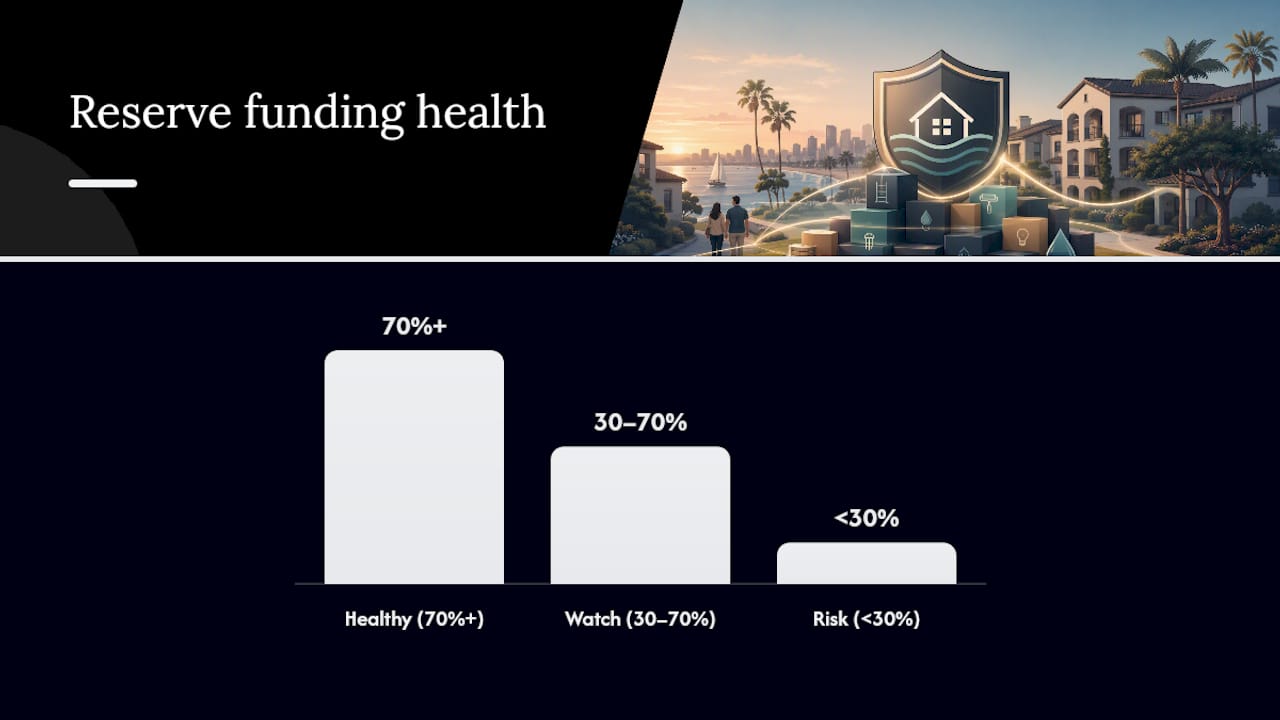
The reserve study's percent-funded number tells you the most. Above 70% funded is generally considered healthy. Between 30% and 70% means watch the reserve schedule closely and ask what capital projects are planned. Below 30% funded, a special assessment is a real possibility, not a hypothetical one.
Watch for red flags that should slow you down or open a renegotiation: active construction-defect litigation, two or more consecutive large dues increases, low reserve funding paired with an aging building, high delinquency rates among owners, or board minutes that keep mentioning deferred repairs without a funding plan. Special assessments in downtown San Diego buildings have caught more than a few buyers off guard after closing.
Pro Tip: If the HOA drags its feet producing documents, treat the delay itself as information. Well-run associations usually have this packet ready within a day or two.
How HOA Dues Affect Your Mortgage and Monthly Budget
Lenders don't just look at your mortgage payment. They fold HOA dues directly into your debt-to-income ratio, which means a higher fee shrinks your approved loan amount.
- A rough rule of thumb: every $100 in monthly HOA dues can reduce your borrowing power by roughly the same amount a $15,000 to $20,000 increase in loan principal would, depending on your rate and loan program
- Lenders underwriting condos also scrutinize reserve funding and litigation history; a poorly funded reserve can make a unit harder to finance even if your personal credit is solid
- Budget for dues, homeowner's insurance, and a cushion for a potential special assessment, not just the mortgage payment quoted on the listing
Skipping this math is how buyers end up house poor in a building that looked affordable on paper.
How Often Do HOA Fees Increase in San Diego?
Most California HOAs review dues annually as part of the budget approval process, and boards can raise fees within limits set by the CC&Rs without a full owner vote in most cases. Some governing documents cap annual increases at a fixed percentage, often somewhere between 5% and 20%, though this varies significantly by association.
Increases beyond that cap, or a special assessment for an unplanned expense, generally require a membership vote under California's Davis-Stirling Act, which governs how common-interest developments operate statewide. The board still has to follow proper notice procedures and hold an open meeting where owners can review the proposed budget before it's finalized.
In practice, expect a modest annual bump most years, tied to inflation in insurance, utilities, and contracted services like landscaping or elevator maintenance. Bigger jumps tend to cluster around insurance renewal periods, especially for coastal buildings facing wildfire or flood-related premium increases, or right after a reserve study reveals a funding gap that needs to be closed quickly.
Boards are required to hold a hearing before adopting a budget with a significant increase, and homeowners typically get written notice at least 30 days in advance. If your association's fee jumped without any of that process happening, that's worth asking about directly, since it may point to a governance problem beyond just the dollar amount.
Can You Dispute or Appeal an HOA Fee Increase?
You can challenge an increase, but the process runs through the association's governing documents and California law, not through direct negotiation with the board on your own terms.
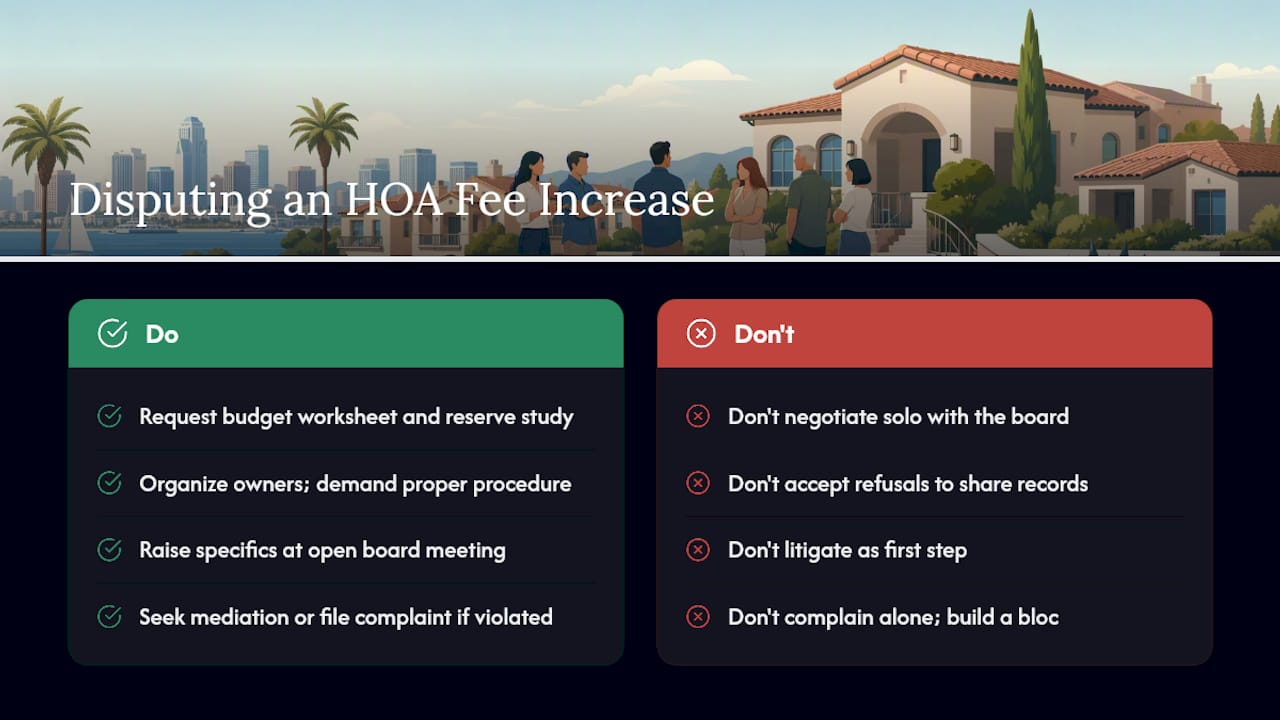
Start by requesting the budget worksheet and reserve study that justified the increase. Under the Davis-Stirling Act, owners have a right to inspect these financial records, and a board that resists a records request is often hiding a weak justification.
If the increase exceeds what the CC&Rs allow without a vote, you and other owners can demand the board follow proper procedure, which may include calling a special membership meeting. Organizing with neighbors carries far more weight than a single owner's complaint. Boards respond to blocs of votes, not individual emails.
For increases that followed the correct process but still feel unjustified, raise the issue at an open board meeting, where owners typically get a comment period. Bring specifics: comparable buildings' fees, questions about vendor contracts, or reserve study assumptions you think are inflated.
If you believe the board violated its own governing documents or state law in adopting the increase, mediation or a complaint through California's Department of Consumer Affairs may be the next step, though litigation is a last resort given the cost relative to most fee disputes. For most owners, the more realistic path is running for a board seat or backing a candidate who will push back on spending decisions.
What Happens If You Don't Pay HOA Fees?
Non-payment triggers consequences faster than most homeowners expect, and California law gives associations real teeth to collect.
Most HOAs begin with a late notice and fee within 15 to 30 days of a missed payment. If dues stay unpaid, the association can record a lien against your property, which clouds your title and must be resolved before you can sell or refinance. Continued non-payment can eventually lead to foreclosure, though California requires specific notice and waiting periods before an association can pursue that route, and it typically follows months of missed payments and unanswered communication.
Beyond the legal consequences, delinquency affects the whole community. A high delinquency rate strains the operating budget, which can force the board to raise dues on paying owners just to cover the shortfall, or delay maintenance that then compounds into larger repair costs down the line.
This is exactly why the delinquency report belongs on your document request list during contingency.
Flat Fees vs. Variable Assessments: How HOA Costs Are Structured
Most San Diego HOAs charge a flat monthly fee set by the annual budget, the same amount every owner pays regardless of unit size, though some associations scale the fee by square footage or unit type in mixed developments. This flat structure covers routine operating costs: landscaping, insurance, staffing, and scheduled maintenance.
Special assessments work differently. They're one-time or limited-duration charges layered on top of regular dues to cover unplanned expenses, a roof failure, a major plumbing repair, storm damage, or a reserve shortfall that regular dues can't absorb fast enough. Assessments can arrive as a single lump-sum bill or get spread across monthly installments over a year or more.
The distinction matters more than it sounds. A low flat fee can look attractive on a listing, but if the reserve is underfunded, you're more likely to face a special assessment down the road, sometimes for thousands of dollars with little notice. A higher flat fee tied to a well-funded reserve often ends up being the cheaper option over a five-year hold, because the association is already saving for the big-ticket repairs instead of billing owners after the fact.
Ask specifically whether the community has levied a special assessment in the past five years, and if the reserve study projects another one. That single question tells you more about the fee structure's real cost than the monthly number ever will.
Who Actually Sets Your HOA Fees?
The HOA board, elected from among the homeowners, holds legal authority to set dues, but the number that lands on your bill usually starts with the management company.
Most San Diego associations, especially larger condo buildings and high-rises, contract with a professional management company to handle day-to-day operations: collecting dues, coordinating vendors, preparing the draft budget, and recommending fee adjustments based on projected costs. The board reviews that draft, asks questions, and votes to approve or amend it, but the underlying cost projections, insurance quotes, and vendor contracts largely come from management staff or the board's finance committee.
Smaller self-managed associations, common in some townhome and single-family planned communities, skip the management company and rely on volunteer board members to handle budgeting directly. This can mean lower administrative costs and lower dues, but it also means the reserve study and budget review depend entirely on how engaged and financially literate the volunteer board actually is.
Either way, the board has fiduciary responsibility to the membership. Owners can attend open board meetings, request financial records, and run for a board seat if they want direct influence over how fees are set. If you're serious about a specific building, checking who manages it and how long they've held the contract tells you a lot about the association's stability.
Agent Perspective: What I See Buyers Overlook
It happens more than people expect in older buildings.
Put the reserve study at the very top of your contingency checklist, above inspection, above almost everything else financial. For a step-by-step walkthrough of what to request and how to read it, our buyer's guide covers the full process.
— Jeff
How Jeff Sells San Diego Helps You Evaluate HOA Costs Before You Buy
Reading a reserve study or a delinquency report cold isn't something most buyers have done before, and it's not the kind of thing you want to learn on the fly during a 17-day contingency period. That's where having someone review the HOA packet alongside you, negotiate around red flags, and put the fee in context against comparable buildings in the neighborhood actually saves money, not just time.

Working with a knowledgeable real estate agent means you get document review on every HOA-governed property you're considering, direct negotiation support if the reserve study reveals a problem, and neighborhood-level context on which San Diego buildings tend to run higher or lower on dues. If you're actively comparing condos, townhomes, or high-rises across the county, start with our home search tool to see current listings with HOA details included, or reach out through the buyer's guide to get a document review lined up before your next offer.
Sources
- HOA fees keep rising in San Diego - Axios San Diego
- Nearly 44% of U.S. homes for sale now carry HOA fees; dues continue to climb, Realtor.com finds (Nasdaq press release)
- San Diego HOA fees: What you pay and what you get