The median home value in Chula Vista sits at $898,338 as of February 2026, down about 1.9% year over year, with early signs of stabilizing after a slide through most of last year. For buyers, that softening plus a fast pace on new listings means there's room to negotiate in some ZIP codes but not all. For sellers, pricing sharp from day one still matters more than holding out for last spring's numbers.
What this means right now:
- Buyers: get preapproved and focus on ZIP codes below the citywide median if budget is tight.
- Sellers: price at or slightly under recent comps. Overpricing is sitting longer than it did a year ago.
Zillow's own citywide tracker puts the average home value at $849,245, a reminder that "median" and "average," and different data providers, don't always agree.
Key Takeaways
Chula Vista's median home value sits near $898,338 as of February 2026, down slightly year over year, with prices stabilizing and wide variation across ZIP codes.
| Point | Details |
|---|---|
| Prices softened, then leveled off | Median value dropped about 1.9% year over year but shows signs of stabilizing into early 2026. |
| ZIP-level spread is huge | Eastlake's 91914 median tops $1,158,000 while west-side 91911 sits near $762,614. |
| Inventory favors sellers modestly | Active listings near 513 and 33 median days on market signal a mild seller's advantage. |
| Renting beats buying on cash flow | Estimated mortgage payments run $1,500 to $2,000 higher monthly than median rent in most ZIPs. |
| Local expertise matters at the ZIP level | Jeffsellssandiego tracks closed-sale data across Chula Vista's neighborhoods to guide pricing and offer strategy. |
This article is general information, not a substitute for advice from a qualified financial advisor. Consult a qualified financial professional about your own circumstances before acting on anything here.
Table of Contents
- Chula Vista Housing Market Snapshot: The Core Numbers
- How Have Home Prices Trended Over the Past Year?
- Is Chula Vista a Buyer's or Seller's Market Right Now?
- Which Chula Vista Neighborhoods Cost the Most or Least?
- Does It Make More Sense to Rent or Buy in Chula Vista?
- Where an Agent Would Point Buyers and Sellers in 2026
- Where the Numbers in This Article Come From
- A Local Read on Where Things Stand
- How Jeffsellssandiego Helps You Navigate This Market
- Sources
Chula Vista Housing Market Snapshot: The Core Numbers
Three sources, three slightly different numbers, one consistent story: prices cooled slightly over the past year, but the market hasn't collapsed and it hasn't gotten dramatically cheaper either.
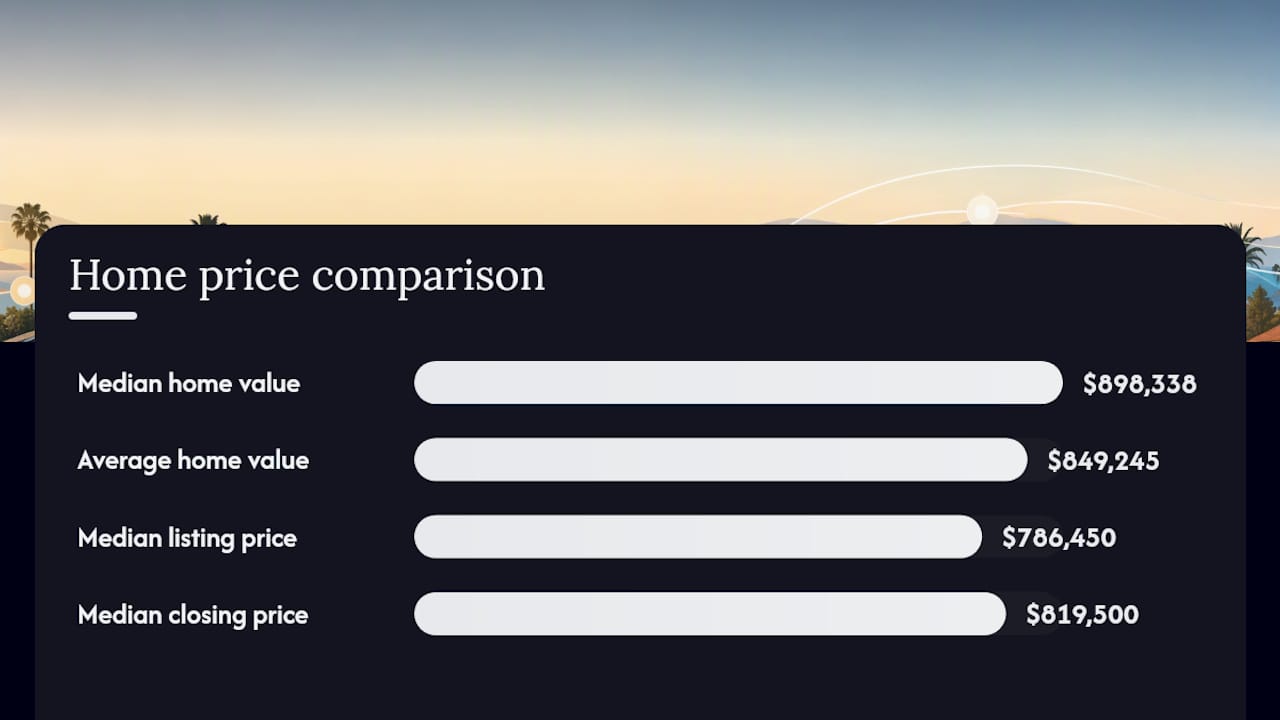
HousingData.report puts the citywide median home value at $898,338, down 1.9% year over year as of February 2026. Realtor shows a median listing price of $786,450, active listings around 513, a median 33 days on market, and median rent near $3,019. Zillow's figure, an average rather than a median, lands at $849,245.
That spread between $786,450 and $898,338 isn't a contradiction. Listing price reflects what sellers are asking today; median home value reflects a broader estimate across the entire housing stock, including homes not currently for sale. A tracked sample of roughly 702 recent closings puts the median closing price at $819,500, which lands right between the two and confirms something practitioners already know: asking prices and what buyers actually pay rarely match exactly.
| Metric | Value | Source / Date |
|---|---|---|
| Median home value | $898,338 | HousingData.report, Feb 2026 |
| Average home value | $849,245 | Zillow, Apr 2026 |
| Median listing price | $786,450 | Realtor.com, Mar 2026 |
| Median closing price | $819,500 | Resideline (sample) |
| Active listings | ~513 | Realtor.com, Mar 2026 |
| Median days on market | 33 | Realtor.com, Mar 2026 |
| Median rent | ~$3,019–$3,177 | Realtor.com / HousingData.report |
If you're a buyer, the listing price is your realistic starting point for negotiation. If you're a seller, the closing-price data is the more honest gut check on what your home will actually fetch.
How Have Home Prices Trended Over the Past Year?
Chula Vista prices moved in a fairly predictable arc: peaked in early spring, dipped through fall, then started firming up.
According to HousingData.report's monthly tracking, citywide values peaked around March 2025, declined steadily through October 2025, and have shown a modest recovery heading into early 2026. Net result: prices are down about 1.9% year over year, but the trajectory over the last few months points toward stabilization rather than continued decline.
A few things are worth separating out here:
- Seasonality plays a real role. Spring listings tend to command a premium; fall and winter buyers have more leverage.
- Mortgage rates near 7% have kept a lid on how aggressively buyers bid, which explains the fall softening more than any structural weakness in the local economy.
- The eastern master-planned communities (Otay Ranch, Eastlake) continue to see new-home deliveries, which adds supply and tempers price growth even as demand stays healthy.
Whether this is a genuine floor or a pause before more softening is impossible to say with certainty this early in 2026. What's clear is that Chula Vista isn't behaving like a market in freefall. It's behaving like a market catching its breath after two years of rapid appreciation followed by rate-driven cooling.
Pro Tip: If you're selling, list in late winter or early spring to catch the seasonal bump. If you're buying, October through December tends to bring less competition and more willingness from sellers to negotiate on price or closing costs.
Is Chula Vista a Buyer's or Seller's Market Right Now?
With 513 active listings, a median 33 days on market, and prices still elevated relative to five years ago, Chula Vista leans toward a seller's market, though not an aggressively competitive one.
- Active listings (~513): modest but not scarce. Buyers have real options across most price points.
- Median days on market (33): faster than a balanced market's typical 45 to 60 days, signaling healthy demand.
- Months of supply: implied to be on the tighter side given the listings-to-sales ratio, consistent with the fast pending timeline Zillow reports.
- Zillow's pending timeline: homes go to pending in about 16 days in some segments, a sign that well-priced homes in desirable ZIPs move quickly.
Part of what's happening here is a spillover effect. Chula Vista often functions as a release valve for buyers priced out of coastal San Diego neighborhoods, and that steady inflow of demand helps explain why prices haven't fallen further even as rates stayed elevated. If you're bidding on a well-priced home in a popular ZIP, expect competition. That can mean waived contingencies are back on the table in some cases, and appraisal gaps are worth planning for if you're stretching your budget. In quieter ZIPs or on homes that have sat longer, you'll have more room to ask for repairs, credits, or a longer closing window.
Which Chula Vista Neighborhoods Cost the Most or Least?
Citywide averages hide a lot. Chula Vista spans everything from older west-side neighborhoods built decades ago to master-planned communities still adding new construction, and the price gap between them is substantial.
*Figures for the three middle ZIPs reflect the broader $762,614 to $1,158,000 range reported citywide; check current listings for precise per-ZIP medians.
The gap between the priciest and most affordable ZIP codes runs close to $400,000. ZIP 91914, anchored by Eastlake's newer construction and lake amenities, sits at the top. ZIP 91911, covering much of west Chula Vista's older housing stock, is the entry point.
That divide tracks almost exactly with build era. West Chula Vista's homes tend to be smaller, older, and closer to the I-5 corridor. Eastern communities like Eastlake and Otay Ranch feature newer square footage, HOA amenities, and better school ratings, all of which show up directly in price. If your budget caps out in the mid-$700,000s, west Chula Vista deserves a serious look rather than getting priced out of the city altogether. If you can stretch toward $900,000 or more, the eastern communities offer more new construction and resale upside as the area continues to build out.
Does It Make More Sense to Rent or Buy in Chula Vista?
On a pure cash-flow basis, renting is cheaper than buying almost everywhere in the city right now.
Estimated mortgage on the median home: Assuming 20% down and a 30-year fixed rate near 7% on a $898,338 home, monthly payments (principal, interest, taxes, and insurance) land roughly in the $5,200 to $5,500 range. Compare that to a citywide median rent of about $3,019 to $3,177, and you're looking at a gap of $1,500 to $2,000 a month in most ZIP codes.
That math shifts the rent-versus-buy calculation toward buying only when equity building, tax benefits, and long-term appreciation outweigh the monthly premium. Consider buying if you plan to stay five or more years and have a stable income cushion. Renting still makes more sense if you need flexibility, are still saving for a larger down payment, or aren't ready to absorb maintenance costs on top of the mortgage.
Where an Agent Would Point Buyers and Sellers in 2026
If you're buying, look east toward Eastlake and Otay Ranch for newer inventory and more predictable pricing. If you're selling in west Chula Vista, price close to recent closed comps rather than aspirational listing prices; homes sitting past 40 to 45 days usually needed a price adjustment they didn't get soon enough.
- Buyers: get preapproval finalized before touring, since well-priced homes in Eastlake and Otay Ranch often see multiple offers within the first two weeks.
- Buyers: schedule inspections early. Fast-moving listings leave little room for delay once an offer is accepted.
- Sellers: lean on closed-sale comps, not listing prices, when setting your number.
- Sellers: budget for minor staging and repairs. Buyers in this market are less forgiving of deferred maintenance than they were during the 2021 to 2022 rush.
Three questions to ask an agent before signing anything: How many comparable homes have you closed in this ZIP in the last 90 days? What's your average list-to-sale price ratio? How do you handle multiple offers or a low appraisal?
Pro Tip: Ask any agent for their actual closed-sale data in your target ZIP, not just active listings. Closed prices tell you what buyers really paid, which is the number that matters when you're setting your own offer or list price.
Where the Numbers in This Article Come From
Metrics here are pulled from HousingData.report (median value, ZIP breakdown, February 2026), Realtor.com (listing price and inventory, March 2026), Zillow (average value, April 2026 update), and U.S. News Real Estate (city-level context).
Keep in mind that listing-site medians and closed-sale medians diverge, sometimes by tens of thousands of dollars, which is why ZIP-level and closed-sale data matter more than a single citywide headline number.
A Local Read on Where Things Stand
I've watched Chula Vista shift from an overlooked alternative to coastal San Diego into a market with its own gravity, pulling buyers who got priced out of Pacific Beach or North Park and giving them real options east of the 805. The current numbers, prices down slightly but stabilizing, inventory moderate, days on market still fast in the right ZIPs, match what I'm seeing on the ground. Nothing here suggests a dramatic shift coming in either direction over the next year, but the neighborhood-level differences are wide enough that generic advice won't serve you well. If you want a read tailored to your specific ZIP or budget, that's a conversation worth having before you write an offer or set a list price.
How Jeffsellssandiego Helps You Navigate This Market
Citywide averages only get you so far when the gap between Eastlake and west Chula Vista runs close to $400,000. Jeffsellssandiego works these ZIP codes directly, tracking closed-sale data rather than just asking prices, so you know what a home will actually fetch before you list or bid.
For buyers, that means neighborhood tours built around your real budget, access to off-market opportunities before they hit the broader search sites, and negotiation support when appraisal gaps or multiple offers come into play. For sellers, it means a pricing strategy grounded in what similar homes in your ZIP actually closed for, not just what's currently listed down the street. Start by browsing current Chula Vista listings or reach out through the buyer's guide to get preapproved and start targeting the right neighborhoods for your budget.
Sources
- Housingdata
- Chula Vista, CA Housing Market: 2026 Home Prices & Trends | Zillow
- Realtor
- Living in Chula Vista, CA - U.S. News Real Estate