
The decision to buy versus rent a home is defined by one core question: which option builds more wealth and fits your life better over your planned time horizon. In San Diego, that question carries extra weight. Home prices rank among the highest in the nation, rents have climbed sharply since 2020, and the local market conditions shift the math in ways that national averages miss. The right answer depends on how long you plan to stay, what you can afford upfront, and what you want your daily life to look like. This article breaks down every factor so you can make a clear, confident call.
What are the financial components of buying vs. renting in San Diego?
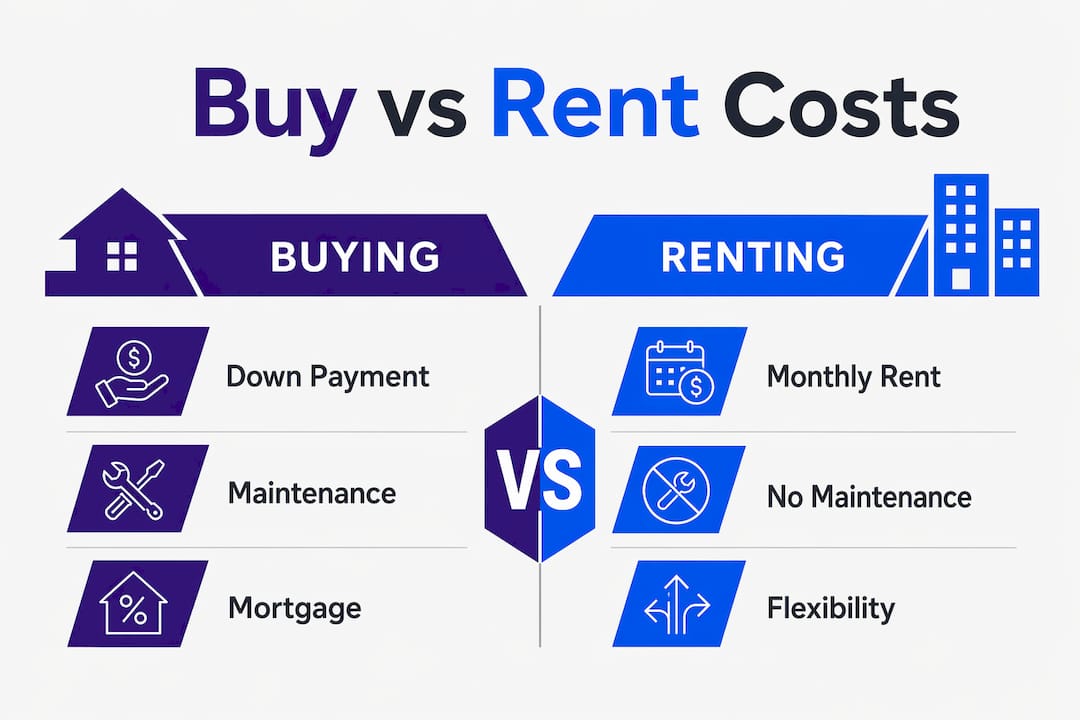
Buying a home costs more than your monthly mortgage payment. Most buyers focus on principal and interest, but the true cost of ownership includes property taxes, homeowners insurance, maintenance, and the opportunity cost of your down payment sitting in real estate instead of investments.
Maintenance alone averages about 0.5% of a home's value per year. On a $900,000 San Diego home, that is $4,500 annually, or $375 per month, before a single major repair. Add property taxes near 1.1% of assessed value and homeowners insurance, and your real monthly cost climbs well above the mortgage figure on any lender's quote sheet.
The upfront costs are equally significant. A 20% down payment on a $900,000 home is $180,000. Add closing costs, broker fees, and prepaid expenses, and you are looking at $200,000 or more out of pocket before you turn the key. That cash has an opportunity cost of the down payment that renters can invest elsewhere, potentially closing the gap between renting and owning over time.
Tax benefits do exist for buyers, but they are not automatic. The mortgage interest deduction applies to loans up to $750,000, and capital gains exclusions reach $500,000 for married couples when selling a primary residence. The catch is that you must itemize deductions to claim mortgage interest, and the 2026 standard deduction sits at $32,000 for married filers. Many San Diego buyers do itemize given high loan balances, but it is worth running the numbers with a tax professional before counting on that benefit.
Here is a snapshot of what full ownership costs look like compared to renting in San Diego:
| Cost component | Typical buyer (San Diego) | Typical renter (San Diego) |
|---|---|---|
| Monthly housing payment | $4,500–$5,500 (mortgage + taxes + insurance) | $2,800–$3,800 (market rent) |
| Maintenance | $375/month average | $0 (landlord responsibility) |
| Upfront cash required | $180,000–$220,000 | First/last month + deposit |
| Tax benefit potential | Mortgage interest deduction | None |
| Equity building | Yes, with each payment | No |
Pro Tip: Run a full cost comparison using your actual loan amount, local tax rate, and a realistic maintenance budget before deciding. The mortgage payment alone understates true ownership cost by 20–30% in most San Diego scenarios.
How does your planned length of stay affect the buy vs. rent decision?
Time is the single biggest variable in the renting vs. buying equation. Buying costs a lot upfront. Those costs only make financial sense if you stay long enough for equity and appreciation to offset them.
Zillow's 2026 national analysis puts the break-even point at about 5.9 years with a 5% down payment and 6.0 years with 20% down, under a slightly above 6% mortgage rate. That means you need to stay roughly six years before buying beats renting on a pure cost basis nationally. San Diego's higher prices and strong appreciation history can shift that timeline, but the principle holds.
Short stays almost always favor renting. Buying and selling within three years typically leaves you worse off financially because:
- Transaction costs and agent commissions on the sale run 5–6% of the sale price.
- Early mortgage payments go mostly to interest, not principal, so equity builds slowly at first.
- Capital gains tax exclusions require at least two years of primary residence ownership to apply.
- Appreciation in any two-to-three year window is unpredictable, even in San Diego.
- Selling quickly can trigger a loss after transaction costs, even if the market held steady.
Longer stays flip the math. After six or more years, your equity grows, appreciation compounds, and the fixed mortgage payment looks better every year as rents rise around you. San Diego renters have seen rents surge over 29% since 2020 nationally, and local increases have been similarly steep. A buyer who locked in a fixed rate in 2020 or 2021 now pays far less than comparable market rent.
Pro Tip: Be honest about your five-year plan before you buy. Job changes, relationship shifts, and family growth all affect how long you realistically stay. Overestimating your horizon is one of the most expensive mistakes San Diego buyers make.
What lifestyle and flexibility tradeoffs separate buying from renting?
The financial case for buying is strong over time, but the lifestyle tradeoffs are real and matter just as much for many San Diego residents.
Homeownership gives you control. You can customize your living space, renovate the kitchen, paint every room, and put down roots in a neighborhood. That sense of permanence and pride of ownership is not just emotional. It connects you to your community in ways that renting rarely does. San Diego neighborhoods like North Park, La Jolla, and Mission Hills have strong homeowner communities where that connection is tangible.
Renting gives you mobility. If your job changes, your relationship changes, or you simply want to try a different neighborhood, you can move with 30–60 days' notice and no transaction costs. That flexibility has real financial value, especially in a city where commute patterns and lifestyle priorities shift.
The maintenance question is often underestimated. As a homeowner, every repair is your responsibility and your expense. A broken HVAC system, a leaking roof, or a plumbing failure can cost thousands with no warning. Renters call the landlord. That difference in stress and financial exposure is significant for buyers who are not prepared for it.
Payment predictability is a genuine advantage of owning versus renting. A fixed-rate mortgage locks your principal and interest payment for 30 years. Rent, by contrast, resets at every lease renewal. In San Diego's competitive rental market, that unpredictability is a real risk for long-term renters who want stability.
How do market conditions and investment returns shape the rent vs. buy equation?
San Diego's real estate market has historically delivered strong appreciation, but past performance does not guarantee future results. The buy or rent considerations that matter most in 2026 center on current mortgage rates, local price levels, and what you could earn by investing your down payment instead.
Higher mortgage rates and home prices have extended the financial break-even time compared to pre-pandemic levels. Renting is more financially attractive in the short term, but buying's advantages grow with time and improve if rates drop and you refinance. San Diego buyers who plan to hold for a decade or more are betting on continued appreciation and the long-term advantages of homeownership, which history supports in this market.
The investment alternative matters too. A renter who invests $180,000 in a diversified portfolio instead of a down payment could generate meaningful returns over time. Renters can invest down payment and closing costs, potentially closing or reversing the ownership premium. Whether that beats San Diego home appreciation depends on market conditions in both real estate and equities, and neither is guaranteed.
In 3 of 5 major U.S. metros, owning with 20% down cost more monthly than renting at the start of 2024. That gap narrows over time as equity builds and rents rise, but it underscores why the long-term investment renting argument is not as simple as "buying always wins." The right answer depends on your specific numbers, your timeline, and your discipline in actually investing the cash you save by renting.
For San Diego specifically, the local market dynamics favor buyers who plan to stay long term. The city's constrained housing supply, desirable climate, and strong job market have supported price growth over decades. Renters who stay for many years without buying often find themselves priced out of ownership as values climb.
Key Takeaways
Buying beats renting in San Diego when you plan to stay at least six years, can absorb upfront costs, and value payment stability over mobility.
| Point | Details |
|---|---|
| Break-even timeline | Buying typically breaks even with renting after about 5.9–6.0 years nationally under current rates. |
| True ownership cost | Add property taxes, insurance, and maintenance to your mortgage for an accurate monthly cost comparison. |
| Short stays favor renting | Buying and selling within three years usually results in a net financial loss after transaction costs. |
| Rents keep rising | National rents have surged over 29% since 2020, making a fixed mortgage more valuable over time. |
| Opportunity cost matters | Down payment cash invested elsewhere can close the financial gap between renting and owning. |
What I've learned about the buy vs. rent decision in San Diego
Most people come to me having already made up their mind. They want validation, not analysis. That is where the real risk lives.
The buyers who regret their purchase almost always made one of two mistakes. They overestimated how long they would stay, or they underestimated what ownership actually costs beyond the mortgage. Both errors are avoidable with honest planning upfront. I have seen buyers in San Diego neighborhoods like Hillcrest and Kensington stretch to buy, then sell two years later at a loss after transaction costs wiped out any appreciation gains.
The renters who regret staying renters made the opposite mistake. They waited for the "perfect" time to buy, watched prices climb, and found themselves priced out of neighborhoods they loved. San Diego does not reward waiting indefinitely. The market has a long track record of rewarding buyers who commit and stay.
My honest advice is this: if you plan to stay six or more years, can handle the upfront costs without draining your emergency fund, and want the stability of a fixed payment, buying makes sense in San Diego. If your timeline is uncertain or your life is in flux, renting is not a failure. It is the right financial call. The first-time buyer guide I put together walks through exactly how to evaluate your own situation with local numbers.
What I push back on hardest is the idea that renting is "throwing money away." You are paying for housing, flexibility, and zero maintenance responsibility. That has real value. The question is whether the advantages of homeownership outweigh those benefits for your specific life. For most San Diego residents who plan to stay, they do.
— Jeff
Working with Jeffsellssandiego to make the right call
Jeffsellssandiego works with buyers and renters across San Diego to cut through the noise and get to a clear answer based on real numbers and local market knowledge.

Whether you are ready to start searching or still weighing your options, the San Diego home search tool gives you a live look at what ownership actually costs in neighborhoods you care about. The Buyer's Guide walks through every step from financial prep to closing, with San Diego-specific context built in. Reach out directly to run the numbers on your situation. A 20-minute conversation can save you from a six-figure mistake in either direction.
FAQ
How long do you need to stay in San Diego for buying to make financial sense?
Buying typically breaks even with renting after about 5.9–6.0 years under current mortgage rates, according to Zillow's 2026 analysis. San Diego's higher prices can extend that timeline slightly, so a six-year minimum is a sound planning benchmark.
Is renting really throwing money away in San Diego?
Renting is not throwing money away. You pay for housing, flexibility, and freedom from maintenance costs. The financial comparison only favors buying when you stay long enough for equity and appreciation to outpace renting and investing the down payment elsewhere.
What costs do most San Diego buyers forget to budget for?
Maintenance averages about 0.5% of home value per year, which is $4,500 annually on a $900,000 home. Property taxes, homeowners insurance, and closing costs add thousands more that most buyers underestimate when comparing ownership to renting.
Does the mortgage interest deduction make buying significantly cheaper?
The deduction applies to mortgage interest on loans up to $750,000, but you must itemize to claim it. The 2026 standard deduction is $32,000 for married filers, so the benefit only applies if your total itemized deductions exceed that threshold.
What happens financially if you buy and sell within three years in San Diego?
Selling within three years typically results in a net loss after agent commissions, closing costs, and the fact that early mortgage payments go mostly to interest. Capital gains tax exclusions also require at least two years of primary residence ownership to apply.