
A single-family home is a detached dwelling built for one household on its own parcel of land. That definition carries more financial weight than most buyers realize. The median U.S. price sits at $420,000 in 2026, yet demand stays strong because no other residential type delivers the same combination of privacy, ownership control, and investment stability. Whether you are buying a primary residence in San Diego or building a rental portfolio, understanding why buy single-family homes is the clearest path to making a confident decision.
Why buy single-family homes for personal use?
Single-family homes win on lifestyle in ways condos and townhomes simply cannot match. You own the land, the structure, and every inch of outdoor space. No shared walls mean no neighbor's midnight TV bleeding through the ceiling. No HOA board means you paint the front door whatever color you want.
Buyers consistently prioritize single-family homes to resolve daily friction points: noise from shared walls, school district uncertainty, and the absence of a private yard. These are not abstract preferences. They shape where families stay for decades and how much they pay to get there.

The resale market for single-family homes is also broader than for condos. Buyers who want a condo represent a narrower slice of the market. A single-family home appeals to first-time buyers, upsizing families, downsizers, and investors alike. That depth of demand protects your exit.
One honest trade-off: single-family homes carry full maintenance responsibility. The roof, the HVAC, the plumbing. All of it lands on you. Budget roughly 1% of the home's value per year for upkeep, and that cost becomes predictable rather than alarming.
Pro Tip: Before you buy, walk the property in the rain. Drainage problems and roof wear show up clearly in wet conditions that a sunny-day tour will hide.
Key lifestyle advantages at a glance
- Privacy: No shared walls, floors, or ceilings with neighbors
- Outdoor space: Private yard for children, pets, gardening, or entertaining
- Renovation freedom: Full exterior and interior control without HOA approval
- School access: Easier to target a specific school district by address
- Resale depth: Broader buyer pool than condos or townhomes
How do single-family homes perform as investment properties?
Single-family rentals in strong suburban markets produce cap rates of 5.5%–6.5% with vacancy rates under 6%. Those numbers reflect a property type that attracts stable, longer-term tenants rather than high-turnover renters. That stability is the core investment thesis.
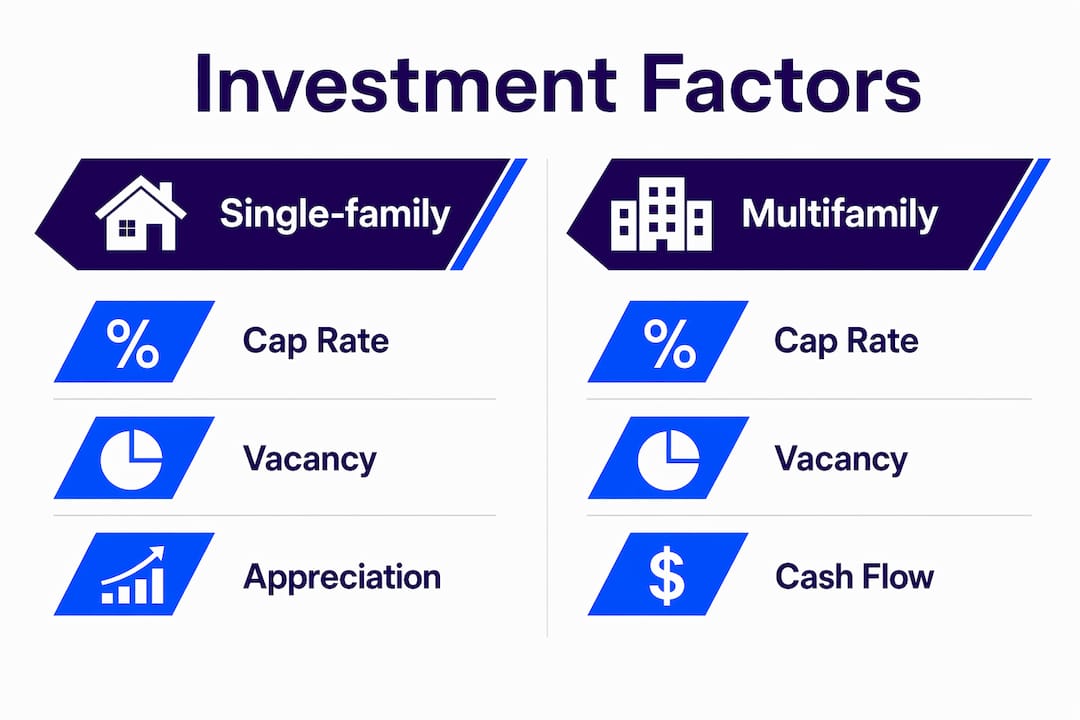
Long-term appreciation for single-family homes averages 3%–4% per year nominally. Combine that with mortgage paydown, depreciation deductions, and rental income, and you have four distinct wealth-building levers working simultaneously. Most asset classes offer one or two.
The main risk is vacancy. Unlike a multifamily building where one empty unit still leaves others producing income, a vacant single-family rental produces zero. Targeting tenant placement within 2–4 weeks of turnover is the standard investors use to protect cash flow. Screening tenants carefully upfront reduces that risk further.
Pro Tip: Screen for tenants with stable employment and a history of 12+ month leases. Single-family renters who treat the property as a long-term home cut your turnover costs dramatically.
Single-family vs. multifamily: investment comparison
| Factor | Single-family | Multifamily |
|---|---|---|
| Typical cap rate | 5.5%–6.5% | 5%–7%+ |
| Vacancy risk | Higher (all-or-nothing) | Lower (spread across units) |
| Management intensity | Low | Moderate to high |
| Financing ease | Simpler underwriting | More complex approval |
| Tenant stability | Longer-term, lower turnover | Shorter-term, higher turnover |
| Entry cost | Lower per property | Higher per building |
Multifamily properties generate more gross cash flow per building. Single-family homes win on simplicity, financing access, and tenant quality. For a first-time investor, that trade-off almost always favors starting with a single-family rental.
What financing options work best for single-family homes?
Single-family homes qualify for the widest range of mortgage products available. Conventional loans, FHA loans with as little as 3.5% down, VA loans for eligible veterans with zero down, and USDA loans for qualifying rural areas all apply. That breadth is a structural advantage over condos, which face additional lender scrutiny on HOA finances and owner-occupancy ratios.
Mortgage underwriting for single-family homes moves faster because lenders skip the building-level approval process required for condos. That speed matters in competitive markets where sellers favor clean, fast offers.
For investors, DSCR loans (Debt Service Coverage Ratio loans) have become a popular tool. These loans qualify based on the property's rental income rather than the borrower's personal income. They work well for self-employed buyers or investors building a portfolio. Investors typically use a 25% down payment to amplify returns through leverage, effectively multiplying equity growth roughly four times compared to an all-cash purchase.
Four steps to a strong single-family home purchase
- Calculate the price-to-rent ratio. Divide the purchase price by annual gross rent. A ratio below 15 signals strong cash flow potential. Above 20 means you are likely buying for appreciation, not income.
- Choose the right loan type. Owner-occupants should compare FHA and conventional rates side by side. Investors should evaluate DSCR loans against conventional investment property loans.
- Target a 21-day closing timeline. Sellers respond to speed. A fast closing offer with solid financing often beats a higher offer with a longer contingency period.
- Account for tax benefits from day one. Depreciation on a rental property offsets taxable rental income. Interest deductions apply to both primary residences and investment properties. Work with a CPA before you close, not after.
How does ownership control differ from condos and townhomes?
Owning a single-family home means owning the land beneath it. That distinction separates it from every other residential property type. Condo owners hold an interest in airspace and shared common areas. Townhome owners often share a wall and an HOA. Single-family homeowners hold the full asset.
That full renovation freedom translates directly into value creation. You can add a bedroom, convert a garage, build an ADU (accessory dwelling unit), or landscape the yard without asking permission. In San Diego, an ADU can add significant rental income and property value. Condos and townhomes block most of those moves entirely.
Single-family homes also sell faster in most markets. The buyer pool is deeper, financing is simpler, and appraisals are more straightforward. If your circumstances change and you need to sell quickly, a single-family home gives you more options than an attached property. You can read more about evaluating your upgrade timing when your equity has grown enough to move up.
Ownership control: single-family vs. condos vs. townhomes
| Ownership factor | Single-family | Condo | Townhome |
|---|---|---|---|
| Land ownership | Full | None | Partial or none |
| Renovation freedom | Unrestricted | HOA restricted | HOA restricted |
| Exterior changes | Owner's choice | HOA approval required | HOA approval required |
| Monthly HOA fees | None (typically) | Yes | Yes |
| Noise exposure | Minimal | High | Moderate |
| Resale liquidity | High | Moderate | Moderate |
The one area where condos and townhomes win is convenience. Exterior maintenance, landscaping, and building insurance are often covered by HOA fees. Single-family homeowners carry those costs themselves. For buyers who want zero maintenance responsibility, that trade-off matters. For buyers who want full control of their asset, it does not.
Key takeaways
Single-family homes deliver the strongest combination of lifestyle control, financing flexibility, and long-term wealth building of any residential property type.
| Point | Details |
|---|---|
| Stable investment returns | Cap rates of 5.5%–6.5% and 3%–4% annual appreciation make single-family rentals reliable wealth builders. |
| Financing advantage | Single-family homes qualify for more loan types and faster underwriting than condos or multifamily units. |
| Ownership autonomy | Full land ownership means no HOA restrictions on renovations, landscaping, or exterior changes. |
| Tenant quality | Single-family rentals attract longer-term tenants, reducing turnover costs and vacancy risk. |
| Resale liquidity | A broader buyer pool makes single-family homes easier to sell quickly across most market conditions. |
What I have learned after years of San Diego real estate
The question I hear most from first-time investors is whether they should start with a single-family home or jump straight into a small multifamily property. My answer is almost always the same: start with single-family.
The reason is not just the numbers. It is the learning curve. A single-family rental teaches you how to screen tenants, handle maintenance calls, and read a neighborhood without the complexity of managing multiple units and multiple personalities at once. Henry Washington at BiggerPockets makes this point clearly, and I have seen it play out repeatedly with clients who bought their first rental in San Diego suburbs.
What surprises most buyers is how long good tenants stay in single-family homes. Families who find a house in the right school district and with a yard they love treat that property as their own. I have seen tenants stay five, seven, even ten years. That kind of retention changes the math on your investment completely.
The other thing I push back on is the idea that you have to choose between cash flow and appreciation. In San Diego, appreciation is the dominant story. But in markets like the Inland Empire or parts of East County, you can find properties where the price-to-rent ratio still pencils out for cash flow. The right buying strategy depends on your goals, your timeline, and how hands-on you want to be.
My honest take: single-family homes are not the flashiest investment. They will not double in a year. But they are the most forgiving entry point into real estate ownership, and they build wealth in ways that compound quietly over time.
— Jeff
Finding the right single-family home in San Diego
Jeffsellssandiego works with buyers and investors across San Diego to find single-family homes that match both lifestyle goals and financial targets. Whether you are buying your first home or adding a rental to your portfolio, the process starts with knowing what is available and what the numbers look like in each neighborhood.

Jeffsellssandiego provides access to up-to-date San Diego home listings across established neighborhoods, with guidance on financing options, price-to-rent ratios, and market timing. If you are not sure where to start, the Buyer's Guide walks through every step from pre-approval to closing. The San Diego market moves fast. Having the right agent in your corner makes the difference between finding the right property and watching it go to someone else.
FAQ
What is a single-family home?
A single-family home is a detached residential structure built on its own lot for one household. The owner holds title to both the building and the land beneath it.
Are single-family homes a good investment in 2026?
Single-family rentals in strong suburban markets produce cap rates of 5.5%–6.5% with vacancy rates under 6%, making them a reliable income and appreciation vehicle for long-term investors.
How do single-family homes compare to condos for buyers?
Single-family homes offer full land ownership, no HOA restrictions, and a broader resale market. Condos cost less upfront but limit renovation freedom and carry ongoing HOA fees.
What loan types work for buying a single-family home?
Conventional, FHA, VA, and USDA loans all apply to single-family homes. Investors can also use DSCR loans, which qualify based on rental income rather than personal income.
Should I buy a single-family home or a multifamily property first?
First-time investors benefit from starting with a single-family home because the financing is simpler, management is less intensive, and tenants tend to stay longer, reducing turnover costs.