
Most people who sell their primary residence owe nothing to the IRS. Single filers can exclude up to $250,000 of profit, and married couples filing jointly can exclude up to $500,000, as long as they've owned and lived in the home for at least 2 of the last 5 years. If your gain is bigger than that exclusion, or you don't meet the ownership and use tests, the leftover profit is taxable.
TL;DR:
- Most homeowners can exclude up to $250,000 of gain for singles and $500,000 for couples if they've both owned and lived in the home for at least two of the past five years.
- Gains exceeding these limits or failing ownership/use requirements are taxable, and depreciation claimed on rental or business use increases taxable gain.
- Partial exclusions may be available for qualifying moves due to work, health, or emergencies, prorated based on time lived in the home.
- Proper recordkeeping of purchase documents, improvements, and sale expenses is essential to accurately calculate gain and avoid surprises at tax time.
- Selling a home used partly for rental or business can trigger depreciation recapture taxes of up to 25%, even when the primary residence exclusion applies to the personal-use portion.
Table of Contents
- How the Home Sale Capital Gains Exclusion Actually Works
- Who Qualifies for the Full or Partial Exclusion?
- How to Calculate Your Taxable Gain
- When and How to Report the Sale on Your Taxes
- Recordkeeping That Actually Protects You at Tax Time
- Next Steps Before You List Your Home
- What Happens if You Rented the Home or Used It for Business?
- What if Your Home Sale Results in a Loss?
- Do State Taxes Add Another Layer?
- Does a Big Gain Affect Other Tax Credits or Deductions?
- Special Rules for Second Homes and Investment Properties
- What if You're Selling an Inherited Home?
- A San Diego Agent's Take on Pricing and Timing Around Taxes
- How Jeff Sells San Diego Helps You Keep More of Your Sale
- Where This Guidance Comes From
- Sources
How the Home Sale Capital Gains Exclusion Actually Works
Your capital gain is the amount realized from the sale minus your adjusted basis. That's the whole formula, but each half hides some detail worth understanding before you list your house.
Amount realized is roughly your sale price minus what it cost you to sell (agent commissions, title fees, that kind of thing). Adjusted basis starts with what you originally paid for the home, then adds your closing costs from that purchase and the cost of any capital improvements you made over the years, like a new roof, a room addition, or a kitchen remodel. Routine repairs, like patching drywall or repainting a bedroom, don't count toward basis.
The $250,000 and $500,000 exclusion amounts only apply to your principal residence, not a vacation property or a rental you never lived in. If depreciation was ever claimed on the home for rental or business use, that reduces your basis, which increases your taxable gain when you sell.
Here's the part people miss: a loss on the sale of a personal residence isn't deductible on your tax return at all. The exclusion protects gains up to the limit. It does nothing for losses, because the IRS treats a personal home the same way it treats a car or furniture, as personal-use property rather than an investment.
Who Qualifies for the Full or Partial Exclusion?
The IRS applies two separate tests, and you need to pass both for the full exclusion. The ownership test asks whether you owned the home for at least 2 years out of the 5 years before the sale. The use test asks whether you lived in it as your main home for at least 2 of those same 5 years. Those 2-year periods don't have to overlap perfectly, and they don't have to be continuous. Two separate 12-month stretches within the 5-year window still count.
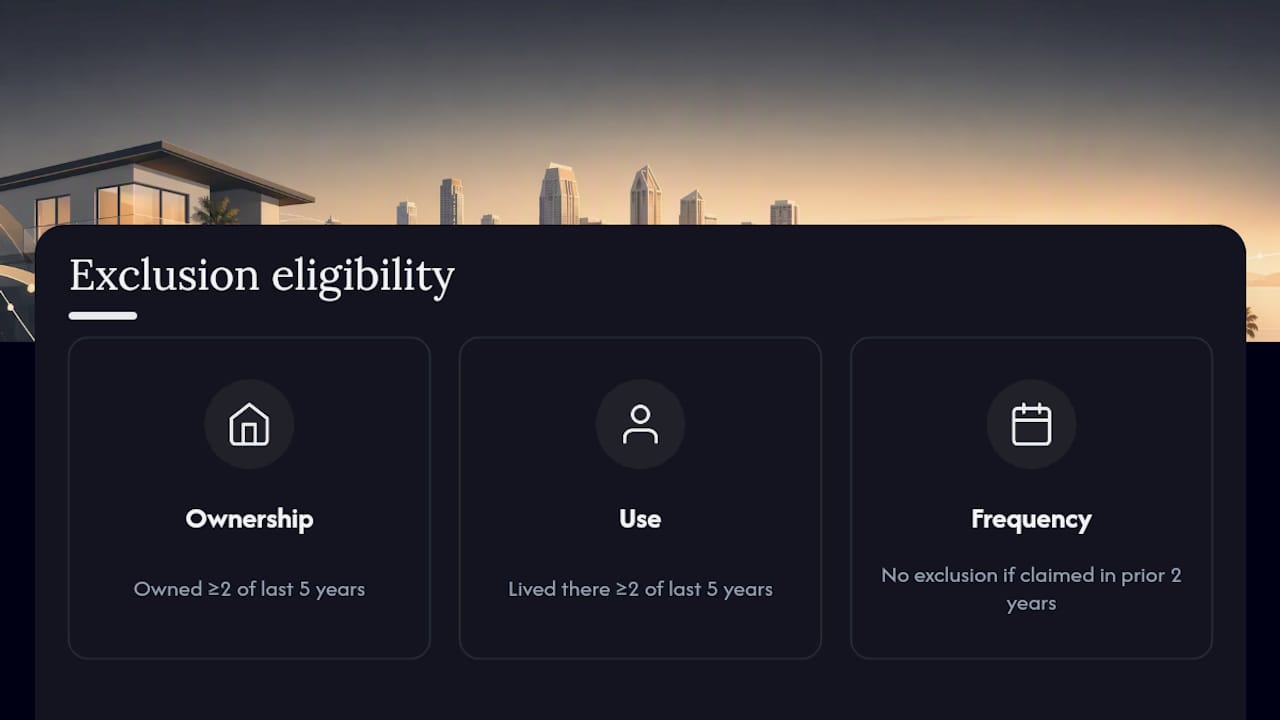
There's also a frequency rule: you can't claim the exclusion if you used it on a different home sale within the two years before this one.
If you don't meet the full 2-year requirement, you might still qualify for a partial exclusion. Publication 523 covers three common triggers: a change in workplace that meets the 50-mile distance test, a health-related move, or an unforeseeable event like divorce or a natural disaster. The math on a partial exclusion is prorated based on how much of the 2-year period you actually satisfied.
A few edge cases come up often in San Diego, where military transfers and remote-work relocations are common. Divorced couples splitting a shared home have special transfer rules. Nonresident spouses face different treatment under some circumstances. And if part of your home was used as a rental unit or a home office, only the personal-use portion typically qualifies for the exclusion.
How to Calculate Your Taxable Gain
Before you assume you're in the clear, run the actual numbers. The formula has more pieces than most sellers expect, and small oversights on either side can shift your taxable gain by tens of thousands of dollars.
- Add up your amount realized. This includes your sale price, plus the value of any property or services you received instead of cash, plus any debts the buyer assumed on your behalf, plus certain credits the buyer gave you.
- Subtract selling expenses. Real estate commissions, advertising costs, and legal fees for the transaction all reduce your amount realized.
- Calculate your adjusted basis. Start with your original purchase price, add your original closing costs, then add documented capital improvements. If any part of the home generated depreciation deductions for rental or business use, subtract that depreciation from basis.
- Subtract adjusted basis from adjusted amount realized. That's your gain.
Say you bought a home for $500,000, spent $8,000 on closing costs, and invested $60,000 in a kitchen remodel and a new roof over the years. Your adjusted basis is $568,000. If you sell for $900,000 and pay $54,000 in commissions and fees, your amount realized is $846,000. Your gain is $278,000, comfortably inside the $500,000 joint exclusion.
When and How to Report the Sale on Your Taxes
Receiving Form 1099-S is usually the trigger that forces reporting, even when the entire gain qualifies for exclusion. Title companies and closing agents issue this form to report gross proceeds from the sale directly to the IRS, so if your name is on one, assume the agency already knows the sale happened.
You generally need to report the sale if any of the following apply:
- You received Form 1099-S for the transaction.
- Your gain exceeds the exclusion limit for your filing status.
- You have any non-excludable gain from business or rental use of the property.
- You want to elect out of the exclusion for a specific reason, such as offsetting a gain with a carried-over loss elsewhere.
When gain is taxable, you report it on Form 8949, then carry the result to Schedule D (Form 1040). Publication 523 includes worksheets that walk through figuring your maximum exclusion and calculating exactly how much of your gain is taxable. Installment sales, where the buyer pays you over multiple years, follow separate reporting rules and typically require Form 6252 in addition to the standard forms.
Recordkeeping That Actually Protects You at Tax Time
After years of walking sellers through closings, the single biggest regret I hear is "I wish I'd kept those receipts." Basis documentation is the difference between a clean tax filing and a stressful guessing game.
Keep these documents in one file, physical or digital, starting the day you buy a home:
- Original purchase closing statement (the HUD1 or Closing Disclosure).
- Receipts and invoices for every capital improvement, plus canceled checks or bank statements as backup.
- Contracts for major renovation work.
- Copies of Form 1099-S when you eventually sell.
Improvements add value, extend the home's life, or adapt it to new uses, think additions, new systems, or a finished basement. Repairs just maintain what's already there. When in doubt, ask whether the work would show up on a home appraisal as added value. If yes, it's likely an improvement.
If you're relocating for a job, confirm the 50-mile distance requirement early, since it affects whether you qualify for a partial exclusion.
Pro Tip: Build your closing file before you list, not after. A folder with your original purchase documents, every improvement receipt, and a running basis calculation makes tax season painless and gives your accountant everything needed to defend your numbers if the IRS ever asks.
Next Steps Before You List Your Home
Start with a realistic gain estimate using your purchase price, improvements, and expected sale price. Then work through this checklist:
- Pull your original purchase closing statement and every improvement receipt you've saved.
- Estimate your gain and compare it against the $250,000 or $500,000 exclusion for your filing status.
- Confirm whether you'll receive Form 1099-S at closing (almost every sale generates one).
- Run the Publication 523 worksheets for a precise exclusion and gain calculation.
- Talk to a tax professional if your gain appears to exceed the exclusion, or if part of the home was rented or used for business.
Complex basis situations, mixed personal and rental use, or gains well above the exclusion threshold are exactly when a CPA earns their fee. For the local numbers, a seller net proceeds breakdown helps you see what you'll actually walk away with after commissions, transfer taxes, and closing costs.
What Happens if You Rented the Home or Used It for Business?
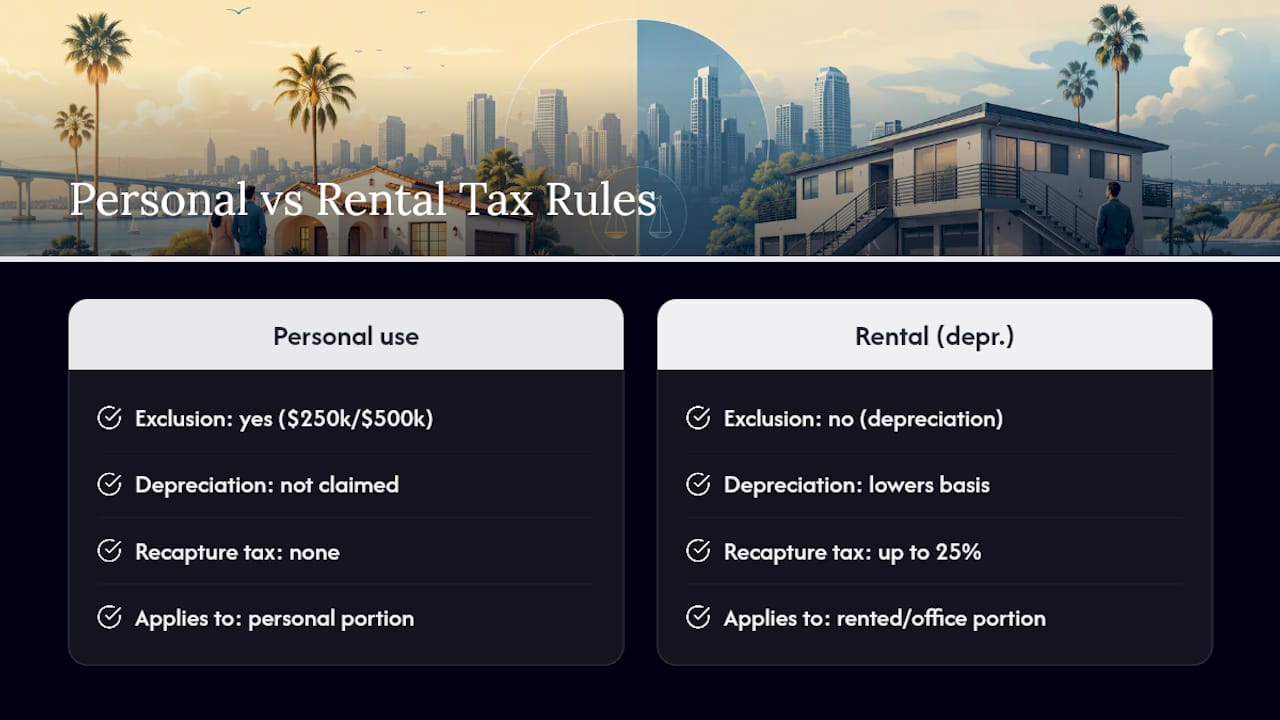
Depreciation recapture is where a lot of sellers get an unpleasant surprise. If you ever rented out part of your home, or claimed a home office deduction, the IRS required you to depreciate that portion of the property. Depreciation lowers your basis, which increases your gain, and the portion of gain attributable to that depreciation is taxed separately.
Here's the mechanism: the personal-use portion of your home can still qualify for the $250,000 or $500,000 exclusion. The depreciation you claimed while renting cannot be excluded, no matter how long you lived in the home afterward. That recaptured amount is taxed at a maximum rate of 25% under current rules, separate from your ordinary long-term capital gains rate.
This comes up constantly with San Diego homeowners who rented out a guest suite on a short-term platform, converted a garage into an ADU rental, or ran a home business and claimed office depreciation. Partial rental use can generate a recapture bill that catches sellers off guard at closing.
The fix isn't complicated, just proactive. Track the exact years and square footage percentage that generated depreciation deductions. If you stopped renting the space years before selling, you still owe recapture tax on the depreciation you claimed during the rental period, even though the home has been 100% personal-use since then. This is a case where a tax professional pays for themselves, since separating personal-use gain from rental-use recapture requires careful math most sellers won't want to do alone.
What if Your Home Sale Results in a Loss?
A loss on your primary residence gives you no tax benefit. The IRS treats your personal home the same way it treats a car: personal-use property, and losses on personal-use property aren't deductible against your income or other gains.
This surprises people who assume real estate works like stocks, where a loss offsets other gains. It doesn't work that way here. If you bought at the top of a market cycle and sell for less than your adjusted basis, that loss simply disappears for tax purposes. No exclusion calculation applies, because there's no gain to exclude.
The exception involves mixed-use property. If part of your home was rented out or used for business, that portion is treated as investment or business property. A loss allocated to the rental or business share may be deductible, subject to passive activity loss rules and other limitations. The personal-use portion of the loss still gets no deduction.
Before assuming you have a loss, double check your adjusted basis calculation. Sellers sometimes forget to add capital improvements made years earlier, which lowers their apparent gain or turns what looked like a loss into a small taxable gain instead. Either way, the number only matters for reporting purposes if you have a gain, not a loss on the personal-use portion.
Do State Taxes Add Another Layer?
The federal exclusion doesn't automatically apply at the state level. Most states that collect income tax also tax capital gains, generally by starting with your federal adjusted gross income and applying their own rate, though a handful of states have no personal income tax at all and therefore no separate capital gains tax on a home sale.
California, where San Diego sits, taxes capital gains as ordinary income at the state level, with no separate lower rate for long-term gains the way federal law provides. California does not offer its own version of the federal $250,000/$500,000 exclusion. It generally follows the federal exclusion for calculating what counts as taxable income, meaning if your gain is fully excluded federally, it's typically excluded from California taxable income too. But any gain that exceeds the federal exclusion and shows up on your federal return will also show up on your California return, taxed at the state's regular income tax brackets.
If you're selling a second home or rental property outside California, or you moved out of state before selling, check that state's specific rules on residency and gain sourcing. Some states tax a sale based on where the property sits regardless of where you currently live. This is an area where a real estate attorney or CPA licensed in the relevant state is worth the consultation fee, especially for sales involving property in more than one state.
Does a Big Gain Affect Other Tax Credits or Deductions?
A home sale gain, even one that's partially or fully excluded, can raise your adjusted gross income (AGI) for the year, and AGI is the gatekeeper for a long list of other tax benefits.
Taxable gain that isn't excluded gets added to your income, which can phase out eligibility for things like certain education credits, the ability to deduct traditional IRA contributions, or income-based thresholds tied to Medicare premiums the following year. High earners should also watch for the 3.8% net investment income tax, which kicks in above certain AGI thresholds and can apply to the taxable portion of a home sale gain.
Even the excluded portion of your gain, while not taxable, still shows up in some calculations tied to your tax return, so a large sale can nudge you into a higher bracket for other income you earned that year or affect subsidy eligibility for programs tied to household income. If you're planning a large sale near year-end, talk to a tax professional about timing. Sometimes splitting a transaction across two tax years, when structurally possible, or adjusting withholding and estimated payments in advance prevents an unpleasant surprise the following April.
Special Rules for Second Homes and Investment Properties
The $250,000/$500,000 exclusion exists for one purpose: protecting gain on a principal residence. A vacation home, a rental property, or a house you bought purely as an investment doesn't qualify, no matter how long you've owned it.
Gain on an investment property is taxed at standard long-term capital gains rates of 0%, 15%, or 20% depending on your taxable income, assuming you held the property longer than a year. Short-term holdings, under a year, are taxed at ordinary income rates instead, which is often a much higher bill.
Depreciation recapture applies in full to a rental property, since the entire home was a business asset rather than a partial personal residence. That recaptured depreciation is taxed at up to 25%, separate from your regular capital gains rate on the remaining profit.
One option worth knowing about, though it's a strategy for investment property only and never applies to a primary residence: a 1031 exchange lets an investor defer capital gains tax by rolling proceeds into a similar investment property, following strict IRS timelines and rules. It requires working with a qualified intermediary and doesn't apply if you've ever lived in the property as your main home. If you own multiple properties in San Diego and you're weighing whether to sell or exchange, that decision is worth a conversation with both a tax professional and an agent who knows the local investment market.
What if You're Selling an Inherited Home?
Inherited property gets one of the friendliest rules in the entire tax code: a stepped-up basis. Instead of inheriting the original owner's purchase price as your basis, your basis becomes the home's fair market value on the date of death (or an alternate valuation date in some estates).
That step-up often erases most or all of the built-up gain the original owner would have owed. If your parent bought a home decades ago for $80,000 and it's worth $700,000 when they pass away, your basis as the heir is $700,000, not $80,000. If you sell shortly after for close to that value, your taxable gain is small or nonexistent, even though the original owner would have owed tax on a $620,000 gain.
The $250,000/$500,000 exclusion still applies separately if you move into the inherited home and meet the ownership and use tests yourself. Many heirs sell fairly quickly without ever living there, in which case the exclusion doesn't apply, but the stepped-up basis usually makes the tax bill manageable anyway. Our guide to selling an inherited home in San Diego walks through the probate, appraisal, and basis documentation steps specific to these sales, which tend to involve more paperwork than a standard listing.
A San Diego Agent's Take on Pricing and Timing Around Taxes
Sellers obsess over sale price, but net proceeds are what actually land in your account, and taxes are only one piece of that math. Transfer taxes, prorated property tax, and San Diego closing costs all chip away at the top-line number, so I always encourage clients to run a full net proceeds estimate before setting a list price, not after an offer comes in.
Timing matters too. If you're close to hitting the 2-year use test, or you're relocating for a job that might qualify you for a partial exclusion, a few weeks of patience can be worth thousands in avoided tax.
— Jeff
How Jeff Sells San Diego Helps You Keep More of Your Sale
Working with a local agent who understands the tax mechanics behind a sale gives you an edge over sellers who list and hope for the best. A local agent can build net-proceeds estimates before you list, help you organize the closing documents and improvement receipts that support your basis calculation, and plan your listing timeline around eligibility milestones like the 2-year ownership and use tests.

This isn't tax advice delivered from a call center. It's local, hands-on planning from someone experienced with sellers in San Diego, familiar with how local transfer costs and market timing interact with your federal exclusion. If you're weighing a sale in the next year, start with a conversation. Visit the Seller's Guide to request a net-proceeds estimate and get a realistic look at what you'll walk away with after taxes, commissions, and closing costs.
Where This Guidance Comes From
This article draws directly on IRS primary sources rather than secondhand summaries. Topic no. 701, Sale of Your Home covers exclusion limits and the ownership/use tests. Publication 523, Selling Your Home provides the worksheets for calculating exclusion and taxable gain. The IRS newsroom guidance on selling a home explains Form 1099-S reporting triggers, and the Tax Policy Center breaks down current capital gains tax rates.
This article is general information, not a substitute for advice from a qualified financial advisor. Consult a qualified financial professional about your own circumstances before acting on anything here.