
A title search is a formal review of public property records to confirm who legally owns a piece of real estate and whether any claims, debts, or restrictions are attached to it. Before any sale closes, this process answers three questions: Does the seller actually have the right to sell? Are there liens that must be paid off? Do any easements or covenants limit how the property can be used?
What is a title search and why does it matter?
A title search is a systematic examination of public records to verify legal ownership and surface any defects, liens, or encumbrances on a property. The records typically reviewed include:
- Deeds recording each transfer of ownership
- Mortgage filings documenting collateral interests tied to home loans
- Tax records showing any unpaid property taxes owed to the government
- Court judgments and liens filed by creditors, contractors, or other parties
- Easements and covenants restricting or granting rights over the land
The goal is to establish a clear "chain of title," a chronological record of every owner going back through the property's history. When that chain is clean and unbroken, the buyer can take ownership with confidence. When it is not, the issues must be resolved before closing.
Why a title search protects you as a buyer

Skipping a title search is one of the costliest mistakes a buyer can make. Undiscovered liens, ownership gaps, or court judgments do not disappear at closing. They transfer with the property, and the new owner inherits them.

Lenders understand this risk well. Most mortgage lenders require a clean title before approving a loan, because the property serves as collateral. A clouded title puts the lender's security interest at risk just as much as it threatens the buyer's ownership rights.
Experts compare a title search to a medical diagnostic test. You might feel fine, but the scan reveals something that needed attention all along. A property can look perfectly clean on the surface while carrying a mechanic's lien from a contractor the previous owner never paid, or a tax debt the county has been waiting to collect.
Pro Tip: Do not assume that pulling records yourself online gives you the same protection as a professional search. County databases vary widely in completeness, and off-record claims, such as unrecorded easements or heir disputes, will not appear in a basic online lookup.
How the title search process works, step by step
The title search process follows a clear sequence, though the timeline and complexity vary by property and county.
- Order the search. After a purchase offer is accepted, the buyer's agent, lender, or closing attorney orders the title search. A title company, licensed abstractor, or real estate attorney typically handles it.
- Gather property identifiers. The searcher collects the parcel number, legal description, and current owner's name to pull the correct records from the county assessor or recorder's office.
- Access county records. The searcher reviews deeds, tax records, court documents, and mortgage filings held at the county level. Some counties have digitized records; others still require in-person searches at the courthouse.
- Build the chain of title. Using grantor and grantee indexes, the searcher traces ownership backward from the current owner to prior owners, confirming each transfer was properly recorded. Title companies and attorneys are essential here because record formats vary by county and era.
- Identify liens, easements, and encumbrances. Every recorded claim against the property is documented, including unpaid mortgages, tax liens, mechanic's liens, easements, and court judgments.
- Compile the title report or abstract. The findings are organized into a formal document, sometimes called an abstract of title, showing the property's complete legal status in chronological order.
- Resolve defects before closing. Any issues uncovered must be cleared before the transaction can proceed. This might mean paying off a lien, obtaining a release from a creditor, or correcting an error in a prior deed.
What a title search actually uncovers
A thorough title search reveals a range of issues that can affect your ability to own, use, or sell the property freely:
- Unpaid mortgage balances from a prior owner that were never formally released
- Tax liens filed by federal, state, or local governments for unpaid property or income taxes
- Mechanic's liens placed by contractors or suppliers who were not paid for work done on the property
- Easements granting utility companies, neighbors, or the public a right to use part of the land
- Restrictive covenants limiting what you can build, operate, or modify on the property
- Breaks in the chain of title where a deed was never recorded or a transfer was improperly executed
- Clerical errors in prior deeds, such as misspelled names or incorrect legal descriptions
- Unknown heir claims from relatives of a deceased prior owner who may assert an ownership interest
Each of these findings carries real consequences. An unresolved lien or ownership gap can block the sale entirely, delay closing, or expose the buyer to a lawsuit after the fact. Resolving them before closing is not optional; it is what makes the transfer legally sound.
Title search vs. title insurance: what's the difference?
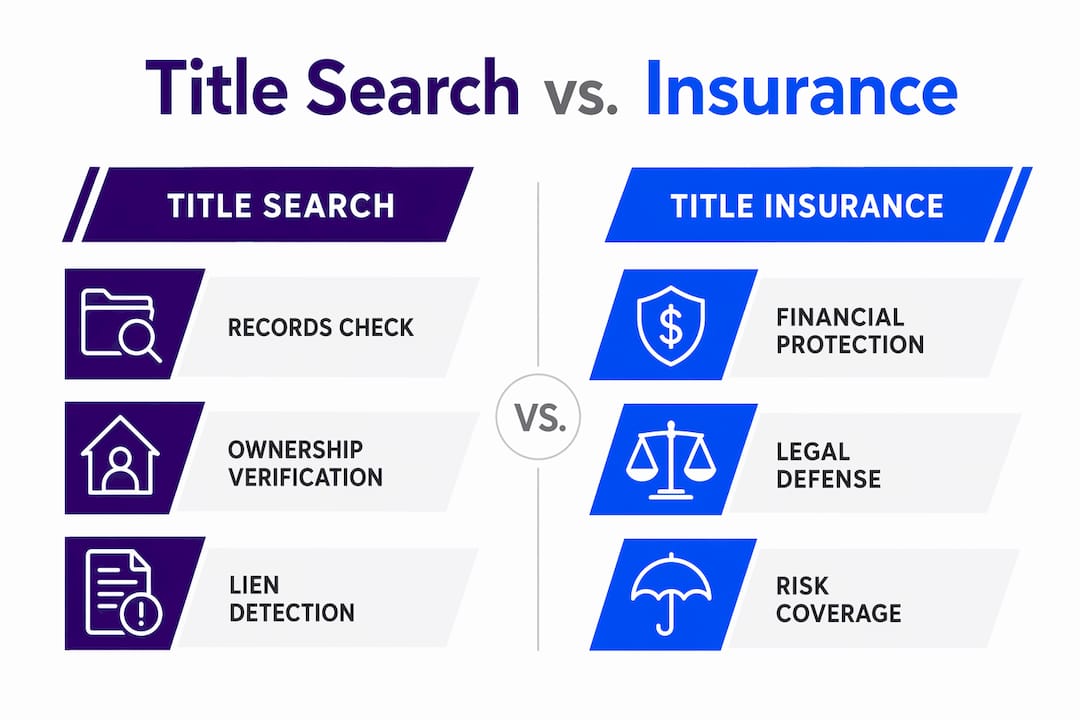
These two tools are often confused, but they serve entirely different purposes. A title search is the investigative step. Title insurance is the financial safety net that follows it.
| Feature | Title search | Title insurance |
|---|---|---|
| Purpose | Examines public records to verify ownership and find defects | Protects financially against defects not found during the search |
| Timing | Completed before closing | Purchased at closing; coverage begins then |
| Coverage | Identifies known, recorded issues | Covers unknown or undiscovered claims that surface later |
| Who benefits | Buyer and lender gain clarity before the transaction | Buyer and lender are protected after the transaction |
| Cost structure | One-time fee paid at or before closing | One-time premium paid at closing |
The National Association of Realtors recommends maintaining both for full protection. A title search cannot catch every possible defect. Forged deeds, undisclosed heirs, and recording errors that predate digitized records can slip through even a thorough search. Title insurance fills that gap. In practice, a title search report is typically required before a title insurance policy can be issued, so the two are closely linked in the closing process.
How long does a title search take, and what does it cost?
Most buyers want a straight answer on timing and price. Here is what to expect:
- Typical cost: Standard residential searches run roughly $75–$200, varying by county and property complexity.
- Time frame: A straightforward search on a property with clean, accessible records can be completed in a few days. Complex properties, older homes with long ownership histories, or counties with limited digital records can push that timeline to two weeks or more.
- Who performs it: Title companies, licensed abstractors, and real estate attorneys all conduct title searches. The right choice depends on your state's practices and the complexity of the transaction. In some states, an attorney's involvement at closing is legally required.
- Search type matters: A full coverage search, used for purchase transactions and construction loans, is more thorough and costs more than a limited coverage search, which is typically used for refinances or equity loans.
- Local record access: Counties with well-organized digital archives allow faster, less expensive searches. Rural counties or those with older paper-based records take longer and may cost more.
For buyers navigating San Diego real estate terms for the first time, understanding these cost variables helps set realistic expectations before you reach the closing table.
Why professional expertise changes the outcome
The Indiana Department of Insurance puts it plainly: missing a recorded document or a gap in the ownership chain can cause catastrophic financial liability after closing. That is not a hypothetical. It happens when buyers or lenders rely on incomplete searches or misread what the records actually say.
Interpreting what a title search finds requires legal knowledge, not just access to records. Non-standardized deed formats, off-record claims, and errors that predate digital filing are exactly the kinds of issues a trained professional catches and a casual search misses. The risk of off-record claims alone, such as unrecorded easements or informal agreements between prior owners, is reason enough to hire someone who knows what to look for. Clear titles are the foundation of every secure property transfer, and even records that appear straightforward deserve a professional set of eyes.
Ready to buy in San Diego and want to make sure every step of your transaction is handled correctly? Jeffsellssandiego works with buyers throughout the process, from the first property search through closing. Explore current listings or review the full buyer's guide to see how the process works from offer to keys.

Key Takeaways
A title search is a non-negotiable step in any U.S. property purchase, confirming legal ownership and clearing liens, encumbrances, and defects before the transaction closes.
| Point | Details |
|---|---|
| Core purpose | A title search reviews public records to confirm ownership and identify liens, easements, and defects. |
| Professional cost | Standard residential searches run roughly $75–$200, varying by county and property complexity. |
| Search vs. insurance | A title search finds known defects; title insurance covers undiscovered claims that surface after closing. |
| Who performs it | Title companies, licensed abstractors, and real estate attorneys conduct searches depending on state practice. |
| Clearing title | Any defects found must be resolved before closing to allow a legally sound property transfer. |