
A fixed-rate mortgage is a home loan whose interest rate is locked in at closing and stays exactly the same for the entire loan term, whether that's 15 years or 30. Your principal-and-interest payment never changes, even if market rates spike five years from now.
That single fact drives two practical realities every buyer should understand before shopping for a loan.
- Your principal and interest payment stays fixed for the life of the loan, which makes long-term budgeting far more predictable than with a variable-rate product.
- If market rates drop after you close, you don't automatically benefit. You have to refinance to capture that lower rate.
The two most common versions of this loan are the 15-year fixed and the 30-year fixed, and according to CNBC Select, fixed-rate loans make up roughly 92% of all outstanding U.S. mortgages. Almost everyone you know with a mortgage has one of these two.
Key Takeaways
A fixed-rate mortgage locks your interest rate and monthly principal-and-interest payment at closing, and that rate never changes for the life of the loan.
| Point | Details |
|---|---|
| Definition stays simple | The rate is set at closing and stays fixed for the full 15 or 30-year term. |
| Fixed rates dominate the market | Roughly 92% of outstanding U.S. mortgages are fixed-rate, per CNBC Select's reporting. |
| Choose fixed for long-term stays | Predictability tends to outweigh a lower ARM starting rate for buyers staying 10+ years. |
| Refinancing is not automatic | You must refinance deliberately to capture a lower rate after market rates drop. |
| Compare APR, not just rate | Request multiple Loan Estimates and compare full annual cost before choosing a lender. |
Ready to see how these numbers play out for your own budget? Run your scenario through Jeffsellssandiego's mortgage calculator, then browse current listings through our home search tool or start with our buyer's guide to see how financing fits into your overall search strategy in San Diego.
Table of Contents
- What Is a Fixed-Rate Mortgage: How the Payment Actually Works
- Common Fixed-Rate Loan Types and Terms You'll Encounter
- Fixed-Rate vs. Adjustable-Rate Mortgage: Which One Fits You?
- When a Fixed-Rate Mortgage Makes Sense (and When It Doesn't)
- How Much Will It Cost? A Worked Payment Example
- What to Expect During Approval and Closing
- Refinancing a Fixed-Rate Mortgage When Rates Drop
- How to Shop for a Fixed-Rate Mortgage Without Getting Burned
- Seeing the Numbers: A First-Year Amortization Snapshot
- How Your Credit Score and Financial Profile Shape Your Rate
- Why Inflation and the Broader Economy Move Fixed Mortgage Rates
- Tax Implications: The Mortgage Interest Deduction
- An Agent's View: Fixed-Rate Loans in a Competitive Market
- Frequently Asked Questions
- Sources
What Is a Fixed-Rate Mortgage: How the Payment Actually Works
Here's the mechanical answer to what is a fixed-rate mortgage, beyond the one-line definition: the lender sets your interest rate the day you close, based on your credit profile, the loan amount, and prevailing market benchmarks. That rate gets plugged into an amortization formula along with your loan balance and term length to produce one fixed monthly principal-and-interest number. That number does not move for 360 months on a 30-year loan, or 180 months on a 15-year loan.
What does move, month to month, is the split between interest and principal inside that fixed payment. Early on, most of your payment goes toward interest because you owe interest on a much larger balance. As Chase's mortgage education team explains, the ratio flips gradually over the loan's life, and by the final years, the vast majority of each payment chips away at principal. This front-loaded interest structure is why paying off a mortgage early in year 3 saves you dramatically more interest than paying it off early in year 25.

One distinction trips up almost every first-time buyer comparing loan offers: interest rate versus APR.
Your interest rate is the number used to calculate your monthly payment. Your APR (annual percentage rate) bundles that rate together with lender fees, points, and certain closing costs into a single figure that reflects the loan's true annual cost. CNBC Select recommends comparing APR, not the advertised rate, when you're weighing offers from different lenders. Two loans can carry the same headline rate and wildly different APRs once fees are factored in.
- The interest rate calculates your monthly principal-and-interest payment.
- The APR reflects the loan's full annual cost, including most fees, and is the better number for comparing lenders.
Pro Tip: A rate lock freezes your quoted interest rate for a set window, usually 30 to 60 days, while your loan moves through underwriting. Lock in as soon as you're under contract on a home. Market rates can move daily, and an unlocked rate leaves your monthly payment exposed right up until closing.
Common Fixed-Rate Loan Types and Terms You'll Encounter
Before you start comparing lenders, it helps to know the vocabulary you'll run into on a Loan Estimate. The term is how many years you have to repay the loan. Principal is the amount you borrowed. Interest is the cost of borrowing it. Amortization is the schedule that spreads principal and interest repayment across the full term.
Fixed-rate loans come in a handful of common flavors, and which one fits you depends heavily on your down payment, service history, and where you're buying.
- Conventional fixed-rate loans: Not backed by a government agency, typically require stronger credit, and are the default choice for buyers with solid financials and at least modest down payments.
- FHA fixed-rate loans: Backed by the Federal Housing Administration, popular with first-time buyers because of lower down payment and credit-score thresholds.
- VA fixed-rate loans: Available to eligible veterans and service members, often with no down payment required.
- USDA fixed-rate loans: Designed for eligible rural and some suburban properties, aimed at lower-to-moderate income buyers.
- Jumbo fixed-rate loans: Used when the loan amount exceeds the conforming loan limit, common in higher-cost markets like San Diego.
- Conforming fixed-rate loans: Loan amounts that fall within limits set for purchase by Fannie Mae and Freddie Mac, generally the easiest to price competitively.
Term length matters just as much as loan type. Ten- and 20-year fixed loans exist but are less common. The real decision usually comes down to 15 versus 30. A 15-year term means higher monthly payments but dramatically less total interest paid. A 30-year term means lower monthly payments and more breathing room in your budget, but you'll pay substantially more interest over the life of the loan, according to Chase.
Fixed-Rate vs. Adjustable-Rate Mortgage: Which One Fits You?
The core tradeoff between a fixed-rate mortgage and an adjustable-rate mortgage (ARM) comes down to one question: do you want certainty, or are you willing to gamble on lower payments today in exchange for risk later?
A fixed-rate mortgage locks your rate for the entire term. An ARM starts with a fixed introductory rate, often for 5, 7, or 10 years, then adjusts periodically based on a financial index plus a lender margin, according to the Consumer Financial Protection Bureau. Most ARMs include rate caps that limit how much the rate can jump at each adjustment and over the loan's life, but your payment can still rise significantly once the introductory period ends.
| Dimension | Fixed-rate mortgage | Adjustable-rate mortgage (ARM) |
|---|---|---|
| Predictability | Payment never changes for the full term | Payment can rise or fall after the intro period ends |
| Typical loan term | 15 or 30 years most common | Often structured as 5/1, 7/1, or 10/1 (fixed years/adjustment frequency) |
| Starting rate | Generally higher than an ARM's introductory rate | Often lower during the fixed intro window |
| Who benefits | Buyers staying long-term or wanting budget certainty | Buyers planning to sell or refinance before the adjustment period |
| Refinancing implications | Must refinance to capture a lower market rate | May refinance into a fixed loan before adjustments begin |
Freddie Mac's homebuyer guidance generally recommends fixed-rate loans for buyers who expect to stay in a home 10 years or longer, since the value of payment predictability tends to outweigh a slightly lower ARM starting rate over that horizon.
Fixed-rate pros: stable payment, protection against rising rates, easier long-term budgeting, no surprise adjustment dates.
Fixed-rate cons: often a higher starting rate than a comparable ARM, no automatic benefit when market rates drop, and refinancing costs money and time if you want a lower rate.
ARM pros: lower initial payments, useful if you plan to move or refinance before adjustments hit.
ARM cons: payment uncertainty, harder to budget years out, potential for real payment shock if rates climb.
When a Fixed-Rate Mortgage Makes Sense (and When It Doesn't)
The strongest case for a fixed-rate mortgage is simple: you want to know exactly what you're paying every month for as long as you own the home. That certainty carries real weight for households on a fixed income, families planning around a single mortgage payment for a decade or more, or anyone who's been burned by financial surprises before.
Advantages that matter in real decisions:
- Predictable principal and interest payments make long-term budgeting far easier, since your housing cost line item never fluctuates.
- Inflation protection: if prices and rates rise broadly across the economy, your locked-in rate stays untouched.
- Availability across nearly every loan category, from conventional to FHA to VA, so you're not limited in loan type by choosing fixed.
Tradeoffs worth weighing honestly:
- The starting rate on a fixed loan is often higher than an ARM's introductory rate, which costs you more in the early years if you don't stay long.
- Capturing a rate drop requires a deliberate refinance, with its own closing costs and paperwork, according to the CFPB's research on mortgage rate impacts.
- Your total monthly payment can still shift over time even on a fixed loan, because property taxes and homeowners insurance, which are often bundled into escrow, are not locked and tend to rise.
Use this quick checklist when deciding between fixed and adjustable:
- You plan to stay in the home for at least seven to ten years.
- You value knowing your exact payment over chasing a slightly lower rate today.
- You have a low tolerance for payment risk or an income that doesn't easily absorb a payment spike.
- You're buying in a market, like much of San Diego County, where holding a property long-term tends to build meaningful equity.
If most of those apply to you, a fixed-rate mortgage is almost certainly the safer structural choice.
How Much Will It Cost? A Worked Payment Example
Numbers make this real faster than any explanation. Say you're financing $500,000 on a 30-year fixed mortgage at an illustrative rate of 6.5%. Your principal-and-interest payment lands around $3,160 a month. Now compare that to a 15-year fixed at an illustrative rate of 5.—%: your monthly payment jumps to roughly $4,170, but you'd pay off the loan in half the time and save a substantial amount in total interest over the life of the loan, since less time means less interest accrual and a much faster shift toward principal, per Chase's amortization guidance.
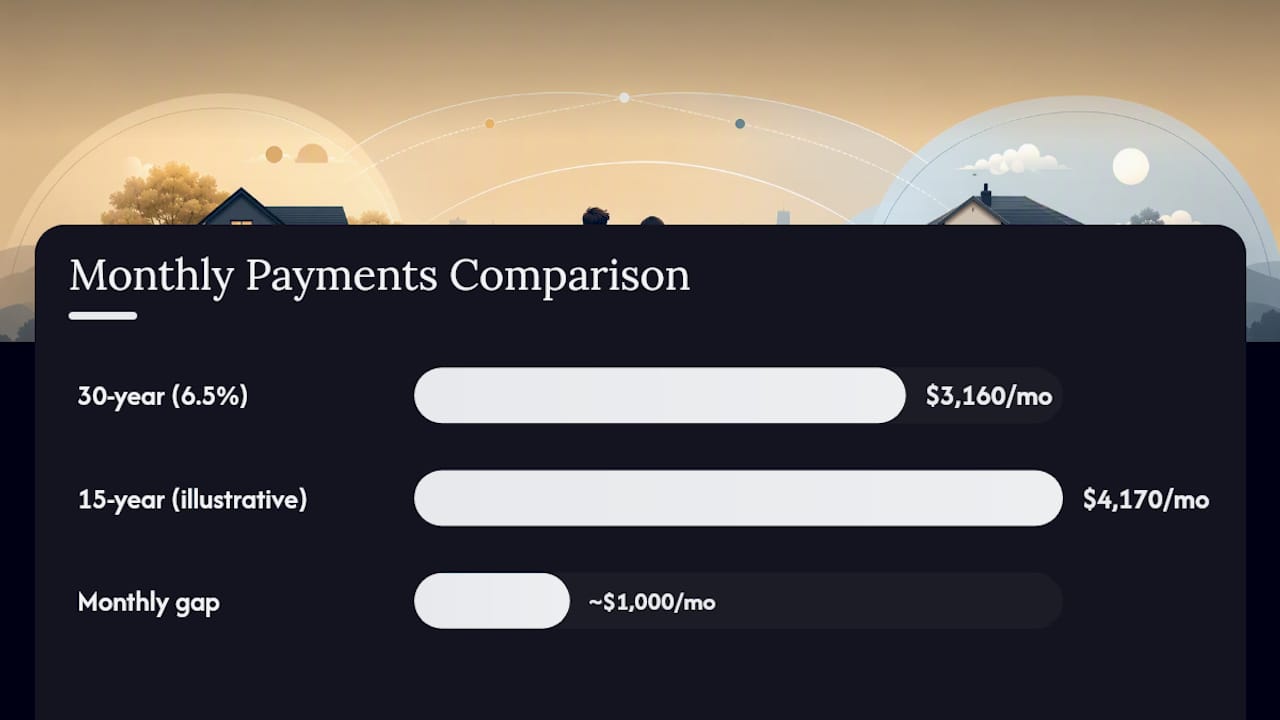
That roughly $1,000 monthly gap between the two terms is the real tradeoff every buyer weighs: cash flow flexibility now versus long-term interest savings.
Several factors determine where your actual rate lands within current market ranges:
- Credit score: Higher scores unlock meaningfully better pricing across every loan type.
- Down payment size: Larger down payments reduce lender risk and often improve your rate.
- Loan-to-value ratio (LTV): The lower your LTV, the less risk you represent, which can translate into better pricing.
- Loan type: Conventional, FHA, VA, and jumbo loans all carry different rate structures and fee schedules.
- Discount points: Paying points upfront can buy down your rate if you plan to stay long enough to recoup the cost.
- Market benchmark rates: Fixed rates move largely in tandem with the 10-year Treasury yield, so broader economic conditions set the floor everyone's rate is built on.
- Loan term: Shorter terms typically carry lower rates than longer ones.
Pro Tip: Never compare lenders on the advertised rate alone. Ask for the APR on every quote. A loan with a slightly higher rate but lower fees can easily beat a lower-rate loan loaded with origination charges once you look at the true annual cost.
What to Expect During Approval and Closing
Getting from application to keys in hand follows a fairly predictable sequence, even though the exact timeline varies by lender and how quickly you supply documentation.
- Pre-approval: Usually takes a few days once you submit income, asset, and credit documentation, and gives you a realistic budget before you start touring homes.
- Underwriting: Once you're under contract, underwriting typically runs two to four weeks as the lender verifies income, assets, debt, and the property itself.
- Appraisal: Ordered early in underwriting, usually completed within one to two weeks, confirming the home's value supports the loan amount.
- Closing: Most conventional purchase loans close 30 to 45 days after the purchase contract is signed, assuming no major underwriting delays.
Closing costs typically run in the range most buyers should budget for, and they include several distinct line items: an origination fee charged by the lender, an appraisal fee, title insurance and search fees, and prepaid escrow deposits for taxes and insurance.
If your down payment is under 20% on a conventional loan, you'll also likely pay private mortgage insurance, or PMI, which protects the lender, not you, in case of default. PMI gets added to your monthly payment and typically drops off once you reach 20% equity, either through payments or appreciation. FHA loans carry a similar but separate insurance requirement that works differently and, in most cases, lasts for the life of the loan.
Refinancing a Fixed-Rate Mortgage When Rates Drop
Because a fixed-rate mortgage locks in your rate at closing, market rates falling later doesn't touch your payment automatically. You have to refinance, which means taking out a new loan to pay off the old one, ideally at a lower rate, according to CFPB research on rate changes.
The math that tells you whether refinancing is worth it is a straightforward breakeven calculation: take your total closing costs and divide by your monthly payment savings. If refinancing costs $6,000 and saves you $200 a month, your breakeven point is 30 months. Stay in the home longer than that, and refinancing pays off. Sell or move sooner, and you lose money on the deal.
Two refinance structures serve different goals. A rate-and-term refinance simply swaps your existing rate and term for better terms without pulling cash out. A cash-out refinance lets you tap home equity for other expenses, but it usually resets your amortization schedule and often carries a slightly higher rate. Either way, refinancing restarts your loan's clock, which matters if you're already 12 years into a 30-year term.
Pro Tip: Before you refinance, check whether your current loan has any prepayment penalty (most standard fixed-rate mortgages don't, according to the CFPB), and look at your remaining total interest owed, not just the monthly payment difference. A refinance that lowers your payment but stretches your term back to 30 years can cost more in lifetime interest even while saving you money each month.
How to Shop for a Fixed-Rate Mortgage Without Getting Burned
Shopping for a mortgage rewards buyers who compare methodically instead of grabbing the first quote that sounds good.
- Get pre-approved with at least two or three lenders before you start touring homes seriously.
- Request a written Loan Estimate from each lender, which standardizes fees so you can compare apples to apples.
- Compare APR and total closing costs across offers, not just the advertised interest rate.
- Ask each lender directly about rate-lock windows, discount points, and any prepayment penalties.
- Verify the lender's disclosures match what was verbally quoted before you commit.
When you're on the phone with a loan officer, a short list of pointed questions saves you from surprises later:
- How long is my rate lock, and what happens if closing gets delayed past that window?
- Do points make sense given how long I plan to stay in this home?
- Will my loan be serviced by you directly, or sold to another servicer after closing?
- Is there any prepayment penalty on this loan?
- Will I need private mortgage insurance, and at what loan-to-value does it drop off?
Pro Tip: Collect at least three written Loan Estimates and line them up side by side. Bankrate's lender education content makes the same point: the advertised rate rarely tells the whole story, and the lender with the lowest headline rate isn't always the cheapest once fees are on the table. If you're buying in San Diego, pairing that comparison with local rate-shopping strategy can sharpen which lenders are actually competitive in this market.
Seeing the Numbers: A First-Year Amortization Snapshot
Numbers on a page make amortization click faster than any description. Here's an illustrative first-year snapshot for a $500,000, 30-year fixed loan at 6.5%, with a monthly principal-and-interest payment of roughly $3,160.
Notice how little the principal portion moves in just twelve months. You've paid nearly $38,000 total, but only about $5,500 of it went toward the actual balance. That's the front-loaded interest structure at work, and it's exactly why extra principal payments made early in a loan carry outsized impact.
Running these numbers for your own scenario, rather than relying on someone else's example, is the only way to know what a specific rate and term actually mean for your budget. Jeffsellssandiego's mortgage calculator lets you test different rates, terms, and down payment amounts side by side.
Pro Tip: Run both a 15-year and a 30-year scenario for the same loan amount before deciding. The monthly payment gap often looks scarier upfront than the long-term interest savings make it worth.
How Your Credit Score and Financial Profile Shape Your Rate
Lenders don't offer the same fixed rate to every borrower, even on the identical loan type and term. Your credit score is one of the heaviest-weighted factors in that pricing, and the gap between a strong score and a mediocre one can mean a materially different monthly payment on the same loan amount, according to Bankrate.
Beyond credit score, lenders weigh your debt-to-income ratio, employment history, cash reserves, and down payment size. A borrower with a large down payment and low existing debt can sometimes offset a slightly lower credit score, but the reverse rarely holds. If your score sits below where you'd like it, spending three to six months paying down revolving balances before applying can meaningfully shift the rate a lender offers.
Why Inflation and the Broader Economy Move Fixed Mortgage Rates
Fixed mortgage rates aren't set in a vacuum. They track closely with the 10-year Treasury yield, which itself reflects investor expectations about inflation, Federal Reserve policy, and economic growth. When inflation runs hot, investors demand higher yields to compensate for the eroding value of future fixed payments, and mortgage rates climb alongside Treasury yields.
This is exactly why the CFPB's own research on changing mortgage rates frames locking in a fixed rate as a hedge: once you close, inflation and Fed policy shifts can no longer touch your payment, even though they continue to move rates for anyone shopping for a new loan.
Tax Implications: The Mortgage Interest Deduction
Homeowners who itemize deductions can generally deduct interest paid on a fixed-rate mortgage up to current IRS loan limits, which reduces taxable income in years when interest payments are highest. Because amortization front-loads interest in the early years of a fixed-rate loan, the deduction tends to be largest in the first decade of ownership and shrinks gradually as more of each payment shifts toward principal.
This isn't a reason by itself to choose a 30-year term over a 15-year one, but it's worth factoring into your overall math, especially in higher-cost markets where loan balances, and therefore interest paid, run larger. A tax professional can walk through how the deduction applies to your specific filing situation, since itemizing only makes sense if your total deductions exceed the standard deduction.
An Agent's View: Fixed-Rate Loans in a Competitive Market
Working with buyers across San Diego, I see fixed-rate loans function as the anchor that lets people move confidently in a competitive offer situation. When a buyer knows their payment is locked the moment they close, they can focus on the parts of the deal that actually require judgment, like how aggressively to price an offer or whether to waive a contingency, instead of worrying that their financing terms might shift under them mid-transaction.
The tactical piece most buyers miss is timing the rate lock against the rest of the transaction calendar. If you lock your rate the day you go under contract but your closing date slips because of an appraisal delay or a slow response on contract contingencies, you can find yourself scrambling to extend a lock that's about to expire, sometimes at a cost. Talk to your lender about your realistic closing date before locking, not after, and build in a buffer if your transaction has any moving parts, like a contingent sale or a home inspection renegotiation, that could push the timeline.
Frequently Asked Questions
What is a fixed-rate mortgage in simple terms? It's a home loan where your interest rate is set the day you close and never changes, which means your principal-and-interest payment stays the same for the entire loan term, whether that's 15, 20, or 30 years.
Is a fixed-rate mortgage better than an ARM? For buyers staying in a home 10 years or longer, Freddie Mac's guidance generally favors fixed-rate loans because predictability tends to outweigh an ARM's lower introductory rate. Buyers planning a shorter stay sometimes benefit from an ARM's lower starting payment.
Can my monthly payment change at all on a fixed-rate mortgage? Your principal and interest stay fixed, but your total payment can still shift if you pay taxes and insurance through escrow, since those costs typically rise over time even though your rate doesn't move, according to Bankrate.
Do fixed-rate mortgages have prepayment penalties? Most standard fixed-rate mortgages in the U.S. do not carry prepayment penalties, but you should always confirm this directly in your loan contract, per CFPB guidance.
What credit score do I need for the best fixed-rate mortgage rates? There's no single universal cutoff, but higher scores consistently unlock better pricing across every loan type. Lenders also weigh your down payment, debt-to-income ratio, and cash reserves alongside your score.
This article provides general information about fixed-rate mortgages and is not a substitute for personalized advice from a licensed mortgage lender or financial advisor. Confirm current rates, terms, and eligibility requirements directly with a qualified lender.
Sources
- What Are Fixed-Rate Mortgages?
- What is the difference between a fixed-rate and adjustable-rate mortgage (ARM) loan?
- Choosing Between a Fixed-Rate and an Adjustable-Rate Mortgage - My Home by Freddie Mac